XRP$1.13▼ 2.92%AMZN$244.39▲ 2.90%COIN$163.26▼ 1.00%FIGR_HELOC$1.01▼ 0.76%SOL$68.61▼ 3.11%BRENT$107.14▼ 8.65%TSLA$400.49▲ 1.04%DOGE$0.0826▼ 1.75%META$577.22▲ 1.70%MSFT$379.40▲ 0.13%HYPE$66.08▼ 4.10%BNB$574.69▼ 2.33%TRX$0.3205▲ 0.16%GOOGL$368.03▲ 1.17%NFLX$77.38▲ 0.55%RAIN$0.0145▼ 0.59%MSTR$112.53▼ 3.46%WTI$102.13▲ 1.80%NATGAS$2.94▲ 6.14%XLM$0.2208▼ 3.64%XMR$326.93▼ 0.68%BTC$62,596.00▼ 1.96%ETH$1,695.41▼ 1.85%AAPL$298.01▲ 0.70%NVDA$210.69▲ 2.95%USDS$0.9998▲ 0.01%ZEC$446.47▼ 2.47%LEO$9.59▼ 1.12%XAG$63.45▼ 10.26%XAU$4,143.80▼ 4.93%XRP$1.13▼ 2.92%AMZN$244.39▲ 2.90%COIN$163.26▼ 1.00%FIGR_HELOC$1.01▼ 0.76%SOL$68.61▼ 3.11%BRENT$107.14▼ 8.65%TSLA$400.49▲ 1.04%DOGE$0.0826▼ 1.75%META$577.22▲ 1.70%MSFT$379.40▲ 0.13%HYPE$66.08▼ 4.10%BNB$574.69▼ 2.33%TRX$0.3205▲ 0.16%GOOGL$368.03▲ 1.17%NFLX$77.38▲ 0.55%RAIN$0.0145▼ 0.59%MSTR$112.53▼ 3.46%WTI$102.13▲ 1.80%NATGAS$2.94▲ 6.14%XLM$0.2208▼ 3.64%XMR$326.93▼ 0.68%BTC$62,596.00▼ 1.96%ETH$1,695.41▼ 1.85%AAPL$298.01▲ 0.70%NVDA$210.69▲ 2.95%USDS$0.9998▲ 0.01%ZEC$446.47▼ 2.47%LEO$9.59▼ 1.12%XAG$63.45▼ 10.26%XAU$4,143.80▼ 4.93%
Delayed

Author: Dan Santarina

  • The S&P 500 Is Growing Earnings at 27%. The AI Capex Behind It Is Consuming 90% of Big Tech’s Cash Flow. When Does That Become a Problem?

    The S&P 500 Is Growing Earnings at 27%. The AI Capex Behind It Is Consuming 90% of Big Tech’s Cash Flow. When Does That Become a Problem?

    Of 440 S&P 500 companies reporting first-quarter 2026 earnings, 83% beat analyst estimates — a beat rate that sits above the historical average and points to an economy that is performing better than the cautious consensus heading into the year had implied. S&P 500 annual earnings growth projections have been revised upward to 27.1% from 14.4% in April. Goldman Sachs estimates that AI-related spending accounts for approximately 40% of that EPS growth. The market closed May 11 at 7,412, with the Nasdaq at a record 26,274.

    The numbers are strong. They are also worth examining with some care, because the same data set that supports the bull case contains the elements of the stress scenario — and the question of when those elements become dominant is not one the current narrative is spending much time on.

    The central tension is between the earnings growth AI spending is producing and the cost of the AI spending that is producing it. Goldman Sachs estimates that the largest cloud infrastructure companies — Amazon, Microsoft, Alphabet, Meta — are planning to spend approximately $670 billion on AI infrastructure in 2026. That figure is equivalent to more than 90% of their combined expected cash flows for the year. In a company context, spending 90% of your cash flow on a single category of capital investment is not inherently alarming — it is what growth investment looks like. But the scale of the commitment creates a specific kind of risk that is worth naming explicitly.

    The Structure of AI-Driven EPS Growth

    Goldman Sachs’s estimate that AI spending accounts for 40% of S&P 500 EPS growth deserves unpacking, because the mechanism through which AI generates earnings is not uniform across the index.

    For Nvidia and the semiconductor supply chain, the mechanism is direct: selling AI chips generates revenue. The $670 billion in cloud infrastructure capex flows primarily to Nvidia, TSMC, ASML, and the broader AI hardware supply chain. These companies’ earnings growth is a direct consequence of others’ AI spending. Their EPS growth is real and represents genuine value creation — but its durability depends entirely on the AI spending that funds it continuing.

    For the cloud hyperscalers themselves — Amazon AWS, Microsoft Azure, Google Cloud — the mechanism is more complex. They are spending on AI infrastructure to sell AI services to enterprise customers. Their AI revenue is growing rapidly, but it is not yet obvious that the revenue is growing faster than the infrastructure cost required to generate it. Each new AI workload they win requires GPU capacity, data centre power, and engineering resources that represent ongoing operating cost. The profitability of AI cloud services, at scale, is a question that the current earnings cycle is not yet fully illuminating — partly because revenue growth and infrastructure cost are both accelerating simultaneously, and partly because the large cloud providers have not been maximally transparent about AI cloud margins at the product level.

    For the broader S&P 500 outside of tech — financial services, healthcare, manufacturing, retail — AI-driven EPS growth is largely an early-stage story. Companies are deploying AI tools to reduce headcount, automate workflows, and improve operational efficiency. These productivity gains are real but they are one-time reductions to cost structures, not ongoing compounding advantages. A company that reduces its customer service headcount by 30% through AI automation captures a one-time earnings benefit; it does not capture ongoing earnings growth from that decision unless AI also drives revenue expansion.

    The aggregate 27.1% EPS growth figure is therefore a composite of: genuine hardware supply chain revenue from AI capex; early-stage cloud AI revenue growing faster than its cost; and one-time productivity savings across the broader economy. Each component has a different durability profile, and treating the aggregate number as a uniform signal about the economy’s AI-generated earning power overstates how much of the growth is structural.

    The Cash Flow Stress Scenario

    Spending 90% of expected cash flows on a single investment category is not a crisis. It is what conviction looks like. But it creates a specific vulnerability: if the return on that investment does not materialise on the expected timeline, the companies that have committed those cash flows have limited capacity to course-correct without cutting the investment — which itself damages the narrative and the downstream suppliers who depend on it.

    The AI capex cycle has two plausible stress scenarios. The first is demand disappointment: enterprise AI adoption does not scale as rapidly as cloud providers have assumed, AI cloud revenue growth slows, and the infrastructure capacity built at great expense sits underutilised. The cloud providers have history here — the post-2022 cloud spending correction, when enterprise cloud adoption slowed sharply after the pandemic-era acceleration, resulted in significant capacity underutilisation and margin compression across the hyperscalers. AI is a more durable demand driver than pandemic-accelerated cloud migration, but the timing risk of building capacity ahead of demand is real.

    The second stress scenario is AI commoditisation on a faster timeline than current capex assumptions imply. If AI inference costs fall faster than expected — driven by model efficiency improvements (DeepSeek’s R1 demonstrated that more efficient training approaches can dramatically reduce inference cost), competitive pressure from open-source models, and custom silicon from Google, Amazon, and Microsoft displacing Nvidia at the infrastructure layer — the revenue per unit of AI compute capacity falls, and the economics of the $670 billion capex commitment look different than they do today.

    Neither scenario is the base case. Both are plausible. The question for investors is whether the S&P 500’s current valuation — trading at an elevated forward P/E that already embeds continued strong earnings growth — provides adequate compensation for the probability that one of these scenarios partially materialises. Goldman Sachs’s sentiment indicator, having recovered from negative 0.9 in March to positive 0.8 in May, is roughly neutral — not euphoric, but also not pricing in significant stress.

    What the Beat Rate Actually Tells You

    An 83% beat rate against analyst estimates sounds impressive. It requires context. S&P 500 companies routinely beat consensus estimates at rates above 70% across market cycles. This is not because companies are consistently exceptional; it is because analyst estimates are deliberately conservative — companies and analysts have a shared incentive to set beatable bars. The guidance-to-consensus dynamic creates systematic downward bias in published estimates.

    The more informative question is by how much companies beat, and whether the beats are accelerating or decelerating. A large beat of a conservative estimate is a different signal from a narrow beat of an aggressive estimate. If the average magnitude of Q1 2026 beats is larger than the historical average, that is genuinely positive. If the beat rate is high but the magnitude is typical, the 83% figure is more descriptive than predictive.

    The revision of earnings growth projections from 14.4% to 27.1% between April and May is itself evidence of significant underestimation heading into the earnings season. That revision is a real signal — the economy and the AI spending cycle are performing ahead of cautious expectations. But it is also evidence that the analyst estimate process was producing unreliable inputs heading into the season, which should introduce some humility about whether current consensus estimates for the second half of 2026 are any more reliable.

    What Investors Should Monitor in the Second Half

    The first half of 2026 has delivered strong earnings, driven substantially by AI infrastructure spending and its supply chain beneficiaries. The second half stress test will come when the market begins pricing the next set of questions: is enterprise AI revenue growing fast enough to justify the infrastructure investment? Are AI productivity gains showing up in margins across the broader economy in ways that produce structural rather than one-time EPS improvement? And what does the Fed’s interest rate path look like as the AI capex cycle continues to pump capital through the economy?

    Goldman Sachs’s US Sentiment Indicator at positive 0.8 suggests the market is cautiously optimistic rather than euphoric — which is a reasonable starting position for a market that has delivered strong earnings without yet fully resolving the durability questions. The risk is that cautious optimism at elevated valuations provides limited buffer if any of the durability questions resolve negatively.

    For investors with exposure to AI infrastructure — whether through direct equity positions, crypto assets that have correlated with risk sentiment, or Web3 infrastructure projects that depend on the same AI adoption trajectory — the S&P 500’s current position is a useful macro context. Strong earnings, elevated valuations, a specific capex commitment that requires continued demand growth to justify, and a sentiment indicator that is neither a contrarian buy signal nor an alarm. The asymmetry at this point in the cycle favours caution over aggression. That is not a prediction of a correction — it is an honest reading of where the risk-reward sits after a significant rally.

    FAQ

    What was the S&P 500 Q1 2026 earnings beat rate? 83% of reporting S&P 500 companies beat analyst estimates, with full-year earnings growth projections revised from 14.4% to 27.1% during the season. Goldman Sachs estimates AI spending accounts for approximately 40% of EPS growth.

    How much are large tech companies spending on AI infrastructure? The largest cloud infrastructure companies — Amazon, Microsoft, Alphabet, Meta — plan to spend approximately $670 billion on AI infrastructure in 2026, equivalent to more than 90% of their combined expected cash flows for the year.

    Why is the 90% cash flow figure significant? It creates a specific vulnerability: if AI cloud revenue growth disappoints or AI compute commoditises faster than expected, companies that have committed 90% of cash flows to AI infrastructure have limited ability to course-correct without cutting investment, which itself damages the supply chain that benefits from that spending.

    Is the 83% beat rate unusually high? Historical S&P 500 beat rates typically exceed 70%, partly due to conservative analyst estimates. The more informative signals are the magnitude of beats and the scale of estimate revisions — the revision from 14.4% to 27.1% EPS growth suggests significant underestimation heading into the season.

    What should investors watch in the second half of 2026? Whether enterprise AI revenue is growing fast enough to justify infrastructure investment; whether AI productivity gains produce structural margin improvement across the broader S&P 500; and how Fed policy interacts with the AI capex cycle. Sentiment is cautiously optimistic at elevated valuations — limited buffer if durability questions resolve negatively.

    Sources

    The Discipline Underneath The Capex Number

    Capital allocation at scale is a discipline problem before it is a strategy problem. The S&P 500 is collectively spending unprecedented amounts on AI infrastructure. The question is not whether the spending is justified at the index level. The question is whether each individual allocation inside the index is being made by an executive team that has the operating discipline to convert the capex into durable cash flow, or by an executive team that is spending because the peer group is spending and the board would prefer not to be left behind.

    Discipline in capital allocation looks like this. You spend on what you have already built the operating capability to use. You do not spend on what you hope to build the capability for once the spending arrives. You measure the spending against the operating outcomes it was supposed to produce, on the calendar you committed to, and you cut the spending when the outcomes do not show up. You hold the executives who committed to the spending accountable for the outcomes, not for the spending. Most of the AI capex inside the index is being committed by teams who would fail one or more of these tests if the tests were applied honestly. The capex will show up. The outcomes will be uneven. The accountability, in most cases, will be diffuse enough that no one will be held to it.

    The earnings-growth number in the index hides this unevenness. Earnings grew 27% because some of the capex worked and some did not, and the average is positive. The discipline question is whether you are an investor in the average or in specific names within it. If you are in specific names, the discipline of each individual management team’s capital-allocation process matters far more than the index-level average tells you. Do the work to know which teams have it. Avoid the ones that do not. The capex cycle separates the disciplined operators from the ones who are spending because the room expects them to. The separation is in the data already. The market has not fully priced it yet.

  • 2026 is Web3’s Reckoning Year: Will the Adults Finally Show Up?

    2026 is Web3’s Reckoning Year: Will the Adults Finally Show Up?


    TL;DR

    Is Web3 dead in 2026? Not exactly. But its biggest narratives are failing a real-world stress test. Stablecoins are useful but represent mission drift, exchanges are increasingly derivatives-led casinos, and the token economy looks built for disposability. The only way out is boring professionalism: audited metrics, real governance, real revenue, and standards that survive a flat market.


    Is Web3 dead in 2026? Not quite. But the current status of Web3 looks far weaker than the industry narrative admits.


    Disclosure: This is editorial analysis based on publicly available reporting and primary-source links embedded in the text. A consolidated list of references appears in Sources & Notes near the end.


    Jump to:


    Abstract editorial illustration: emperor figure unraveling under spotlight


    Last year we argued that Web3 was living out the story of The Emperor’s New Clothes. The industry was parading around in public, insisting it had built something revolutionary — while everyone quietly pretended not to notice that the “clothes” were mostly narrative, optics, and vibes.

    The conclusion wasn’t that crypto had to die. It was that the emperor needed to be re‑clothed — with real clothes. Real standards. Real professionals. Real accountability. Not more marketing, not more token launches, not more “next cycle” cope.

    Now it’s 2026, and the sequel is uglier than anyone wanted: the ship didn’t stabilise after the call‑out. More rats fled. Project after project kept dying. And while other asset classes found their footing, most of Web3 kept underperforming like an industry that was running out of excuses to be taken seriously.

    Even some of the “serious” corners are pulling up the drawbridge. Morpho has restricted Discord access after users were repeatedly phished in public channels, and DeFiLlama has been moving away from Discord for similar reasons — because it’s become a scam magnet that’s hard to police at scale (DL News, Jan 2026).

    And it’s not just online. NFT Paris and RWA Paris — a real‑world bellwether for the scene — were cancelled for 2026 after organizers said they “had to face reality” in a prolonged downturn (NFT Paris announcement on X; follow‑on coverage in TheStreet, Jan 2026).

    As I read it, the announcement was tone deaf. “Saying you’re proud of failing is ridiculous. You can say you learned a lot and thank everyone for the opportunity — but you shouldn’t be proud. This is exactly the childish behaviour we need to divorce from the industry now.” — Ben Rogers, VaaSBlock

    But there’s a glimmer of hope — not because the numbers suddenly improved, but because someone with real credibility stopped pretending. Crypto desperately needs more professionals telling the truth, precisely because the scoreboard has been brutal.

    This piece is a stress test, not a eulogy: what happens when the narratives meet the scoreboard. We’ll use primary quotes, market-structure data, and institutional research to show why 2026 is the year Web3 either professionalises. Audited metrics. Real governance. Real revenue. Or it keeps shrinking into a leverage casino wrapped around digital dollars.

    By “reckoning year,” I mean the moment excuses stop working: when narratives have to cash out in audited metrics, durable users, and outcomes that survive a flat market. And by “adults showing up,” I mean boring competence — clear definitions, transparent reporting, governance that outlives founders, and a willingness to say “this doesn’t work” before the market says it for you.

    Is Web3 Dead in 2026? The Short Answer

    No, Web3 is not fully dead in 2026. But if you are asking about the current status of Web3, the honest answer is uncomfortable: the sector looks weaker, narrower, and less credible than its marketing still implies.

    The real activity that still matters is concentrated in a few areas: stablecoin settlement, infrastructure, selective institutional rails, and the minority of teams that can show real users, revenue, or durable utility. Everything else is being exposed by flat markets, AI competition, token failure rates, and a market structure built around churn instead of adoption.

    So the better answer to “is Web3 dead?” is this: the hype cycle is dead, much of the low-quality middle has died with it, and what survives now has to earn the label with evidence.

    That distinction matters. Industries rarely disappear in one dramatic moment; they lose permission slowly. First the easy capital leaves. Then the talented operators get selective. Then users stop tolerating products that are clever in theory but exhausting in practice. By the time everyone agrees a category has a credibility problem, the market has usually been voting that way for a while.

    From Exposure to Reckoning: The Current Status of Web3

    Bull markets are forgiving. They reward speed over judgment, narrative over discipline, and momentum over competence. In those conditions, weak operators can look brilliant. Capital flows mask inefficiency. Rising prices convert unfinished ideas into “success stories.”

    Flat markets do the opposite. They remove narrative oxygen and force systems to survive on fundamentals. When price stops doing the work for you, execution matters. Retention matters. Real users matter.

    That’s why 2026 feels different. It isn’t just another bear market. It’s the year consequences start arriving.

    Vitalik Stopped Pretending — and That Matters

    This week, Vitalik Buterin did something the industry has been allergic to for years: he stopped pretending everything will work itself out “long term.” He warned publicly that parts of crypto are rotting — that incentives are broken, that fragility is real, and that the drift away from values is accelerating (his recent critique of incentive-driven crypto social, Jan 2026).


    Abstract editorial illustration: lighthouse beam through fog revealing wreckage


    It shouldn’t be controversial to say this, but in crypto it is: truth is a professional act. And Vitalik choosing to speak plainly is the closest thing this industry has had to adult supervision in a long time.

    He didn’t just critique abstract theory. He called out two areas that define what crypto has become:

    • Exchanges as casinos: leverage loops, churn incentives, and “growth” measured in turnover rather than adoption.
    • Stablecoins as mission drift: the uncomfortable reality that crypto’s biggest mainstream success is… digital USD distribution.

    On stablecoins specifically, he’s also been blunt that today’s “decentralized” designs still have deep structural weaknesses — from the benchmark they track, to oracle capture risk, to staking-yield competition (Vitalik’s January 2026 post on stablecoin design flaws).

    That combination — casino economics + dollar rails — is not the future of decentralisation. It’s TradFi with extra steps, and worse incentives.

    The Scoreboard is Getting Brutal

    If you asked a Bitcoiner six or seven years ago what would validate the thesis, the answer was simple: high inflation, instability, digitisation, and money flowing into the best store of value technology ever created.

    We got the high inflation. U.S. CPI hit 9.1% year‑over‑year in June 2022 — the biggest 12‑month increase since 1981 BLS on the June 2022 inflation peak. We got the instability.

    We also got gold doing what the “digital gold” story promised: the World Gold Council says 2025 set a record demand year with an unprecedented $555B in total value and a record‑breaking run in price World Gold Council: Gold Demand Trends (Full Year 2025). Meanwhile Bitcoin kept trading like a risk asset — whipping between rallies and drawdowns — including a late‑January 2026 drop to around $85,200 on a day gold briefly surged above $5,600 before snapping back The Guardian on the Jan 29, 2026 gold spike and bitcoin drop.


    Abstract editorial illustration: balance scale with gold and volatile glowing orb


    That doesn’t mean Bitcoin is dead. But it does mean the “inevitable” story has failed its cleanest stress test so far. And I say that as someone who wanted the thesis to be true. If even the flagship narrative struggles to land cleanly, what does that say about the rest of the industry?

    And here’s the uncomfortable part: when the flagship story can’t cash out cleanly, the rest of the market doesn’t get the benefit of the doubt. That’s when “innovation” starts getting judged like any other industry — by outcomes, not optimism. In 2026, the scoreboard isn’t just harsh. It’s selective.

    The Great Die‑Off: An Industry Built for Disposability

    CoinGecko research estimates that roughly 11.6 million crypto tokens failed in 2025 alone — and that most historical failures in its dataset are concentrated in that one year CoinGecko’s GeckoTerminal “dead coins” analysis (updated Jan 12, 2026).

    That number is not normal “startup failure.” It looks more like industrial‑scale disposability — an assembly line of tradable assets that were never designed to last.


    Abstract editorial illustration: conveyor shredding blank tokens into dust


    When launching is cheaper than building, the ecosystem selects for one thing: issuance over durability. And when issuance becomes the business model, credibility becomes a consumable resource.

    Stablecoins and the Soul Problem

    I’ll admit something that makes me uneasy: the most successful “real‑world” crypto product in 2026 is stablecoins. It looks suspiciously like traditional finance, just delivered with different rails.

    And it’s not just a vibes-based worry. In its Annual Economic Report 2025, the Bank for International Settlements argues that stablecoins perform poorly as money on the core tests of singleness, elasticity, and integrity — and that they can threaten monetary sovereignty as they scale BIS on why stablecoins fail key “money” tests.

    Yes, stablecoins are useful. They move value fast. They reduce friction. In the right contexts, they help real people in real places. Both things can be true: stablecoins can improve settlement and payouts — and they can still represent mission drift. But if the industry’s greatest triumph is recreating fiat IOUs at scale, it raises an uncomfortable question: did we shed the original purpose of crypto just to become TradFi’s shadow infrastructure?


    Abstract editorial illustration: dollar coin connected to pipes feeding a fragile ecosystem


    There’s also a second-order effect people don’t like admitting. As dollar-pegged stablecoins scale, they can function as a digital distribution layer for the U.S. dollar. That means crypto’s most popular “product” may end up reinforcing the very system it claimed to route around CoinDesk on stablecoins reinforcing U.S. national power. Central-bank research has also noted that stablecoins’ reserve structures blur the line between crypto and traditional finance and can have measurable impacts on short-term Treasury markets BIS working paper on stablecoins and safe asset prices.

    And yes — some of the loudest proponents say the quiet part out loud: dollar stablecoins can actually preserve U.S. dollar dominance by exporting digital dollars globally and increasing demand for dollar assets Financial Times on stablecoins and dollar dominance.

    The pragmatic counterpoint is simple: stablecoins do solve real money-movement problems, especially around settlement timing and cross-border payouts. Visa is already running pilots that let partners settle obligations in USDC Visa USDC settlement launch (Dec 2025) and send Visa Direct payouts directly to stablecoin wallets (Visa Direct stablecoin payouts pilot, Nov 2025). That’s real utility — but it also makes the industry’s identity crisis unavoidable.

    Altcoins vs AI: The Split‑Screen Nobody Wants to Admit

    The most damning comparison in 2026 isn’t internal crypto drama. It’s the outside world. Other assets are running. AI is eating capital, talent, and cultural oxygen. Meanwhile most altcoins look like they’ve been left on the platform: still tradable, still noisy, but increasingly peripheral.

    Put it on a chart: TOTAL2 (crypto excluding BTC) TradingView’s TOTAL2 index versus an AI leader proxy like NVDA NVDA price history (MacroTrends). If the story was “macro,” both should look like they’re swimming with the same tide. Instead you get a split‑screen: one category regaining confidence, another stuck in a credibility recession.

    This isn’t just a chart game. The capital allocation backs it up. PitchBook data reported that AI accounted for 71% of total VC deal value in Q1 2025, a stark signal of where investors believe compounding happens Fortune on PitchBook’s Q1 2025 AI share. In crypto, the story has been the opposite. Galaxy Research data showed crypto venture funding fell 59% quarter‑over‑quarter to about $1.98B in Q2 2025 Galaxy Research: Crypto & Blockchain Venture Capital (Q2 2025).

    • Capital is voting: money and attention keep reallocating toward categories that ship and compound.
    • The long tail is getting culled: projects that can’t survive without incentives are being quietly abandoned.
    • It’s not just price — it’s trust: users stop showing up when outcomes are unauditable and numbers are inflated.

    Exchanges as Casinos: Derivatives Ate the Industry

    If you want to understand why Web3 feels dead while “crypto” still looks busy, start here: the growth engine isn’t adoption. It’s leverage.

    CoinDesk’s exchange reviews show derivatives routinely swallowing the market: in August 2025, derivatives hit $7.36T and accounted for 75.7% of total centralized exchange activity CoinDesk Data: Exchange Review (Aug 2025). CCData reported a similar picture in July 2025, with derivatives at 71.3% market share even as spot volumes rebounded CCData: Exchange Review (July 2025).

    That isn’t “users arriving.” It’s turnover masquerading as adoption. When the business model is fees on churn, the product becomes volatility — and the customer becomes the liquidation queue.

    And when leverage is the engine, it’s fragile. CoinDesk’s October 2025 review notes the Oct. 10 liquidation event erased nearly $60B in open interest in a single day — the largest single-day decline on record CoinDesk Data: Exchange Review (Oct 2025).

    Say it plainly: if the industry’s center of gravity is off‑chain leverage venues and liquidation cascades, it isn’t “Web3.” It’s a derivatives arcade wrapped in token branding — with worse consumer protections and weaker recourse when things blow up.


    Abstract editorial illustration: slot machine with abstract candlestick shapes and dissolving coins


    Web3 was supposed to mean transparent rails, verifiable activity, and systems you can audit on-chain. When the category’s “growth” is mostly off‑chain leverage and forced liquidations, the tech isn’t the product — the churn is. And that’s why the next problem matters: if the tape can’t be trusted, nothing else downstream can be trusted either.

    User Illusion: Fake Volume, Fake Demand

    Then there’s the industry’s oldest trick: inflated activity. When volume is treated as proof of relevance, the incentive to manufacture it becomes existential.

    Kaiko researchers have repeatedly flagged wash trading indicators across both DeFi and certain centralized venues — including assets with extreme volume-to-liquidity ratios that can suggest synthetic flow rather than real demand Bloomberg/Kaiko via Livemint (Oct 2024).

    Fake volume doesn’t just mislead traders — it contaminates everything downstream: price discovery, risk models, listing decisions, even the “user growth” story founders use to raise. It turns diligence into theatre. And once institutions suspect the tape is fake, they stop showing up.

    The Marketing Mirage: When “Attention” Stops Paying

    The old playbook was simple: buy KOL coverage, buy “community,” buy traction. For a while, the market rewarded the theatre. In 2026, the bill is coming due.

    Vitalik put a name on the failure mode: crypto social kept repeating Web2’s mistakes by financializing attention instead of improving information quality Buterin on why crypto social failed. And platforms are starting to act like they’ve had enough. In mid‑January 2026, X revised its API policies to ban apps that reward users for posting (“InfoFi”), citing “AI slop” and reply spam — and revoked API access for affected projects X product lead Nikita Bier announcing the InfoFi API ban.

    Within hours, Kaito sunset its “Yaps” rewards product and Cookie DAO began winding down “Snaps” after the ban Yu Hu announcing Kaito sunsetting “Yaps” and Cookie DAO discontinuing “Snaps” after discussions with X (reported). When the incentive switch flipped, the “growth” disappeared — which tells you what it was made of. I’ve noticed it at ground level too: fewer agencies pitching “CMC rank fixes” and Telegram member packs, fewer KOLs sending rate cards for a paid video about a product they haven’t even touched, fewer fake communities pretending to be real.

    What “Professional” Actually Means (And Why It’s Missing)

    Crypto has never had a shortage of smart people. It has had a shortage of professional standards.

    In mature industries, professionalism is boring. That’s the point. Definitions are clear. Metrics are audited. Governance exists. Leadership continuity matters. Marketing is tied to outcomes. Risk controls are treated as table stakes. If you’ve actually operated a real business, this is just Tuesday — not a revolutionary roadmap.

    In Web3, those norms are still treated like optional extras — and the industry keeps paying the price.

    A useful operator test is brutally simple: if you removed the token incentive, the points program, and the speculative upside, would the product still solve a problem someone cares about enough to return for? If the answer is no, you do not have product-market fit. You have subsidized motion.

    Re‑Clothing the Emperor: The VaaSBlock Lens

    If the industry is going to recover, it has to stop rewarding theatre and start rewarding maturity. Here’s the adult checklist Web3 keeps avoiding:

    • Governance: independent oversight, not founder Twitter governance.
    • Transparency: defined metrics (active users, revenue users, retention) and auditable claims.
    • Revenue reality: explain how money is made without relying on token price.
    • Results delivered: shipping + maintaining systems, not announcing them.
    • Team proficiency: leaders who have built real companies and stay long enough to own outcomes.
    • Technology & security: audits, incident response, and controls treated as non‑optional.

    Strategically, this is a power question as much as a culture question. Categories survive when they build trust advantages that compound: better reporting, cleaner governance, safer rails, higher switching costs for serious users, and products that become more credible with age instead of less. If Web3 cannot produce those compounding advantages, it will remain noisy but strategically weak.

    FAQ: Is Web3 Dead in 2026?

    Is Web3 dead in 2026?

    Not fully. But the hype-led version of Web3 is clearly breaking down. The current market rewards the few categories with measurable utility or revenue and punishes the rest.

    What is the current status of Web3 in 2026?

    Web3 in 2026 looks like a smaller, harsher, more selective market. Stablecoins and a handful of infrastructure plays still show real use, but most of the sector is being judged on retention, transparency, governance, and whether demand survives without incentives.

    Why are stablecoins a “mission drift” problem for Web3?

    Because the industry’s most successful mainstream product is dollar IOUs on new rails — which can strengthen USD distribution rather than replace it (CoinDesk opinion, June 2025) and can blur into TradFi via reserve structures that touch Treasury markets (BIS working paper, 2025).

    Do stablecoins provide real utility?

    Yes. Payment networks are already piloting stablecoin settlement and payouts in production‑adjacent ways — for example Visa’s USDC settlement and Visa Direct stablecoin payouts (Visa newsroom releases, Nov–Dec 2025).

    Why does the BIS argue stablecoins “perform poorly as money”?

    The BIS’s Annual Economic Report frames stablecoins as failing key tests of money (singleness, elasticity, integrity) and warns they can threaten monetary sovereignty as they scale (BIS Annual Economic Report 2025, stablecoins chapter).

    What did CoinGecko mean by “11.6 million failed tokens” in 2025?

    CoinGecko’s GeckoTerminal research tracked token “failures” (dead/inactive listings) and found 2025 concentrated the majority of historical failures, totaling roughly 11.6 million in that year alone (CoinGecko Research, updated Jan 12, 2026).

    Why say exchanges became “casinos”?

    Because centralized exchange activity is dominated by derivatives — which rewards churn and liquidations rather than onboarding real users. Exchange reviews show derivatives taking the majority share of total CEX activity across 2025 (CoinDesk Data, Aug 2025; CCData, July 2025).

    Is “crypto vs AI” just a narrative — or is capital actually moving?

    The funding split suggests capital reallocated hard: PitchBook data reported AI taking 71% of total VC deal value in Q1 2025 (Fortune citing PitchBook, Apr 2025), while Galaxy Research shows crypto VC funding dropping sharply in 2025 (Galaxy Research, Q2 2025).

    What’s the cleanest “stress test” for the Bitcoin narrative?

    One simple check is the inflation era: U.S. CPI hit 9.1% YoY in June 2022 (U.S. Bureau of Labor Statistics, June 2022); gold saw record‑scale demand/value conditions in 2025 (World Gold Council, Full Year 2025); and Bitcoin kept trading with higher volatility and risk‑asset behavior, including sharp drawdowns even as gold surged (The Guardian live markets, Jan 29, 2026).

    What does “professionalization” actually look like in practice?

    It looks like boring discipline: audited metrics, real governance, revenue clarity, results delivered, competent teams, and security controls treated as table stakes — the exact gaps the industry keeps trying to marketing‑hack around.

    The Clock is Ticking

    This is the part the industry doesn’t want to hear: 2026 is not infinite runway.

    If more leading voices start having frank conversations — and if the industry starts hardening standards instead of marketing around rot — then there’s a path forward.

    But if this moment passes and crypto returns to the same cycle of narrative, hype, issuance, and churn, then long‑term it risks becoming lights out. Not just for Web3. For Bitcoin’s broader story too.

    The emperor has been exposed. The question now is whether we can re‑clothe him with something real — before the crowd stops caring entirely. The more practical question for founders, operators, and investors is even simpler: when the market stops grading on narrative, what is left that a serious person would still want to build, use, or own?

    What Disruption Theory Actually Predicts for Web3 in 2026

    Clayton Christensen documented a consistent finding across the industries he studied: incumbent failure was usually not the result of incompetence or complacency. The incumbents were rational. They served their best customers well. They invested in the product improvements their customers valued. And they were disrupted from below by entrants who initially looked worse on every dimension the incumbents measured, until those entrants improved fast enough to attack where it counted. The disruption pattern is a structural feature of how markets develop, not a moral failing of the incumbents.

    Web3 in 2026 has the disruption narrative but not the disruption trajectory. The narrative has internal coherence: decentralized infrastructure displacing rent-seeking intermediaries. The trajectory has mostly stalled. Web3 began with speculative traders, who are not under-served customers of the traditional financial system. They are a distinct customer category with distinct needs. Building a DeFi protocol that serves speculative traders well does not create a foothold for marching toward corporate treasury management or retail banking. Those are different jobs, and the customer base that values maximum permissionlessness is not the same customer base that values regulatory compliance and counterparty certainty.

    The stablecoin exception is where disruption theory would focus attention. Stablecoins for cross-border remittances, international commercial payments, and treasury management in currency-unstable markets represent a genuine disruption trajectory: serving a customer that the incumbent banking system under-serves through cost and friction. That is the textbook initial market that disruption theory identifies as the foundation for eventual upmarket movement.

    The AI competition changes the baseline Web3 must beat. Enterprise AI adoption is absorbing the technology attention budget and experimentation capital that would otherwise be available for blockchain deployment. The enterprise that is not deploying blockchain in 2026 is not idle. It is deploying AI. The opportunity cost of blockchain experimentation versus AI deployment has become much more legible over the last two years, as AI moved from theoretical to cheap-and-functional. The rational CFO comparison is now concrete rather than abstract.

    The Chinese AI open-source wave through DeepSeek and Qwen has accelerated this comparison by making capable AI available at near-zero inference cost. When the cost of deploying an AI capability drops by two orders of magnitude, the opportunity cost of deploying blockchain infrastructure instead becomes more stark. Web3 advocates who argued in 2023 that blockchain provided unique capabilities AI could not replicate need to be more specific in 2026 about which capabilities remain unique. The list is shorter than it was.

    The NFT market’s structural decline is the clearest example of what happens when a Web3 vertical loses its speculative energy before developing a replacement demand base. The projects that survived did so by pivoting toward brand licensing and physical consumer product revenue. That is a traditional business model using blockchain for specific infrastructure functions. The survival strategy is not Web3 as a primary value proposition. It is a real business that uses blockchain where blockchain is the best tool, which turns out to be a smaller set of use cases than the 2021 narrative implied.

    Crypto venture capital in 2025-2026 has concentrated heavily on infrastructure and largely abandoned the application layer. Disruption theory would predict this: the infrastructure layer is where genuine technical positions are being built, and the application layer is where disruption risk is highest. Prediction markets on Web3 industry consolidation are pricing significant reduction in viable application-layer projects by 2028. Christensen would read that not as failure but as the filter: the reckoning that removes marginal players is the mechanism that concentrates value in legitimate use cases and makes the next phase possible for the survivors.

  • WeFi Bank ($WFI): The web3 project that had a great 2025, will it last in 2026?

    WeFi Bank ($WFI): The web3 project that had a great 2025, will it last in 2026?


    TL;DR

    In a year where much of Web3 has struggled to deliver amid weak crypto sentiment and macro pressure, WeFi Bank has emerged as an unexpected outlier. Its reported token performance and growing visibility stand in contrast to an industry dominated by stalled roadmaps and broken narratives. That makes WeFi interesting, but not automatically credible. This article looks at the project behind the price: what WeFi says it is building, what can be verified today, where the risks sit, and what would need to be true for this to hold up under stress.


    WeFi Bank: The Under-the-Radar “Deobank” Bucking Web3’s Tough 2025 — So Far

    In a year where many Web3 narratives have failed the delivery test, WeFi has been framed as a counter-trend outlier.

    How to read this: This deep dive aims to separate verifiable facts from marketing claims, and to keep scepticism front and centre.


    Disclosure: This is editorial analysis based on publicly available reporting, project documentation, code/audit materials where available, and third-party market data. A consolidated list of references appears in Sources & Notes at the end.

    Written by: VaaSBlock Research


    January 2026 Update

    This article was originally published on December 21, 2025. This January 2026 update adds a time-stamped market snapshot and incorporates new publicly available information and project documentation that emerged after publication. As always, we distinguish between what can be verified and what remains reported or claimed.

    • Market snapshot refreshed: Price, market cap, supply and volume figures are now time-stamped (see below).
    • Incentives layer noted: WeFi now describes an “Energy” (NRG) program that may alter the value proposition for some users (details covered later in the article).
    • Emissions context clarified: WeFi’s mining / emission schedule and halving mechanics are treated as a key risk and volatility driver into 2026.
    • Compliance language tightened: We continue to separate “registration” from “banking licence” and treat broad licensing claims as jurisdiction-by-jurisdiction assertions that require verification.

    Market Snapshot (As of January 25, 2026)

    Market data changes quickly. The figures below are intended as a reference point for this update, based on major market-data trackers at the time of writing.

    Note: Some sites list similarly named tickers (e.g., “WEFI”). This article refers to WFI as shown on the trackers above.


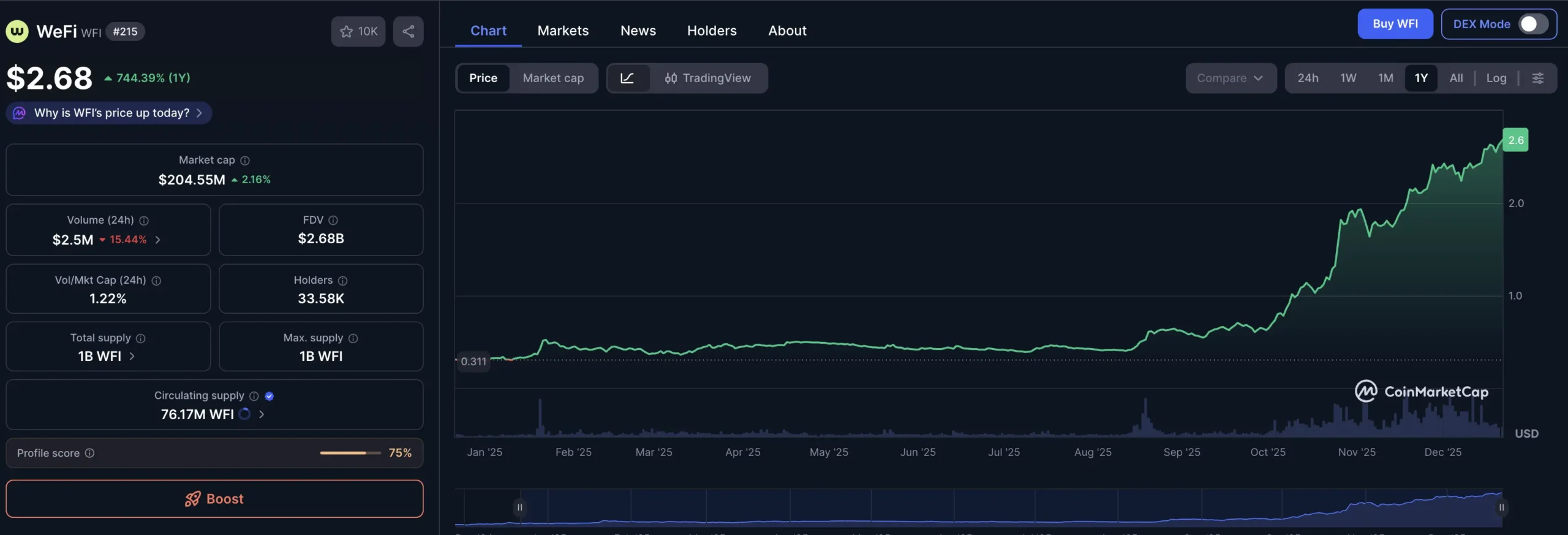
    WeFi (WFI) market performance chart reference (2025) used in this editorial analysis.


    In a turbulent 2025, where Bitcoin has struggled at points even as major equity indices hit record highs and inflation remains a persistent pressure in many economies—the Web3 sector has once again been crowded with overhyped sales stories: projects heavy on promises but light on delivery. Against that backdrop, WeFi Bank (marketed as a decentralised on-chain bank or “Deobank”) has emerged as a counter-trend outlier. Recent coverage and market-data trackers report sharp appreciation in its WFI token over the year, while the company and several outlets also claim rapid adoption across dozens of countries.

    As broader crypto sentiment has remained uneven and regulatory uncertainty continues to shape the market, WFI has reportedly moved from the low-cents/low-dollars range earlier in the year to the mid-$2 range by late December 2025, with market capitalisation estimates around ~$200m depending on venue and methodology. These figures are market-data estimates, not “fundamentals.”

    This performance contrasts with an industry that often rewards story-telling more than operational excellence—an issue we’ve previously framed as “amateur hour” in Web3 operations. WeFi may be an exception—for now—but scepticism is still the correct posture: is this sustainable value creation, or simply another narrative that has not yet met the stress-tests that typically break crypto “winners”?

    This deep dive covers WeFi’s positioning, team, code signals, token trajectory through 2025’s key moments, and the risk factors that matter into 2026. Where information cannot be independently verified, we label it as “reported” and avoid treating it as fact. If you’re here specifically for a faster orientation on claims, risks, and positioning, our WeFi banking analysis is a dedicated starting point.


    The Deobank Revolution: What is WeFi and Its Core Innovation?

    What does “Deobank” mean?

    “Deobank” is not a regulated category and has no standard definition. In practice, it is usually used to describe a hybrid product that borrows the interface and convenience of a neobank (cards, payments, fiat on/off‑ramps) while routing some functions through crypto rails (wallet-based custody, token incentives, on-chain settlement, and smart contracts). Where risk sits depends on the custody model, counterparties, and jurisdictional structure — not on the label.

    Quick comparison: This table is intentionally simplified. Real-world implementations vary by provider and by country.

    ModelTypical user experienceWhere risk often concentrates
    NeobankApp-first banking interface, fiat accounts, cards, paymentsBanking partner structure, account protections vary by jurisdiction, operational risk
    “Deobank”Neobank-like UX plus stablecoins, self-custody elements, token incentivesCustody design, smart-contract risk, incentives sustainability, regulatory ambiguity
    DeFi appWallet-native, on-chain protocols, composable yield and lendingSmart-contract exploits, governance/control risk, oracle/bridge dependencies

    WeFi positions itself as the “world’s first Deobank,” reimagining banking by migrating traditional services onto blockchain rails while emphasising regulatory compliance. Launched in early 2025 after a closed beta in late 2024 (as described in project materials and several third-party profiles), WeFi says it operates on “WeChain,” described in coverage as a Cosmos-based stack with cross-chain ambitions. Where this matters for users is not the branding, but whether the chain and its dependencies withstand real-world adversarial conditions.

    Users access a unified interface for fiat and crypto management: deposits convert seamlessly to stablecoins, enabling global payments, yield earning (the company and some coverage cite figures “up to” ~18% on stablecoins, though terms, duration, and sustainability can vary), ATM withdrawals via payment cards (card acceptance is typically mediated through card programme partners and networks, so “merchant count” claims are best treated as marketing shorthand), and automated services like lending, borrowing, and bill payments—all settled in WFI for genuine utility.

    Important caveat on yields: High advertised returns are not a neutral feature in crypto—they are a risk signal. Rates can change without notice, may depend on promotional periods, may involve counterparty and smart-contract risk, and in the worst cases can resemble the early-stage dynamics of yield-driven failures. Sadly, there are countless examples of consumers losing funds chasing yield in prior cycles. Treat any “up to” number as non-guaranteed and manage your exposure accordingly.

    Energy (NRG): a secondary incentives layer

    Since publication, WeFi has described an “Energy” (NRG) program — a loyalty-style incentives layer that, according to project materials, can be used to increase certain reward rates and reduce some platform fees for active users. What matters is the mechanism: if rewards are boosted by incentives rather than organic revenue, the sustainability of those benefits becomes a core diligence question.

    Practical lens: Treat “Energy” as an incentive design choice. It may improve retention and perceived value for some users, but it also increases the importance of (1) clearly documented terms, (2) emission and subsidy dynamics, and (3) what happens when promotional structures change.

    This model aims to reduce familiar friction points — fiat on/off-ramps, payments usability, and cross-border transfers — while keeping a crypto-native incentive layer. Some coverage claims adoption has been strongest in parts of the Global South, where stablecoins and crypto rails are used for remittances and inflation hedging. Treat geographic adoption narratives as “reported” unless backed by primary data.

    WeFi describes a distributed custody and social‑recovery approach intended to reduce the risk of permanent loss from key mismanagement, while avoiding a fully custodial model. Details matter here (who holds recovery shares, under what conditions recovery is possible, and what a user’s recourse looks like in a dispute), so readers should treat high-level custody language as “claimed” unless it is backed by a published design spec, audit scope notes, or a clearly documented custody partner arrangement. In the project’s own words, the positioning is aspirational: “We’re not just building a bank; we’re building a movement.”

    How to evaluate any “Deobank” claim set

    Awards and “record” narratives can be useful cultural signals, but they are not substitutes for due diligence. A more reliable approach is to treat the product as a set of claims that can be stress-tested against documentation, registry entries, and live availability.

    • Separate registration from licensing: an MSB/PSP registration may be legally required for certain activities, but it is not the same as a prudential banking licence.
    • Verify availability by country: card programs, limits, fees, and KYC requirements often vary materially by jurisdiction.
    • Read the yield terms like a lawyer: confirm duration, caps, eligibility rules, and what is subsidised versus revenue-backed.
    • Audit scope matters: check what was actually audited (contracts vs infrastructure), the date, and whether critical dependencies (bridges, custody, key management) were included.
    • Model dilution: compare current market cap to FDV, and treat emission schedules as ongoing sell pressure unless there is clear demand absorption.
    • Track operational execution: uptime, support responsiveness, disputes/chargebacks (if applicable), and whether the product remains consistent through market stress.

    This is not a claim that any particular criticism is correct — only that crypto-banking hybrids tend to fail at the edges: unclear legal structure, weak consumer recourse, unsustainable incentives, or fragile technical dependencies.


    The Team: Veterans or Questionable Ties?

    WeFi’s leadership blends fintech and blockchain expertise, suggesting intent for lasting infrastructure over quick schemes. Sakharov, ex-founder of crypto exchange Exflow, brings compliant infrastructure experience from emerging markets. Chairman Reeve Collins, Tether (USDT) co-founder, a history that attracts scrutiny in some narratives given Tether-era controversies; where claims go beyond public records, they should be treated as unverified and are not relied upon here. Chief Product Officer Roman Rossov, formerly at Wise (TransferWise), excels in cross-border payments.

    Recent additions include ex-Visa executive Michael Batuev as Global Head of Payments, which some observers interpret as a credibility signal with 18+ years of fintech experience including leadership roles in mobile payments and self-custody card solutions at Tangem. In the project’s own communications (and in syndicated coverage), the appointment is framed as part of an institutional expansion narrative: “The payments industry is now at a turning point. Legacy systems are struggling to keep up with the fluid, borderless nature of digital finance. WeFi’s model combines the trust of banking with the freedom of Web3”.

    COO Alice Tärk and others like Adrian Liddiard (ex-BlueWater Communications, sold to Presidio) and John Schmidt (ex-Castle Pines Capital, sold to Wells Fargo) round out a team with successful exits. However, bios are sparse in places, and Collins’s ties invite scrutiny—echoing how stellar teams in past projects didn’t prevent collapse when market conditions changed.

    Professional analyst John Lee from PiggyCell adds perspective: “The best projects solve everyday problems,” fitting WeFi’s practical bent toward addressing real financial infrastructure gaps.


    Code and Technical Architecture: Transparency Meets Security?

    WeFi’s GitHub shows active development, with repositories like the WFI Token Distribution Contract on Binance Smart Chain (Solidity 0.8.20, Foundry framework) featuring mining rewards with halvings (8 → 4 → 2 → 1 WFI per block), linear vesting for referrals/staking over two years, and security via OpenZeppelin’s ReentrancyGuard, Ownable controls, ECDSA signatures, and pausability.

    Audits by SolidProof, Cyberscope, Peckshield, and Quillhash identified minor issues but no critical flaws, with routine code reviews noted. However, “audited” does not mean “safe,” and audit scope can be narrow or time-bounded. Not all code and operational systems are fully open, and some discussions reference marketing-style technical claims (for example, “quantum-grade” language) that are difficult to independently validate and should not be treated as evidence of security. In a year with over $3 billion in DeFi hacks, this partial transparency warrants caution.

    More broadly, crypto security incidents remain common at both the protocol and user-wallet level; this context matters when evaluating any app that blends payments, yield, and on-chain mechanics.

    Some project materials and coverage describe a distributed custody architecture with social-recovery mechanics designed to reduce single points of failure. As with any custody claim set, the key diligence question is scope and verification: which components are audited, which are operational (not on-chain), and which dependencies (custody partners, key-share storage, recovery workflows) are actually in place for users in a given jurisdiction.


    Token Performance: Key 2025 Moments and Market Dynamics

    WFI’s reported rise through 2025 can be described in distinct phases that help explain how the narrative formed — but the exact figures should be treated as time-bound market-data estimates rather than “fundamentals.” For a current reference point, see the Market Snapshot (As of January 25, 2026) above. Earlier milestones and quarter-by-quarter moves below are retained for context, not as a guarantee that the same dynamics persist.


    2025 WeFI CMC chart shows price gains above 700% for $wefi


    Q1 Launch (January-March): +200% to $0.50 amid Deobank rollout, as BTC dipped 15% during broader market uncertainty.

    Mid-Year Rally (April-June): +400% to $1.50 on Asian licensing announcements, bucking BTC’s stagnation during regulatory headwinds.

    Q3 Adoption (July-September): +30% to ~$2.00, with coverage increasingly emphasising emerging-market corridors and payments narratives. Sector-wide TVL and “macro DeFi” context should be treated as background rather than a direct explanation for WFI’s move.

    Q4 Peak (October-December): The move to ~$2.68 coincided with award coverage and institutional-expansion narratives, with +90% reported in November alone as traditional finance executives joined the project.

    Some market coverage has framed WFI’s move as an anomaly versus Bitcoin’s choppier periods; however, attributing price action to “utility rather than speculation” is inherently uncertain in crypto markets.

    However, the disconnect between current market capitalization and fully diluted valuation signals significant dilution risks as more tokens enter circulation through mining rewards and staking distributions.

    2026 Roadmap and Milestones (reported / documented)

    Roadmaps in crypto change frequently. The table below separates what appears live today from items that are announced or reported in project materials and coverage. Timeframes are indicative and should be treated as non-binding unless backed by jurisdiction-specific disclosures or released product terms.

    MilestoneIndicative windowStatusWhy it matters
    Energy (NRG) incentives layer2025–2026 (ongoing)Reported / documented in project materialsChanges effective rewards/fees; sustainability becomes a key diligence question.
    Emissions schedule and halving mechanics2026 (notably early September, as reported)Documented (mechanics) / Reported (timing)Reduces new issuance rate; may act as a volatility catalyst without guaranteeing price outcomes.
    Payments expansion narrative2026 (ongoing)Reported in project comms and syndicated coverageExecution quality (availability, fees, limits, KYC) matters more than headline “global” claims.
    Jurisdiction-by-jurisdiction compliance build-out2026 (ongoing)Reported / partially verifiable via registriesRegulation strength and consumer recourse differ widely; “registered” is not “licensed as a bank.”


    Regulatory Strategy and Global Expansion

    WeFi and several third-party profiles describe a “multi-jurisdictional” approach to compliance—often listing registrations or authorisations such as Canadian MSB registration with FINTRAC, and additional permissions in other regions. The key point: these terms are frequently used loosely in crypto marketing. For example, FINTRAC MSB registration is a legal requirement for certain activities in Canada, but registration does not imply endorsement, a prudential “banking” licence, or top-tier consumer protections. Readers should treat any broad “licensed everywhere” framing as a claim that needs jurisdiction-by-jurisdiction verification.

    The company is pursuing Singapore, UAE, and US expansions while using AI-driven KYC and zero-knowledge proofs for privacy-preserving compliance. This “regulatory-first” approach creates significant operational costs but positions the platform advantageously as global cryptocurrency regulations evolve.

    Macro context: Major policy and financial-stability institutions have repeatedly warned that “crypto-banking” or crypto-to-payments hybrids can create risks through opacity, leverage, maturity mismatches, and growing interconnectedness with traditional finance. For a high-quality overview, see the European Central Bank’s Financial Stability Review (including its crypto-focused analysis) and the Basel Committee’s prudential framework for banks’ cryptoasset exposures.

    However, third-party safety assessors have raised concerns about the strength of oversight. For example, BrokerChooser argues that WeFi is not regulated by a top-tier regulator and recommends avoidance on that basis. Even if one disputes BrokerChooser’s framing (it reviews “brokers” and may not map perfectly onto a deobank model), the underlying point is still relevant: the quality of regulation matters, and not all registrations provide meaningful consumer recourse.


    Why Bucking the Trend? Competitive Analysis and Market Positioning

    WeFi’s competitive edge lies in addressing real market failures that traditional finance and pure DeFi have failed to solve. The platform targets the 1.4 billion unbanked globally while serving cross-border workers, freelancers, and businesses needing multi-currency functionality.

    As professional analyst Valerio Attilio Rossi noted: “Who creates value, receives value”—a principle that appears to drive WeFi’s focus on practical utility over speculative features. The platform’s payment-card narrative is framed around Visa-network acceptance in many locations, but real-world utility depends on the specific card programme, issuer terms, regional availability, fees, limits, and KYC requirements.

    Competitors like Coinbase, Binance, Revolut, and N26 offer pieces of WeFi’s functionality but none provide the same integrated DeFi-traditional fusion. Traditional banks struggle with crypto integration due to legacy infrastructure, while crypto exchanges typically lack comprehensive banking services and regulatory compliance across multiple jurisdictions.

    Yet this positioning also creates vulnerabilities. Traditional financial institutions with deeper resources could replicate WeFi’s model, while regulatory changes could impact the platform’s multi-jurisdictional approach. The project’s success has attracted attention, but sustainable competitive advantages require continuous innovation and investment.


    Risks, Challenges, and 2026 Outlook

    Despite impressive achievements, WeFi faces significant challenges that could derail its momentum. The most immediate concern involves sustainability of advertised yields: 18% returns on stablecoin deposits appear optimistic amid traditional finance’s low-yield environment.

    Technical risks include smart contract vulnerabilities where industry reporting has consistently documented multi‑billion‑dollar losses from DeFi exploits and scams in recent years. While WeFi’s audits show no critical flaws, the partial transparency around some “quantum-grade” claims raises questions about unverified technological assertions.

    Regulatory risks loom large as the platform’s multi-jurisdictional approach creates exposure to evolving rules across numerous markets. A single regulatory action in a key jurisdiction could impact global operations, while compliance costs continue rising as the platform expands.

    Token economics present another challenge: gradual release of the 1 billion maximum supply creates inherent selling pressure that must be offset by continuous user growth and utility expansion. The disconnect between current market cap and fully diluted valuation suggests significant dilution risk as more tokens enter circulation.

    The WFI halving: what changes mechanically

    WeFi’s published token mechanics describe an emissions model that reduces mining rewards over time via scheduled halvings (often framed as 8 → 4 → 2 → 1). If implemented as described, a halving does one thing with certainty: it reduces the rate of new token issuance. What it does not guarantee is a higher price — markets can react in multiple directions depending on liquidity, demand, and the level of sell pressure from rewards recipients.

    Why it matters: For readers evaluating WFI, the halving is best treated as a potential volatility catalyst and a stress-test for whether demand and utility are sufficient to absorb ongoing emissions and unlock-related selling.

    Rather than leaning on point forecasts — which age quickly and often embed hidden assumptions — a more useful way to think about 2026 is scenario-based. In a stronger outcome, demand (users, payments volume, and genuine utility) absorbs ongoing emissions and offsets dilution. In a weaker outcome, incentives fade, sell pressure dominates, or regulatory friction reduces distribution. The practical diligence focus is whether usage and revenue drivers (if any) remain resilient when market conditions tighten.

    The cautionary tale of Kadena’s rapid rise and fall serves as reminder that even projects with strong technical foundations and experienced teams can falter when market conditions change or promised utility fails to materialize at scale.


    Conclusion: Exception or Harbinger?

    WeFi is a useful test case for whether crypto-banking hybrids can mature beyond speculation into something closer to financial infrastructure. The platform’s reported token appreciation and growing visibility have been framed in coverage as “utility-led,” but that interpretation remains hard to prove in crypto markets. The more practical question is whether the product holds up through stress: changing market conditions, tighter regulation, and the inevitable unwind of promotional incentives.

    The project is positioned around practical use-cases — cross-border payments, inflation hedging, and access — that traditional finance often serves imperfectly in many corridors. Its “regulatory-first” framing and experienced hires may help, but they are not guarantees. The appointment of executives like Michael Batuev is better read as an institutional-expansion signal than as evidence that key product claims (availability, compliance posture, or economics) are already proven.

    However, significant risks remain. Unverified technological claims, sustainability questions around high yields, regulatory exposure across multiple jurisdictions, and the inherent challenges of scaling complex financial infrastructure create substantial uncertainty. The platform’s short track record provides limited evidence of long-term viability, while competitive pressures from better-funded institutions could erode current advantages.

    For the broader crypto sector, WeFi is best treated as an early case study rather than a template. It suggests one possible path for teams trying to combine payments, compliance narratives, and crypto-native incentives — but the hard part is operational: maintaining availability across jurisdictions, keeping terms clear, and proving that demand exists without subsidy-heavy mechanics.

    Whether WeFi represents the exception that proves the rule about crypto’s tendency toward hype over substance, or a harbinger of a more mature phase of cryptocurrency development, remains to be seen. The project’s next phase—scaling globally while maintaining compliance, generating sustainable revenues, and preserving token value—will determine whether it joins the ranks of genuine financial innovation or becomes another cautionary tale.

    For now, WeFi is one of the more visible examples of a Web3 project attempting to ship consumer-facing financial tooling through a difficult market. Whether that translates into sustainable value creation is still an open question. The diligence lens remains the same: are claims stable across jurisdictions, are incentives sustainable, and does usage persist when the easy growth levers (subsidies, hype cycles, and favourable liquidity) fade?


    FAQ: WeFi Bank, “Deobanks,” and WFI

    Is WeFi Bank a regulated bank?
    WeFi and several third-party profiles describe various registrations or authorisations in multiple jurisdictions. However, these should not be assumed to be equivalent to a prudential banking licence or regulatory endorsement. Consumer protections and recourse vary significantly by country and by the specific legal entity providing the service.

    Are WeFi’s advertised yields guaranteed?
    No. Any “up to” yield figures referenced in company materials or coverage are non-guaranteed and can change without notice. Returns may depend on promotional periods, incentives, counterparties, and smart-contract or custody risks. Treat yields as a risk signal and size exposure accordingly.

    What does “Deobank” mean in practice?
    “Deobank” is not a standard regulatory category. In practice, it typically refers to a hybrid model that combines crypto rails (wallets, token incentives, on-chain components) with traditional finance interfaces (cards, payments, fiat on/off-ramps). The exact design — and where risk sits — depends on custody, counterparties, and jurisdictional structure.

    What is WeFi “Energy” (NRG) and how does it affect users?
    WeFi describes “Energy” (NRG) as a loyalty-style incentives layer that can be used to boost certain reward rates and reduce some platform fees for active users. The key diligence point is the mechanism and the terms: if benefits are driven by incentives or subsidies rather than organic revenue, sustainability and eligibility rules become central to evaluating the offering.

    What is the WFI halving and what does it change?
    WeFi’s published token mechanics describe scheduled halvings that reduce the rate of new token issuance over time (often framed as 8 → 4 → 2 → 1). Mechanically, a halving reduces emissions. It does not guarantee a higher price, and it can act as a volatility catalyst depending on liquidity, demand, and sell pressure from rewards recipients.

    Does WFI token performance prove long-term value?
    Not by itself. Token price action can reflect liquidity conditions, market narratives, incentives, and speculation as much as utility. A more durable evaluation looks at dilution dynamics, usage and revenue drivers (if any), governance and control, audit scope, and whether key claims remain true under stress.


    Sources & Notes

    All figures and claims in this editorial should be read alongside their original references.

    Source hygiene note: The Energy (NRG) and ITO/mining links below are project-affiliated and are used primarily to describe claimed mechanics (not to verify outcomes). Where possible, we rely on independent registries, code/audit portals, and major market-data trackers for verification.


    Evidence standard and sourcing note

    This article intentionally separates (1) primary/official materials (regulators, registries, code repositories, audit portals), (2) reputable secondary reporting, and (3) lower-credibility or promotional sources. Where only category (2) or (3) sources were available for a claim — or where the only available source was project-affiliated documentation (for example: incentive mechanics, emission schedules, user counts, “up to” yields, broad licensing language, or awards) — the wording is framed as “reported” or “the company claims,” and the claim is not treated as verified. Readers should assume that terms, yields, programme availability, and regulatory posture can change quickly in crypto-banking products and should always check current terms and jurisdiction-specific disclosures before relying on any statement.

    This article is not investment advice.

    The Behavioural-Finance Question Behind A “Great 2025”

    Any project that had a great year produces a specific cognitive trap for the people evaluating whether the next year will also be great. The trap is the assumption that the qualities that produced the good year are the qualities that will produce the next one. Sometimes that assumption holds. More often it does not, and the reason it does not is not that the project changed but that the conditions that rewarded the project’s qualities changed underneath it.

    The honest behavioural reading of WeFi’s 2025 is that the project did genuinely good work in a year that was unusually receptive to the specific category of work it was doing. The token mechanics rewarded the projects that had clean tokenomics in a year when clean tokenomics were a differentiator. The bank-licensing angle rewarded projects that were positioning for institutional bridges in a year when institutional bridges were the narrative. None of this is a criticism of WeFi. It is a description of how a project and a market can align unusually well for a window of time, and how the alignment can move without the project moving.

    The forward-looking question is not whether WeFi will continue to do good work. The honest assumption is that it probably will. The forward-looking question is whether the conditions in 2026 will reward the same qualities that 2025 did, and the behavioural-finance answer is that they will not — not because anything is wrong with the qualities, but because markets rotate which qualities they reward on a cycle that is faster than most projects can re-position against. The broader tech-cycle reset is the same dynamic at a larger scale: the conditions that rewarded a generation of companies are not the conditions of the next generation, and the gap between the two is where most of the underperformance comes from.

  • Book your Bali getaway with Crypto: Bali Adventours partners with VaaSBlock

    Book your Bali getaway with Crypto: Bali Adventours partners with VaaSBlock

    Bali, Indonesia – 1 November 2025 — Bali Adventours is now accepting crypto payments through VaaSBlock’s VB Payments service, a setup that lets travellers pay in digital assets while the merchant receives fiat. Customers can book tours using Bitcoin (BTC), Ethereum (ETH), Tether (USDT), and more than 200 other cryptocurrencies. The point for the operator is simple: conversion and settlement happen in the background, so the business doesn’t have to manage wallets, pricing swings, or compliance workflows.


    Making Travel Simpler for Crypto Holders

    Crypto holders want to spend their assets on real services, but most travel operators still don’t accept it. That’s starting to change—especially when the workflow looks familiar. VB Payments lets a business accept crypto while receiving fiat, with invoicing, KYC/AML compliance, and crypto-to-fiat conversion handled behind the scenes.

    For Bali Adventours, the pitch isn’t “go Web3.” It’s to add a payment option without becoming a treasury desk. The operator keeps the same booking flow and bank rails. The customer pays from a wallet.

    Bali Adventours is the latest operator to test the model — and travel is one of the clearest use cases.


    What Bali Adventours offers to Travellers

    Bali Adventours sells bookable, fixed-scope experiences—exactly the kind of service where payments need to be predictable. The platform offers tours and activities across the island, from temples and waterfalls to rafting and ATV adventures.

    The company leans on local operators and on-the-ground knowledge, which makes packages feel more tailored than a generic marketplace. Popular options include:

    • Bali Nature and Waterfall Tour

    • Uluwatu Sunset and Kecak Dance Tour

    • Mount Batur Sunrise Trekking

    • Ubud Rafting and ATV Combo

    • North Bali Temple and Lake Tour

    The site is easy to use, and the prices are competitive. Many travellers looking for stress-free bookings choose Bali Adventours to arrange their holiday plans ahead of time. Now, with VB Payments integrated, they can also choose to pay with crypto instead of traditional credit cards or transfers.


    VB Payments, a great fit for high-end Travel Services.

    Travel operators deal with cross-border customers, high-intent bookings, and payment methods that vary by market. Crypto can add demand, but it also adds complexity—unless the system makes it look like a normal invoice. Here is how it works in simple terms:

    • The business (in this case Bali Adventours) sends a regular invoice to the customer.

    • The customer chooses to pay using crypto like Bitcoin, Ethereum, USDT or others.

    • VaaSBlock accepts the crypto payment and handles identity checks and compliance.

    • VaaSBlock converts the crypto to fiat (like USD or IDR) and sends it to the business.

    • The business receives the payout in their bank account, without holding or touching any crypto.

    For the merchant, the value is risk reduction. No wallets to secure. No exposure to token volatility. No new compliance workflow to stitch together. Bali Adventours gets paid in fiat and keeps operating as usual.


    Why “crypto-to-fiat” matters in travel (and why “just accept crypto” isn’t enough)

    Travel is unforgiving for payments. Bookings are time-sensitive, customers are often cross-border, and ticket sizes can be large enough to attract chargebacks. For an operator, “accept crypto” can quietly become a second job: wallet management, settlement tracking, and a front-row seat to volatility.

    That’s why crypto in, fiat out matters. It’s the difference between crypto being a talking point and crypto being usable. The customer pays from a wallet. The merchant gets a normal payout. The messy parts stay behind the curtain.

    As more mainstream businesses test digital-asset rails, expectations also change. Partners and customers increasingly want familiar assurance signals—controls that look closer to SOC 2 discipline than a Telegram promise, and security governance that resembles an ISO 27001-style operating model. In travel, protecting customer data and preventing payment disputes is not “Web3 culture.” It is table stakes.

    For Bali Adventours, the upside is straightforward: capture crypto demand without inheriting crypto ops. If this category scales, it won’t be because every merchant becomes crypto-native. It will be because the plumbing gets boring—reliable, compliant, and invisible.


    Raph Rocher, Co-founder of VaaSBlock, shared his thoughts on the partnership: “We are delighted to welcome Bali Adventours into the VB Payments ecosystem. Seeing a real-world business adopt crypto payments proves that crypto is not just for niche use cases. It belongs in everyday commerce. This is another example of travel oriented partnership signed by VB Payments and it shows the potential for crypto to open doors for both travellers and businesses.”

    In other words: crypto only becomes “payments” when it works for normal businesses. Tour operators don’t want ideology. They want settlement that clears and customers that show up.


    More partnerships to come

    VaaSBlock is betting that the fastest path to adoption is boring execution: real merchants, real invoices, and fewer moving parts. The tourism and hospitality sector is one of the most promising fields for crypto payments. Travellers already arrive with crypto balances. Operators want a way to accept them without taking on extra risk.

    The direction is clear: more tourism and hospitality operators are testing crypto rails when the operational burden is removed. If adoption spreads, it will be because the payment experience looks familiar to the merchant and the customer — not because businesses suddenly become crypto-native.


    What users gain from this announcement

    If you hold crypto and travel often, you’ve seen the friction: off-ramping to fiat, fees, and repeating KYC with every provider. VB Payments is designed to remove that loop.

    With VB Payments, crypto users get a much simpler experience:

    • Pay directly in crypto for tours and services

    • No need to convert to fiat first

    • One-time KYC with VaaSBlock covers all future payments

    • Use your tokens for real-world experiences

    For crypto holders, the pitch is simple: spend assets on real experiences, not just speculation.


    A Step toward the Future of Payments

    Crypto payments only work at scale if they feel easier than a bank transfer. For Bali Adventours, the workflow is deliberately plain:

    • They do not install anything

    • They do not need wallets

    • They get fiat directly

    • They keep their usual booking and invoice system

    For customers, it’s a payment link and a wallet transfer. For merchants, it’s a bank payout. That’s the kind of infrastructure that can actually move crypto from niche to normal commerce.


    What this signals for travel payments

    This partnership only matters if it holds up under real usage: invoices paid on time, funds settled reliably, and no new operational headaches for the merchant. That’s the bar travel operators care about.

    • For customers: more ways to pay without extra hoops.

    • For merchants: crypto demand captured without running a treasury desk.

    • For the category: the winner won’t be the flashiest token — it’ll be the most boring infrastructure.

    If VB Payments keeps the experience plain — crypto in, fiat out — more operators will test it. Not to become a Web3 brand, but because travellers are already showing up with digital assets and asking to use them.

  • MHL Solutions Earns RMA™ Verification

    MHL Solutions Earns RMA™ Verification

    June 2, 2025 – Akron, Ohio, USA VaaSBlock is proud to announce that MHL Solutions has successfully earned the RMA™ verification, the Web3 world’s largest mark of credibility, and the most comprehensive review on the market today. This rigorous certification underscores MHL Solutions’ commitment to transparency, risk management, and best practices in tokenomics and blockchain advisory.

    MHL Solutions, founded in 2022 and headquartered in Akron, Ohio, is a global Web3 consulting firm specializing in tokenomics development and economic audits, SAFT analysis, and full-spectrum Web3 business consulting. By leveraging partnerships with over 100 blockchain service providers and independent contractors, MHL Solutions delivers bespoke solutions—whether clients are designing token economies, preparing for a fundraising round, or fine-tuning existing decentralized ecosystems.

    “Achieving the RMA™ verification is a testament to our dedication to the highest standards of due diligence and client-focused innovation,” said Mark Mhilli, founder of MHL Solutions. “We set out to build a consulting practice rooted in transparency and data-driven analysis. This recognition from VaaSBlock validates our approach and reinforces our mission to empower projects with the tools and guidance they need to thrive in Web3.”

    The RMA™ (Risk Management Assessment) is VaaSBlock’s flagship certification. It represents a comprehensive evaluation that spans six critical categories: Corporate Governance, Revenue Model, Planning & Transparency, Results Delivered, Team Proficiency, and Technology & Security. Each badge is tokenized for immutable verification and includes a unique digital token and QR code, ensuring authenticity and ease of validation without relying on traditional marketing terminology like “NFT.” The process combines document audits, stakeholder interviews, and investigative research to produce an objective score—making it the most thorough review available in the blockchain space.

    “MHL Solutions demonstrated exceptional rigor in every category of our assessment—especially in tokenomics design and risk management,” said Benjamin Rogers, CEO of VaaSBlock. “Their ability to translate complex economic models into actionable, compliant frameworks sets a new benchmark. We’re honored to award them the RMA™ badge and look forward to seeing how their clients leverage this certification to build trust and resilience.”

    Since its inception, MHL Solutions has collaborated with noteworthy projects such as iAgent Protocol, Hen House NFT, and AquaSave.io—providing everything from tokenomic modeling to fundraising strategy and technical audits. Mark Mhilli brings nearly a decade of blockchain industry experience, focusing on token economics, market-behavior analysis, and governance. Under his leadership, MHL Solutions has become known for customizable, data-driven strategies that align with both regulatory requirements and the evolving demands of decentralized communities.


    About RMA™

    The RMA™ (Risk Management Assessment) is VaaSBlock’s signature accreditation, designed to help Web3 projects and service providers demonstrate credibility and operational soundness. It covers six evaluation categories—Corporate Governance, Revenue Model, Planning & Transparency, Results Delivered, Team Proficiency, and Technology & Security—through an independent scoring process. Each RMA™ badge is tokenized, featuring a QR code that allows instant on-chain verification, ensuring stakeholders can trust the underlying data.


    About MHL Solutions

    MHL Solutions is a Web3 consulting firm founded in 2022, specializing in tokenomics development and blockchain advisory services. Headquartered in Akron, Ohio, the company operates globally, assisting startups, investors, and decentralized communities in navigating blockchain complexities. Their core offerings include tokenomics development, audits, SAFT analysis, and Web3 business consulting. Leveraging a network of over 100 blockchain service providers and contractors, MHL Solutions delivers tailored solutions designed to meet each client’s unique needs. Learn more on their VaaSBlock profile, or follow them on Twitter and LinkedIn.

  • ProtoKOLs earns prestigious RMA™ Certification from VaaSBlock.

    ProtoKOLs earns prestigious RMA™ Certification from VaaSBlock.

    Tortola, British Virgin Islands – December 20, 2024 – VaaSBlock proudly announces that ProtoKOLs, a leading blockchain analytics platform, has successfully achieved the RMA™ (Risk Management Authentication) certification. This milestone underscores ProtoKOLs’ unwavering commitment to transparency, governance, and operational excellence within the blockchain ecosystem.

    A Trusted Leader in Blockchain Analytics

    ProtoKOLs has established itself as a key player in the blockchain industry, offering cutting-edge analytics tools to combat fake projects, inflated traction metrics, and unverified Key Opinion Leaders (KOLs). Their innovative platform empowers developers, investors, and users by providing actionable insights that foster trust and accountability in Web3.

    Achieving the RMA™ Badge validates ProtoKOLs’ adherence to the highest industry standards. The certification reflects rigorous evaluations across governance, security, data management, and results delivered, solidifying ProtoKOLs’ reputation as a trusted provider in the blockchain space.

    A Milestone in the VaaSBlock-ProtoKOLs Collaboration.

    This certification represents the first step in a broader collaboration between ProtoKOLs and VaaSBlock. By leveraging ProtoKOLs’ blockchain analytics and VaaSBlock’s RMA™ framework, the partnership aims to set new benchmarks for transparency and trust in the Web3 ecosystem.

    Ben Rogers, CEO of VaaSBlock, commented: “We are delighted to award ProtoKOLs the RMA™ Badge. Their innovative solutions and dedication to governance align perfectly with our mission to enhance trust in blockchain. This certification is a testament to their excellence.”


    About ProtoKOLs

    ProtoKOLs is a leading blockchain analytics platform dedicated to promoting transparency and accountability in Web3. By providing in-depth on-chain data insights, ProtoKOLs helps identify fake projects, unverified KOLs, and inflated metrics, empowering users, developers, and investors to make informed decisions and foster trust in the blockchain ecosystem.

    About VaaSBlock

    VaaSBlock is a leading provider of blockchain security and compliance solutions, offering the RMA™ certification to organizations that meet rigorous standards of risk management and authentication. Their mission is to promote security and trust within the blockchain industry. To learn more about the RMA™ badge and its impact on the Web3 space, visit vaasblock.com.

  • VaaSBlock and 10Clouds forge Strategic Partnership to drive Blockchain Innovation.

    VaaSBlock and 10Clouds forge Strategic Partnership to drive Blockchain Innovation.

    VaaSBlock and 10Clouds Partnership

    Seoul, South Korea – December 13th, 2024 — VaaSBlock is thrilled to announce a strategic partnership with 10Clouds, a globally renowned development firm known for its expertise in blockchain and digital transformation. This collaboration marks a significant milestone for both organizations as they unite to advance trust, transparency, and innovation within the blockchain ecosystem.


    Mutual benefits for shaping the future of Web3.

    As part of the partnership, VaaSBlock will offer exclusive Risk Management Authentication (RMA™) benefits to 10Clouds’ partners and clients, furthering their shared commitment to trust and compliance in blockchain. As one of the top development firms worldwide, 10Clouds is also on track to announce its own RMA™ certification soon – a milestone that will solidify its position as a trusted leader in blockchain development.

    Moving further, this partnership is set to become a strategic move for regional growth, as 10Clouds will assist VaaSBlock in building partnerships across Europe, while VaaSBlock will introduce 10Clouds to opportunities in Asia – particularly in blockchain hubs like Korea and Singapore. As demand for innovative blockchain solutions rises, this collaboration positions both companies to leverage their expertise and expand their influence in key markets, setting new standards for excellence.


    Keep building trust together.

    The collaboration between VaaSBlock and 10Clouds is grounded in shared values of innovation and trust. Fans of VaaSBlock’s “No Chain No Gain” (NCNG™) podcast will soon have the opportunity to hear from 10Clouds as guests, sharing insights and expertise on blockchain advancements.

    Additionally, the teams are exploring a data partnership that would allow 10Clouds to contribute valuable insights to VaaSBlock’s project verification pages. This potential collaboration aims to improve transparency and elevate the accuracy of project evaluations across the blockchain industry.

    “This partnership represents a significant step forward in building better innovation within the blockchain industry,” said Kevin Ahn, Co-Founder of VaaSBlock. “By combining 10Clouds’ development expertise with VaaSBlock’s compliance framework, we’re setting new standards for growth in the Web3 ecosystem.”

    By joining forces, VaaSBlock and 10Clouds are setting new standards for excellence in blockchain technology. This partnership underscores their shared commitment to driving innovation, fostering trust, and creating a more connected and transparent global blockchain ecosystem. Together, they are poised to lead the next wave of blockchain advancements.


    About 10Clouds

    10Clouds is a leading software development company specializing in blockchain, fintech, and digital transformation solutions. With over a decade of experience, the company has built a reputation for delivering innovative, secure, and scalable products tailored to meet the needs of clients worldwide. From decentralized applications (DApps) to complex blockchain infrastructures, 10Clouds combines technical expertise with a user-centric approach to drive success in the rapidly evolving digital landscape. Dedicated to fostering trust and transparency, 10Clouds partners with businesses to shape the future of technology and create impactful solutions.

  • Hashlock earns prestigious RMA™ Certification from VaaSBlock

    Hashlock earns prestigious RMA™ Certification from VaaSBlock

    Sydney, Australia, November 15, 2024 Hashlock, a leading provider of blockchain and Web3 security solutions has been awarded the esteemed RMA™ (Risk Management Authentication) badge by VaaSBlock. This certification underscores Hashlock’s unwavering commitment to upholding the highest standards of security and credibility within the blockchain ecosystem.

    As a company deeply embedded in the Web3 space, Hashlock’s focus on empowering developers and securing decentralized networks makes this certification a significant milestone, reinforcing their reputation as a leader in blockchain security.


    Jock Haslam, Director and Co-founder of Hashlock, commented: “Earning the RMA™ badge from VaaSBlock reflects our dedication to ensuring the highest level of security and trust within the Web3 space. This recognition affirms to our clients and partners that we are serious about maintaining the integrity of the blockchain ecosystem.”

    Ben Rogers, CEO of VaaSBlock, stated: “We’re thrilled to welcome Hashlock into the RMA™ network. Their dedication to Web3 security and technical excellence aligns perfectly with our mission to raise industry standards. Together, we’ll make credibility more accessible and elevate trust across the blockchain ecosystem.”

    This collaboration not only makes RMA™ certification more accessible but also has the potential to elevate the standards of blockchain security significantly. It strengthens the bond between Hashlock and VaaSBlock as leaders in blockchain security, providing more opportunities for projects to gain credibility and recognition.


    About Hashlock

    Founded with a commitment to blockchain security excellence, Hashlock addresses the escalating need for reliable and thorough security measures in the Web3 space. Our suite of services is tailored to safeguard projects at every phase, from initial development to post-deployment monitoring. As adoption of decentralized technologies increases, Hashlock is dedicated to mitigating security threats through comprehensive audits, attack simulations, and continuous on-chain analysis, ensuring that blockchain ecosystems remain resilient and trustworthy for users and investors worldwide.

    About VaaSBlock

    VaaSBlock is a global leader in blockchain credibility, setting the standard for trust and accountability. Through the RMA™ certification, VaaSBlock provides businesses with a comprehensive framework for proving their operational integrity to stakeholders worldwide. To learn more about the RMA™ badge and its impact on the Web3 space.

    Website | LinkedIn |  X |  Threads | Facebook