XAG$67.86▲ 6.22%FIGR_HELOC$1.03▼ 0.27%ZEC$419.68▲ 1.21%TSLA$401.51▲ 0.59%MSFT$387.89▼ 0.63%USDS$0.9999▲ 0.02%MSTR$124.44▲ 3.57%RAIN$0.0131▲ 0.17%COIN$159.77▼ 0.41%ADA$0.1736▲ 5.39%BNB$607.71▲ 1.71%BRENT$107.14▼ 8.65%NFLX$80.91▼ 0.44%LEO$9.59▲ 1.09%XMR$364.22▲ 1.91%BTC$63,888.00▲ 2.38%SOL$67.96▲ 4.25%ETH$1,672.43▲ 2.23%DOGE$0.0887▲ 4.87%AMZN$237.11▼ 1.82%TRX$0.3140▼ 0.24%AAPL$291.29▼ 1.47%XRP$1.14▲ 2.50%NATGAS$2.94▲ 6.14%HYPE$61.64▲ 9.92%WTI$102.13▲ 1.80%META$569.62▲ 0.21%NVDA$204.91▲ 0.02%XAU$4,240.10▲ 3.66%GOOGL$362.31▲ 1.27%XAG$67.86▲ 6.22%FIGR_HELOC$1.03▼ 0.27%ZEC$419.68▲ 1.21%TSLA$401.51▲ 0.59%MSFT$387.89▼ 0.63%USDS$0.9999▲ 0.02%MSTR$124.44▲ 3.57%RAIN$0.0131▲ 0.17%COIN$159.77▼ 0.41%ADA$0.1736▲ 5.39%BNB$607.71▲ 1.71%BRENT$107.14▼ 8.65%NFLX$80.91▼ 0.44%LEO$9.59▲ 1.09%XMR$364.22▲ 1.91%BTC$63,888.00▲ 2.38%SOL$67.96▲ 4.25%ETH$1,672.43▲ 2.23%DOGE$0.0887▲ 4.87%AMZN$237.11▼ 1.82%TRX$0.3140▼ 0.24%AAPL$291.29▼ 1.47%XRP$1.14▲ 2.50%NATGAS$2.94▲ 6.14%HYPE$61.64▲ 9.92%WTI$102.13▲ 1.80%META$569.62▲ 0.21%NVDA$204.91▲ 0.02%XAU$4,240.10▲ 3.66%GOOGL$362.31▲ 1.27%
Prices as of 17:15 UTC

Author: Ben Rogers

  • The GENIUS Act Is Law. The July 18 Regulatory Deadline Is the One Most Stablecoin Operators Are Not Ready For.

    The GENIUS Act Is Law. The July 18 Regulatory Deadline Is the One Most Stablecoin Operators Are Not Ready For.

    The Guiding and Establishing National Innovation for US Stablecoins Act — the GENIUS Act — passed the US Senate 68 to 30 on June 17, 2025, and the House 308 to 122 on July 17, 2025. The bipartisan margins were large enough that the legislation’s passage was never seriously in doubt once it cleared committee. What was left unresolved at enactment — deliberately, because these are technically and operationally complex questions — were the specific regulations governing issuer licensing requirements, capital adequacy standards, custody standards, anti-money laundering provisions, and a set of related operational requirements.

    The GENIUS Act Is Law. The July 18 Regulatory Deadline Is the One Most Stablecoin Operators Are Not Ready For.

    Those additional regulations are due from federal and state regulators on July 18, 2026. The gap between the GENIUS Act’s passage and the July 18 deadline is the compliance window most operators have underused. The regulation is law; the implementation details are the regulation within the regulation; and the deadline is 40 days away as of this June 2026 update.

    This piece examines what the July 18 deadline actually requires, who it applies to, and where the compliance gaps are most likely to be found — particularly for Web3 businesses that use stablecoins operationally rather than issuing them directly.

    June 2026 update: This article was first published May 18, 2026 when the July 18 deadline was 61 days away. With 40 days remaining, the final countdown phase has started. Key developments since publication: Treasury has still not issued a USDT equivalency determination, and multiple non-bank stablecoin operators have publicly confirmed they are in active licensing discussions with the OCC. The urgency below has increased, not decreased.

    What the GENIUS Act Actually Requires at the Legislation Level

    The GENIUS Act establishes a federal framework for “payment stablecoins” — defined as digital assets issued by an entity that is required to redeem them for a fixed value. The definitional boundary matters: stablecoins that do not meet the “payment stablecoin” definition as written — algorithmic stablecoins, yield-bearing tokens, or tokens whose value floats — are not directly covered by the GENIUS Act framework, though they may be subject to other securities regulation.

    The legislation’s core requirements at the statutory level include 1:1 reserve backing with cash or short-term Treasuries, monthly reserve disclosure, legal protections for stablecoin holders in the event of issuer insolvency, and a framework for both domestic and foreign issuers to operate in the US market. Foreign issuers may offer stablecoins in the US subject to Treasury’s determination that their home-country regulatory regime is comparable to the GENIUS Act framework.

    Critically, the GENIUS Act explicitly states that permitted payment stablecoins are not securities under federal securities law. The companion CLARITY Act addresses the broader market structure question for crypto assets that are not stablecoins. This removes the most significant source of regulatory uncertainty that had frozen institutional stablecoin issuance since the SEC’s 2023 enforcement campaign. For institutional players — banks, trust companies, non-bank entities with federal approval — the legal path to stablecoin issuance is now defined at statute level.

    What is not defined at statute level — and this is the core of the July 18 deadline — are the operational specifics. The legislation directs regulators to issue rules on issuer licensing, capital requirements, custody standards, AML/BSA compliance, and a range of other technical requirements. Those rules become effective July 18, 2026. Until they are issued, compliant stablecoin issuance under the GENIUS Act framework cannot begin in earnest.

    What the July 18 Regulations Will Govern

    Based on the legislative text and regulatory comment processes that have been underway since the GENIUS Act’s enactment, the July 18 regulations are expected to address several key areas where current operational practice falls short of the forthcoming requirements.

    Issuer licensing and eligibility. The GENIUS Act creates tiered licensing categories: federally chartered banks and credit unions may issue stablecoins under their existing charters; non-bank entities must obtain federal approval from the Office of the Comptroller of the Currency or equivalent; state-chartered entities may operate under state licensing regimes that meet federal minimum standards. The specific requirements for each tier — capital thresholds, operational standards, examination schedules — are what the July 18 regulations will specify. Non-bank entities that have been operating stablecoin programs informally — and several have — need federal approval under the forthcoming rules before continuing.

    Reserve composition and custody standards. The 1:1 reserve requirement is clear in the statute; the permitted reserve composition and custody arrangements are not. Are overnight repo agreements permissible as primary reserve instruments? Which custodians are approved? What haircuts apply to assets other than cash? These questions have significant operational implications for issuers. Circle’s USDC, which holds reserves primarily in cash and short-duration Treasuries at approved financial institutions, is likely positioned well — but the exact custody standards will determine whether its current arrangements require any modification.

    AML and Bank Secrecy Act compliance. The GENIUS Act subjects stablecoin issuers to Bank Secrecy Act obligations — the same framework that applies to banks and money services businesses. For issuers that have been operating without full BSA compliance programs, this is not a minor adjustment. It requires a BSA Officer designation, a written compliance program, customer due diligence procedures, suspicious activity reporting, and ongoing monitoring. FinCEN’s $3.5 million penalty against Paxful in 2025 for willful BSA violations — and the DOJ’s $500 million fine against OKX for similar failures — are data points on what inadequate AML infrastructure costs.

    Foreign issuer equivalency determinations. Treasury must determine which foreign regulatory regimes are sufficiently comparable to the GENIUS Act framework to allow foreign-issued stablecoins to operate in the US market. Tether’s USDT, issued in the British Virgin Islands, is the most commercially significant case. As of June 2026, Treasury has not made a USDT equivalency determination. Whether USDT can legally serve as payment infrastructure for US businesses under the GENIUS Act framework — its current widespread use — depends on a regulatory determination that has not yet been issued.

    Who Is Actually Affected

    The GENIUS Act compliance question is often framed as a stablecoin issuer problem. It is also a stablecoin user problem — and the user population is vastly larger than the issuer population.

    Any Web3 business that uses stablecoins as a settlement layer, as treasury management, as payment rails, or as collateral in DeFi protocols is operationally dependent on the regulatory status of the stablecoins it uses. If Tether’s USDT does not receive a Treasury equivalency determination, and your protocol relies on USDT as primary collateral, you have a counterparty regulatory risk that has nothing to do with your own compliance posture. If a stablecoin you use ceases US operations because its issuer cannot meet licensing requirements, the operational disruption lands on you regardless of your own regulatory preparedness.

    The forward-looking diligence question for Web3 operators is therefore not only “are we compliant?” but “are the stablecoin issuers we depend on going to be compliant, and what is our contingency if they are not?” This is the kind of forward-modelled regulatory exposure that distinguishes operators doing serious risk management from those reading press releases about their infrastructure providers.

    The specific stablecoins to evaluate against the July 18 framework are USDT (foreign issuer, equivalency determination pending), USDC (Circle, domestically issued, well-positioned for compliance), PYUSD (PayPal, bank-partnered, likely to meet licensing requirements), and DAI/USDS (algorithmically overcollateralised, outside the “payment stablecoin” definition, regulatory status under GENIUS Act framework less clear).

    Where Compliance Programs Are Most Likely to Have Gaps

    Having reviewed publicly available information about stablecoin operator compliance programs and the enforcement history that preceded the GENIUS Act, the most likely gap areas are in AML operational infrastructure rather than reserve or disclosure requirements.

    Reserve disclosure is visible and verifiable — Circle publishes monthly attestations, BlackRock’s BUIDL holdings are transparent through SEC filings, and the major issuers have established audit relationships. Failing this requirement is difficult to conceal and relatively straightforward to fix for any operator of scale.

    AML infrastructure is different. A written BSA compliance program and a compliance officer designation are easy to establish on paper. Whether the on-chain transaction monitoring is actually functioning — whether suspicious activity is being identified and reported rather than just nominally tracked — is where enforcement actions have consistently found the gaps. The DOJ’s case against OKX cited “billions in suspicious transactions” flowing through systems that had nominal AML controls in place. Nominal compliance and functional compliance are not the same thing, and regulators in 2026 are explicitly assessing whether monitoring controls work in practice, not just whether they are documented.

    For Web3 operators whose primary compliance risk is as a stablecoin user rather than issuer, the gap is more likely to be in counterparty documentation — knowing which regulatory category your stablecoin infrastructure falls into, having a contingency plan if that category changes, and being able to demonstrate to partners and regulators that you have done the evaluation. The enforcement standing problem that hobbled GDPR compliance — having a policy document but no operational programme — is precisely the failure mode to avoid here.

    The Timeline Reality

    Forty days is not long for compliance programme development. If the July 18 regulations require BSA Officer designation, written AML programme, and customer due diligence procedures, a stablecoin issuer or high-volume stablecoin-dependent operator that does not already have these elements in place has a tight timeline to implement them before enforcement risk begins.

    The realistic expectation is that the regulations will include some implementation runway beyond the July 18 effective date — a phased compliance schedule that distinguishes between requirements that must be met immediately and requirements that must be met within 12 or 18 months. This is standard regulatory practice for complex operational requirements. But the expectation of a runway should not be used as a reason to delay engagement with the requirements.

    Regulatory risk in the current environment is not primarily prosecution risk for operators who are making genuine good-faith compliance efforts with documented progress. It is the risk of being operationally disrupted by a regulatory development — an equivalency determination that does not go your way, an issuer that fails licensing requirements, a specific product that gets reclassified — that you did not model because you were waiting to see what the regulations actually said.

    Reading the July 18 regulations when they are published, understanding which elements of your operation they affect directly and which they affect through your counterparties, and having a documented response plan is the minimum standard of operational seriousness the GENIUS Act era requires. That is a different frame from asking whether you are “compliant” — the question is whether you understand your exposure. The operating cost of staying ahead of regulatory change is a fixed cost of operating in this category professionally.

    FAQ

    What is the GENIUS Act? The Guiding and Establishing National Innovation for US Stablecoins Act — federal legislation establishing the first regulatory framework for payment stablecoins in the United States. Passed 68-30 in the Senate and 308-122 in the House in 2025. Stablecoins covered by the Act are explicitly not securities under federal law.

    What happens on July 18, 2026? Federal and state regulators are required to issue additional regulations specifying issuer licensing requirements, capital standards, custody requirements, AML/BSA compliance obligations, and related operational rules. These regulations become the operational compliance framework for the GENIUS Act’s statutory requirements.

    Does the GENIUS Act apply to stablecoin users or only issuers? Directly, it applies to issuers. Practically, it affects users through their dependence on issuer compliance — if an issuer cannot meet licensing requirements, stablecoins issued by that entity may not be legally operable in the US market. Tether’s USDT status under the GENIUS Act is the most commercially significant unresolved question for users.

    Is USDT compliant with the GENIUS Act? Not yet determined. Tether is a foreign issuer and requires a Treasury equivalency determination to continue legally serving US businesses under the GENIUS Act framework. As of May 2026, that determination has not been issued. This is a material counterparty regulatory risk for operators depending on USDT as primary infrastructure.

    What compliance steps should stablecoin-dependent Web3 businesses take now? Identify every stablecoin product your operation uses or depends on, assess each against the GENIUS Act licensing and equivalency framework, document your exposure if any fail to qualify, and develop contingency plans for stablecoin substitution. Additionally, if you process stablecoin flows above BSA thresholds, assess whether you have independent BSA compliance obligations as a money services business.

    Sources

  • The End Of The Easy Tech Era: Why Output No Longer Equals Value

    The End Of The Easy Tech Era: Why Output No Longer Equals Value


    TL;DR

    Between 2015 and 2022, being a developer or product manager felt like joining a priesthood. Growth was infinite, budgets were assumed, perks were theater, and you could ship features inside a silo and still win. That era is over. AI has increased the output ceiling while tighter teams have collapsed the tolerance for insulated activity. The question is no longer “did it ship?” but “did it matter?” The builders who survive will be the ones who talk to customers, understand economics, and measure themselves by outcomes rather than output.


    The shift is not ideological. It is economic.


    Abstract illustration representing the collapse of tech's cushy perk era and the end of the developer Valhalla illusion.

    When abundance becomes normal, people start treating benefits like entitlements and the company like a vending machine. The margins no longer exist to tolerate it.


    Disclosure: This page is editorial analysis of developer culture, tech labor economics, and the commercial shift in builder accountability. Sources appear near the end.


    There was a moment—roughly 2015 to 2022—when being a developer or product manager felt like joining a protected economy. If you could ship features and speak fluently about systems, you could live inside a world where the rules of gravity did not seem to apply. Companies grew at all costs. Teams expanded like empires. Budgets were an assumption, not a constraint. Perks were theater: snack walls, massage credits, brand-new MacBooks, entire internal merch stores dedicated to employees who had not yet built anything meaningful. A tier-one logo on your résumé did not just get you a job—it became a kind of passport. You were set for life.

    The culture that formed in that period was predictable: confidence hardened into entitlement. Not everyone—there are exceptional teams and humble builders—but enough that it shaped the norms. Developers and product managers began to view customer conversations as “someone else’s job” and commercial accountability as an inconvenience. Growth would continue forever. SaaS budgets would keep rising. You could be siloed, ship your tickets, and still win.

    That world is ending. Not with a bang, but with receipts.


    The Efficiency Winter Arrived

    The details matter because they were not metaphors—they were policy. Google has been reported to shutter microkitchens and swap higher-end snacks for cheaper alternatives as it tightens costs. Meta has repeatedly trimmed perks and meal programs during its “year of efficiency,” even as it pushed for greater performance intensity. Business Insider has described the broader shift as the end of “the good life,” noting that the pullback on perks coincides with layoffs and a management posture that has the upper hand for the first time in many workers’ careers.

    Compensation has already shown the shift. Levels.fyi’s 2022 end-of-year report found median total compensation in the U.S. dropped across the board compared to 2021, with software engineers down 2.2%—small in isolation, but historically meaningful as the first real break in the “always up” story. TrueUp’s tracker shows the scale of the correction: 239,101 people were impacted by tech layoffs in 2024, and 209,838 in 2025 so far. This is not a storm you wait out. It is a climate.

    If you want a single case study for the new era, look at what happened at Twitter—now X—after Elon Musk took over. The company’s workforce was cut dramatically within months, with roughly 6,000 employees laid off following the acquisition. Musk publicly pushed a ruthless performance standard—calling engineers into late-night code reviews and repeatedly signaling that titles, credentials, and process were secondary to shipping working software. Whatever you think of the man, the message to the broader market was unmistakable: the era of bloated headcount and ticket-shuffling as a career is over.

    The shift shows up in the smallest places first. The “easy era” was not only high salaries; it was the ability to hide. A developer could stay inside code and still be valuable because output was scarce. A product manager could live inside roadmaps and Jira and still rise because teams were large and the organization could afford inefficiency. Today, teams shrink while expectations grow. AI increases the output ceiling, meaning “I shipped it” is no longer the differentiator.

    No more hiding.

    The differentiator is: did it matter?


    The Identity Threat Beneath The Panic

    The reason a viral Reddit post about a customer canceling a $300/month SaaS subscription was misread so aggressively by tens of thousands of developers is not because the post was ambiguous. It is because the post threatened the identity built in the old world. It was not just a churn story. It was a reminder that customers can leave silently, that ownership can beat polish, and that value is not measured in features shipped but in outcomes delivered.

    That is not a comfortable thought if your professional life has been structured to avoid customers.

    The widespread misreading exposed a profound blind spot: developer and product culture often lacks commercial acumen, and treats churn like betrayal instead of feedback. Complaining publicly on Reddit instead of talking to users signals a deeper failure—detachment from how customers measure value. The post was a mirror held up to the industry, reflecting a profession at a crossroads: continue down the path of shipping-only development, or embrace the harder, more rewarding path of commercial empathy and value creation.

    This connects directly to the broader thesis from the Reddit hub page: the real warning is not that AI is replacing developers. It is that the easy era is ending, and the builders who understand customers, economics, and measurable value will be the ones who survive the transition.


    The Broken Bargain

    The old bargain between builders and the market was simple: you build, the market pays, and the organization provides meaning and direction. The new market no longer funds that arrangement. AI increases output, economies tighten, and teams compress. In that environment, outcomes matter more than activity, and proximity to customers becomes a competitive advantage.

    This is where the culture becomes dangerous—not because it is harsh or unkind, but because detachment starts to look like sophistication. “We’re builders,” people say, as if builders do not need to know what the building is for. “Sales and support handle that.” “We should not have to talk to customers.” The implication is always the same: the work is beneath us.

    Amazon built an operating system to prevent that kind of detachment. Its “working backwards” process starts not with a roadmap, but with a draft press release and FAQ written as if the product already exists—forcing teams to articulate the customer problem, the measurable benefit, and why the user should care before a single sprint is planned. The discipline is blunt by design: if you cannot explain the value in plain language, you do not understand it well enough to build.

    Paul Graham wrote about this in his essay “Do Things That Don’t Scale,” warning founders not to fall into the myth that building a great product is enough—that if you build it, users will automatically come. Instead, in the early stages, founders have to do unscalable things: personally recruit users, talk to them, sell them, learn from them, and be uncomfortably close to the truth.


    What The New Era Rewards

    The uncomfortable reality is that many developers and product managers have become, culturally, allergic to outcomes. They want their value to be assumed rather than proven. They want the organization to provide meaning and direction rather than demanding it from them. They want to remain in the bunker of technical identity while the market shifts outside. They want to be insulated. And insulation is a luxury the new market no longer funds.

    The new era rewards a different profile:

    • Proximity to customers: the builder who talks to users, hears their actual problems, and translates those into product decisions.
    • Commercial literacy: understanding not just what can be built, but what the customer will actually pay for.
    • Friction hunting: actively seeking the points where users struggle, rather than waiting for dashboards to flag them.
    • Outcome accountability: measuring work by its effect on the business, not by the volume of output produced.
    • Integration over silos: moving across customer, product, and economics rather than staying inside a single discipline.

    If you are a developer or product manager who still believes customer conversations are beneath you, you are standing on the wrong side of history. In the old world, you could hide behind process and prestige. In the new world, you will be audited by reality: by churn, by usage decay, by budgets tightening, and by teams that can no longer afford passengers. The market is not hiring for siloed excellence anymore. It is hiring for people who can see the whole system—customer, product, economics, and outcomes—and who can explain, in plain language, why their work creates value.


    Conclusion

    The Reddit post reaction matters because it was a cultural tell. The fear, projection, and victimhood were not about AI; they were about the end of the bargain many thought they had signed: “I’ll build, and the market will keep paying.” That bargain is broken. Customers are more sophisticated. Alternatives are cheaper. Teams are leaner. Output is commoditizing. And the only safe place left is commercial value—measured, defensible, and felt by the user.

    The tribe metaphor is useful here. When a tribe lives in surplus for long enough, it begins to forget why its tools exist. The rituals become performative. The hunters brag about their spears. The planners argue about new designs. The village grows comfortable. Then winter arrives, and the tribe realizes too late that comfort was never the point. Survival was. Surplus does not last forever. Winter always arrives.

    The easy era is over. The builders who adapt will not just survive—they will become more valuable than ever, because the market will finally start rewarding substance over theater.


    Sources

    The Power Re-Distribution Underneath The Tech Maturation Story

    The end-of-easy-tech-era narrative is correct as far as it goes and incomplete in the way the macro tech narratives usually are. The deeper structural story is that the underlying power distribution in the technology economy is being reset in a specific way, and the companies that survive the reset are not the same companies that defined the prior cycle. The reset has predictable winners and predictable losers; it has been visible in the data for several quarters; and the markets that price it correctly will compound an advantage over the markets that read the headline narrative without going underneath it.

    Map the prior cycle in terms of the seven powers. Software companies dominated through some combination of network economies (consumer platforms with cross-side network effects), scale economies (cloud infrastructure where unit cost declines with usage), and counter-positioning (incumbents structurally unable to match the cloud-native cost structure). The combination produced a generation of companies whose competitive position was genuinely defensible across multiple business cycles. The “easy tech era” referenced in the article was the period when these three power sources reinforced each other so strongly that any reasonably-executed software company in the right segment looked like a winner.

    The reset is the period in which those three power sources are unwinding at different rates. Network economies in consumer platforms are mature; new platforms face network effects that already exist in the incumbents, which is the same dynamic that protected the incumbents in the prior cycle now operating against new entrants. Scale economies in cloud infrastructure are partially commoditised by hyperscaler price competition; the unit-cost-decline curve that previously rewarded the cloud-native company also rewards every other cloud-native company. Counter-positioning has weakened because the incumbents have absorbed the cost-structure lessons of the prior cycle and are no longer structurally unable to match them. None of these three power sources has disappeared. All three are now weaker on a per-company basis, which is what produces the macro picture of “output no longer equals value.”

    What replaces them is not nothing. It is a different set of powers becoming load-bearing. Process power — the accumulated operational know-how that is hard to replicate even when the technology and the cost structure are well-understood — matters more in the next cycle. Cornered resources — exclusive access to data, to specific compute capacity, to particular talent — matter more. Switching costs matter more, as enterprise customers find that AI-era tooling integration is genuinely hard to unwind once embedded. The companies that win the next cycle will be the ones whose competitive position rests on these three power sources, not on the three that defined the prior one.

    This is the same structural diagnosis that explains why the Web3 leadership cohort built on narrative skills is being quietly reorganised out of relevance. The skills that produced the prior cycle’s outcomes are no longer the skills that produce the next cycle’s outcomes. The reorganisation happens at the executive layer first, then at the company layer, then at the industry layer. Investors and operators reading the macro narrative without going underneath it will see the reorganisation as a series of unrelated bad-news events. The structural reading shows them as one event with three observable surfaces, and the bet worth making is on the operators positioned for the three power sources that are becoming load-bearing.

  • The Game Pass Loyalty Tax: When Subscription Rent Replaces Platform Confidence

    The Game Pass Loyalty Tax: When Subscription Rent Replaces Platform Confidence


    TL;DR

    Game Pass Ultimate jumped from $19.99 to $29.99 per month—a 50% increase—while Xbox hardware revenue collapsed, subscriber growth went quiet, and marquee franchises started appearing on competing platforms. The price hike reads less like a confident value update and more like a mature subscription being pushed harder for revenue per user because the easier parts of the growth story are gone. For players, it lands as a loyalty tax. For Microsoft, it looks like a strategy under pressure.


    The price did not go up because the strategy is working. It went up because the strategy has fewer levers left.


    Editorial illustration showing Microsoft under pressure from multiple sides as customer backlash builds across gaming, enterprise, and developer ecosystems.

    When subscriptions start to feel like rent, the first churn is emotional. The price controversy is the visible symptom; the strategic pressure is the cause.


    Disclosure: This page is editorial analysis based on Microsoft investor materials, reporting on Xbox and Game Pass economics, and market-structure evidence. Sources appear near the end.


    On October 1, 2025, Microsoft raised Xbox Game Pass Ultimate from $19.99 to $29.99 per month. That is a 50% increase. At $29.99 before tax, the service now costs roughly $360 a year—crossing a psychological threshold that turns a gaming subscription into something that feels uncomfortably close to a utility bill.

    The official framing was predictable: “reflects the value we’re delivering with Call of Duty day-one.” But the customer backlash was immediate and legible. Threads titled “pricing backlash” and “$30 is insane” dominated Reddit that week. And then, in December, came the dagger that made the price increase look even more extractive: a Halo remake would launch same-day on PlayStation 5. If the wall is coming down, the rent reads like a tax on loyalty.

    This is the consumer version of the same pattern running through Microsoft’s developer and enterprise squeezes. When the bill rises faster than the revenue proof, monetize the moat. The people least able to leave—gamers who have invested years into libraries, achievements, and social graphs—are the ones who absorb the increase.


    The Numbers Behind The Price Hike

    Microsoft’s own investor reporting explains why this move looks more financial than triumphant. In FY25 Q4, Xbox content and services revenue rose 16%, while Xbox hardware revenue fell 25%. In FY26 Q1, hardware revenue fell again—down 29%—while content and services grew just 1%.

    That combination matters. Hardware is shrinking. Services are still the strategic center. But service growth itself no longer looks explosive. When a company loses one growth engine and sees another start to mature, pricing becomes one of the cleanest remaining levers.

    The Ben-style read of the situation is blunt: Microsoft is increasingly asking Game Pass to do too many jobs at once. It has to retain users, justify premium content costs, support the Activision Blizzard deal logic, compensate for hardware weakness, and still look like a consumer-friendly bundle. A steep price increase is what that pressure looks like when it hits the customer.


    The Subscriber Transparency Problem

    One reason this price increase feels revealing is that Microsoft has not given the market a clean updated subscriber-growth story to celebrate alongside it. The last major public milestone was 34 million Game Pass subscribers in early 2024. Since then, Microsoft has talked about content, strategy, and revenue mix—but much less about headline subscriber expansion.

    That does not prove Game Pass is shrinking. It does justify an inference: if subscriber growth were still the cleanest part of the story, Microsoft would likely put it closer to the center of the narrative. Instead, the public emphasis has shifted toward content breadth and service monetization.

    Third-party reporting citing Antenna data suggests new Game Pass subscriptions had been declining even before the latest price increase, with sign-up spikes increasingly tied to specific releases rather than a broad accelerating trend. That is the strategic difference between a growth subscription and a mature one. A growth subscription can afford to undercharge because new volume does the work. A mature subscription starts squeezing more from the base it already has.


    Call Of Duty And The Cannibalization Trap

    The Activision Blizzard acquisition made the economics more complicated, not less. Microsoft closed the deal in October 2023 for roughly $69 billion. The thesis was straightforward: put world-class franchises into the ecosystem, strengthen Game Pass, and turn premium content into recurring subscription value.

    But a subscription does not create value from nowhere. It redirects it. If a player accesses Call of Duty through Game Pass instead of buying it outright, Microsoft gets subscription retention but may lose a full-price sale. Bloomberg reported that Microsoft may have given up more than $300 million in Call of Duty sales as a result of putting the franchise into Game Pass. Whether that exact number proves durable or not, the underlying tradeoff is obvious: subscription convenience can cannibalize premium unit economics.

    That is why the Game Pass price increase reads less like product confidence and more like financial balancing. Premium content gets pulled into the subscription. Unit sales get pressured. ARPU has to rise somewhere. The customer absorbs the difference.


    Emotional Churn Before Hard Churn

    The real problem is not that Microsoft cannot justify a premium. It is that the emotional surplus around the service has shrunk. Once customers begin to feel they are paying to protect Microsoft’s strategy rather than to access obvious consumer surplus, loyalty gets weaker. That is why “loyalty tax” is a better phrase than “price increase.” It describes the psychology of the move, not just the math.

    Pricing controversy does not need to crater subscribers overnight to weaken the moat. It just needs to make “value” feel disputed. People cancel not because they cannot afford it, but because they resent the trade. That resentment is the real warning signal—and it is the same pattern that shows up when Microsoft raises M365 prices or tests new fees on developer workflows. When the future arrives more slowly than the bill, the instinct is to tax the trapped.

    This article connects to the broader Microsoft thesis at the AI squeeze hub, where the same extraction logic runs across gaming, enterprise, and developer ecosystems. Game Pass is not an isolated pricing decision. It is a data point in a larger pattern.


    Conclusion

    Game Pass is not broken. It remains one of Microsoft’s strongest gaming assets. But the late-2025 price increase makes the service look more like a mature revenue engine than a fast-growing growth engine. When a subscription starts to feel like rent, the relationship changes. Customers do not just compare price to content anymore. They compare price to respect.

    The strongest way to read this move is as financial pressure dressed up as value alignment. That does not mean the strategy is failing. It means it is changing phase. And in that phase, loyalty stops being rewarded and starts being monetized.


    Sources

    The Quiet Game Pass Story Hidden In A London Pub At 11pm

    The Game Pass subscription model is easiest to understand if you watch how the people inside it actually behave, not what the marketing team measures. Spend an evening in any pub frequented by software engineers in their early thirties and the pattern becomes visible. The conversation about games is almost never about which game someone is playing. It is about which game they have been meaning to start, which game they downloaded six weeks ago and never opened, which game they completed on a service they have since cancelled. The product the subscription delivers is not the games themselves. It is the feeling of being a person who has access to a lot of games.

    That feeling has a specific price elasticity, and the elasticity is the part the Game Pass model is most interesting about. Most subscribers do not actively play enough games to justify the cost on a per-hour-of-entertainment basis. Most subscribers know this when asked directly. Most subscribers continue to pay the subscription anyway, because the cost of cancelling is not the small monthly fee they save; it is the implicit admission that they are not the kind of person who plays many games, which is a category they thought they belonged to. The subscription preserves the category membership at a cost the membership feels worth.

    This is the loyalty tax in its actual functional form, and it explains why subscription pricing in entertainment has held up better than most analysts predicted. The pricing is not aligned to the consumption of the entertainment. It is aligned to the identity claim the entertainment supports. A subscriber who plays one game a month at the price of fifteen monthly subscriptions could acquire the same hours of entertainment for substantially less through one-off purchases. The math does not move them. The identity does. And Microsoft, having understood this dynamic at the structural level perhaps better than any competitor, has been operating the service as an identity product with games attached rather than the other way around.

    The pattern resembles, in miniature, the structure of the gym membership economy. A gym charges fifty dollars a month for a service that the average member uses for forty-five minutes a week, when they use it at all. The gym’s revenue depends on the gap between what members aspire to use the service for and what they actually use it for, and the gym’s growth strategy is to acquire more aspirations rather than more workouts. The numbers in gaming are different. The structure is the same. The marketing language is the same — community, identity, belonging — and the actual product is the same: a category-membership signal that costs less than the alternative ways of acquiring the same signal.

    Where this becomes interesting from a strategic angle is what happens when the identity attachment weakens. Gyms have spent the last decade losing share to alternatives — at-home equipment, app-based programmes, drop-in fitness classes — whose value proposition is not category membership but actual outcomes. The gyms that adapted built their service around outcome-based programmes. The ones that did not lost members. The Game Pass equivalent of this transition is in the data, faint but visible: a slow erosion in the under-25 demographic toward F2P models, Discord-native communities, and short-session mobile games whose category-membership claim is different and, for that cohort, more credible.

    The implication for the loyalty tax is that it is durable but not permanent. It depends on a generation of subscribers whose identity category is being a person who plays many video games on a console. The next generation’s identity category is something else, and the subscription product calibrated to the prior generation’s identity will, on the timeline of any subscription product calibrated to a fading identity, lose its pricing power slowly and then quickly. Microsoft has eight to twelve years on the existing model. After that, the loyalty tax stops being a tax because the loyalty stops being attached to the category the service serves. The companies that understand this transition early tend to reposition before the identity erosion is visible in the subscription metrics; the ones that do not tend to discover the erosion only after it has compounded past the point where a repositioning is still possible from a position of strength.

  • The Attribution Illusion: Why Measurable Marketing Is Not Automatically Meaningful

    The Attribution Illusion: Why Measurable Marketing Is Not Automatically Meaningful


    TL;DR

    Marketing teams often confuse what is easy to measure with what actually drives demand, trust, and memory. Attribution systems produce clean reports that describe only a narrow slice of how buyers decide. The dashboard is never the whole market. Stronger marketers combine data with judgment, read weak signals across multiple channels, and refuse to let the limits of their measurement tools dictate which work is worth doing. What cannot be attributed precisely still shapes buying behavior.


    The cleanest report in the room is not always the most honest one.


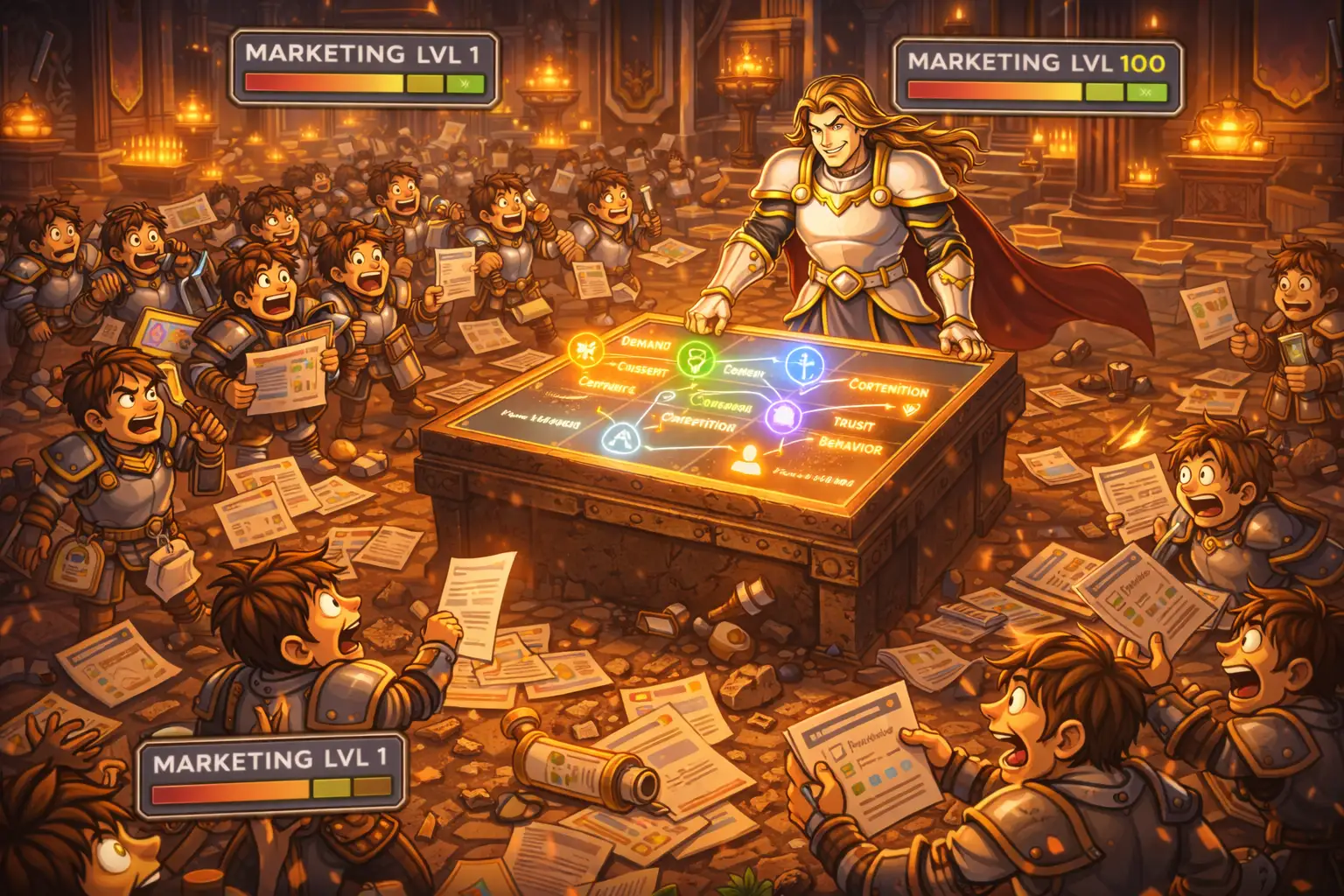
    Editorial illustration showing weaker marketers chasing measurable signals while a stronger operator reads the broader market.

    Attribution precision can create false confidence while the real market moves through channels the dashboard barely sees.


    Disclosure: This page is editorial analysis of attribution limits, measurement psychology, and first-principles marketing. Sources appear near the end.


    One of the most reliable ways to spot weak marketing strategy is to watch how the team reacts when something important cannot be measured cleanly.

    Do they pause and investigate anyway? Or do they quietly stop doing work that the dashboard cannot easily credit?

    That reaction is often the first visible sign of the attribution illusion: the belief that what is measurable precisely is the same thing as what matters most. In practice, the relationship often runs in the opposite direction. The most strategically powerful marketing frequently spreads through channels where attribution is partial, delayed, or messy. The easiest things to measure are rarely the most influential.

    This page sits beside the apathy marketing diagnosis for a reason. Apathy marketers retreat toward the metrics they can still see. Alpha marketers understand that the market is larger than the dashboard.


    The Promise That Shaped a Generation Of Marketing

    For a long stretch of the digital marketing era, teams became addicted to the idea that everything valuable should be perfectly measurable. Dashboards improved, attribution models multiplied, and marketing platforms promised increasingly detailed reporting about what had driven a click, a lead, or a sale.

    The industry quietly absorbed a dangerous assumption: if something could not be measured precisely, it probably was not worth doing.

    For a while, that assumption appeared plausible. User behavior could be tracked with reasonable clarity across search, paid social, and email. A marketer could connect spend to conversion with enough confidence to justify budget. The reporting looked clean, and the clean reporting felt like control.

    That period is now closing. Not because measurement got worse in absolute terms, but because the environment in which buyers encounter brands has become fundamentally harder to track. Platform-native content, algorithmic feeds, privacy protections, and fragmented attention patterns make clean attribution far harder than it once was. A potential customer might discover a brand through a podcast mention, see the founder on LinkedIn two weeks later, watch a short clip shared by a friend, read a comparison article in search results, and finally convert through a branded Google query. The dashboard may credit only the final click even though the real influence was spread across several moments the system cannot easily observe.


    Why The Attribution Illusion Feels So Convincing

    The attribution illusion is seductive not because it is obviously false, but because it is partially true. Attribution systems do describe something real. They show which ads were clicked, which landing pages converted, which campaigns generated leads within a tracking window. The data is not fabricated. It is just incomplete.

    That incompleteness creates a specific cognitive trap. Marketing KPIs can look healthy while revenue remains stubbornly ordinary because the team has been optimizing inside the visible slice of the market. The dashboard rewards lower-funnel activity where clicks and conversions are easy to track. Upper-funnel influence—brand familiarity, word of mouth, reputation, cultural presence, trust built slowly over time—shapes buying behavior without producing tidy rows in a spreadsheet.

    Experienced marketers usually sound more relaxed about attribution gaps than junior teams or executives expecting perfect reporting because they understand that the market has always been wider than the measurement. Rand Fishkin has been one of the clearest voices explaining this shift. As he has argued, “clicks are dying and attribution is dying.” The platforms where audiences spend time are designed to keep users inside their own ecosystems. Valuable marketing happens there without producing the tidy trail of clicks that older attribution systems were built to measure.

    Fishkin has also been direct about the commercial blind spot this creates. Many of the channels that shape demand most powerfully now sit in what he has described as the hard-to-measure category: PR, media, native social, events, many forms of content, and word of mouth. The fact that those channels are difficult to attribute cleanly does not make them strategically unimportant. In many markets, it is the opposite.


    Why Mediocre Marketers Cling To Certainty

    This shift creates a psychological problem inside organizations. When measurement becomes less complete, many teams respond by retreating toward the metrics they can still see. They double down on lower-funnel channels. They optimize for what the dashboard will reward. On paper, this looks rational. In practice, it produces a distorted marketing strategy that overinvests in easily measurable activity while underinvesting in the brand, influence, and narrative work that actually shapes demand upstream.

    It is also one of the clearest reasons marketing KPIs can look healthy while revenue remains stubbornly ordinary.

    Apathy marketers are particularly vulnerable to this trap because dashboards offer something they crave: defensibility. A clean attribution report allows a marketer to say exactly what happened and why the team deserves credit. The problem is that the market does not care how comfortable the reporting looks internally. Customers make decisions based on a mixture of signals, impressions, and experiences that rarely pass neatly through a single tracking system.

    Once everyone in the category has access to roughly the same performance data, there is no durable edge in merely reading what is visible.


    How Elite Marketers Read Incomplete Signals

    Stronger marketers approach the problem differently. They understand that imperfect attribution does not mean the work has no value. It means the system measuring the work is incomplete.

    Instead of demanding perfect visibility before acting, they look for patterns across multiple weak signals:

    • Search demand rising over time without a corresponding paid campaign.
    • Brand mentions increasing in communities where the brand does not actively post.
    • Inbound leads referencing content that was never meant to drive direct conversions.
    • Competitors suddenly reacting to a narrative the brand introduced months earlier.
    • Founders reporting that prospects “already know who we are” before the first sales call.

    In other words, they treat marketing as a probabilistic system rather than a mechanical one. They combine data with judgment, context, and experience. They understand that a podcast appearance may never appear in the dashboard even if it triggered hundreds of future searches. They know a strong article may shape industry perception long before it produces a measurable lead. They recognize that influence often appears first as subtle shifts in attention before it shows up in revenue.

    This difference in thinking is why senior marketers sometimes frustrate executives who demand perfect attribution for every decision. The executive may believe they are asking for accountability. In reality, they may be asking the marketer to operate only inside the narrow slice of the market that can be measured easily. That constraint almost always favors short-term, easily tracked tactics over the deeper strategic work that builds durable demand.


    First-Principles Thinking Beats Dashboard Superstition

    The antidote to the attribution illusion is not better models. It is better questions.

    First-principles marketers begin with reality rather than ritual. Before deciding on the channel, the format, or the KPI, they ask where the customer is already paying attention, what they want emotionally and commercially, what kind of claims they are likely to trust, what the competition is overlooking, and what would genuinely deserve to rank, spread, convert, or be remembered. Diagnosis comes before prescription.

    That order matters even more in the AI era because execution is getting cheaper, which means the cost of asking the wrong question is rising. A team can now produce flawless reporting about work that was never strategically sound to begin with. The dashboard will confirm that everything ran on schedule. The market will confirm that nothing changed.

    First-principles thinking cuts through that waste by forcing every decision back through the same filter: is this connected to a real constraint, a real source of demand, or a real opportunity to change behavior. If the answer is no, the tactic is usually noise no matter how cleanly it is tracked.


    The Attribution Illusion In Practice

    The attribution illusion is the belief that what can be measured precisely is the same thing as what matters most. In reality, the relationship often runs in the opposite direction. The easiest activities to measure are rarely the most strategically powerful. The most influential marketing—ideas that reshape a category, narratives that travel socially, brands that become culturally recognizable—often spreads through channels where measurement is partial and delayed.

    Elite marketers do not ignore data. They simply refuse to confuse measurement with reality. Attribution systems describe a slice of the market, not the whole market, and because some version of those systems is available to nearly everyone competing for the same customers, the edge comes from interpreting the data and the market together. The real skill lies in knowing when a clean number matters, when a missing number matters more, and when an incomplete signal is enough to justify a bold move before the rest of the field catches up.

    That is why this topic connects directly to the attention competition argument. If your work cannot earn attention in the first place, the attribution question never arises. And if your work does earn attention through channels the dashboard struggles to track, the smart move is not to stop doing the work. It is to build better judgment around the signals you do receive.


    Conclusion

    The dashboard is never the whole market. Attribution systems are useful, but they are not a substitute for strategic judgment. The teams that will win in the next phase of marketing are not the ones with the cleanest reports. They are the ones that can read incomplete data, interpret it against market reality, and still make bold decisions when the evidence is suggestive rather than conclusive.

    The attribution illusion will keep tempting marketers who want perfect proof before they act. The market does not offer perfect proof. It offers signals. The quality of your judgment in reading those signals is the real competitive edge.


    Sources

    A Probabilistic Reading Of What Measurable Marketing Actually Tells You

    The marketing-attribution conversation suffers from a specific kind of confidence error. Teams treat the numbers their attribution system produces as evidence about reality when the numbers are more accurately evidence about the attribution system’s design choices. The actual confidence the data warrants is meaningfully lower than the confidence the dashboard implies, and the gap between those two confidence levels is where most attribution mistakes are made.

    Run the math honestly. A typical multi-touch attribution model assigns weights to touchpoints in a customer journey using rules the data scientist who built the model chose, sometimes years ago, often using assumptions about customer behaviour that have not been re-validated since. The model’s output is “23% of conversion credit goes to channel A, 17% to channel B.” The actual statement the data can support is “given the assumptions baked into the model, the credit distribution looks roughly like this, with a confidence interval the model is not equipped to report and which is almost certainly wider than the credit numbers suggest.”

    Probabilistically, the question worth asking is not “what is the credit distribution” but “what would have to be true about the customer journey for this credit distribution to be the right answer.” When you write down the assumptions explicitly — that touchpoints are observable when they occur, that the model’s lag windows match the actual decision lag, that the channel-level data is not corrupted by ad-fraud or by bot traffic — most of the assumptions are uncertain enough that the resulting credit distribution is closer to a guess than to a measurement. The dashboard reports the guess with two-decimal-place precision. The underlying data does not warrant the precision.

    Where this matters most is in budget allocation decisions. A team that takes the attribution output at face value will move spend across channels based on credit shifts that may or may not reflect real underlying changes in customer behaviour. A team that holds the probabilistic uncertainty in mind will move spend more slowly, with more validation, with smaller bets sized to the actual confidence the data warrants. The second team converges on better allocation over time. The first team converges on whatever the model’s assumptions happened to imply.

    The pattern is familiar from the broader Web3 marketing failure to distinguish measurable activity from causal impact. The dashboards measure what is easy to measure. The decisions get optimised against the measured quantities. The measured quantities turn out to correlate weakly with the outcomes that matter. By the time the gap is visible in revenue data, the budget has been allocated for several quarters on the basis of the wrong quantities, and the corrective re-allocation is itself a slow process because the new quantities — the ones that actually correlate with revenue — are harder to measure.

    The serious response is not to abandon attribution. It is to treat each attribution number as a probability-weighted estimate, to ask explicitly what would change the estimate, and to allocate budget against the underlying confidence rather than against the headline credit. This is harder than running the dashboard. It produces better outcomes. The teams who do it look like they have a measurement advantage; they do not. They have a methodology that takes the measurement uncertainty seriously, which is the same methodology that any field with proper quantitative rigour applies to its data.

  • Microsoft Is at a Crossroads in 2026. It Still May Be the Best-Positioned American Tech Giant in AI.

    Microsoft Is at a Crossroads in 2026. It Still May Be the Best-Positioned American Tech Giant in AI.

    Microsoft Is at a Crossroads in 2026


    TL;DR

    Microsoft is under genuine AI-era pressure in 2026. The cost base is enormous, customers are more sensitive to monetization moves, and the company is increasingly tempted to squeeze captive ecosystems before clean proof of value fully catches up. But that pressure should not be confused with weakness. Among major American tech incumbents, Microsoft may still be the best positioned to convert AI into durable power because it controls more of the enterprise stack than almost anyone else. The real crossroads is not whether Microsoft can matter in AI. It is whether it can turn that position into lasting value without overtaxing the customers and developers who made the moat so strong in the first place.


    Why Microsoft’s 2026 AI position looks both stronger and more fragile than the applause suggests.


    Editorial illustration of Microsoft entering a new AI infrastructure phase as Azure and Foundry become more central to the 2026 story.

    The crossroads is real: Microsoft has unusual strategic strength, but the bill is now large enough to shape behavior.


    Disclosure: This is editorial analysis based on Microsoft investor materials, official product and pricing communications, and high-trust reporting on the company’s AI-era investment posture. Sources appear near the end.


    The lazy way to read Microsoft in 2026 is to choose one of two extremes. Either the company is an unstoppable AI juggernaut and every concern is noise, or the company is already repeating the oldest incumbent mistake in the book and quietly sliding from growth into extraction. Both framings miss the point.

    Microsoft is not an ordinary incumbent facing an ordinary technology shift. It sits on one of the deepest positions in enterprise technology anywhere in the world: Azure, Microsoft 365, GitHub, Windows, data tooling, security products, developer surfaces, compliance plumbing, and now a broad AI narrative that still commands real attention. That matters because AI is not only a model race. It is a distribution race, a workflow race, and a monetization race. Microsoft enters all three with real advantages.

    But strength can create its own form of danger. Once capital expenditure rises fast enough and the infrastructure build-out becomes a story in its own right, the temptation grows to defend returns by leaning harder on the users who are least able to leave. That is the pattern behind the broader Microsoft AI squeeze thesis. The question is not whether Microsoft is weak. It is whether it uses strength in a way that compounds trust or quietly taxes dependence.


    Why The Crossroads Matters Now

    The official numbers still look formidable. Microsoft reported $81.3 billion in revenue for fiscal Q2 2026, up 17% year over year, with Azure and other cloud services up 39% and Microsoft Cloud revenue reaching $51.5 billion. On the surface, this is the kind of scorecard that lets headlines keep using words like “dominant” and “unassailable.”

    The issue is not whether the company is still strong. It clearly is. The issue is what kind of strength this is becoming. Over the last year, Microsoft’s AI story has been sustained by three things at once: massive infrastructure spending, unusually broad enterprise distribution, and a still-open market willingness to believe that the monetization curve will ultimately justify the spend. That combination is powerful, but it is not frictionless.

    This is why the capex discussion matters so much. Once a company is building AI capacity at a scale large enough to dominate investor calls, datacenter maps, and supplier narratives, the cost base begins to exert pressure back on the operating model. That does not make Microsoft uniquely vulnerable. It makes Microsoft newly visible. As we argued in our capex analysis, the most important question is no longer whether Microsoft can spend. It is how quickly the revenue quality behind that spending becomes undeniable.


    Why Microsoft Still May Be Best Positioned

    For all the concern around AI pricing, Copilot monetization, and ecosystem squeeze behavior, Microsoft still has one advantage most rivals would kill for: it does not need to win AI as a standalone product category. It can win by embedding AI inside systems enterprises already depend on.

    That sounds obvious, but it is strategically enormous. Many AI companies still need to convince buyers to adopt a new vendor, a new workflow, or a new spend category. Microsoft often only needs to extend an existing relationship. The same buyer already uses Azure. The same buyer already has Microsoft 365. The same security, identity, and governance stack is already present. That does not guarantee monetization, but it lowers the political and operational friction around adoption in ways that smaller competitors cannot easily match.

    This is also where Microsoft differs from many of the American tech companies now trying to define the next AI platform. Amazon has infrastructure scale but weaker productivity-layer intimacy. Apple has device intimacy but a narrower enterprise position. Meta has reach but weaker enterprise trust. Google has world-class AI assets but still feels less deeply welded into the compliance-heavy operating core of many enterprise customers. Microsoft is imperfect at every layer, but unusually present across all of them.

    That breadth is why the crossroads thesis has to remain nuanced. The stronger conclusion is not that Microsoft is heading toward irrelevance. It is that Microsoft may be best positioned precisely because it can turn AI from a headline feature into workflow gravity, provided it does not overplay the moat.


    Where The Pressure Is Already Showing

    The reason the squeeze thesis keeps recurring is that the stress is already visible around the edges. Copilot usage headlines and paid-seat reality are not obviously the same thing. Microsoft 365 price changes and bundling moves read, at least in part, like an attempt to defend ARPU while value proof is still uneven. GitHub and VS Code remain deeply valuable properties, yet they are also obvious surfaces for monetization experiments because the habit base is strong and switching costs can be subtle but real.

    Even consumer-facing categories tell a similar story. Xbox content and services revenue fell 5% in fiscal Q2 2026. That does not make gaming the center of the Microsoft story, but it does reinforce the pattern: when costs rise and mature ecosystems lose some easy growth, pricing and monetization pressure become more visible. That is the same logic behind the Game Pass loyalty-tax thesis and the more developer-facing concerns inside the planned Microsoft developer squeeze page.

    What matters is not one move in isolation. It is the pattern: once the market stops assuming every AI-era price increase is obviously justified, the burden of proof changes. The user starts asking harder questions. Why this fee? Why this bundle? Why this upsell? Why is “usage” the headline metric but paid conversion still harder to read? Those questions do not imply failure. They imply a more demanding phase of the Microsoft story.


    The Real Bull Case Is Operational, Not Theatrical

    Microsoft’s best route through this crossroads is not to win the loudest AI press cycle. It is to become the operating layer enterprises trust when AI moves from experimentation into boring daily dependence.

    That means reliability, governance, security, identity, compliance, data access, and measurable workflow improvement matter more than one more keynote promise about agents changing everything. In practice, the company is strongest when it behaves like the adult in the room: the provider that helps enterprises adopt AI without breaking procurement, auditability, or organizational cohesion.

    That is also why the market should not treat every criticism of Microsoft’s squeeze behavior as a contradiction of the bullish case. Inference from the evidence: the same structural advantages that make Microsoft powerful also make the company dangerous to underestimate. A company with weaker distribution would not be able to test these monetization boundaries so aggressively in the first place.


    What To Watch Through 2026

    There are four signals worth watching if you want to know whether Microsoft is using this crossroads well or badly.

    • Azure quality of growth: not just the topline percentage, but whether growth remains healthy without requiring increasingly awkward narrative support.
    • Copilot monetization clarity: paid-seat reality matters more than broad “usage” framing.
    • Ecosystem squeeze behavior: watch whether pricing and packaging shifts feel like product improvement or toll-booth logic.
    • Enterprise trust durability: if customers keep absorbing more AI spend because the workflow value is undeniable, the moat strengthens. If they start feeling managed rather than served, the halo weakens.

    Microsoft can still win this era convincingly. It may even be best positioned to do so among the big American incumbents. But the company is now large enough, expensive enough, and embedded enough that the style of the victory matters. A Microsoft that compounds trust can become even more central. A Microsoft that monetizes dependence too aggressively can still grow, but at a rising cost to goodwill.


    Conclusion

    Microsoft is at a crossroads in 2026 because its strategic position is now too strong to be judged only by the old metrics of growth and narrative momentum. The real question is whether the company converts that position into durable value or prematurely leans on the users, developers, and enterprises already trapped inside its gravity.

    The stronger reading is still that Microsoft may be the best-positioned American tech incumbent in AI. But being best positioned is not the same thing as being beyond scrutiny. In fact, it is the opposite. The bigger the position, the more important it becomes to watch how the company behaves once the bill arrives.


    Sources

    • Microsoft FY26 Q2 earnings release
    • Microsoft FY26 Q1 earnings release
    • Microsoft 365 pricing update, December 4, 2025
    • GitHub Actions pricing changes, December 2025
    • Anthropic pricing

    The Contrarian Case For Microsoft Specifically, Not Microsoft Generally

    The Microsoft conversation in 2026 has converged on a consensus that the company has structural advantages, is executing the AI transition reasonably, and will probably do fine over the medium term. Consensus is usually a signal worth examining. The contrarian case for Microsoft is not that the company will fail — the consensus case is probably right on aggregate — but that the company’s specific positioning has features the consensus is not pricing correctly, and the mispricing produces an investable asymmetry in either direction depending on which features the next two years validate.

    Start with what the consensus has right. Microsoft has Azure scale, an enterprise distribution channel that took thirty years to build, and a customer base whose switching costs increase with each year of Office and Teams embedding. These are real advantages. They will produce real revenue and real margin for the foreseeable horizon. No reasonable contrarian case denies any of this.

    What the consensus underweights is the specific way Microsoft has chosen to monetise the AI transition. The decision to bundle Copilot pricing aggressively into existing enterprise contracts is a strategic choice with two possible outcomes that do not have equal probability. Outcome one: enterprises absorb the price increase because the productivity gain justifies it, Microsoft captures most of the AI value layer, and the company emerges from the transition with margin expansion at scale. Outcome two: enterprises balk at the bundle, push back on renewals, and Microsoft discovers it has monetised too aggressively too early, requiring a partial walk-back that damages pricing power in ways that compound for years. The consensus prices outcome one at probably 65-70% likelihood. The contrarian read is that the probability is closer to 50-55%, and the gap between those two estimates is where the asymmetric position lives.

    The second contrarian point is about the founder-equivalent layer. Microsoft, unusually for a company of its size and age, has spent the past decade under a single CEO with strong execution credentials and unusual strategic clarity. Satya Nadella’s tenure has produced enough good decisions that the market has implicitly priced “Nadella continues to make Microsoft decisions” into the company’s valuation. The consensus does not actively model the post-Nadella succession question because doing so would lower the company’s multiple. But every prior Microsoft cycle has been defined more by who was running the company than by the company’s structural position, and the next decade will be too. The question of who succeeds Nadella, and on what timeline, is not being priced in any meaningful way.

    The third contrarian point is regulatory. Microsoft has navigated antitrust scrutiny in three distinct eras — the 90s, the 2010s, and the current AI-era. The company has learned to navigate the regulatory process expertly, and that expertise has consistently been one of its quiet advantages. But the regulatory environment of 2026 is different in a specific way the company has not navigated before: it is global, it is coordinated across jurisdictions, and it is focused on AI in a way that the previous regulatory cycles were not. Microsoft’s regulatory navigation has been built for serial bilateral engagements with national regulators. The current environment is closer to a coordinated multilateral challenge. Whether the existing playbook works against the new challenge is genuinely uncertain, and the consensus assumes it does.

    The same diagnostic frame applies to other platform incumbents currently negotiating the operating-system upgrade Web3 is also negotiating in miniature. The visible communications layer of Microsoft’s transition is well-executed. The underlying systems — pricing discipline, succession planning, regulatory navigation — are where the actual bet sits. The investor who reads the headlines without going to the systems layer will be priced according to the consensus. The investor who reads the systems layer will discover that the asymmetry exists, and that taking either side of it is a defensible position depending on which system surfaces over the next eight quarters.

  • AI, SaaS and Crypto in 2026: Bubble, Reset or Reality Check?

    AI, SaaS and Crypto in 2026: Bubble, Reset or Reality Check?


    TL;DR

    AI, SaaS, and crypto still command enormous capital and attention, but 2026 looks increasingly like a year of harder questions. Enterprise AI is producing real winners, yet many companies remain stuck in pilots. SaaS growth is running into seat scrutiny, tool consolidation, and AI-driven price pressure. Crypto continues to generate value, but weak governance and treasury theater still expose how far stories can drift from business reality. The more useful question is no longer “does the technology work?” It is “does the business model justify the valuation, the spend, and the trust being asked of the market?”


    Published January 18, 2026. Updated March 20, 2026.


    Disclosure: This page is editorial analysis of AI, SaaS, and crypto markets. It draws on public reporting, enterprise-adoption research, security and governance analysis, and VaaSBlock’s broader work on credibility and operating quality.


    Jump to:

    There is a familiar stage in every technology cycle when the argument changes. Early on, the market argues about possibility. Later, it argues about scale. Eventually it starts asking a rougher question: who is actually making money, who is just burning it, and which stories were priced as if execution were already solved?

    That is where AI, SaaS, and crypto now seem to be converging.

    The technologies are real. Their uses are real. Their long-term importance is not in doubt. What is in doubt is whether the current business cases, margin assumptions, treasury strategies, and governance standards are strong enough to support the weight that capital markets and private investors have placed on them.

    So this is not an anti-technology essay. It is an accountability essay. The point is not that AI fails, SaaS dies, or crypto disappears. The point is that 2026 looks increasingly like a year when markets stop rewarding story quality alone and start demanding stronger proof that the economics underneath the story can carry it.


    The AI Bill Is Arriving

    AI remains the most obvious example of the gap between excitement and execution. Large organizations are spending aggressively, vendors keep reporting broad enthusiasm, and public markets still assign heavy valuation premiums to firms seen as AI beneficiaries. That part of the story is clear.

    The less convenient part is what happens after the press release and the pilot budget.

    A large share of organizations are still struggling to move from experimentation to durable business value. Some projects work. Some teams are clearly ahead. But many others remain trapped in the familiar middle ground of pilot programs, consultant-heavy deployments, unclear ownership, fuzzy ROI definitions, and cultural resistance inside the operating business.

    That gap matters because markets are often pricing AI as if broad enterprise monetization is already a settled fact. In reality, adoption quality is still uneven. The best AI stories are often very good. The median AI story is much less convincing.

    This is why the question “is there an AI bubble?” is usually framed too crudely. The better question is whether the market is pricing a minority of well-executed outcomes as if they were already normal across the whole enterprise landscape. That is a very different risk, and a more plausible one.

    It also helps explain why VaaSBlock’s earlier work on Microsoft’s capex pressure and AI-driven user squeeze dynamics matters here. When spending surges faster than clean proof of value, somebody eventually has to absorb the bill.


    The Open-Model Problem for Margin Dreams

    The other force pressuring the AI story is that capability is not staying scarce in the way many investors once hoped.

    Open-weight and lower-cost models have made it harder to argue that a small set of proprietary providers will capture every meaningful margin layer indefinitely. Even when frontier systems remain ahead, “good enough” alternatives keep getting stronger. For many workloads, especially enterprise tasks that do not require absolute frontier performance, the difference between premium and practical is shrinking.

    That matters because a lot of current valuation optimism depends on the assumption that high-margin AI services will stack cleanly on top of already-expensive infrastructure bets. If open or cheaper models absorb more of the workload than expected, that margin story gets pressured from underneath.

    This is another reason 2026 feels more like a reality-check year than a collapse year. The likely outcome is not that AI stops mattering. It is that the market becomes more selective about who actually captures the value.


    SaaS Is Entering a Harsher Pricing Era

    SaaS is dealing with a related but slightly different version of the same problem. For years, many software businesses benefited from an environment where budgets were broad, tooling could sprawl, and growth stories were strong enough to cover a lot of operational slack.

    That environment is weaker now. CFOs are looking harder at seat counts, renewal terms, overlapping subscriptions, and how many tools genuinely matter. Procurement teams are more skeptical. Departments are being asked to justify spend more explicitly. At the same time, AI tools are creating cheaper alternatives for narrow workflows that used to support specialized subscriptions.

    This does not mean SaaS is finished. It means the sector is under sharper pricing pressure. Products that still create obvious leverage will survive. Products that had quietly drifted into rent-like territory will find renewal conversations much harsher.

    That is exactly the pattern behind VaaSBlock’s work on rent versus leverage in SaaS. Once buyers start asking whether a workflow really justifies the recurring bill, the emotional framing of the product changes. The software may still be useful. But if the customer no longer feels an asymmetric benefit, the subscription becomes easier to challenge.

    This is also why seat inflation and pricing complexity matter more now. In a looser market, companies often tolerated overprovisioning. In a tighter market, those inefficiencies become visible. Products that still price as if switching is impossible and alternatives are expensive are increasingly exposed to a world where neither assumption feels safe.


    The Real SaaS Risk Is Not Slower Growth Alone

    Slower growth by itself is not the full problem. The harder issue is what slower growth reveals.

    It reveals which businesses were relying on expansion behavior that no longer feels normal. It reveals which products are more optional than management wanted to admit. It reveals how much of the valuation story depended on the idea that once software got into the account, it would keep expanding almost automatically.

    In a more disciplined environment, that assumption breaks faster. Net retention becomes harder to defend. Upsell stories weaken. Tool consolidation becomes rational. Buyers stop confusing “present in the stack” with “strategically indispensable.”

    That is not a software apocalypse. It is a pricing and accountability reset. The result is likely to be a market that still rewards excellent software, but punishes lazy pricing and weak product leverage much faster than before.


    Crypto Still Has a Governance Problem Disguised as a Market Problem

    Crypto’s version of the same reality check sits less in enterprise ROI and more in trust, treasury behavior, and operating quality.

    The market still produces innovation. It still produces useful infrastructure. It still produces real demand in certain corners. But it also still produces huge amounts of theater, fragile governance, weak disclosures, and business models that lean too heavily on token reflexivity rather than durable economics.

    That is why crypto treasury strategies deserve closer attention. When listed entities or high-profile projects lean heavily on digital-asset balances without strong governance, disclosure discipline, and risk limits, they can turn what looks like strategic optionality into an embedded volatility machine. At that point the treasury is not simply a reserve. It becomes part of the speculative story.

    This is also where VaaSBlock’s broader credibility work matters most. In pages such as our standards review and our verification framework, the recurring conclusion is the same: code quality and narrative quality do not automatically produce business resilience.

    As our operator critique argues, governance, disclosure, and operating discipline still decide whether the story survives contact with stress.


    What Survives a Reality Check

    The projects most likely to survive a 2026-style honesty session share a few common traits.

    • They can show the economics. Not just excitement, but real cost savings, margin improvement, retention, or cash-flow logic.
    • They can show the governance. Clear ownership, sensible controls, better disclosure, and fewer black-box risk assumptions.
    • They know where AI changes the stack. If a product is exposed to cheaper general-purpose alternatives, its pricing and scope need to acknowledge that reality.
    • They understand that trust is now part of the business model. This is especially true in crypto, but increasingly relevant across AI and SaaS too.

    That is why 2026 should not be framed as a year when innovation dies. It is better framed as a year when the market becomes less patient with innovation that cannot explain its economics, its governance, or its right to durable trust.


    A Short Checklist for Founders and Investors

    If you are evaluating an AI, SaaS, or crypto story in 2026, the most useful questions are still basic:

    • Can this business explain its value in cash-flow terms, not just strategic terms?
    • Does adoption look real, or mostly performative?
    • How vulnerable is the margin story to cheaper alternatives?
    • Would the governance survive skeptical outside review?
    • Is this a business that works, or a narrative that still needs markets to stay unusually forgiving?

    Those questions are not anti-growth. They are how serious capital eventually behaves when the easiest phase of the story ends.


    The More Useful 2026 Framing

    The useful conclusion is not that AI, SaaS, and crypto are collapsing together. It is that all three are being asked to grow up at the same time.

    AI has to prove that the spending wave becomes real enterprise value beyond the best-case pilots. SaaS has to prove that recurring pricing still maps to real leverage in a world with cheaper alternatives. Crypto has to prove that governance and business reality can catch up with the stories told around tokens and infrastructure.

    That is a tougher environment, but also a healthier one. It favors clearer economics, better discipline, and more serious operators. For VaaSBlock, that is not a side theme. It is the point. Markets become more investable when trust, governance, and evidence stop being optional extras and start becoming central to valuation.


    FAQ: AI, SaaS and Crypto in 2026


    Is there an AI bubble forming in 2026?

    The stronger case is not that AI is fake, but that parts of the market may be priced as if broad enterprise ROI is already proven when many organizations are still struggling to move beyond pilots.


    Why are SaaS valuations and growth slowing?

    Because buyers are consolidating tools, CFOs are challenging seat inflation, and AI alternatives are increasing pricing pressure on software that no longer feels clearly indispensable.


    What makes crypto treasury strategies risky in 2026?

    Crypto treasuries can turn operating companies into highly visible volatility vehicles, especially when governance, disclosure, and risk limits are weaker than the market assumes.


    What survives a 2026 reality check?

    The projects most likely to survive are the ones that can show real unit economics, disciplined governance, measurable adoption, and business models that do not rely on perpetual narrative inflation.


    Sources

    Disclaimer

    This page is for general information and editorial analysis only. It does not constitute investment, legal, tax, or financial advice.

    The Plain-Reader Translation Of “Bubble, Reset Or Reality Check”

    If you read this piece without the financial vocabulary, what is the article actually saying? It is saying that three large technology categories — AI, SaaS, and crypto — entered 2026 with expectations that ran ahead of what the underlying businesses could deliver, and that the next twelve months will resolve the gap in one of three directions. Either the underlying businesses catch up to the expectations (the reality-check outcome), the expectations come down to meet the businesses (the reset outcome), or the gap stays open long enough that the loss of confidence forces a sharp re-pricing (the bubble outcome).

    The reason this matters to a non-specialist reader is that the three outcomes look very different from inside whatever role you happen to occupy. If you work at a SaaS company, a reset means hiring freezes and tighter pricing discipline; a bubble outcome means layoffs and possible acquisition. If you hold crypto, a reset means a slower 2026 with less volatility; a bubble outcome means another deep drawdown. If you are an AI operator, a reset means the easy fundraising window closes and the bar for the next round rises; a bubble outcome means several of your peers do not survive the round at all. The honest framing is that you do not get to choose which outcome happens to your category. You get to choose how prepared you are to operate well in any of the three.

    The preparation worth doing is the same across all three. Build the business so that it would still be a defensible business if the most pessimistic of the three outcomes were the one that arrived. That is not the same as pretending the pessimistic outcome will arrive. It is the discipline of building toward fundamentals that hold regardless of which path the cycle takes, and then letting whichever cycle arrives reward the discipline appropriately. The teams who run this playbook do better than the teams who try to predict which outcome will land, because no one is good at predicting that and almost everyone is capable of running the discipline if they decide to.

  • Crypto Due Diligence in 2026: A Trader’s DYOR Stewardship Audit

    Crypto Due Diligence in 2026: A Trader’s DYOR Stewardship Audit

    Late-night investigative desk scene representing crypto due diligence and a trader’s stewardship audit

    In crypto, one slogan gets repeated more than any other: “do your own due diligence”. The problem is that most traders never turn it into a method. After the last cycle, many learned that price action isn’t due diligence. In 2026, that gap is costly: attention is fragmented, exit liquidity can vanish, and the market punishes projects that can’t prove outcomes. This guide is a practical framework for auditing whether a crypto project can survive when the story stops working. It turns “DYOR” into a trader’s stewardship audit and a full crypto due diligence checklist for 2026, focused on the operational signals that decide whether a project survives when sentiment turns.


    Published January 19, 2026. Updated March 22, 2026.

    This page is built for traders, allocators, and serious retail buyers who want a repeatable way to evaluate a token or crypto project before allocating. It is not a price-prediction piece. It is a field manual for separating operational reality from narrative noise.

    If your real question is “how do I evaluate a crypto project before investing?” or “how do launchpads and allocators vet new crypto projects?”, this page is designed to answer that at a practical level.


    TL;DR

    Most traders don’t lose money because they missed the next narrative. They lose because they didn’t audit whether the organization behind the token could survive when the narrative stopped working. This article turns “DYOR” into a repeatable stewardship checklist you can run in under an hour.


    • Hype isn’t momentum. Momentum is customers, revenue, and repeated usage.
    • Most blow-ups are social-layer failures (runway, execution, governance), not technical failures.
    • In 2026, your edge is auditing stewardship: runway, outcomes, dependency risk, liquidity, and token integrity.

    Last updated: March 22, 2026. Original framework published January 19, 2026. Evidence links are listed below.


    DYOR in 2026 (the 5-signal version)

    • Runway: can the org survive a drawdown without selling its own token?
    • Customers: does usage repeat without incentives—and does it translate into revenue?
    • Dependency: can one external platform, API, or venue kill the growth loop?
    • Liquidity: can you actually exit your intended size across more than one venue?
    • Token integrity: are supply rules stable, legible, and aligned (no surprise dilution)?


    What matters

    • Runway beats rhetoric. If a project’s survival depends on selling its own token into drawdowns, it’s a timed bomb.
    • Strategic announcements aren’t receipts. If outcomes aren’t verifiable, treat the claim as marketing until the ledger confirms it.
    • Dependency risk is underrated. If growth depends on a third party the team doesn’t control, treat it as borrowed time.
    • Liquidity is part of due diligence. If you can’t exit, your “conviction” becomes a trap.
    • Tokens aren’t shares. Supply expansion is dilution, not a stock split.


    How to use this guide

    Use this as a repeatable audit, not a one-time read. Run it before you size into a new position, and rerun it whenever the market regime changes.

    Use this as an audit, not a prediction engine. Run it before sizing into a token, and rerun it after any major claim that implies demand. We treat “strategic announcements” as marketing until the receipts show up. The goal is simple: remove obvious failure modes before you put real money on the line.

    • Best for: spot holders, swing traders, and anyone using perps who wants to avoid “social-layer” blowups.
    • What it protects against: runway failures, dependency shocks, delisting cascades, and token rule changes.
    • How often: monthly for core holdings, and immediately after any major announcement that claims “mass adoption.”


    Quick navigation

    • 1) Financial Pulse (runway)
    • 2) Customer Pulse (momentum vs hype)
    • 3) Dependency Pulse (single point of failure)
    • 4) Development Pulse (founder risk)
    • 5) Stewardship Pulse (governance + continuity)
    • 6) Market Pulse (liquidity + exit reality)
    • 7) Token Integrity (supply + dilution)
    • 60‑minute workflow (Step 1 → Step 6)
    • Sources and evidence

    Quote (Ben): “When I put my money on the line, I separate hype from momentum—and momentum is customers.”


    Crypto doesn’t trade in a vacuum. A lot of portfolios are still working through drawdowns, the market is quicker to label projects “vaporware,” and teams get less runway for promises than they did last cycle.


    Traders are behaving rationally. When other asset classes deliver cleaner returns, speculative tokens have to justify their risk. So this isn’t a “hot takes” list. It’s a field guide to signals you can verify when you’re trading real money: runway, verifiable outcomes, dependency risk, liquidity reality, and whether the team can keep shipping when the market stops cheering.

    The 2025 Scoreboard: How Other Assets Performed

    This isn’t a “crypto is dead” argument. It’s an allocation check. If traders can get clean returns elsewhere, speculative assets have to earn attention through fundamentals—especially when risk appetite is thin.

    Window: Jan 1–Dec 31, 2025 (UTC). Figures are directional and sourced below as receipts.

    Asset class (proxy)2025 performance (approx.)Why it matters for crypto DD
    S&P 500 (Total return)+17.9% (source: Slickcharts)Risk-on returns existed elsewhere; tokens had to earn allocation.
    Nasdaq Composite+28.6% (source: Slickcharts)Narrative capital rotated to mega-cap + AI; crypto lost mindshare.
    Gold~+65% (source: Nasdaq recap)“Safety” outperformed; credibility and staying power mattered more.
    US Core Bonds+7.1% (source: Morningstar recap)Even bonds paid—raising the bar for holding high-volatility tokens.
    Bitcoin (BTC)~−6.3% (source: DQYDJ calculator)The benchmark underperformed; alts were punished harder.
    Ethereum (ETH)~−28.5% (source: DQYDJ calculator)High-beta exposure hurt; traders became more risk-sensitive.

    As‑of / methodology: The figures above are directional, compiled from the linked sources, and may vary by provider depending on whether returns are price-only vs total return and the exact start/end cut‑off used. This table uses a year-end framing (Jan 1, 2025 to Dec 31, 2025, UTC) as a practical reference window, and the links are included as receipts.


    Why Sentiment Feels Negative in Early 2026

    When the market starts the year with drawdowns and underperformance versus other asset classes, traders stop paying for promises. This is the environment where operational risk becomes the real trade: if a team can’t show runway, outcomes, and execution you can verify, the market prices the token like a brittle startup, not like infrastructure with staying power.

    Dimly lit boardroom with scattered documents and evidence, symbolizing scrutiny of claims versus receipts


    The Core Thesis: Great Code Can’t Save a Failing Business

    Quote (Ben): “When I put my money on the line, I treat ‘strategic announcements’ as marketing until the receipts show up.”


    A project can have real engineering and still be a bad trade. Many of the most painful failures aren’t smart-contract exploits—they’re continuity failures: runway ends, teams stop shipping, exchanges de-risk, and liquidity evaporates. That’s why this guide focuses on a trader’s Stewardship Audit: not just what the protocol claims, but what the organization can prove.

    When I put my own money on the line, I treat continuity risk as the real trade: if stewardship disappears, the market reprices before you can exit.


    In 2026, you’re not only trading technical risk. You’re trading continuity risk—the risk that stewardship disappears, the market panics, and your exit becomes a time‑bounded scramble.


    We call this a social‑layer failure: the chain can still produce blocks, but the human system that keeps it safe, relevant, and supported stops functioning. The failure mode is predictable—runway ends, builders stop building, exchanges de‑risk, and liquidity evaporates—and it hits fast in real time.


    In every cycle, traders get mesmerized by status signals: impressive pedigrees, conference photos, “strategic partnerships,” and bold grant numbers. Those signals can be real—or they can be theater. Humans are wired to follow the tribe’s confidence, not the ledger. In 2026, the ledger wins.


    This is the stewardship premium: protocols that can prove execution, outcomes, and continuity earn liquidity and forgiveness. Protocols that can’t get repriced like brittle startups—even if the tech is elegant.


    The Receipts Ladder (what evidence deserves weight)

    In 2026, the fastest way to reduce mistakes is to rank evidence. Traders tend to overweight narrative signals and underweight ledger signals: usage, revenue, governance control, and shipping cadence.

    • Level A (highest weight): live product you can test, repeat users, fee/revenue data, and on-chain activity that matches the story.
    • Level B: audited disclosures, transparent treasury composition, published governance/operations docs, and shipped milestones with measurable outcomes.
    • Level C (lowest weight): “strategic partnerships,” grant headlines, conference travel, and influencer-driven attention.


    What this guide does: gives you a practical audit you can rerun. The aim is to remove obvious failure modes from your portfolio.

    What this guide doesn’t do: promise that “good fundamentals” will pump in a straight line. Fundamentals reduce the probability of catastrophic failure; they don’t eliminate volatility.


    The L1 Stewardship Audit: A Trader’s Checklist

    Use this checklist to evaluate whether a Layer‑1 (or any tokenized protocol) is built for longevity—or drifting toward a social-layer failure.


    1) The Financial Pulse (The Runway Test)

    Quote (Ben): “When I put my money on the line, I ask one question first: how does this business make money—and how does it keep making money in a bear market?”

    Key question: Can this organization survive a drawdown without funding itself by dumping tokens?

    • Treasury composition: meaningful fiat/stable reserves vs mostly native-token treasury.
    • Burn vs revenue: is there a credible path to cover operating costs without dumping tokens?
    • Grant outcomes: look past headlines; require a verifiable outcomes ledger.


    Definition: In a downturn, most protocols don’t “run out of tech.” They run out of cash. If the organization has to sell its own token to pay salaries, the token becomes a funding instrument—not an investment thesis.


    Why it gets missed: Treasuries are often presented as big numbers without composition. A “$200M treasury” sounds comforting until you realize it’s mostly illiquid native tokens marked at peak-cycle prices.


    Hard red flags:

    • Treasury is mostly the native token (or locked tokens) with little stable/fiat buffer.
    • Runway is never addressed—no credible discussion of costs, burn, or sustainability.
    • Grants are announced but outcomes are untrackable (no recipients list, no milestones, no shipped products).
    • Revenue narrative is vague: “future enterprise,” “institutional interest,” “ecosystem flywheel” without receipts.

    10-minute check

    • Do: read the last 90 days of official updates.
    • Check: do they publish an outcomes ledger (grants, shipped milestones, adoption) and discuss treasury composition in stable/fiat terms?
    • If → assume: if outcomes and stable/fiat runway are never addressed, assume the runway is brittle.


    2) The Customer Pulse (Momentum vs Hype)

    Key question: Is usage repeatable and revenue-linked, or is it subsidy-driven activity that disappears when incentives stop?


    Rule: “Strategic announcements” only become meaningful signals when they translate into measurable user behavior (or revenue) inside a short, observable window.


    Why this matters: In Web3, press releases often function as narrative maintenance rather than business evidence—partnership language, roadmap theater, and “ecosystem” claims that never show up on-chain. This doesn’t mean every announcement is fake; it means the burden of proof is on outcomes. We’ve broken down the common patterns (and how they mislead traders) in our press-release analysis.


    10-minute test:

    • Usable today: can a user complete the promised action right now (not “coming soon”)?
    • Ledger reflection: do usage/fees/active addresses move in weeks, not quarters?
    • Distribution reality: did the announcement create a real customer pathway, or just a headline?

    External receipt: see how mainstream coverage describes “announcement-first” dynamics and trader fatigue in crypto markets (overview: Wall Street Journal).

    Momentum is repeat usage and paid demand. If adoption only stays alive when incentives are running, you’re trading a subsidy—not a business.

    • Retention: do users come back without being paid?
    • Revenue quality: fees are useful; recurring paid demand is stronger.
    • Integration reality: can a user complete the promised journey today?


    Definition: Real momentum is users doing the thing the protocol exists for—repeatedly—without being bribed.


    Why it gets missed: Crypto is trained to treat activity as demand. But airdrops, quests, and points programs can simulate demand for months while the underlying product-market fit stays at zero.


    Hard red flags:

    • Growth is always described in followers, impressions, or “hype” metrics, not customers or revenue.
    • Incentives are the product: usage spikes only when rewards are paid.
    • Partnership announcements don’t ship: no working integration, no user pathway, no measurable outcome.
    • Retention is ignored: the team reports signups/TVL once, never cohort retention or repeat usage.

    10-minute check

    • Do: pull one public dashboard or third-party dataset (TVL, active addresses, fee revenue).
    • Check: does the trend direction match the story being sold?
    • If → assume: if the narrative is “mass adoption” but the ledger is flat, believe the ledger and downgrade the claim.


    3) The Dependency Pulse (Single Point of Failure)

    Quote (Ben): “When I put my money on the line, I’m allergic to dependency risk. If your growth relies on a platform you don’t control, you’re living on borrowed time.”

    Key question: Can a single external platform, API, or venue kill the growth loop?

    • Platform risk: what breaks if a third-party API, exchange, or distribution channel disappears?
    • Control: does the project’s core loop rely on rules set by someone else?


    Definition: Dependency risk is when a token’s growth engine depends on a third party the team doesn’t control—an API, an app store rule, a single exchange, or a social platform. If that dependency changes policy, your “business model” can disappear overnight.


    Why it gets missed: In bull markets, distribution looks like product‑market fit. In reality, some projects are just riding someone else’s rails. When the rail owner reprices access or shuts a door, tokens that were priced like “infrastructure” trade like disposable apps.


    A 2026 check: We’ve already seen tokens tied to engagement and incentive mechanics wobble when platform access or rules change. Bottom line: if you don’t control the dependency, you don’t control your future.


    Rule: If a project’s growth depends on a platform whose incentives are not aligned with the project’s survival, treat that dependency as a timer, not a moat.


    Why this matters: Platform owners optimize for their own customers, spam controls, and revenue—not for your token’s price. A business model built on borrowed distribution can look inevitable—until a policy change makes it unviable.


    Dependency Timer Test:

    • Name the dependency: the platform, API, exchange, or venue the growth loop relies on.
    • Find the rulebook: link the policy, terms, or platform rules that govern access.
    • Write the zero case: if access is removed tomorrow, what real value remains?

    Mainstream receipt: Yahoo Finance coverage of X API access bans impacting crypto projects.


    Hard red flags:

    • The core loop relies on a single platform (e.g., “earn” mechanics, APIs, distribution rules) outside the team’s control.
    • There is no contingency plan explained publicly for what happens if access is restricted.
    • Revenue is upstream-controlled: the project can’t earn without another company approving it.
    • Usage is non-portable: if you remove the dependency, there is no remaining product value.

    10-minute check

    • Do: write the project’s growth loop in one sentence.
    • Check: which external party can kill, restrict, or tax that loop?
    • If → assume: if you can name a single entity, treat it as higher risk and size accordingly.


    4) The Development Pulse (Can It Survive Without the Founders?)

    Key question: If the founders disappeared for 90 days, would the protocol still ship, fix bugs, and maintain critical tooling?

    • Contributor diversity: meaningful commits from many contributors, not a tiny inner circle.
    • Ecosystem independence: third parties building wallets/explorers/infrastructure.
    • Docs recency: dead links and stale docs are early decay signals.


    Definition: On the ground, decentralization isn’t a slogan—it’s redundancy. If the core team disappears, does the protocol still have enough distributed competence to maintain clients, fix bugs, and keep integrations alive?


    Why it gets missed: Traders often assume “open source” means “maintained.” It doesn’t. A repo can be public and dead. Meanwhile, many projects quietly rely on a tiny group of engineers holding the whole system together.


    Hard red flags:

    • Low contributor diversity: most meaningful commits come from 1–2 accounts over long periods.
    • Single-vendor infrastructure: the core org maintains the wallet, explorer, and critical tooling.
    • Release stagnation: long gaps between releases, or releases that are cosmetic rather than substantive.
    • Developer surface decay: stale docs, broken links, and outdated tutorials.

    10-minute check

    • Do: open the primary GitHub repos.
    • Check: recent commit frequency, unique contributors, and whether releases are happening.
    • If → assume: if the surface looks inactive or founder-only, assume cadence and redundancy are weak.


    5) The Stewardship Pulse (Governance + Continuity)

    Key question: Is authority legible (keys, upgrades, treasury) and is there a credible continuity plan if the core org exits?

    • Transition plan: if the core company vanished tomorrow, what happens?
    • Authority: foundation/DAO with budget + legal authority, not just a Discord vote.
    • Leadership presence: tough questions answered; not just hype posts.


    Definition: Governance isn’t about ideology. It’s about continuity. If the people who currently hold keys, budgets, and roadmap control disappear, can the network coordinate fixes, upgrades, and security responses without collapsing into chaos?


    Why it gets missed: Governance tends to look boring—until it becomes the only thing that matters. In reality, many “decentralized” projects are operationally centralized: a small group makes decisions, runs infrastructure, and controls key contracts.


    Rule: Transparency is optional; legibility is not. You don’t need every detail, but you do need enough clarity to price continuity risk.

    If a project leans on “industry standards” or certifications as proof, treat it as a claim that must be verified—use a verification checklist rather than trusting the label.


    Why this matters: Some work is commercially sensitive. But if you can’t quickly map who controls upgrades, how decisions are made, and how incidents are handled, you’re not doing due diligence—you’re doing narrative participation.


    10-minute test (legibility artifacts):

    • Treasury legibility: composition (stable/fiat vs native token) and where decisions are documented.
    • Authority map: who holds multisig keys, upgrade authority, and emergency powers.
    • Incident + upgrade process: how the project responds to critical bugs, outages, or security events.

    External receipt: Proof-of-Reserves is one common mechanism with known limits; see Chainalysis.


    Hard red flags:

    • No clear authority map: you can’t tell who controls the treasury, upgrade keys, or emergency processes.
    • No transition narrative: the project never explains what happens if the core org exits.
    • Governance theater: votes exist, but budget control and execution remain centralized.
    • Leadership only shows up for hype: tough questions get ignored, critics get blocked, and risk is never acknowledged.

    10-minute check

    • Do: find the governance/operations page (or equivalent docs).
    • Check: who holds multisig keys, who controls upgrades, and where treasury decisions are documented.
    • If → assume: if authority and process aren’t legible quickly, assume continuity risk is high.


    6) The Market Pulse (Liquidity + Exit Reality)

    Key question: Can you exit your intended size without getting trapped by thin books or withdrawal windows?

    • Exchange diversity: can you exit in more than one place?
    • Withdrawal windows: time-bounded delisting windows are a real risk.
    • Volume vs cap: if exit liquidity is thin, panic becomes self-fulfilling.


    Definition: Liquidity is part of the product. If you can’t exit without moving the market, your “thesis” is now hostage to sentiment. In a panic, thin books don’t just reflect fear—they amplify it.


    Why it gets missed: Markets look liquid when nobody is selling. Traders also confuse “listed” with “safe.” Delisting risk is not theoretical: exchanges de‑risk assets that create support burden, security risk, or low-quality order flow.


    Hard red flags:

    • One‑venue liquidity: most volume is concentrated on a single exchange or region.
    • Withdrawal risk: deposits/withdrawals are paused frequently, or you rely on narrow withdrawal windows.
    • Volume is cosmetic: reported volume is high, but order books are thin (large spreads, obvious slippage).
    • Delisting cascade risk: once one reputable exchange exits, others often follow to reduce exposure.

    10-minute check

    • Do: open the order book on your top venue and simulate your exit size.
    • Check: multiple credible venues, active withdrawals, and realistic depth (spreads/slippage).
    • If → assume: if your exit materially moves price or withdrawals are unreliable, size it like high risk—or avoid it.


    7) Token Integrity (Supply, Dilution, and the “Not Shares” Trap)

    Quote (Ben): “When I put my money on the line, I remember tokens aren’t shares. If supply expands, you didn’t get a split—you got diluted.”

    Key question: Are supply rules stable and aligned, or is dilution (emissions/unlocks/expansions) the real business model?

    • Supply schedule: unlock cliffs, emissions, and who benefits.
    • Precedent: have they changed token rules before?
    • Incentive dependence: do users disappear when rewards end?


    Definition: Token integrity is whether the economic rules are stable, legible, and aligned. Most traders get trapped by a simple mistake: treating tokens like equity. Tokens are closer to liquid incentive instruments—and the issuer can often change the game mid‑stream.


    Why it gets missed: Token documents are long, vesting charts are confusing, and the pain shows up later. In the short term, emissions and unlocks can look like “growth.” In the long term, they can be a constant sell wall that prevents sustained upside.


    Hard red flags:

    • Supply expansion or “re-minting” framed as strategy—this is dilution, not innovation.
    • Never normalize supply expansion: if supply expands, your scarcity thesis just broke. This is not a stock split—you don’t own the business, and the hurdle rate for holding just changed.
    • Opaque unlock schedules: unclear cliffs, unclear allocations, or changing timelines.
    • Incentives masquerading as demand: usage that collapses the moment rewards taper.
    • Insider imbalance: large allocations with weak lockups or repeated early unlocks.
    • Rule‑change precedent: any history of changing emissions, caps, or vesting terms should raise your required return.


    Never ignore token supply expansion

    Expanding supply changes the risk–reward profile immediately. This is not a stock split: token holders typically don’t own the business, and new supply increases the sell pressure your thesis must overcome.


    10-minute test:

    • Authority: who approved it (vote, multisig, foundation), and where is that decision documented?
    • Precedent: has supply/emissions changed before?
    • Outcomes link: what measurable outcome justified dilution (and when will it be checked)?

    External receipt: for a neutral overview of supply-side tokenomics pressure, see Coinbase Learn.

    10-minute check

    • Do: pull the token supply chart and the next 12 months of unlocks/emissions.
    • Check: who is the natural buyer against that supply (fees, real demand, recurring users)?
    • If → assume: if the only buyer is “future hype,” treat it as high risk.


    What Breakaway Projects Do Differently (and what weak ones never fix)

    Frameworks matter, but patterns matter more. The projects that hold up in rough regimes tend to look boring and disciplined. The weak ones look loud and “strategic” right until the day they aren’t.


    Breakaway pattern: adult teams, quiet execution, real customers

    Two examples we’ve studied in depth are Wefi and Maple Finance. Different models, similar operational DNA:

    • Real operating histories: teams with deep finance and institutional work backgrounds—not hype-first “KOL” execution.
    • Under-promise, over-deliver: they build quietly and avoid theatrical roadmaps.
    • Customer-led iteration: they invest in relationships and feedback loops, then ship what customers actually need.
    • Token restraint: they avoid “selling the future” through aggressive dilution. (Always verify supply rules and unlocks yourself.)
    • End-to-end ownership: they try to own their process rather than relying on external platforms to remain friendly.


    Weak pattern: dependency timers, narrative receipts, and borrowed distribution

    A common failure mode is building a token economy around a dependency the team does not control. When that platform changes access or incentives, the value proposition can vanish. A recent example was “InfoFi” projects that were disrupted when access to a key platform API was restricted. If your growth loop can be killed by a policy change, you don’t have a moat—you have a timer.

    See the Dependency Pulse section above for the full “timer test” and receipts.


    A 60‑Minute DD Workflow (Practical)

    This is the repeatable part. You don’t need to be a protocol analyst. You’re trying to eliminate obvious failure modes fast—then size risk appropriately. Run this workflow the same way every time so your decisions aren’t hostage to market swings.


    Step 1 (10 minutes): Usage scan

    Start with the ledger. If the narrative is “mass adoption,” the numbers should look alive. If the numbers are flat, treat the hype as marketing until proven otherwise.

    • Check: TVL (if relevant), active addresses, fee revenue, and repeat activity proxies.
    • Ask: is this organic usage or incentive-driven spikes?
    • Receipts to save: one screenshot of the key dashboard(s) and a timestamped link.


    Adoption triangulation (TVL + on-chain + dev proxy)

    One metric can lie. A simple triangulation makes it harder to be fooled by incentives or PR. In reality, you’re looking for multiple independent signals pointing the same way.

    • TVL (if relevant): useful for DeFi, less useful for infrastructure narratives. Watch for incentives-driven spikes and fast decay.
    • On-chain activity: active addresses, transactions, fees, and repeat behavior. Compare trend direction to the story being sold.
    • Dev proxy: repo activity, releases, and contributor diversity. If shipping slows while marketing gets louder, treat it as a warning.

    Sizing rule: if two of three signals disagree with the narrative, downgrade the position (size/time horizon) until the ledger catches up.


    Step 2 (10 minutes): Treasury sanity check

    Now test survivability. A project that can’t fund operations without selling its own token is brittle in drawdowns, no matter how good the tech looks.

    • Check: treasury composition (stable/fiat vs native token), runway commentary, and any transparency reporting.
    • Ask: what happens if the token drops 50%? Does the runway evaporate?
    • Receipts to save: links to treasury disclosures, transparency reports, or official statements about sustainability.


    Step 3 (10 minutes): Dependency map

    Write the growth loop in one sentence. Then identify the external entity that can kill or tax it. This is where “great distribution” often turns into “borrowed time.”

    • Check: platform/API reliance, single‑exchange dependence, or a single incentives channel.
    • Ask: if the dependency changes policy tomorrow, what value remains?
    • Receipts to save: a one-sentence dependency statement you write, plus a link to the dependency’s terms/policy if relevant.


    Step 4 (10 minutes): Repo + developer surface

    Decentralization is redundancy. A live repo with multiple contributors and recent releases is a better signal than any marketing thread.

    • Check: commit frequency, contributor diversity, releases, and documentation recency.
    • Ask: can the ecosystem survive without the founders doing everything?
    • Receipts to save: links to the main repos, plus a screenshot of recent activity (commits/releases).


    Step 5 (10 minutes): Liquidity reality

    If you can’t exit, you don’t have a position—you have a forced hold. Thin books amplify stress and can turn “conviction” into forced holding.

    • Check: venue diversity, order book depth, spreads, withdrawal reliability, and delisting risk signals.
    • Ask: could you exit your intended size without collapsing price?
    • Receipts to save: order book screenshot + list of viable venues (with withdrawal status notes).


    Step 6 (10 minutes): Token integrity

    Tokens aren’t shares. Your job is to understand the next 12 months of supply and who has an incentive to sell into your bid.

    • Check: unlock calendar, emissions, supply-change precedent, and incentive dependence.
    • Ask: who is the natural buyer versus that supply?
    • Receipts to save: the unlock schedule link + a short note on the largest upcoming unlock driver.


    Sizing rule (2 minutes): The “No‑Trade Zone”

    You don’t need perfect information. You need consistent rules. A simple one that works: if you hit two critical red flags (runway risk + exit risk, for example), treat it as a no‑trade or a strictly short‑term speculation—not a “hold.”


    Optional: a personal sizing rubric

    DYOR warning: the whole point of due diligence is to develop a scoring lens that fits your goals, time horizon, and risk tolerance. The rubric below is how I think about sizing when I’m putting my own money on the line. It is not a universal template—and if you want a real edge, you’ll need to notice what other people ignore.

    Signal levelWhat it looks likeHow I treat sizing
    GreenOutcomes match the story, runway looks credible, multiple venues/liquidity, no dependency timer.Core position sizing (still risk-managed).
    YellowSome receipts, but weak on one pulse (e.g., governance clarity or liquidity depth).Smaller size, tighter time horizon, rerun audit more often.
    RedTwo meaningful red flags (e.g., weak runway + token integrity concerns) or obvious narrative/ledger mismatch.No spot hold; only short-term speculation if at all.
    CriticalExit risk (thin books / withdrawal risk) + runway risk (or severe dependency timer).Avoid. If you trade it, treat it like a high-risk instrument with strict rules.


    FAQs: Crypto DD in 2026


    1) What does “DYOR” actually mean in 2026?

    In 2026, DYOR means building a repeatable audit that separates activity from sustainability. You’re not just evaluating a protocol—you’re evaluating whether the organization behind it can survive, keep shipping, and keep earning when narratives stop working.

    The practical definition: DYOR is the process of verifying runway, customers, dependency risk, liquidity, and token integrity using receipts you can re-check—not just reading threads, watching price, or trusting “strategic partnerships.”

    • Runway: can they survive without selling their own token into drawdowns?
    • Customers: does usage repeat without incentives—and does it translate into revenue?
    • Dependency: can one platform/API/venue switch off the growth loop?
    • Liquidity: can you exit your size across more than one venue?
    • Token integrity: are supply rules stable and aligned (no surprise dilution)?

    Receipts: start with the evidence hierarchy in this article and the “Press releases vs outcomes” breakdown: VaaSBlock research.


    2) What’s the single biggest mistake crypto traders make?

    Putting more money into a trade than they are prepared to lose—especially in a market where liquidity can vanish and exits can become time-bounded. In crypto, your position sizing isn’t just risk management; it’s survival. If your size assumes perfect liquidity, you’re already exposed.

    • Do: define the maximum loss you can take without changing your life.
    • Check: whether you can realistically exit your intended size (order book depth + withdrawals + venue diversity).
    • If → assume: if liquidity is thin or withdrawals are unreliable, size down or treat it as short-term only.

    Receipts: exchange risk is real; review how exchanges describe delisting and risk controls: Binance delisting process.


    3) How do I tell if adoption is real or just incentives?

    Triangulate. A single metric can lie. Real adoption tends to show up across multiple independent signals—and it eventually shows up as revenue. If you can’t verify how the business earns, assume there is potentially a black hole between “activity” and sustainability.

    • TVL (if relevant): useful for DeFi, less useful for infrastructure narratives; watch for incentives spikes and decay.
    • On-chain activity + fees: active addresses, transactions, fees, and repeat behavior—trend direction matters more than one-off peaks.
    • Dev proxy: releases, contributor diversity, and shipping cadence—if shipping slows while marketing gets louder, downgrade.
    • Revenue reality: can you verify the protocol/company is actually earning (fees, recurring demand), or is it just subsidized activity?

    Receipts: methodology references: DefiLlama (TVL) and Token Terminal (fees/revenue definitions).


    4) What’s the fastest way to detect a “third-party dependency timer”?

    Ask whether the project owns the technology and the customer flow end to end. If something in the chain got switched off—an API, a social platform, a distribution channel, or a single venue—would they still have revenue?

    • Do: write the growth loop in one sentence (user → value → distribution → revenue).
    • Check: what external party can kill or tax that loop (platform rules, API access, app store policy, exchange access).
    • Zero-case: if that dependency disappears tomorrow, what value and revenue remain?

    Receipts: mainstream example of platform rule changes impacting crypto projects: Yahoo Finance.


    5) When should I treat a token as “no-trade”?

    For spot longs, “no-trade” means the position has too many failure modes relative to upside. That said, the same data can sometimes inform a short thesis—so the disciplined framing is: no spot long unless the ledger supports survivability and you have an exit plan.

    • Runway risk: survival depends on selling tokens into drawdowns.
    • Exit risk: thin books, one-venue liquidity, or withdrawals that feel time-bounded.
    • Severe dependency timer: one external platform can switch off the growth loop.
    • Token integrity break: surprise dilution, supply expansion precedent, or emissions with no natural buyer.

    Receipts: for how exchanges think about asset quality and ongoing risk, see: Binance listing standards.


    6) What does “community-maintained” actually mean for traders?

    “Community-maintained” usually means the project is effectively dead as a business unless there’s a substantial backer funding development, security response, and coordination. The chain might keep running, but the stewardship layer becomes brittle: upgrades slow, incidents become harder to manage, and exchanges de-risk—so liquidity often thins.

    • Assume: slower patch cadence and weaker coordination unless funding and authority are clearly documented.
    • Watch: whether credible organizations backstop infra (clients, explorers, wallets) and whether releases continue.
    • Trade implication: liquidity and exit timing matter more; treat it as higher risk unless receipts prove continuity.

    Receipts: continuity and organizational failure patterns are covered in: Kadena case study.


    Definitions (the terms traders should use precisely)

    • Continuity risk: the risk that stewardship disappears and the market reprices the token before you can exit cleanly.
    • Social-layer failure: the chain may keep running, but the human system (maintenance, upgrades, security response, BD) stops functioning.
    • Stewardship premium: the market’s willingness to allocate liquidity to teams that prove execution, outcomes, and continuity over time.
    • Dependency risk: when growth relies on a third party the team doesn’t control (platforms, APIs, distribution rules, single venues).
    • Exit liquidity: your ability to sell your intended size without causing disproportionate slippage or getting trapped by withdrawal windows.
    • Token integrity: whether supply rules, unlocks, and incentives are stable, legible, and aligned (tokens are not equity).


    Conclusion

    In 2026, the market will reward teams that can survive without narrative oxygen. The job isn’t to find the most exciting story. The job is to find the projects that can still function—and still earn—when attention moves on.


    There’s also a harder truth: 2026 is not forgiving if your due diligence is lazy. If the market stays choppy, narratives will compress faster, liquidity will disappear faster, and weaker projects will fail faster. That doesn’t mean there won’t be winners. It means the winners will look boring on the surface: predictable execution, visible outcomes, and fewer “miracle announcements.”


    And even if you run this audit perfectly, nothing is certain. Crypto has real black swans: sudden regulatory changes, exchange policy shifts, and jurisdiction moves that can break businesses overnight. The point of this checklist is not to make you fearless. It’s to make you less surprised.


    Finally: remember what the job is. Trading is not identity. You don’t get paid for loyalty. You get paid for decision quality, sizing, and taking profit when it’s offered. Fundamentals reduce the probability of catastrophic failure; they don’t eliminate volatility.


    Quote (Ben): “When I put my money on the line, I take profit. The job is to make profit—not to be right on the internet.”


    Sources and Evidence

    We use an evidence-tier approach so readers can verify claims quickly. The links below are the specific receipts referenced in this guide.

    Evidence tiers: Tier 1 = primary/official notices and first-party documentation. Tier 2 = reputable secondary reporting and major market-data aggregators. Tier 3 = supporting commentary (used sparingly).


    Most‑cited receipts (quick links)


    Tier 2: Market performance context (2025 scoreboard)


    Tier 2: Sentiment and positioning (early 2026)


    Tier 1–2: Operational-risk case studies referenced in this guide


    Tier 1: Exchange listing and delisting standards (project-agnostic)


    Tier 1–2: Dependency risk (platform/API policy changes)


    Tier 2: Adoption triangulation tools (TVL + on-chain + dev proxy)

  • VaaSBlock Adds On-Chain Verification for SOC 2 and ISO 27001

    VaaSBlock Adds On-Chain Verification for SOC 2 and ISO 27001


    TL;DR

    VaaSBlock now adds on-chain verification for SOC 2 and ISO 27001 across Ethereum, ICP, KAIA, TON, Base, and Polygon. The real value is not that blockchain magically replaces auditors or certification bodies. It is that verification of widely used trust signals is still too manual, too fragmented, and too easy to misread. This launch adds a public proof layer that can make those credentials easier to check, easier to track, and harder to present carelessly. It improves verification. It does not eliminate the need for serious due diligence.


    Published September 26, 2025. Updated March 20, 2026.


    Disclosure: This page explains a VaaSBlock product launch and is written in a publication-style format. Claims about standards, attestations, and verification are grounded in public source material listed near the end.


    Jump to:

    VaaSBlock now offers on-chain verification for two of the most widely used security and assurance signals in technology procurement: SOC 2 and ISO 27001. The supported verification layer is available across Ethereum, ICP, KAIA, TON, Base, and Polygon.

    That sounds simple, but the problem it is addressing is real. Security credentials travel through procurement, partner diligence, exchange reviews, and enterprise sales all the time. Yet the proof layer around those credentials is still often awkward. Buyers see PDFs, screenshots, sales pages, trust-center summaries, or outdated badges. Some claims are legitimate but hard to verify quickly. Some are technically true but framed too loosely. Some are false.

    So the point of this launch is not to pretend blockchain suddenly solves trust by itself. The point is narrower and more useful: add a clearer, tamper-evident public verification layer to credentials the market already relies on.


    Why Verification Still Breaks Even for Familiar Standards

    The market often speaks as if the hard part is getting audited or certified. That is only half the problem. The other half is how outsiders verify the claim later.

    UKAS, the United Kingdom Accreditation Service, has been explicit about this. It warns about counterfeit certificates and false claims of accreditation, and it launched CertCheck in June 2022 to help users validate accredited management-system certifications. Its public warning page makes the broader issue clear too: claims about accreditation are important procurement signals, which means they are also worth abusing UKAS counterfeit certificates guidance.

    SOC 2 creates a different kind of confusion. AICPA materials continue to frame SOC 2 correctly as a report produced through a SOC 2 examination by an independent licensed CPA firm, not as a loose marketing trophy AICPA SOC services overview. That distinction matters because a lot of the market still collapses the nuance. Buyers hear “SOC 2 certified,” vendors simplify language for convenience, and the proof chain gets weaker rather than stronger.

    ISO 27001 adds scale to the same issue. ISO’s own materials note that the standard is widely used around the world and that tens of thousands of certificates have been reported globally ISO/IEC 27001 overview. A crowded credential ecosystem makes better verification more valuable, not less.


    What VaaSBlock’s Product Actually Does

    The launch adds an on-chain record layer for SOC 2 and ISO 27001 credentials. In practical terms, VaaSBlock is making those trust signals easier to surface and check across public blockchains the Web3 market already uses.

    The immediate product structure is straightforward:

    • RMA holders with SOC 2 or ISO 27001: on-chain verification is included.
    • VB1 holders: on-chain verification can be added for an admin fee.
    • Supported chains: Ethereum, ICP, KAIA, TON, Base, and Polygon.

    The reason this is useful is not ideological. It is operational. A public verification layer can make it easier for buyers, exchanges, partners, and analysts to confirm that a credential exists, is tied to the right entity, and is being presented through a more durable proof surface than an isolated PDF or a trust-center screenshot.

    That logic fits a broader VaaSBlock argument we have made elsewhere: the market has too many claims and not enough clean verification paths. It is the same reason pages like our blockchain standards review and our Web3 verification framework keep returning to accountability, evidence quality, and traceability rather than decorative trust language.


    What On-Chain Verification Still Does Not Prove

    This is the part most launch copy gets wrong, so it is worth stating clearly.

    On-chain verification does not replace the underlying auditor, CPA firm, or accredited certification body. It also does not prove that a company is well run, financially healthy, ethically sound, or strategically durable. It does not eliminate the need to understand scope, dates, entity boundaries, or what exactly was tested.

    In other words, the blockchain record improves the verification layer. It does not magically upgrade the underlying credential into a complete trust answer.

    That distinction is important for VaaSBlock too. If this product were sold as “trust solved,” it would weaken the argument. The stronger and more honest claim is that it helps solve one recurring failure mode: weak, fragmented, or ambiguous verification.

    That also aligns with how UKAS itself treats digital validation. Its own e-certificate system describes verification through QR code technology and blockchain as a way to validate accreditation certificates more reliably UKAS e-certificates. The lesson is not that blockchain replaces accreditation. It is that better validation infrastructure improves the trust experience around accredited claims.


    Why This Matters for Buyers, Partners, and Procurement Teams

    Most people reading this are not trying to win an abstract debate about blockchains. They are trying to make a real decision. Can we trust this vendor? Is this credential current? Is the entity making the claim the same entity that was actually examined? Is the proof easy enough to check that the diligence process does not collapse into hand-waving?

    That is why the launch matters. A clearer public verification layer can reduce some common forms of diligence friction:

    • Less dependence on screenshots and one-off PDFs.
    • Better persistence for proof surfaces shared across ecosystems.
    • Cleaner visibility when a project wants to show the credential inside Web3-native contexts.
    • A more legible bridge between traditional assurance and on-chain trust expectations.

    That last point matters more than it sounds. Web3 often asks outsiders to trust entities, treasury structures, or operators with very thin business-grade proof. Traditional compliance signals like SOC 2 and ISO 27001 help, but they still tend to live in legacy delivery formats. Putting a verification layer on-chain is one way to make those signals travel more naturally in the environments where Web3 companies actually operate.

    It also supports the same broader credibility stack behind pages like our ISO 27001 analysis and our operator-competence critique.

    The same logic also runs through our identity-verification work. The repeated theme is simple: trust should get easier to verify, not harder.


    How To Evaluate an On-Chain SOC 2 or ISO 27001 Claim Properly

    A better verification surface is useful, but buyers still need discipline. The right workflow is not “see badge, stop thinking.” It is closer to this:

    • Check the entity name carefully. Make sure the organization presenting the credential matches the relevant legal or operating entity.
    • Check what the credential actually is. For SOC 2 especially, know whether you are dealing with a report and what type of report it is.
    • Check scope and dates. A valid credential can still be narrow, outdated, or irrelevant to the service you are evaluating.
    • Treat on-chain proof as a verification accelerator, not a complete diligence substitute.
    • Connect the credential to the broader trust stack. Governance, business model, operational maturity, and disclosure quality still matter.

    That is the practical standard VaaSBlock should be held to as well. If the product helps good actors present real credentials more clearly while making sloppy or misleading claims easier to spot, it is valuable. If it is treated as decorative badge theater, it is not.


    The More Defensible 2026 Reading of This Launch

    The strongest interpretation of this release is not “blockchain replaces compliance.” It is “the proof layer around existing compliance signals still needs improvement, and public verification infrastructure can help.”

    That is a narrower claim, but it is also a more durable one. It acknowledges the original institutions that generate the underlying trust signal. It avoids pretending SOC 2 and ISO 27001 answer every trust question by themselves. And it positions VaaSBlock in the part of the workflow where the market still genuinely struggles: translating assurance claims into proof that outsiders can check without too much friction.

    That is the right standard for this page. Not hype. Not a slogan about Web3 transparency. A clearer explanation of what changed, where the launch helps, and where diligence still begins.


    FAQ: On-Chain SOC 2 and ISO 27001 Verification


    What did VaaSBlock launch for SOC 2 and ISO 27001?

    VaaSBlock launched on-chain verification records for SOC 2 and ISO 27001 so organizations can attach a tamper-evident public proof layer to those credentials across supported blockchains.


    Does on-chain verification replace the original auditor or certifier?

    No. The original audit, attestation, or certification still comes from the relevant audit firm or accredited certification body. The on-chain layer improves verification and traceability; it does not replace the underlying assessment.


    Is SOC 2 a certification?

    No. SOC 2 is an attestation report performed by an independent licensed CPA firm under AICPA standards. That distinction matters because the market still describes SOC 2 too loosely.


    Why does on-chain verification matter for buyers?

    Because buyers often face fragmented, manual, or ambiguous verification workflows. A clearer public verification layer can reduce some friction and make claims easier to check.


    Sources


    Disclaimer

    This page is for general information and editorial explanation only. It does not constitute legal, audit, tax, investment, or compliance advice. Readers should confirm current facts with official and primary sources before relying on any credential or assurance claim.

    The Discipline Test On-Chain Verification Actually Imposes

    Putting an audit attestation on-chain is the easy part. Operating in a way that keeps the attestation honest, day after day, is the hard part — and the part the on-chain layer makes much harder to fake. That is the actual value of the architecture, and it is the part that the press releases announcing on-chain verification tend to skip past.

    Run the discipline this way. The certificate that goes on-chain on day one is a record of how the operation was running on day one. By day ninety the operation has drifted, because all operations drift. The on-chain record is immutable. The drift is not. The question becomes whether the team responsible for the operation is running it at the standard the on-chain record asserts, or whether the on-chain record is now describing a state the operation has quietly stopped being in. That gap — between the asserted state and the operating state — is the gap auditors return for, and it is the gap that the on-chain layer makes more visible, not less.

    The discipline is not putting the certificate on-chain. The discipline is running the operation the certificate describes, every quarter, between the audit windows when no one is watching. The on-chain layer raises the cost of letting the operation drift, because the immutable record means the drift becomes a public discrepancy rather than a private one. Run it like an audit is permanent rather than periodic, because the on-chain record makes it permanent in a way that periodic audits never did.

  • Blockchain Industry Standards in 2026: Why Technical Frameworks Still Do Not Solve the Trust Problem

    Blockchain Industry Standards in 2026: Why Technical Frameworks Still Do Not Solve the Trust Problem


    TL;DR

    Blockchain industry standards matter more in 2026 than they did in 2024, but the problem is no longer a total absence of standards. It is a mismatch between the standards that exist and the trust failures the market actually suffers. ISO, IEEE, regulators, and policy bodies have moved. The gap is that most formal frameworks remain narrow, technical, slow, or jurisdiction-specific, while Web3 trust failures increasingly sit in governance, disclosure, identity, access control, treasury reality, and operational discipline. A serious blockchain standard in 2026 has to cover the business layer as well as the technical one.


    Published October 1, 2024. Updated March 20, 2026.


    Disclosure: This page is editorial analysis informed by public standards catalogues, policy documents, security research, regulatory publications, and market evidence. A consolidated source list appears in Sources & Notes near the end.


    Jump to:

    In 2024, it was still common to say blockchain lacked standards. In March 2026, that sentence is no longer precise enough. The better description is this: blockchain now has more standards activity, more policy attention, and more compliance language, but still not enough industry-grade trust discipline.

    That distinction matters because the trust problem changed. The market does not only need shared vocabularies, data models, technical specifications, or regional rulebooks. It needs ways to judge whether a blockchain company is actually credible. That means asking harder questions about governance, identity, disclosure, operational controls, deliverability, and whether outsiders can verify the story being sold.

    So this article is not arguing that ISO, IEEE, or regulators have done nothing. They have moved. The problem is that the industry’s biggest failures still happen in places those frameworks do not fully solve. If the market wants real standards rather than more badge theater, the standard has to reach the business layer as well as the technical one.


    Do Blockchain Industry Standards Exist in 2026? The Short Answer

    Yes. Blockchain industry standards do exist in 2026. But they are fragmented, uneven, and often too narrow to function as a complete trust layer for Web3.

    ISO/TC 307 continues to publish and develop blockchain and distributed ledger standards, including work on use cases, data-flow models, and a taxonomy for smart contracts ISO/TC 307 catalogue. IEEE also continues to issue blockchain-related standards in specific verticals, such as its 2025 standard for blockchain-based renewable energy certificates trading IEEE 3240.04-2025.

    The real issue is scope. Those efforts are useful. They are not useless. But they do not automatically answer the question most people actually care about: can this blockchain organization be trusted?


    What Changed Since 2024?

    Three things changed since the original version of this page.

    First, the standards landscape matured. The old “there are basically no standards” framing is too lazy now. ISO/TC 307 is active, with published work and additional items still under development, including a smart-contract taxonomy. IEEE’s blockchain track is also no longer hypothetical. There is real standards production happening.

    That activity is not limited to general-purpose standards bodies. Sector-specific efforts have also become more visible. The Blockchain Security Standards Council, for example, now publishes standards and guidelines for areas such as key management, node operation, and general security and privacy. That does not settle the wider trust problem either, but it does show the market has moved beyond the old “there are no standards” complaint.

    Second, the regulatory landscape moved. Europe’s MiCA regime is now live in parts of the market, and global bodies such as the Financial Stability Board have spent the last year reviewing how crypto frameworks are being implemented. But even with that progress, the FSB’s October 2025 peer review still found significant gaps and inconsistencies across jurisdictions FSB thematic peer review, October 2025. The European Supervisory Authorities were blunt too, warning consumers on October 6, 2025 that protections can remain limited depending on the asset and provider involved EBA, EIOPA and ESMA joint warning.

    Third, the failure pattern got clearer. The market now has better evidence that Web3 trust failures do not sit only in code. Hacken’s 2025 TRUST Report found that across the first three quarters of 2025, 57.8% of losses came from access-control exploits versus just 10.7% from smart-contract vulnerabilities Hacken TRUST Report 2025. Chainalysis also said scam revenue in 2025 could finish above $17 billion, while AI-service impersonation scams surged sharply Chainalysis 2026 Crypto Scam Research. That is why the standards conversation has to move past code alone.


    Why Technical Standards Still Are Not Enough

    The biggest mistake in this category is assuming that more technical standardization automatically produces more trust. It does not.

    Technical standards are useful for creating shared language and repeatable design patterns. They help with interoperability, terminology, data structures, and implementation consistency. Those are real gains. But they do not by themselves solve whether a token issuer is honest, whether a treasury is real, whether governance is captured, whether disclosures are misleading, whether signer controls are weak, or whether a project is simply over-selling what it has built.

    That is why the old Web3 habit of confusing audits, badges, and documents for trustworthiness keeps failing. We have covered this more broadly in our work on what verification should actually prove and why bounded assurance artifacts like SOC 2 need context. Standards help when they are treated as part of a bigger trust system. They fail when they are treated like a shortcut around judgment.

    This is also a pace problem. Formal standards bodies move carefully by design. That is not a moral failure. It is part of how consensus standards work. But Web3 failure modes mutate faster than many committees publish. By the time a narrow technical topic becomes standardized, the market may already be getting hurt somewhere adjacent, such as wallet governance, phishing, disclosure manipulation, or business-model opacity.


    Why the Market Still Does Not Trust Web3

    The industry’s trust problem persists because the market keeps seeing the same pattern: lots of activity, lots of security language, and not enough durable evidence of discipline.

    CoinGecko’s dead-coins analysis says 53.2% of all cryptocurrencies tracked on GeckoTerminal have failed, with 11.6 million token failures in 2025 alone CoinGecko dead-coins analysis. That is not a normal innovation curve. It looks more like industrial disposability.

    Meanwhile, the market structure itself still rewards churn. CCData reported that derivatives trading on centralized exchanges rose to $7.36 trillion in August 2025 and represented about 75.7% of total centralized exchange activity that month CCData Exchange Review: August 2025. That is one reason the industry still struggles to earn the benefit of the doubt. The surface looks busy. The underlying trust signal often does not improve with the noise.

    This is why the idea of a “blockchain standard” has to be stricter now. A market that keeps producing weak claims, inflated traction, and governance failures cannot repair itself with technical specs alone. It needs standards for what serious operators actually do. We have written elsewhere about the professionalism gap in Web3 and why identity and accountability have to adapt to blockchain contexts. Those are not side issues. They are part of the standard.


    What Most Standards Pages Still Miss

    A lot of current pages ranking around blockchain standards still make the same category mistake. They explain standards as if the main question were whether formal frameworks exist at all. In 2026 that is no longer the interesting problem. The more useful problem is whether the standards that exist are mapped to the failure modes that still cost real money and trust.

    That means a better page has to do more than define ISO committees, cite IEEE initiatives, or summarize MiCA. It has to connect those frameworks to the actual places Web3 keeps failing: access control, signer governance, misleading disclosures, entity opacity, verification theater, and business-model incoherence. Otherwise the article becomes technically informative and strategically weak.


    What a Good Blockchain Industry Standard Should Cover

    A useful 2026 standard for blockchain companies should not be treated as a narrow technical checklist. It should be a repeatable trust framework that forces the right questions into the open.

    At minimum, that means covering:

    • Identity and accountability: who controls the entity, wallets, legal counterparties, and public claims.
    • Governance: what can be changed unilaterally, what oversight exists, and how decision rights are actually structured.
    • Operational controls: signer workflows, access control, incident response, key-person risk, and vendor dependencies.
    • Technical integrity: audits, scope, unresolved findings, upgradeability, monitoring, and environment separation.
    • Legal and regulatory posture: entity structure, claims discipline, sanctions/AML exposure, and jurisdictional risk.
    • Business-model reality: how the organization makes money without leaning on token price as the only explanation.
    • Disclosure quality: whether evidence is dated, auditable, and specific enough for outsiders to verify independently.
    • Ongoing verification: whether trust is monitored continuously instead of being packaged as a one-time event.

    That is the difference between a standards document and a real trust standard. One describes how systems may be built. The other helps determine whether an organization is credible to work with, integrate with, invest in, or rely on.


    A Practical Buyer Checklist for Standards Claims

    If you are a buyer, partner, or procurement lead evaluating a blockchain company in 2026, do not stop at the badge or the framework name. Use a short checklist:

    • Ask what exact scope the standard covers. A narrow control scope does not prove the whole organization is mature.
    • Check whether the status is live and independently verifiable. Screenshots and PDFs are weak substitutes for a live verification path.
    • Look for governance and identity evidence alongside technical evidence. A standard that ignores decision rights and accountability misses too much.
    • Ask what changed after the audit or certification. If the artifact did not change behavior, it may be operating mostly as theater.
    • Separate the standard from the operator. A strong framework does not compensate for weak disclosure, weak leadership, or poor operational hygiene.

    This is where many buyers still get caught. They verify that a framework exists, but not whether the framework answers the actual risk they care about. A modern standards page should help close that gap, not widen it.


    The VaaSBlock View: Standards Have to Reach the Business Layer

    VaaSBlock’s position is simple: the blockchain industry does not only need more standards. It needs the right kind of standards.

    That means not treating ISO, IEEE, or regulatory frameworks as the enemy. They are useful and necessary parts of the stack. It means admitting that the stack is incomplete. A company can align with a narrow control framework and still be misleading. A protocol can pass a technical review and still be operationally weak. A market can have more rulebooks and still leave outsiders unable to answer the basic trust question.

    That is why our own work increasingly focuses on verification, accountability, and operator maturity rather than compliance theater. The standards conversation should lead to the same place: not more decorative assurance, but better evidence. That logic runs through our broader writing on how ISO 27001 fits blockchain organizations.

    It also appears in our work on how on-chain verification should be checked and what real due diligence should cover.

    The mature 2026 conclusion is therefore straightforward. Blockchain standards are real, and they are improving. But the industry still does not have enough standards that map cleanly to the failures users, investors, partners, and regulators actually care about. Until that gap closes, “standardized” will not automatically mean “trusted.”


    FAQ: Blockchain Industry Standards


    Are there blockchain industry standards in 2026?

    Yes. ISO/TC 307 and IEEE both have active blockchain-related standards work, and regulators have also advanced frameworks for parts of the crypto market. The problem is that the landscape is still fragmented and often too narrow to function as a complete trust layer.


    Why are blockchain standards still important?

    Because the industry still suffers from weak trust, inconsistent disclosures, governance problems, access-control failures, and a market structure that rewards noise over credibility. Standards help when they create repeatable, checkable expectations.


    What is wrong with purely technical blockchain standards?

    Nothing is wrong with them as far as they go. The issue is that they do not fully answer whether a blockchain organization is trustworthy, well governed, operationally competent, or honest in its market-facing claims.


    Do regulations like MiCA solve the standards problem?

    No. They improve part of the picture, but official EU and global publications in 2025 still warned that protections can remain limited and implementation is inconsistent across jurisdictions. Regulation helps, but it does not replace a serious trust standard.


    What should a strong Web3 standard include?

    A strong Web3 standard should combine technical integrity with identity, governance, operational controls, disclosure quality, legal posture, and ongoing verification. If it ignores the business layer, it will miss too many real-world failure modes.


    Sources & Notes


    Disclaimer

    This article is for general information and editorial analysis only. It does not constitute legal, investment, tax, or compliance advice. Standards, regulations, and market conditions change quickly; readers should verify current facts directly with official and primary sources.

    The Five-Forces Read On Why Technical Standards Are Not Enough

    Industry standards are an exercise in shaping the competitive structure of an industry. They influence which suppliers have power, which buyers have leverage, which substitutes become credible, which new entrants find easy or hard paths in, and how the rivalry among existing competitors plays out. A standard that does not consciously engage with these five forces is a standard that may be technically sound and competitively irrelevant. The blockchain-industry-standards conversation has spent disproportionate effort on the technical layer and disproportionately little on the competitive-structure layer, and the result is a landscape of well-engineered standards that have not produced the industry shaping that their proponents expected.

    The competitive-strategy frame asks of any proposed standard: who in the industry’s value chain becomes more powerful when this standard is widely adopted, and who becomes less? If the answer is that everyone becomes equally powerful, the standard will struggle to be adopted, because no one with the resources to drive adoption has a sufficient incentive to do so. If the answer is that incumbents become more powerful at the expense of new entrants, the standard will be driven hard by incumbents and resisted by the entrants whose business models the standard would foreclose. If the answer is that new entrants gain a credible path against incumbents, the standard will face well-funded resistance from the incumbents whose moats it threatens. None of these dynamics is technical. All of them determine whether a technically sound standard becomes the operating norm or sits on a website as an aspirational document.

    The blockchain-industry standards that have stuck are the ones whose adoption pattern accidentally or deliberately aligned with the interests of a coalition powerful enough to push them through the adoption barrier. The ones that have not stuck are the ones whose adoption would have required the coalition to act against its short-term interests for a longer-term industry-structure outcome. Coalitions rarely act that way, in any industry. The strategic move worth making for any standards advocate is to identify the coalition whose interest aligns with the standard’s adoption and design the adoption path to flow through their incentives, rather than asking the coalition to override their incentives in service of the standard. The RMA framework’s adoption trajectory is a useful comparison: technical rigour was necessary, but the adoption pattern was driven by the procurement-signalling job that aligned with the interests of the entities best positioned to drive it.

  • Microsoft’s Silent Squeeze: Why 2026 Could Be the Year Investors Finally Jump Ship

    Microsoft’s Silent Squeeze: Why 2026 Could Be the Year Investors Finally Jump Ship


    TL;DR

    Microsoft’s 2025 success story hides a quieter pattern: as AI capex surges and growth normalises, the company begins testing how much it can extract from captive ecosystems—developers, IT admins, and gamers—through pricing moves, deprecations, and “value alignment” emails. The warning sign isn’t one change; it’s the playbook: when the bill rises faster than the revenue story, tax the trapped.


    Microsoft’s Silent Squeeze

    Microsoft has entered the most dangerous phase of corporate success: universal admiration, rising costs, and a quiet shift from growth to extraction.


    2025, Microsoft a frog in boiling water, customer backlash 2025


    Disclosure: This is editorial analysis based on publicly available reporting, company filings, and product documentation. A consolidated list of references appears in Sources & Notes at the end.

    By mid‑2025, Microsoft had reached the most dangerous phase of corporate success: admiration without scrutiny. In public, the story is clean—record‑high confidence, a CEO treated like a steady‑handed custodian, and an AI halo powered by the OpenAI partnership and Copilot branding. But beneath the applause sits a darker, quieter tension: the AI bill is rising faster than the revenue proof, and the company is beginning to test how much it can extract from the people least able to leave—developers, IT admins, and gamers. That’s the “secret” hiding in plain sight. Not a scandal. A pattern. When growth normalises and capex spikes, the easiest lever is the captive user—through price hikes, deprecations, and “value alignment” emails that read like progress while functioning like toll booths.

    Satya Nadella walks into the Build keynote in May 2025, and the room feels like a cathedral roofed with light. He delivers the sentence that becomes wallpaper for the year—“We are the company shipping AI at scale”—and the applause rolls across Lake Washington. Live-bloggers type “unassailable” before the next slide. Fortune and Korn Ferry’s “Most Admired” list reinforces the mood: admiration without scrutiny. On CNBC, B‑roll loops of Nadella walking through chilled server halls built for machines, not people.

    Two days earlier, in the quieter theatre of an earnings call, Microsoft told a different story. CFO Amy Hood slipped a single sentence into her prepared remarks: “We expect capital expenditures to grow faster than revenue in FY26.” It was the first time that line had appeared in a Microsoft script in more than a decade. The market barely reacted. The stock ticked up. The halo held.

    Between the fireworks of July 4 and the first snowfall of December, the company delivers four quiet incisions to its most loyal constituencies. Each cut is bandaged with the same phrase—“aligning investment with customer value”—and each is timed for the blind spot of the news cycle: buried in a changelog, stapled to a holiday Friday, whispered beneath a Call of Duty trailer. Together they form a montage of extraction, scored by the hum of ten-thousand GPUs that never sleep.


    Four squeezes, one playbook

    None of these moves is catastrophic on its own. The pattern is what matters: when growth normalises and capex spikes, the easiest lever is the captive user.


    GitHub Actions: taxing your own metal

    In mid‑December 2025, GitHub published a pricing change that would have introduced per‑minute fees for Actions self‑hosted runners—compute you run on your own electricity, your own metal. The reaction was immediate: developer forums, social feeds, and issue trackers lit up with complaints that the change felt like a toll on captive workflows. GitHub later said the rollout was postponed. Even if the fee never lands, the test matters: when the AI bill rises, Microsoft can trial new toll booths in the places developers can’t easily abandon.


    VS Code: deprecate free AI, meter the tab

    In mid‑December 2025, Microsoft signaled that IntelliCode’s individual tier was being deprecated. In plain terms: a long-running free AI assist is being discontinued. For years, developers pressed Tab and got AI help for free. Now the same reflex triggers an upsell: “Try GitHub Copilot—$10/month, 300 completions included.” Hacker News responds with migration scripts—Tabnine, Codeium, open models. A free habit is quietly converted into a meter. Not a scandal. A hairline crack: the halo holds, but the hand now pays to keep typing.


    Microsoft 365: Copilot cover for another hike

    On December 4, the third hike in four years lands quietly in IT inboxes—E5 up 16.7 percent, effective July 2026. The justification email arrives like a Christmas card from an ex: “over 1,100 new features, including Copilot integrations.” But Microsoft’s own Work Trend Index suggests Copilot usage is still uneven across eligible seats. The customer backlash is muted but visible: Reddit r/sysadmin fills with screenshots of Google Workspace pilot invites—“We’re tired of the nickel-and-dime.” In the same month, Skype consumer is unplugged—once the largest voice network on Earth, now a line item in a cost-out ledger, its ghost forwarded to Teams.


    Game Pass: higher rent, fewer walls

    On October 1, Game Pass Ultimate jumps to $29.99—an extra $120 a year for families already juggling Netflix, Disney+, Spotify. The official framing is predictable: “Reflects the value we’re delivering with Call of Duty day-one.” But the customer backlash is immediate and legible—threads titled “pricing backlash” and “$30 is insane” dominate the week. Then December’s dagger: a Halo remake will launch same‑day, same‑price on PlayStation 5. Reddit declares the quiet part out loud: if the wall is coming down, the rent reads like a tax on loyalty. Not a crisis. Another crack in the armor.

    Four squeezes, one playbook: when the future arrives more slowly than the bill, monetize the moat.


    The numbers the halo can’t hide

    The numbers arrive like a second moon—too large to ignore, too quiet to scream.

    • Revenue: $281.7 billion, up 15 percent —a city of money the size of Finland.
    • Azure growth: 33 percent, but the slope is bending (51 → 42 → 33 in thirty‑six months) —the lip still high, the landing already softer.
    • Capex: $62 billion FY25 → guidance >$70 billion FY26; Q1 alone $34.9 billion —a new Nissan factory every week.
    • Free cash flow: flat at $60 billion —the same river as last year, despite the city growing.
    • Cloud gross margin: 66 percent, down a percentage point —a slow leak you only feel when the sea is calm.


    Copilot adoption rate 2025

    The headline is “use.” The business model is “paid seats.” Those are not the same metric.


    Microsoft says 70 percent of the Fortune 500 “use” Copilot. The revenue metric is colder: < 2 percent of eligible Office seats appear to be paying.

    At $30/user/month, that implies roughly $1.2 billion ARR—small beside a $280 billion empire and short of the $8 billion narrative. Verdict: the PR talks scale; the seats don’t yet agree.

    Layoffs: 15,000+ in three waves—May, June, July—followed by a $4 billion beat.

    Operating margin: +3 percentage points post-cuts.

    Nadella’s internal memo: “The layoffs have been weighing heavily on me.

    The spreadsheet answers: the machine ran smoother without them—proof of bloat, not transformation.


    Game Pass economics

    Game Pass is often framed as the perfect subscription flywheel: recurring revenue, sticky libraries, and a constant drip of “day‑one” moments. But the economics are less magical when the content bill rises and exclusivity stops being exclusive.

    Microsoft hasn’t consistently published a current Game Pass subscriber number in 2025 disclosures, and third‑party estimates vary. The direction still matters: as the catalogue expands (and now carries Call of Duty expectations), the cost base grows faster than the average player’s willingness to pay.

    That makes the $29.99 Ultimate price point read less like “more value” and more like margin protection—especially when marquee releases are no longer locked to Xbox hardware. If Halo can be a day‑one PlayStation headline, the exclusivity premium becomes harder to defend inside a monthly bundle.

    Editorial read: when subscriptions start to feel like rent, the first churn is emotional—people cancel not because they can’t afford it, but because they resent the trade. That resentment is the real warning signal: pricing controversy doesn’t need to crater subscribers overnight to weaken the moat; it just needs to make “value” feel disputed.


    Azure deceleration whisper-track

    Azure’s growth arc is still impressive, but the slope is bending—51 percent to 42 percent to 33 percent over three years. Market chatter suggests further deceleration into the high‑20s by early FY26, even as AWS growth holds closer to the low‑30s.

    If Azure slips below 25%, the premium multiple cracks—32× → 22× overnight, a $700 billion haircut.

    Credit-market footnote: as Microsoft’s AI infrastructure spending accelerates, analysts and investors have started asking the obvious question—how quickly does revenue catch up to the build-out? Reporting in 2025 highlighted the scale of Microsoft’s datacenter investment plans (including the role of capital leases) and the sensitivity of the AI trade to any sign of pacing or pullback.

    That doesn’t require a downgrade narrative to matter. It’s enough that the cost base is now big enough to become a story on its own—one that can overwhelm the PR if growth softens.


    History does not repeat; it harmonises in a minor key

    IBM (1988–1993) – The Blue Whale’s Last Song

    1988: IBM is the blue whale of enterprise—36 percent share of every datacenter, margins fat as blubber.

    The PC clone tide rises; mainframe sales stall.

    The response: raise maintenance fees 30 percent overnight, sunset the cheaper “basic” tier, force enterprises onto “premium support.”

    Analysts nod—“still dominant.”

    1993: Revenue flatlines at $62 billion, same as 1989.

    January: new CEO Lou Gerstner announces 60,000 layoffs—not a drip, a deluge.

    Stock: $130 → $46 in eighteen months—65 percent of market cap evaporates.

    Gerstner later writes: “We’d been living off legacy cash cows, raising prices faster than value, while the world moved to networks.”

    The whale survives—barely—by abandoning PCs and selling services.

    But the goodwill? Bleached bones on the beach of tech history.


    BlackBerry (2010–2013) – The Crack in the Keyboard

    2010: Research In Motion owns the thumbs of the planet—40 million addicts, BIS fees printing cash.

    The iPhone is a toy; Android is a hobby.

    2011: Co-CEO Mike Lazaridis hikes BIS/BES fees 10 percent, kills the Wi-Fi-only PlayBook.

    CNBC clip: “We’re pivoting to software.”

    2012: Revenue down 19 percent to $11 billion—first annual drop ever.

    2013: 4,500 layoffs, $192 million loss, stock $85 → $6—a 95 percent crater.

    The company that invented pocket email becomes a cautionary footnote in someone else’s keynote.


    Intel (2018–2024) – The Silicon Crown Rusts

    2018: Intel is the silicon crown—90 percent server share, gross margin 60 percent.

    10-nanometer delays; AMD surges.

    The response: raise Xeon prices 5–8 percent, end perpetual licences, push subscriptions.

    2024: 15,000 layoffs—15 percent of workforce—while capex balloons to $25 billion chasing TSMC.

    Revenue flat, margin 41 percent, stock halved.

    The kingdom that built the digital century becomes a foundry tenant in its own backyard.


    Cisco (2001 & 2011–2016) – The Network That Ate Itself

    2001: Dot-com bust; Cisco is the spinal cord of the internet—80 percent router share, margin 53 percent.

    Bandwidth demand collapses.

    The response: raise support contracts 25 percent, end-of-life cheaper ASR routers.

    8,500 layoffs August 2001, 6,000 more by 2003.

    Stock: $80 → $10—88 percent gone.

    2011–2016: SDN threat—white-box switches, Arista, AWS Direct Connect.

    Cisco’s answer? Another round of support hikes, 14,000 cuts, growth from 50% → low single digits.

    The network that once routed every packet becomes a support-invoice engine no one loves.

    All four were “admired” the year before the cliff.

    All blamed “transition.”

    All lost 25–90 percent of market cap inside twenty-four months.

    Microsoft is not the first frog. It is simply the biggest.


    The ropes and the forecast

    The “boiling frog” story is more metaphor than lab result, but it captures the risk: when change is gradual, people adapt—until the costs are undeniable.


    Microsoft’s ropes today

    • Azure: high switching costs for large enterprises—migration is expensive, slow, and politically risky.
    • Microsoft 365: deeply embedded productivity + compliance plumbing that’s painful to unwind once standardised.
    • Game Pass: a convenience bundle that can become “rent” if value feels disputed.


    Water-temperature forecast for 2026

    • Azure: watch whether growth continues to decelerate as AI demand normalises.
    • Copilot: watch whether paid adoption meaningfully catches up to “usage” messaging.
    • Game Pass: watch whether pricing backlash translates into sustained churn or just noise.

    If two of the three deteriorate at once, the market narrative can flip from “AI halo” to “margin defense,” and the squeeze becomes the story.

    The frog will finally see steam; the only question is whether it jumps or croaks louder.


    Postcards from the boil

    Imagine New Year’s Eve 2026.

    The datacenter outside Des Moines glows like a city that never sleeps; ten thousand GPUs hum a single note: margin.

    On Slack, a developer in Lagos pastes: “Moved my last repo off GitHub—feels like exhaling.”

    In a WeWork in Warsaw, an IT admin clicks “Export to Google” on fourteen terabytes of SharePoint and feels the same exhale.

    In a living room in Wichita, a father tells his son they’re cancelling Game Pass—Halo is on PlayStation now.

    The water is 47 °C.

    The frog is still quoting the stock price.


    FAQ


    Why did Microsoft raise prices in 2025–2026?

    Microsoft’s public framing is “more capabilities” and “more value,” often bundled with AI positioning. This pressure isn’t unique to Microsoft. We examined the same collision between rising AI costs and mature SaaS economics in our AI profit boardroom review—the broader backdrop that makes these squeezes feel less like coincidence and more like timing. The editorial lens in this piece is different: when AI infrastructure spending accelerates and growth normalises, pricing becomes the cleanest lever—especially inside locked‑in ecosystems. That doesn’t prove bad faith; it explains why Microsoft price increases in 2025 and the Microsoft 365 price hike for July 2026 can cluster—and why customer backlash is the signal to watch.


    What happened with GitHub Actions self-hosted runner pricing?

    GitHub announced a per‑minute fee for Actions self‑hosted runners—compute you run on your own machines. The move sparked a GitHub self‑hosted runners pricing backlash (and a broader GitHub Actions pricing controversy in late 2025), before GitHub said the change was postponed indefinitely—effectively a reversed rollout for now. Even with that rollback, the episode signaled a willingness to test new tolls inside a captive workflow.


    What does “extraction” mean in platform businesses?

    In this context, “extraction” is shorthand for shifting from growth-led expansion to monetising users who are already locked into a platform—through pricing changes, reduced free tiers, bundling, or policy shifts. It doesn’t imply illegality; it describes a strategy that can feel like a tax on switching costs.


    What is capex, and why does it matter here?

    Capex (capital expenditure) is money spent building long-lived assets—like datacenters and AI infrastructure. When capex rises faster than revenue, the pressure to protect margins increases. One common response is to lean harder on captive ecosystems where small pricing moves can compound into large returns.


    What’s the risk of ecosystem lock‑in?

    Lock‑in can be efficient when it reduces complexity and improves reliability. The risk is asymmetry: once exit costs become high, the buyer’s bargaining power falls—making it easier for the vendor to change terms, pricing, or product direction without immediate loss of demand.


    How should buyers evaluate Copilot ROI claims?

    Treat broad “usage” claims as a starting point, not proof of value. Buyers can pressure-test ROI by separating pilots from paid adoption, measuring time saved on specific workflows, and tracking whether productivity gains persist after novelty fades. Where possible, compare results to cheaper alternatives and to process improvements that don’t require new licenses.


    Sources & Notes

    All figures and claims in this editorial should be read alongside their original references. Where exact numbers are cited, sources should be provided as direct links or formal citations below.


    GitHub Actions pricing and reversal


    VS Code / IntelliCode deprecation and Copilot upsell


    Microsoft 365 pricing, Copilot usage, and product changes

    • Microsoft 365 Blog: “Advancing Microsoft 365: new capabilities and pricing update” (Dec 4, 2025) — pricing update referenced for the July 2026 change and Microsoft’s feature/value framing.
    • Microsoft: 2025 Work Trend Index — adoption/usage context referenced for Copilot messaging versus seat-level reality.
    • Microsoft Support: “Skype is retiring in May 2025: What you need to know” — product change referenced in the M365 section.


    Game Pass pricing, exclusivity changes, and churn claims


    Financials, capex, margins, layoffs, and credit commentary


    Method notes

    Connecting The Dots Backwards On The Microsoft 2026 Story

    You cannot connect the dots looking forward, only looking backward, and the Microsoft 2026 story is one whose dots will be clearer in 2028 than they are now. The visible dots already on the page — aggressive Copilot bundling, developer-tier reorganisation, gaming monetisation, the regulatory exposure across multiple jurisdictions — look like separate decisions taken by different parts of the company under different pressures. They are. They are also, in retrospect, very likely to look like the connected pattern of a platform incumbent moving from extractive to over-extractive during the last phase of an incumbency cycle.

    Looking backward at Microsoft 2026 from a hypothetical 2030 vantage point, the dot worth connecting to is the executive succession question. Every period of over-extraction at a platform incumbent has been followed, in the historical record, by a leadership transition that re-orients the company toward a different stance toward customers and developers. The transition is not always voluntary. Sometimes the over-extraction breaks the trust badly enough that the board forces a reset. Sometimes the platform shift underneath the incumbent forces it. In either case, the dots that look like separate pricing decisions in 2026 look, from 2030, like the visible run-up to whatever transition arrives between now and then.

    The investor reading of this is that the squeeze does work in the short run — the cash flows are real, the bundling is sticky, the developer migration is slow. The squeeze does not work in the long run, because the same actions that produce the cash flows are the actions that produce the credibility deterioration that limits Microsoft’s next platform position. The trade-off being made is not “today’s revenue versus tomorrow’s”, which the management team would defend on quarterly-execution grounds. The trade-off being made is today’s revenue versus the option value of Microsoft’s leadership in whatever comes after the current platform configuration, and the option value is not in any of the models the management team uses to justify the squeeze. The dots will connect later. They always do.