RAIN$0.0131▲ 0.60%XMR$414.67▼ 0.20%GOOGL$344.00▼ 0.55%HYPE$59.51▲ 0.30%FIGR_HELOC$1.01▲ 0.50%NFLX$76.02▼ 2.74%DOGE$0.0699▼ 0.40%AMZN$261.31▼ 0.51%MSFT$480.35▼ 3.04%BTC$64,189.00▲ 1.10%BRENT$83.76▼ 1.92%MSTR$97.68▲ 4.99%NATGAS$2.89▼ 8.25%USDS$1.00▸ 0.00%ETH$1,895.91▼ 0.30%COIN$150.55▲ 1.40%WTI$80.46▼ 5.13%TSLA$339.30▼ 0.87%NVDA$225.01▼ 0.07%LINK$9.44▼ 0.70%XRP$0.9949▼ 0.80%XAU$4,448.00▲ 0.68%META$568.97▼ 3.54%AAPL$305.59▼ 0.11%BNB$603.15▼ 0.30%LEO$9.45▲ 0.20%ZEC$512.08▲ 3.30%SOL$75.86▲ 0.40%XAG$65.19▼ 1.42%TRX$0.3317▼ 0.20%RAIN$0.0131▲ 0.60%XMR$414.67▼ 0.20%GOOGL$344.00▼ 0.55%HYPE$59.51▲ 0.30%FIGR_HELOC$1.01▲ 0.50%NFLX$76.02▼ 2.74%DOGE$0.0699▼ 0.40%AMZN$261.31▼ 0.51%MSFT$480.35▼ 3.04%BTC$64,189.00▲ 1.10%BRENT$83.76▼ 1.92%MSTR$97.68▲ 4.99%NATGAS$2.89▼ 8.25%USDS$1.00▸ 0.00%ETH$1,895.91▼ 0.30%COIN$150.55▲ 1.40%WTI$80.46▼ 5.13%TSLA$339.30▼ 0.87%NVDA$225.01▼ 0.07%LINK$9.44▼ 0.70%XRP$0.9949▼ 0.80%XAU$4,448.00▲ 0.68%META$568.97▼ 3.54%AAPL$305.59▼ 0.11%BNB$603.15▼ 0.30%LEO$9.45▲ 0.20%ZEC$512.08▲ 3.30%SOL$75.86▲ 0.40%XAG$65.19▼ 1.42%TRX$0.3317▼ 0.20%
Delayed

Author: Andy K.

  • Rayls Review: Why an 80% Crash Became a Credibility Event

    Rayls Review: Why an 80% Crash Became a Credibility Event

    TL;DR

    Rayls launched with an “institutional-grade” story at the exact moment that narrative should have landed. Instead, $RLS was down more than 80% within weeks. That’s not routine volatility. It’s the market rejecting the pricing, the structure, or the evidence.

    This article breaks down why: pilots and partnerships doing the heavy lifting, a low-float launch paired with a high fully diluted valuation, and a delivery timeline that still sits in “next quarter.” When the token met real liquidity, the gap between implication and proof got priced fast.

    The takeaway is blunt: if you brand yourself as financial infrastructure, an 80% drawdown this early is a credibility event. Recovery would require structural fixes — clearer value accrual, radical transparency on unlocks, and production usage that doesn’t need marketing to explain it.

    Modern bank-vault interior with a cracked pedestal under a glowing halo ring and scattered tokens on the floor.
    A polished institutional façade — with the cracks already showing.

    How to verify the claims

    If you want to sanity‑check this quickly, start with the scoreboard. Verify the all‑time high, current price, and drawdown on CoinMarketCap or CoinGecko. Then compare circulating supply to total supply and open the vesting calendar (CryptoRank or Messari) to see what unlock pressure is scheduled next. For delivery claims, ignore partnership headlines and look for timestamped proof: mainnet status, recurring fee activity, and production usage that would still exist if the marketing went silent.

    The vesting calendar: dilution is a schedule, not a theory

    If you want the cleanest explanation for why $RLS struggled to defend its launch story, start with supply design, not sentiment. Rayls entered price discovery with a low float and most of the supply locked behind a calendar. The market wasn’t debating whether dilution would arrive. It was pricing when it would.

    At token generation, roughly 1.5B of 10B tokens were circulating — about 15%. That makes the unlock schedule a first‑order variable, not a footnote. In practice, traders treat vesting dashboards the way equity investors treat earnings dates: not because every event guarantees a sell‑off, but because every event changes the risk of holding through the next rally.

    Low float on its own isn’t a crime. It can be a sensible way to stage distribution while a network proves demand. The problem is the pairing: low float, infrastructure branding, and a valuation that implicitly asked buyers to pay today for usage that still reads like “next quarter.” In that setup, markets tend to do the same thing across cycles — they discount future supply before they reward future adoption.

    The practical outcome is mechanical. When unlock pressure is visible and the demand engine is still theoretical, rallies often become de‑risk moments. Price doesn’t drift on vibes; it grinds under the weight of a calendar.

    That’s how “early” becomes expensive for public buyers. If the network is genuinely early, the token usually trades like an option on execution — discounted for uncertainty, not priced like the finish line. When valuation is pulled forward and supply is pushed into the future, holders carry two risks at once: delivery risk and scheduled dilution. Until usage shows up as boring, repeatable metrics, the market will keep treating the unlock schedule as the loudest piece of truth.

    What is the token for? The missing demand engine

    Rayls is marketed like financial infrastructure — but “institutional” is not a demand model. Infrastructure tokens hold value when the token is welded to the network’s work: fees you can’t route around, stakes you must maintain, or access rights that actually gate throughput.

    That’s the question hanging over $RLS: what is the unavoidable role? If most meaningful activity is expected to happen in private, institution‑hosted environments — where access is permissioned, pricing can be negotiated, and usage can occur under commercial agreements — then public‑token demand becomes optional by design. Optional demand is exactly what markets punish when the branding implies “financial plumbing.”

    This is the institutional paradox. The more you position the product for banks, the more the public token is expected to behave like a conservative instrument: legible value accrual, restrained assumptions, and proof that usage repeats without a marketing push. Instead, holders are being asked to finance a conversion chain: pilots become production, production becomes volume, and volume eventually becomes buy pressure.

    Markets don’t refuse that possibility — they discount it. Until the loop shows up as timestamped, boring signals (steady fee activity, repeat usage that isn’t announcement‑driven, and a token role that can’t be bypassed), $RLS trades on implication. And when implication is doing the heavy lifting, the chart becomes the loudest product on the page.

    Next, we separate the halo from the substance: what Rayls has actually delivered so far, what still lives in future tense, and why that gap gets priced brutally fast once a token becomes liquid.

    Cinematic bank-vault interior with a small stack of metallic tokens in a glass case, a looming shadow of locked supply behind frosted glass, and a cracked halo ring above.
    The visible float is small. The locked supply is the story the market keeps reading behind the glass.

    Delivery reality check: pilots aren’t production

    If you want to pressure-test an “institutional blockchain” claim without getting hypnotised by buzzwords, use one filter: would the usage still exist if the marketing went silent tomorrow?

    Not interest. Not alignment. Not a proof-of-concept deck. Look for operating proof — recurring transactions tied to real workflows, fee activity that stays steady instead of spiking around announcements, and deployments that keep running because someone depends on them.

    If you want a quick framework for auditing announcement-heavy projects, use a simple checklist: demand page-level proof, outcomes, and a clear definition of failure — not just “pickups” and logo walls (see our 10-minute vendor audit checklist).

    It’s also worth stating the counterpoint: 2025 wasn’t kind to most tokens, but “the tape was bad” isn’t a blanket excuse. A few projects held up precisely because they under-promised, showed value accrual, and let metrics do the talking — for example, how Maple’s SYRUP token behaved under stress and what kept WeFi’s WEFI price action unusually resilient.

    Rayls has assembled the kind of signals that often precede adoption — pilots, partnerships, benchmarks, institutional framing — but much of what matters most is still described in future tense. That can be normal for an early network. It’s harder to defend when the token was marketed like infrastructure and priced like the hard part was close.

    This is where the institutional halo becomes a valuation risk. A central-bank pilot can be legitimate and still remain a trial. A proof of concept with a major institution can be real and still create zero sustained demand for a public token. Even strategic capital can signal curiosity more than throughput. Those distinctions sound pedantic until the asset is liquid — then they become the framework the market uses to grade you.

    Rayls’ own roadmap language reinforces the fragility: phased launches, “upcoming” milestones, larger rollouts later. When decisive proof keeps slipping to next quarter, holders aren’t buying present-tense demand — they’re financing an assumption. And assumptions get repriced fast once the chart becomes the headline.

    Rayls didn’t fade the way most microcaps do — quietly, over months, on low attention. It launched straight into an “institutional Web3” moment, where the narrative was supposed to do the heavy lifting: compliance, privacy, RWAs, tokenized finance — the language of boardrooms, not Discord.

    Then the token failed fast, in public. On mainstream trackers, $RLS is hovering around a cent after printing a launch‑era high in early December — a drawdown in the 80% range depending on the reference high. That’s not a normal cool‑off after excitement. It’s a repricing event: the market deciding the valuation, structure, or proof didn’t match the story.

    The launch design made that judgement harsher. Roughly 15% of supply was circulating at TGE (about 1.5B of 10B), while the implied fully diluted valuation asked public buyers to pay upfront for years of execution. Low float can support early price discovery — but it also makes disappointment violent. When proof doesn’t arrive quickly, the chart doesn’t wobble. It breaks.

    This is the thesis we’ll prove beyond reasonable doubt: Rayls marketed itself like critical financial infrastructure, but introduced its token like a narrative‑heavy growth story that couldn’t withstand liquid scrutiny. The result was predictable — an overconfident opening valuation, a rapid correction, and a credibility overhang that gets harder to unwind the longer the token stays underwater.

    In crypto, charts aren’t just reflections of sentiment. They become reputation records. An asset that breaks its promise during favorable market conditions gets labelled early — overhyped, overpriced, under‑delivered — and that label repels fresh capital long after the initial crash stops being news.

    “This wasn’t a bear‑market casualty. This was a bull‑market rejection — and the distinction matters.” — Ben Rogers

    This isn’t a pile‑on. It’s an autopsy. We’ll examine the positioning, the launch economics, and the evidence gap — and why the market priced that gap immediately once $RLS became liquid. If Rayls is going to survive long term, it will take structural change, not louder marketing. The uncomfortable possibility is that the market may already have made its decision.


    The pitch vs. the chart

    Rayls pitches itself as “the blockchain for banks” — compliance-first, privacy-forward, built for tokenized finance and the kind of institutional liquidity Web3 loves to describe in trillion-dollar sentences. It’s boardroom language, not Discord language, and it’s designed to signal: this is infrastructure, not entertainment.

    Then the public market put that positioning on trial — almost immediately. Rayls printed a launch-era high in early December and slid into an 80%+ drawdown zone fast enough that “volatility” stops being a complete explanation. A memecoin can survive an ugly chart because nobody pretends it’s plumbing. A project that brands itself as financial plumbing can’t.

    The mismatch shows up in the mechanics as well as the mood. Only about 15% of supply was circulating at TGE, while the fully diluted picture implied an outcome closer to maturity than experiment. Scarcity can hold an early price — but it also makes disappointment violent. When proof doesn’t arrive quickly, the market doesn’t drift. It reprices.

    None of this proves the technology is fake. It does prove something more relevant for tokenholders: Rayls misjudged what it means to become liquid. Bank-grade positioning demands bank-grade discipline — conservative opening expectations, legible unlock pressure, and a clear bridge from pilot language to production usage. Without those, the token becomes a proxy bet on future announcements, not a claim on present-tense demand.

    To understand how Rayls got here, you have to look at what it leaned on pre-launch — and what was missing when the token met the real test: supply, incentives, and measurable adoption.

    How Rayls built the institutional halo

    Rayls didn’t sell itself like a typical retail-first altcoin. It led with institutional cues: compliance, privacy, and a hybrid model built to host private activity while still connecting to public liquidity. That framing matters because it sets an expectation — this isn’t a meme, it’s “financial infrastructure.”

    The language is deliberate. Rayls talks in big, regulated nouns (RWAs, tokenized finance, bank liquidity) and pairs them with an ambition statement so large it functions as a shortcut: the idea of pulling trillions of dollars on-chain and reaching billions of bank customers. You don’t have to believe the numbers to feel their psychological effect. They make today’s valuation feel like “early.”

    We’ve seen the extreme version of this movie before — the hype-first Baby Doge playbook shows what happens when implication outruns evidence: attention spikes, the chart does the talking, and reality arrives later with a discount.

    Then comes the halo stack: pilots, proofs of concept, and strategic capital — the kind of signals that are real, but easy to overread. A central-bank pilot can be legitimate and still remain a trial. A proof of concept with a major institution can be meaningful and still produce zero recurring demand for a public token. Even a brand-name backer often signals optionality, not inevitability.

    That distinction becomes brutal the moment a token is liquid. Before launch, “institutional” works as a credibility proxy because it sounds like adoption. After launch, the market grades you on repeatable evidence: mainnet status, production usage, and whether the token has a role demand can’t route around. When those proofs aren’t yet obvious, the halo stops supporting the price — and starts inflating the expectation gap.

    Next, we get specific about why that gap matters in markets: the low float at TGE, the fully diluted valuation optics, and the unlock calendar that turns “future upside” into a visible reason to sell.

    Sleek banking terminal interface in a sterile institutional setting, with a single transaction approval panel illuminated while the surrounding system remains dim and inactive.
    The story is always “adoption.” The test is whether anything is running when nobody’s watching.

    Tokenomics designed for failure

    Rayls wasn’t punished because markets are “irrational.” It was punished because the launch structure asked public buyers to price years of execution before the evidence was on-chain. The ingredients were familiar: a small slice of supply tradeable on day one, most of the supply locked behind a calendar, and a fully diluted picture that implied a level of maturity the project hadn’t yet proved.

    This isn’t unique to Rayls. When governance and messaging drift from market reality, the unwind can turn structural fast — the long, public breakdown of Kadena’s foundation-era execution and credibility is a reminder that “good tech” doesn’t compensate for bad incentive design and weak market discipline.

    At token generation, roughly 1.5B of 10B tokens were circulating — about 15%. That isn’t just a tokenomics footnote; it becomes a live trading input. In practice, vesting dashboards function like earnings calendars: they don’t guarantee selling, but they change the risk of holding through the next rally — especially when demand is still being argued in narrative terms.

    This is where the low-float / high-FDV combination turns from “staged distribution” into an overhang. When future supply is large and the schedule is public, traders discount that supply early. The behavior is predictable: bounces get sold into, momentum gets capped, and the token struggles to earn a premium until it can point to repeatable usage that would exist without an announcement cycle.

    The incentive optics compound the problem. Early strategic participants typically enter at lower effective prices than public liquidity, and the market understands that. When the token reprices sharply below the levels implied by the launch narrative, it doesn’t read as a normal shakeout; it reads as miscalibration — the public market being asked to hold the most fragile part of the curve while unlock risk sits in the background.

    None of this requires bad intent to be true. It only requires a design that front-loads narrative and back-loads supply. The result is predictable: selling pressure doesn’t need a headline — it’s built into the calendar. Next, we’ll look at what happens when that chart becomes the story the market tells about you.

    The reputational rubicon: when the chart becomes the brand

    In equities, a brutal quarter can be framed as a temporary miss. In crypto, a brutal launch becomes a permanent label. When a token falls 80%+ soon after trading begins, most of the market doesn’t file it under “short‑term dislocation.” It categorises it — and that category becomes the default lens for every future update.

    For Rayls, the damage is amplified by timing. It didn’t collapse in a sector-wide wipeout where everything was bleeding together. It broke early while the project was still introducing itself to the public market, which is why the chart starts behaving less like a datapoint and more like a character reference.

    That matters because the market has been trained over multiple cycles to treat “new token + big narrative” as a high‑probability extraction setup until proven otherwise. The memecoin factory era didn’t just create losses — it rewired expectations (see how the token-mill model reshaped investor behaviour by training markets to treat every new launch as guilty until proven useful). When supply is back‑loaded and demand is still expressed in future tense, traders don’t “wait for the roadmap.” They sell rallies and demand evidence.

    This is where the institutional positioning cuts both ways. If you brand yourself as financial infrastructure, investors expect a different kind of discipline: conservative launch assumptions, crisp communication around unlocks, and a credible bridge from pilots to recurring production usage. Instead, Rayls looked like a growth‑token launch wrapped in infrastructure language — low float, high implied future value, and proof points that still lived in milestones.

    Once a chart is filed as “overhyped” or “overpriced,” the hurdle rate for fresh capital rises. New buyers don’t show up to litigate nuance; they show up for momentum, and momentum doesn’t like explaining itself. That’s why a damaged launch chart has a long tail: it keeps forcing the project to argue against the simplest story the market can tell.

    If Rayls wants a second chance, it won’t come from louder marketing or bigger nouns. It comes from the boring, expensive work of rebuilding trust: radical transparency on unlocks, measurable proof of production usage, and a token role that creates demand without relying on hope. Otherwise, the project will keep trading like a reputational problem — not like infrastructure.

    That’s not just a capital problem — it becomes a talent problem. Once a project is filed as “overhyped” or “under‑delivered,” builders and operators start treating it like a career risk, not an opportunity. You can see that pattern play out in real time in public forums, where the default assumption becomes: if the chart breaks this early, the team will struggle to recruit and retain the people needed to turn pilots into production (see how Reddit talks about projects once dev confidence snaps). And more broadly, the industry still has a professionalism gap — too many teams are optimised for narrative, not execution (see why “amateur hour” remains a structural problem in Web3 organisations).

    Minimal corporate calendar display inside a bank-like setting, with pages tearing and falling away as metallic tokens spill across the floor, suggesting unlock pressure and loss of control.
    Dilution doesn’t arrive as a surprise. It arrives as dates — and markets trade the dates.

    Community betrayal: when “participation” becomes unpaid labor

    Rayls didn’t just sell a token. It sold a participation path — testnets, KYC, and “proof‑of‑humanity” mechanics — that implicitly told retail users: if you show up early and do the work, you won’t be forgotten.

    That promise matters because it’s how a lot of Web3 still recruits. People don’t only buy an asset; they buy the idea they’re helping validate something real. When the token then trades down 80%+ and the reward structure feels thin, the damage isn’t limited to P&L. It turns into a trust problem.

    Coverage of Rayls’ airdrop and testnet incentives points to a familiar pattern: large participation and identity‑verification effort, followed by allocations many users described as token‑sized relative to the time and data they contributed. You can debate whether any airdrop is ever “fair,” but you can’t debate the market impact. In crypto, a frustrated early cohort doesn’t stay quiet — it becomes the comment section new buyers read before they click buy.

    Institutional framing makes the optics worse, not better. Banks want compliance; retail will tolerate compliance when the tradeoff is clear and proportional. Mandatory KYC becomes combustible when the payoff is modest and the roadmap still reads like “next quarter.” If Rayls wants the community to function as an adoption engine rather than a grievance board, it needs to reset expectations with transparent incentives, clearer timelines, and evidence that early participation translated into something more than marketing fuel.


    Conclusion: this is what a bull-market rejection looks like

    Rayls didn’t drift lower in the background the way most thinly traded small‑caps do. It debuted inside an “institutional Web3” window — the moment when founders talk in bank‑sized nouns (compliance, RWAs, privacy, tokenized finance) and expect the market to pay for the implication. Then $RLS did the one thing that positioning can’t survive: it broke early, in public.

    The point isn’t that pilots are meaningless or that partnerships are fake. It’s that public markets don’t price intention — they price repeatable proof. If the supply is back‑loaded, the vesting calendar is visible, and the token’s role in demand still needs explanation, the market treats every bounce as a chance to reduce exposure. That’s not cynicism. It’s risk management.

    If Rayls wants a recovery that’s more than a temporary reflex rally, the work is unglamorous: publish the uncomfortable details, make unlock expectations boring, and show recurring, timestamped usage that would still exist if marketing went silent tomorrow. Without that, the project risks settling into the category the market assigns to early chart failures — remembered less for what it promised, and more for how quickly the market stopped believing.

    The final question is the only one that matters for tokenholders: when you look at the $RLS chart, do you see the future of bank chains — or the completed diagram of a tokenomic trap?

    Sterile institutional interior where a heavy stack of metallic tokens has cracked the polished floor, with fractures spreading outward under cool corporate lighting.
    When the structure is wrong, the damage shows up first in the foundations — not the headlines.

    FAQ

    What is Rayls ($RLS)?

    Rayls is a blockchain project that positions itself as regulated financial infrastructure — a compliance- and privacy-focused stack aimed at institutional use cases. $RLS is the public token tied to that network.

    Why did Rayls fall more than 80% after launch?

    The market appears to have repriced the gap between the story and the evidence. $RLS entered trading with a low circulating float and a large locked supply on a visible vesting calendar — a setup where unlock overhang becomes a constant risk input. Without immediate, repeatable demand signals to counterbalance that structure, downside moves tend to accelerate quickly.

    Do partnerships and pilots guarantee adoption?

    No. Pilots and proofs of concept can be legitimate signals of interest, but they are not the same as production usage that repeats on its own. Public-token value is easier to defend when activity is recurring and the token’s role can’t be routed around.

    Is Rayls ($RLS) a good investment?

    This article is not investment advice. An 80%+ post‑launch drawdown is a warning sign, not a feature — it usually means the market is discounting risk around valuation, supply, or delivery. If you’re considering $RLS, do more research than you think you need to: read the tokenomics, review upcoming unlocks, and size any exposure around your own risk tolerance and financial situation.

    What is Rayls’ circulating supply and total supply?

    Rayls has a large total supply with only a fraction circulating (around 15% at launch, based on public trackers). That gap matters because future unlocks can add sell pressure if demand doesn’t grow faster than supply. Verify the latest circulating and total numbers on CoinMarketCap or CoinGecko before you make any assumptions.

    When do Rayls ($RLS) tokens unlock?

    Unlocks are not a rumor — they’re a schedule. If most supply is still locked, the timing and size of each release can change the risk of holding through rallies. Check a vesting calendar (CryptoRank or Messari) and treat upcoming unlock dates the way you’d treat earnings dates: they don’t guarantee selling, but they do change the odds.

    What is Rayls’ fully diluted valuation (FDV) and why does it matter?

    FDV is the implied valuation if all tokens were circulating at today’s price. A big gap between market cap and FDV is often a signal of future dilution risk — especially early in a project’s life. Don’t rely on a single metric: compare FDV, circulating supply, and the unlock schedule, then decide if the valuation makes sense for your own financial situation.

    Does Rayls have a mainnet yet?

    Mainnet status matters because it’s the difference between a promise and a production system. If the thesis is “institutional infrastructure,” the market will eventually demand proof in the form of live, repeatable usage. Verify the current status on official Rayls channels and independent trackers — and be skeptical of timelines that keep moving.

    What do Rayls’ partnerships with banks or institutions actually mean?

    Partnerships, pilots, and proofs of concept can be real and still produce little or no ongoing token demand. The key question is whether the relationship translates into production workflows, recurring transactions, and fees that would exist without headlines. Treat institutional logos as a starting point for research, not a substitute for it — and weigh any decision against your own financial situation and risk tolerance.

    Sources

    References used (primary + background):

    Price, supply, and market structure (the scoreboard):

    Vesting / unlock schedule (dilution pressure by date):

    Official positioning and claims (what Rayls says it is):

    Independent coverage (external reporting / controversy context):

    Market backdrop (why the timing made the drawdown feel unforgivable):

    Broader pattern research (how markets learned to discount “big narrative, thin proof”):

    Following the record: what the on-chain trail will settle

    Strip away the launch coverage and one question remains for anyone holding $RLS: does the token capture value that the network actually generates, or does it sit beside that value? The distinction is not rhetorical. It is a record that either exists on-chain or does not.

    A crash tells you how the market felt in a given week. The subsequent months tell you whether that feeling was correct. In the case of Rayls, the evidence that would revise the March verdict is specific and observable: fee flows that route through the token rather than around it, treasury movements disclosed rather than inferred, and usage that repeats without an announcement attached. This is where protocol revenue transparency stops being a talking point and becomes a test a project either passes or fails in public.

    What makes the Rayls case instructive is the gap between what was claimed and what can be checked. Institutional positioning invited institutional scrutiny, and institutional scrutiny does not accept implication as evidence. When the token role is designed so that most meaningful activity can occur in permissioned, off-token environments, the on-chain trail stays thin by construction — and a thin trail, over enough months, reads as an answer.

    The reconstruction here is not a prediction. It is a set of markers the record will fill in. If value accrual shows up as boring, timestamped, repeatable signal, the crash becomes a mispriced entry in hindsight. If it does not, the crash becomes the most honest data point the project produced. Either way, the ledger decides, not the pitch deck.

    June 2026: What Has (and Has Not) Changed

    This review was first published in March 2026. The core analytical framework — low float against high FDV, delivery claims measured against production evidence, the credibility cost of early price action — has not changed. What has changed is the broader context in which Rayls now operates.

    The institutional blockchain sector that Rayls positioned itself within has bifurcated sharply. Networks and projects that moved from pilot-stage language to production-stage evidence — timestamped mainnet activity, recurring fee flows, clients using the infrastructure for real transactions rather than announced intentions — have held or improved their credibility standing. Those that remained in “next quarter” delivery language as the sector’s patience shortened have seen compounding credibility erosion that does not respond to narrative updates.

    The three structural questions that this review identified as the recovery prerequisites — clearer value accrual to the token, radical transparency on unlock schedules as they execute, and production usage that does not need marketing to explain it — remain the right tests. Investors and observers tracking Rayls in 2026 should be asking those questions specifically, rather than evaluating any narrative update in isolation from the delivery record it sits against. The credibility framework the market applied in the first weeks of Rayls trading is the same one it is applying now. Early price action became the first reputation record; subsequent evidence is either revising that record or confirming it.

  • AI Is Exposing Mediocre Marketing. And the Best Marketers Are About to Get Rich

    AI Is Exposing Mediocre Marketing. And the Best Marketers Are About to Get Rich


    TL;DR

    AI is exposing the gap between marketers who generate visible activity and marketers who generate genuine commercial movement. Average execution is becoming cheaper, faster, and easier to automate, while elite judgment is becoming more valuable. This article explains why apathy marketing is being exposed, why alpha marketers are pulling away from the field, and why the profession is moving toward the rise of the million-dollar marketer.

    Key Takeaways

    • AI is exposing the difference between visible marketing activity and genuine commercial impact.
    • Apathy marketers optimize for motion, while alpha marketers optimize for outcomes.
    • Average execution is becoming cheaper, which makes elite judgment more valuable.
    • The best marketers win by understanding attention, attribution limits, and first principles better than their competitors.
    • Repeatable outperformance across different environments is one of the clearest signs of an alpha marketer.


    Why AI is exposing mediocre marketing, rewarding repeatable commercial judgment, and accelerating the rise of the million-dollar operator.

     

    Editorial illustration showing an elite marketer standing above a crowded field of weaker marketers in a brutal competitive market.

    AI is raising the floor of execution while exposing the widening gap between average marketing output and elite commercial judgment.


    Disclosure: This is editorial analysis based on publicly available research, industry reporting, and the author’s direct professional experience. A consolidated list of references appears in Sources & Notes at the end.

    Artificial intelligence is not just changing how work gets done. It is exposing, at speed, how much work across the economy was only ever tolerated because people assumed it must have been necessary, must have been professional, or must have been producing some meaningful result behind the scenes. In many cases, it was neither exceptional nor especially effective. It simply looked like the sort of work serious people were supposed to be doing.

    What matters now is the question AI forces into the open. Once the same passable output can be reproduced in seconds, the market has to ask whether the work ever truly moved the needle or whether it merely enjoyed the protection of habit, process, and professional theatre. That question is hanging over countless functions, but marketing is one of the clearest places to see it because the discipline has always been unusually good at hiding weak outcomes behind visible activity.

    For years, companies have accepted a long list of marketing motions because competitors were doing them, agencies were recommending them, or someone near the business presented them as standard practice. A team could point to a full content calendar, a fresh batch of blog posts, a steady flow of campaign updates, and a report showing that posting targets or traffic KPIs had been met, sometimes comfortably. That often created the impression that the marketing function was healthy, modern, and properly managed. Yet in far too many cases, the business itself remained stubbornly unchanged: revenue did not materially accelerate, demand did not deepen in a durable way, and the brand did not become more memorable, more trusted, or more difficult to ignore. What looked like competent execution was often just organized activity sitting where results should have been.

    That is why this article is not really about AI tools, prompt tricks, or workflow hacks. It is about outcomes. It is about the people behind the tools and the widening gap between marketers who can produce visible output and marketers who can produce genuine commercial movement. AI has made that distinction harder to hide because it can now manufacture mediocre execution cheaply, quickly, and at scale. Once that happens, the old defence of average work starts to collapse.

    In my view, that is the real divide now opening up in the profession. On one side are what I would describe as apathy marketers: people who generate marketing activity, often with sincere effort, but rarely create meaningful shifts in attention, trust, demand, or revenue. On the other side are alpha marketers: people with the judgment, pattern recognition, and strategic depth to produce outsized results across different markets, different teams, and different competitive conditions over a long period of time. The first group can use AI to accelerate mediocre output. The second group can use AI to compound real talent.

    The argument here is more direct than the usual discussion about how AI will reshape marketing because it goes straight to results. Most marketers and most marketing strategies do not produce exceptional outcomes, and a great many do not produce meaningful outcomes at all. They produce motion, reassurance, and reporting that can look respectable inside an organization while leaving the market largely unmoved. What AI is doing now is stripping away some of the ambiguity that protected that arrangement, while increasing the leverage of the much smaller class of operators who can genuinely shift demand, attention, and commercial performance. That is why mediocrity is becoming harder to defend, why elite judgment is becoming more valuable, and why the conditions are forming for the rise of the million-dollar marketer.

    In this editorial, we break down:

    • Why AI is exposing mediocre marketing rather than replacing the profession evenly
    • What apathy marketing is and why it survives inside organizations
    • Why attention, attribution, and first-principles thinking matter more now
    • How to recognize an alpha marketer and why repeatable results matter more than one-off wins
    • Why the profession is moving toward the rise of the million-dollar marketer


    AI Is Exposing Marketers

    Artificial intelligence is not just changing how work gets done. It is exposing, at speed, how much work across the economy was only ever tolerated because people assumed it must have been necessary, must have been professional, or must have been producing some meaningful result behind the scenes. In many cases, it was neither exceptional nor especially effective. It simply looked like the sort of work serious people were supposed to be doing.

    What matters now is the question AI forces into the open. Once the same passable output can be reproduced in seconds, the market has to ask whether the work ever truly moved the needle or whether it merely enjoyed the protection of habit, process, and professional theatre. That question is hanging over countless functions, but marketing is one of the clearest places to see it because the discipline has always been unusually good at hiding weak outcomes behind visible activity.

    For years, companies have accepted a long list of marketing motions because competitors were doing them, agencies were recommending them, or someone near the business presented them as standard practice. A team could point to a full content calendar, a fresh batch of blog posts, a steady flow of campaign updates, and a report showing that posting targets or traffic KPIs had been met, sometimes comfortably. That often created the impression that the marketing function was healthy, modern, and properly managed. Yet in far too many cases, the business itself remained stubbornly unchanged: revenue did not materially accelerate, demand did not deepen in a durable way, and the brand did not become more memorable, more trusted, or more difficult to ignore. What looked like competent execution was often just organized activity sitting where results should have been.

    That is why this article is not really about AI tools, prompt tricks, or workflow hacks. It is about outcomes. It is about the people behind the tools and the widening gap between marketers who can produce visible output and marketers who can produce genuine commercial movement. AI has made that distinction harder to hide because it can now manufacture mediocre execution cheaply, quickly, and at scale. Once that happens, the old defence of average work starts to collapse.

    In my view, that is the real divide now opening up in the profession. On one side are what I would describe as apathy marketers: people who generate marketing activity, often with sincere effort, but rarely create meaningful shifts in attention, trust, demand, or revenue. On the other side are alpha marketers: people with the judgment, pattern recognition, and strategic depth to produce outsized results across different markets, different teams, and different competitive conditions over a long period of time. The first group can use AI to accelerate mediocre output. The second group can use AI to compound real talent.

    The argument here is more direct than the usual discussion about how AI will reshape marketing because it goes straight to results. Most marketers and most marketing strategies do not produce exceptional outcomes, and a great many do not produce meaningful outcomes at all. They produce motion, reassurance, and reporting that can look respectable inside an organization while leaving the market largely unmoved. What AI is doing now is stripping away some of the ambiguity that protected that arrangement, while increasing the leverage of the much smaller class of operators who can genuinely shift demand, attention, and commercial performance. That is why mediocrity is becoming harder to defend, why elite judgment is becoming more valuable, and why the conditions are forming for the rise of the million-dollar marketer.


    Editorial illustration showing an alpha marketer standing apart from a crowd of weaker marketers as the talent gap widens.

    AI compresses the value of average execution while amplifying the value of strategic judgment.


    The Growing Divide in Marketing Talent

    The divide opening up in marketing is not especially mysterious once you stop pretending capability is distributed evenly across the profession. It never has been. Many people can execute marketing tasks, manage channels, prepare reports, and keep a calendar moving well enough to look competent inside an organization. Far fewer can create the kind of commercial separation that changes the trajectory of a business more than once, in more than one environment, under more than one set of market conditions. AI did not create that hierarchy, but it is making it much harder to hide behind process, polish, and output.

    A useful way to understand the shift is through the economics of superstar markets. In his classic paper on the subject, economist Sherwin Rosen argued that in some fields, relatively small differences in performance quality can translate into very large differences in reward. Elite sport is an obvious example, which is partly why the analogy works here. Many people can play football. A much smaller number can play professionally. An even smaller number can decide matches, shape seasons, command global attention, and attract extraordinary pay because their influence on the result is not marginal. Marketing is becoming easier to read through a similar lens, even if the profession has often preferred the fiction that competence is flatter, more transferable, and more evenly spread than it really is.

    That is what AI is clarifying. Once execution becomes cheaper and easier to replicate, execution by itself loses status. The more important question becomes whether the person behind the work can make better decisions than the market average: whether they can identify an opening others miss, diagnose the real constraint in a crowded market, and distinguish between activity that feels reassuring and work that is likely to produce a materially different result. Those are the abilities that separate a useful operator from a genuinely valuable one, and they are not distributed widely just because the tools are.


    Why the floor is rising faster than the ceiling

    The reason this shift is so easy to misread is that AI is visibly raising the floor of execution. Average marketers can now produce cleaner decks, faster briefs, more polished copy, better formatted content, and more confident-looking plans than they could a few years ago. The scale effect is already measurable: Ahrefs found that 87% of marketing professionals use AI for content creation, that marketers using AI publish 42% more content each month, and that AI-generated content is 4.7 times cheaper than human-written content. To an executive who is not looking carefully, those gains can create the impression that the underlying strategic capability has improved at the same pace, when in many cases the presentation has improved far more than the underlying quality of the thinking.

    That is why so many teams can look more capable in the AI era while remaining just as ineffective where it matters. They can generate more material, hit more intermediate targets, and sound more fluent in the language of modern marketing without developing sharper judgment about audience behavior, channel selection, positioning, or competitive trade-offs. When the real test arrives—whether the brand becomes harder to ignore, whether demand improves in a durable way, whether a channel strategy creates an actual edge, or whether revenue meaningfully outperforms the field—the gap reappears very quickly. The floor has risen. The ceiling, in most cases, has barely moved.


    Why elite marketers gain disproportionate value

    This is the part many people inside the industry still underestimate. Once acceptable-looking work becomes abundant, scarce judgment becomes more expensive. The marketer who knows which channel to ignore, which customer tension can support a stronger narrative, which metric is misleading, which competitor behavior is worth copying, and which apparent opportunity is merely a distraction becomes far more valuable than the marketer who is simply able to produce more output. In a crowded market, the quality of those decisions compounds faster than the quantity of the assets.

    That compounding effect helps explain why elite marketers often become more valuable over time rather than less. Pattern recognition sharpens across markets. Strategic instincts improve. The ability to interpret weak signals, weigh trade-offs, and spot leverage before it becomes obvious grows with experience, provided the marketer has actually been accountable for results rather than simply close to them. Two people can have access to the same models, the same dashboards, and the same tools, yet still arrive at radically different outcomes because one of them understands the game several layers deeper than the other.

    That is the widening gap this article is concerned with. Companies will still be able to buy motion, and in many cases they will be able to buy it cheaply. What they will not be able to buy cheaply is the much smaller class of marketers who can repeatedly create separation from competitors when markets are noisy, channels are saturated, and attribution is imperfect. Those operators are not valuable because they do more marketing. They are valuable because they change what the marketing is capable of accomplishing.

    Takeaway: As AI lowers the cost of acceptable execution, the real competitive advantage shifts to the marketer who consistently makes better strategic decisions than the market average.


    3. Defining Apathy Marketing

    Apathy marketing is the term I use for marketing activity that is disconnected from genuine audience attention, strategic originality, and business outcomes, even when it looks organized, consistent, and professionally managed from the inside. It is not the same thing as laziness. In many cases it is sincere, diligent work carried out by people who believe they are doing exactly what modern marketing requires. What makes it dangerous is not the absence of effort, but the absence of effect.

    That is one reason it is so common, and it is also why I have come to think of it as a kind of magnetic force inside organizations. I have seen the same pattern in Asia, Australia, the United States, and Europe: people are drawn toward metrics that are easy to measure, easy to defend, and easy to discuss in meetings, even when those metrics have only a weak relationship to growth. Much of the profession is trained to think in terms of channel management, campaign hygiene, reporting cadence, and KPIs that often have only a loose relationship to business growth. If the posting calendar is full, the traffic trend is up, the engagement dashboard is moving, and the keyword report looks healthy, the work can appear successful even when the brand remains forgettable, the audience remains indifferent, and the revenue line remains stubbornly ordinary. Apathy marketing thrives in that gap between visible motion and meaningful commercial change.

    The surest way to recognize it is to stop listening to the narrative around the work and look instead at the shape of the outcomes. A team can publish on schedule for an entire quarter, exceed its activity targets, produce detailed reporting, and still fail to deepen search demand, strengthen pipeline quality, improve conversion economics, or make the brand any more interesting to customers than it was before. In that environment, the marketing may look active, disciplined, and modern while producing little more than a low industrial hum of content, reporting, and internal reassurance. A company can spend heavily on signs of activity while remaining strategically motionless. That is often the hidden answer to the question many founders eventually ask in frustration: why is my business not growing when the marketing team looks busy all the time?

    One version of this shows up in the people who become disproportionately concerned with surface-level perfection while losing sight of why the work exists in the first place. Something is not quite on brand. The shade of blue is slightly off. A line of copy feels uncomfortable. A spelling mistake becomes the central issue in the room. None of those things are irrelevant, and strong marketers should care about quality, but apathy marketers turn them into substitute metrics because they are measurable and controllable. It is much easier to insist on perfect formatting than to ask whether the piece will be seen, remembered, shared, trusted, or connected to revenue.


    What apathy marketing looks like in practice

    Once the pattern is named, it becomes difficult not to see it everywhere. A social media team can beat its posting target by 40% for the quarter and still create almost no additional gravity around the brand because the content was built to satisfy the calendar rather than earn attention. An SEO team can publish article after article that is technically optimized, formatted correctly, and superficially aligned with search intent while saying nothing distinctive enough to attract links, citations, memorability, or retrieval by AI systems. A paid media team can rotate creative, hold spend, and report stable efficiency while relying on concepts so generic that the ads never stand a real chance against the entertainment, personalities, and native content surrounding them. In each case, the visible markers of order are present, but the commercial signal is weak.

    The same instinct appears when marketers lose sight of the fact that marketing exists to influence a sale, strengthen demand, and put more money in the bank for the business. Many apathy marketers have spent long careers in-house or inside agencies without ever having to live under the disciplines of commissioned-only work, direct selling, or being held tightly to a commercial outcome. As a result, they learn to optimize for second-, third-, and fourth-tier metrics because those are the numbers most available to them. That is how teams end up obsessing over user experience before they have enough users to create a meaningful user experience problem at all. As I often put it, if you do not have users coming to the website, you do not have a user experience problem yet. You have an attention and demand problem.

    The same logic extends into PR and link building, where apathy often hides behind the appearance of distribution. A press team can send out a steady stream of announcements that no serious journalist would choose to cover unless obligation, partnership, or payment entered the picture. An outreach specialist can secure content placements on pages that exist largely to host another generic article with another generic backlink, even though the page itself contributes almost nothing to authority, discoverability, or belief. On paper, deliverables were produced and KPIs may even have been met. In the market, almost nothing of consequence changed.

    Why apathy marketing creates indifference

    The deeper problem is not simply that apathy marketing fails to create excitement. It creates indifference. It gives potential customers no strong reason to pay attention, existing customers no stronger reason to care, competitors no reason to adjust their behavior, search engines no compelling reason to surface the page more prominently, AI systems no distinctive reason to retrieve or cite the work, and social algorithms no strong signal that the content deserves broader distribution. It asks the market to be interested without first doing enough to earn interest.

    That dynamic becomes even more damaging in an environment where the supply of acceptable-looking activity is exploding. Ahrefs found that 87% of marketing professionals use AI for content creation, that marketers using AI publish 42% more content each month, and that AI-generated content is 4.7 times cheaper than human-written content. The same research found that 97% of companies still review or edit AI-generated content before publication, which is a useful reminder that speed has improved far faster than judgment. Meanwhile, the attention market is becoming more crowded by the day. YouTube says more than 20 million videos are uploaded daily, and Shorts now average more than 200 billion daily views. In a media environment like that, simply producing more content, more posts, more pages, or more campaign assets does not create relevance by itself. It just increases the volume of things available to ignore.

    One reason apathy marketing survives for so long is that it produces enough evidence to defend itself internally. There are calendars, decks, screenshots, keyword reports, engagement summaries, media lists, and campaign updates. In organizations without deep marketing leadership, that can be enough to sustain the impression that the function is healthy because it is visibly busy. It is much easier to ask whether the posts went live, whether traffic rose, whether the impressions were healthy, whether the colors were correct, or whether the copy stayed tightly on brand than to ask whether any of the work deserved to outperform a crowded market in the first place. Apathy marketing is often less a failure of effort than a failure of standards.

    This is where the distinction between apathy marketing and alpha marketing becomes useful. Apathy marketing treats motion as evidence. Alpha marketing treats outcomes as evidence. Apathy marketing asks whether the team executed the plan. Alpha marketing asks whether the plan changed the company’s position in the market. Once that line becomes visible, much of what passes for modern marketing begins to look less like strategy and more like organized reassurance.

    Takeaway: Apathy marketing focuses on motion and internal validation, while alpha marketing focuses on measurable shifts in demand, attention, and revenue.

     

    Editorial illustration showing apathy marketers lost inside a maze of activity while a stronger operator stands above the confusion.

    When activity becomes the metric, apathy becomes the strategy.


    4. The Michelangelo Problem: Tools vs Talent

    The mistake many people make when they look at AI is to confuse access to a tool with access to the talent required to direct it well. That confusion is everywhere right now, and it helps explain why so many companies are getting comically average results from very powerful systems. Anyone can buy marble, a hammer, and a chisel. Very few people can turn those materials into David. Anyone can buy timber, nails, and a saw. Very few people can use them with the judgment of a master carpenter. The difference was never the mere presence of tools. It was the quality of the hands directing them, the standards behind the work, and the ability to see a worthwhile result before it existed.

    That is why the familiar claim that AI will make everyone great has always felt unserious to me. AI is only as good as the person directing it. It can make average marketers faster. It can help them generate more copy, more concepts, more plans, more summaries, and more variations than they could have produced on their own. What it does not do is supply the strategic instinct required to know which idea is worth pursuing, which audience tension is worth building around, which format deserves investment, or which message has any real chance of being remembered. It increases output. It does not, by itself, raise judgment.

    That distinction matters because output is the easiest thing in the world to misread once powerful tools can produce polished work on command. A marketer can now generate a respectable-looking article, a competent creative brief, a plausible email sequence, or a decent ad concept in very little time. None of that proves the work is original, strategically sound, memorable, or commercially useful. It proves only that the cost of producing something acceptable-looking has collapsed. That is why so many teams now find themselves producing more while still failing to break through.

    What average use of AI actually looks like

    In most organizations, average use of AI does not look like genius. It looks like acceleration. The team produces more content. The decks come together faster. The copy has fewer obvious rough edges. The reports sound more coherent. The scale effect is already measurable: Ahrefs found that 87% of marketing professionals use AI for content creation, that marketers using AI publish 42% more content each month, and that AI-generated content is 4.7 times cheaper than human-written content. The same research also found that 97% of companies still review or edit AI-generated content before publication, which quietly concedes the central point. The machine can accelerate production, but judgment still has to enter somewhere.

    That is also why average operators so often use AI to scale average thinking. They use it to mimic what already exists, summarize what has already been said, and produce material that feels complete because it is fluent rather than strategically sharp. The result is often polished mediocrity: work that is cleaner, quicker, and cheaper than before, but still too generic to win serious attention in a crowded market. Over time, that raises a brutal possibility for a lot of average teams. If all they can reliably produce is apathy-level output, there may eventually be very little reason to pay a full team to do what the tools can increasingly assemble on their own.


    What elite use of AI looks like

    Elite marketers use the same tools differently because they are trying to solve a different problem. They are not asking the machine to replace judgment. They are using it to extend judgment. That can mean widening the research surface before making a decision, pressure-testing multiple angles before choosing a narrative, drafting faster so more time can be spent on refinement, or building support material around a strategy that already has a strong commercial point of view. This article itself is a useful example. It is being written with AI, but it has taken repeated passes over research, tone, framing, competitive analysis, and argument. By the time it is finished, the process will have taken well over sixteen hours. The tool helped accelerate the work. It did not remove the need for taste, direction, standards, or experience.

    Takeaway: AI accelerates production, but it does not supply judgment. The operator directing the tool remains the real source of competitive advantage.


    That is why AI compresses the value of labor while expanding the value of judgment. The cheap part of marketing is becoming cheaper. The difficult part—taste, prioritization, narrative instinct, strategic discipline, and the ability to produce work that deserves a market response—is becoming more visible and, in many cases, more valuable. These tools are powerful, and they are the worst they are ever going to be. They will keep improving. Some apathy-driven work may eventually be automated so thoroughly that the people producing it are no longer needed at all. The companies that continue to win will be the ones with the most talented captains steering the ship: the marketers who can direct the tools, direct the team, and direct the story toward a commercial result competitors cannot easily match.

     

    Editorial illustration showing one strong strategist directing the field while weaker marketers struggle to copy the same tools and tactics.

    The tools are shared. The judgment is not.


    5. Why Most Marketing Knowledge Is Low Quality

    A large share of the marketing knowledge that large language models were trained on is not especially high in quality, and that matters more than many people want to admit. Good marketing is rare. The kind of marketing that makes people laugh, remember a brand, tell other people about it, or change their behavior in a way that leads to revenue has always been the exception, not the rule. Most of what the internet produced during the digital marketing era was never operating at that level. It was written by people with ordinary results, ordinary instincts, and ordinary incentives, then published with far more confidence than the quality of the thinking deserved.

    Not everyone in the system was lazy or acting in bad faith. In many cases, they were doing the best they could with the knowledge they had. The deeper problem is structural. There were very few barriers to entry, very strong incentives to publish, and almost no requirement that the person giving the advice had ever really had to win. Agencies published to attract leads. Software companies published to capture search traffic. Freelancers published to look authoritative. In-house teams translated routine process into thought leadership because the format rewarded visibility more than proof. Over time, the result was an information economy in which publishing knowledge spread faster than operator knowledge.

    The distinction is important. Publishing knowledge tells you how to sound like you know marketing. Operator knowledge tells you how to win a market. The first is easy to package into frameworks, listicles, checklists, and recycled best practices. The second is rarer, messier, more contextual, and usually tied to real commercial scar tissue. A great deal of what later came to be treated as canonical marketing advice was simply repeated often enough to acquire authority. It spread socially before it proved itself empirically. That is how an industry can become saturated with language that sounds strategic while remaining strangely disconnected from whether any of it actually produced meaningful commercial results.

    The AI era intensifies that weakness because large language models do not inherit only the best thinking on the web. They inherit the center of gravity of the web. They absorb what was most commonly published, most frequently repeated, most legible, most search-optimized, and most easily remixed. In marketing, that means they inherit not just good ideas and bad ideas, but the publishing incentives of the profession itself. The model has learned to sound like the profession before it has learned how often the profession is wrong.


    Why “AI slop” was often just old apathy in a new format

    One reason the conversation around AI slop often misses the deeper point is that it treats the machine as though it introduced a completely new kind of mediocrity. If you take a breath and think back only a few years, a large amount of what now gets dismissed as AI slop was already being produced by humans. The sloppy article that regurgitates a safer version of someone else’s opinion, the SEO page that says nothing new, the social post that repeats a tired observation without justification or a counter-argument, the thought-leadership piece written primarily to signal expertise rather than demonstrate it—none of that began with the machine. The machine simply made it faster, cheaper, and easier to multiply.

    The point matters because what AI is replacing at the lower end is often not brilliance. It is replacing what used to be tolerated as competent, useful, or at least normal because a human had produced it. Now that the same level of output can be assembled in seconds, the underlying truth becomes harder to avoid. Much of the content published online was already built on apathy: derivative beliefs, recycled frameworks, shallow listicles, and polished content designed to capture attention for the publisher rather than create real leverage for the reader. AI did not invent that weakness. It industrialized it.

    Takeaway: When average marketing knowledge becomes easier to reproduce, genuine insight and original thinking become dramatically more valuable.


    Why average knowledge cannot reliably produce standout marketing

    Marketing is a competitive game for attention, memory, and action. Sometimes you are competing directly with your category peers. Just as often, you are competing with everyone else trying to reach or entertain the same person at the same time. In a zero-sum environment like that, average knowledge is a terrible place to start if the goal is to outperform the field. What is popular is not always right, and in marketing it is often popular precisely because it is the easiest thing to package, repeat, and sell to the next person looking for an answer. If everyone has access to the same listicles, the same frameworks, the same prompts, the same SEO advice, and the same polished summaries of conventional wisdom, then the output those inputs generate will tend toward sameness. And sameness is usually fatal in a crowded market.

    The battlefield logic becomes impossible to ignore once you see the market clearly. It is not a static system that politely rewards everyone for following the same playbook. The other side gets a vote. Competitors respond. Platforms shift. Audiences get bored. What worked once becomes crowded, then noisy, then ineffective. One of the clearest limits of average guidance in the hands of an amateur is that it trains people to do what is already legible and already popular, which is often the very moment a channel or tactic starts losing its edge. By contrast, the same tools in the hands of a stronger operator can be used to read the field faster, spot where the crowd is converging, and move before the advantage disappears.

    The X factor is whatever cannot be reduced to a template. A serious marketer needs the ability to see the rules, understand the rules, and know when to break them. They need to understand the accepted standards of a channel, but also the truth beneath those standards: what actually earns attention, what actually gets remembered, what actually travels, and what actually converts. The Michelangelo comparison helps here. The amateur and the master may be holding the same tools, but the result is still defined by the person directing them. That is why the best marketers remain valuable even when the tools become widely accessible. Everyone can access the average. Very few people can consistently turn it into something singular.

    Takeaway: Access to the same tools does not equalize outcomes. The difference between average and elite marketing still comes from judgment, taste, and strategic courage.


    Why this creates a bigger gap between apathy marketers and alpha marketers

    The unit economics make the problem worse. Ahrefs found that 87% of marketing professionals use AI for content creation, that marketers using AI publish 42% more content each month, and that AI-generated content is 4.7 times cheaper than human-written content. Once publishing becomes that cheap, the web fills faster with content that is coherent, formatted, and legible but still adds very little to the world. The same research found that 97% of companies still review or edit AI-generated content before publication, which is a quiet admission that the machine can accelerate production without solving the judgment problem underneath it.

    The deeper divide running through this article is not that people are suddenly trying less hard. In many cases they are trying just as hard as before. The problem is that the best they can produce now looks much less impressive when everyone else can generate a similar standard of material with the help of a machine. AI is exposing both groups at once: the apathy marketer, whose strengths were always more procedural than strategic, and the alpha marketer, who can still produce something distinctive enough to earn attention, trust, and revenue even after the average has been mechanized.

    I do not think the real job is to sound like a marketer. The real job is to produce something the market rewards. When mediocre advice becomes easier to package, publish, and repeat, genuine insight becomes relatively more valuable, not less. The serious operator is not the one who merely uses AI. It is the one who can transcend the average quality of the material the system was trained on and direct it toward something sharper, riskier, more original, and more commercially true.

     

    Editorial illustration showing an alpha marketer winning scarce attention while weaker marketers are trapped in a crowded competitive field.

    When average knowledge scales, originality becomes more valuable.


    6. The Attention Economy Reality

    One of the most common mistakes I see in marketing discussions is that companies ask channel questions before they have done a serious competitive analysis of the attention they are trying to win. A team will ask whether it should run TikTok ads, publish more LinkedIn posts, or invest in YouTube content, as though the channel itself were the answer. It rarely is. Channel is usually secondary. The harder question comes first: once this piece of marketing enters the feed, what is it actually competing against, and why should anyone choose it over everything else available in that moment?

    When a brand publishes a post, an ad, or a video today, it is not entering a quiet space filled with attentive potential customers waiting politely for information. It is entering one of the most aggressive attention markets in history. A paid social ad is not competing only with other brands in the same category, or even only with other marketers. It is competing with creators who have spent years learning how to hold attention, with friends sharing personal updates, with favorite celebrities, with sports highlights, with comedians, with music clips, with memes, with breaking news, with cat videos, with influencers, with OnlyFans creators, and with an endless stream of entertainment engineered to stop someone from scrolling. The competition is not merely the brands selling what you sell. It is everyone else trying to command that individual’s attention at the same time.

    The scale of that competition is staggering. YouTube says more than 20 million videos are uploaded to the platform every single day, and Shorts alone now generate more than 200 billion views daily. TikTok, Instagram Reels, and other short-form platforms operate with similar intensity. The internet age already made attention brutally competitive, and the LLM era is making it even more targeted, personalized, and crowded. In that environment, the idea that a brand can publish safe, generic marketing content and still capture meaningful attention is difficult to defend because most of what companies produce simply does not stand a realistic chance against the entertainment options surrounding it.

    That helps explain why so many teams believe their channels are not working when the deeper problem is that the work never deserved to win the attention battle in the first place. A technically correct advertisement that looks like an advertisement is usually at a severe disadvantage in a feed designed around entertainment, personality, and novelty. A blog post that repeats familiar advice struggles when the reader has thousands of other pieces of content available within seconds. The competition is not merely other marketers. It is the entire internet. If you have ever wondered why nobody cares about your content or why your TikTok ads are not working, this is usually where the real answer begins.


    Why elite marketers start with the battlefield

    The first instinct of a stronger marketer is to understand the attention they are competing for before committing resources to a channel. Instead of asking whether a brand should be on TikTok, they ask what kind of content actually survives inside the TikTok environment, what kind of creative earns a pause, and what kind of message people will remember after they scroll away. Instead of asking how many LinkedIn posts to publish, they examine what kinds of posts people stop for, return to, and send to colleagues. The work begins with the audience, the competition, and the behavior inside the feed. Only then does channel strategy start to make sense.

    A great deal of tactical marketing advice falls apart for the same reason. Checklists that say post three times per week or test multiple ad variations assume that the channel itself is the central variable. In reality, the variable that matters most is whether the work behaves like something the audience actually wants to consume. Platforms reward content that fits the emotional and cultural rhythm of the feed. That often means entertainment, surprise, humor, strong opinions, unusual production choices, or ideas that travel socially. Content that exists only to satisfy a posting calendar rarely survives that filter.

    HubSpot’s 2025 social media research points in the same direction, with funny content, relatable content, and authentic behind-the-scenes material all ranking among the most commonly used approaches, which is another way of saying that marketers themselves know the feed rewards work that feels human and native rather than mechanically on-brand.


    Why channel strategy often starts somewhere else

    Understanding the battlefield also explains why the best marketers sometimes decide not to prioritize a channel at all. A company might technically be able to run TikTok ads, but if the brand cannot produce creative that feels native to the platform, the budget may be better spent somewhere else. A B2B brand might publish consistently on LinkedIn, but if the content does not introduce a distinctive point of view or a useful insight, the audience will quickly learn to scroll past it. Sometimes the correct strategic move is to build authority in search, PR, or long-form media first so that when a brand does appear in social feeds, it arrives with credibility rather than anonymity.

    This is also why channel strategy usually comes second. Once you have an idea, an insight, or a narrative that is worth communicating, you can adapt it to the realities of the channel. What often fails is the reverse sequence: teams start with the channel, produce for the format, and only later wonder why the work feels thin. The same mistake appears when brands create something for one medium and then lazily repackage it for another without respecting how different the environments actually are. Some ideas can travel across channels. Many cannot. Attention has to be earned in the language of the medium you are entering.

    The divide between apathy marketing and alpha marketing becomes visible here again. Apathy marketers start with the channel because the channel is easy to see. Alpha marketers start by understanding the attention they are competing for, the behaviors already dominating that environment, and the standard the work will need to exceed. Once you understand that, many tactical decisions become much clearer. You either build something strong enough to earn attention in that environment, or you choose a different battlefield where your brand has a better chance of winning.

    Takeaway: Great marketers do not begin with channels. They begin with the competitive reality of attention and choose the battlefield only after they understand what winning there would require.



    Editorial illustration showing the brutal competition for attention as marketing content battles entertainment, creators, feeds, and platform noise.

    The competition is not just your category. It is the entire internet.


    7. First-Principles Marketing

    Most bad marketing does not fail because the team cannot execute. It fails because the team began with the wrong question. In my experience, that mistake is everywhere. I have seen teams in different countries, different industries, and different business cultures move quickly on content, channels, and campaign mechanics without first isolating what was actually stopping the customer from paying attention, trusting the message, or taking action. Elite marketers work from first principles. They strip the situation back to demand, trust, competition, attention, and behavior before anyone earns the right to talk about tactics.

    That sounds obvious when stated plainly, which is part of the problem. Most organizations begin much lower down the ladder. They start with activity. They want to know whether they should post more often, whether they should be on TikTok, whether they need another landing-page test, whether they should invest in backlinks, whether they should launch another campaign. None of those questions is automatically foolish, but they are usually premature. Asked too early, they treat marketing as a menu of available actions rather than a problem of diagnosis. The business starts moving faster before it has worked out what problem it is actually trying to solve.

    First-principles marketing works in the opposite order. It begins with reality rather than ritual. Before deciding on the channel, the format, or the KPI, a strong marketer asks where the customer is already paying attention, what they want emotionally and commercially, what kind of claims they are likely to trust, what the competition is overlooking, and what would genuinely deserve to rank, spread, convert, or be remembered. Diagnosis comes before prescription. In the AI era, that order matters even more because execution is getting cheaper, which means the cost of asking the wrong question is rising.


    The questions elite marketers ask first

    In practice, first-principles thinking often sounds less impressive in a meeting because the questions are simpler and more fundamental than people expect. Where is the customer actually spending attention when they are in the mood to care about this problem. What are they seeing from competitors, and why is it failing to move them. What friction is stopping them from acting. What emotional need sits underneath the commercial need. What kind of message would earn trust rather than trigger skepticism. What would have to be true for this content, this campaign, or this channel strategy to deserve success. These are not glamorous questions. They are just the questions that keep a marketer tethered to reality.

    I have seen too many teams become extremely competent at solving the wrong problem. They optimize a landing page that is not receiving meaningful traffic. They debate user experience before they have built enough demand to create a serious user experience problem. They improve a KPI sitting several steps removed from the commercial outcome and then wonder why the business still feels flat. First-principles thinking cuts through that waste by forcing every decision back through the same filter: is this connected to a real constraint, a real source of demand, or a real opportunity to change behavior. If the answer is no, the tactic is usually noise no matter how cleanly it is executed.


    Why first-principles thinkers often frustrate checklist-driven teams

    First-principles thinkers are difficult inside mediocre systems because they keep asking questions that force the system to defend its habits. A senior strategist will often say no to things that sound sensible on paper because the underlying logic is weak. They may reject a channel the company feels it should be on, resist a content idea that looks efficient but indistinct, or refuse to optimize a metric that sounds useful but is too detached from revenue. To a checklist-driven team, that can look uncooperative or even arrogant. In reality, it is often the opposite. It is a refusal to waste time polishing tactics that were badly chosen in the first place.

    The strongest marketers also think more clearly about trade-offs. Every channel chosen means another channel gets less attention. Every message foregrounded means another message is left behind. Every budget allocation creates an opportunity cost somewhere else. Average marketers often respond to uncertainty by spreading effort thinly, which creates the comforting illusion of coverage. First-principles marketers respond by choosing more carefully. They are thinking in systems, not isolated activities. They understand that strategy is often the art of deciding what not to do.


    Where this creates real advantage

    The practical advantage of first-principles thinking is that it produces better decisions under messy conditions. When attribution is incomplete, channels are shifting, and competitors are copying one another, the marketer who can return to fundamentals has a much better chance of finding something the market will still reward. Constraints become useful because they force sharper thinking. Limited budget becomes a reason to pursue asymmetry. Audience skepticism becomes a reason to make the message more concrete. Crowded categories become a reason to say something truer, riskier, or more distinctive than the field.

    People often imagine elite marketing as a collection of tactics. I do not think that is where the edge lives. The tactics are downstream from the thinking. First-principles marketers do not win because they have memorized more channel advice than everyone else. They win because they can strip a situation back to what matters, decide what is actually worth doing, and execute with far less wasted motion once they decide to move. In a world where AI is making average execution cheaper and easier, that habit of thought becomes even more valuable. It is one of the clearest lines separating the apathy marketer from the alpha marketer.

    Takeaway: The edge is rarely the tactic itself. It is the quality of the diagnosis that determines which tactic is worth using in the first place.


    Editorial illustration showing a strong strategist thinking clearly at the center of complexity while weaker marketers crowd around the problem.

    The strongest marketers simplify complexity before they choose tactics.


    8. The Attribution Illusion

    For a long stretch of the digital marketing era, many teams became addicted to the idea that everything valuable should be perfectly measurable. Dashboards improved, attribution models multiplied, and marketing platforms promised increasingly detailed reporting about what had driven a click, a lead, or a sale. For a while, that promise appeared plausible because a large share of marketing activity happened in environments where user behavior could be tracked with reasonable clarity. The industry quietly absorbed the idea that if something could not be measured precisely, it probably was not worth doing.

    That assumption now sits awkwardly against reality. The internet has moved toward platform-native content, algorithmic feeds, privacy protections, and fragmented attention patterns that make clean attribution far harder than it once was. A potential customer might discover a brand through a podcast mention, see the founder on LinkedIn two weeks later, watch a short clip shared by a friend, read a comparison article in search results, and finally convert through a branded Google query. The dashboard may only credit the final click even though the real influence was spread across several moments the system cannot easily measure.

    Experienced marketers usually sound more relaxed about attribution gaps than junior teams or executives expecting perfect reporting because they understand that the market is larger than the dashboard. Marketing has always included signals that cannot be captured neatly in a spreadsheet, including brand familiarity, word of mouth, reputation, media coverage, cultural presence, and trust built slowly over time. Those forces influence buying behavior even when the reporting system cannot prove the connection with mathematical certainty.

    Rand Fishkin has been one of the clearest voices explaining this shift. As he has argued, “clicks are dying and attribution is dying.” Increasingly, the platforms where audiences spend time—social feeds, podcasts, video platforms, communities, messaging apps—are designed to keep users inside their own ecosystems. Valuable marketing can happen there without producing the tidy trail of clicks that older attribution systems were built to measure.

    Fishkin has also been unusually clear about the commercial blind spot this creates. Many of the channels that shape demand most powerfully now sit in what he has described as the hard-to-measure category: PR, media, native social, events, many forms of content, and word of mouth. The fact that those channels are difficult to attribute cleanly does not make them strategically unimportant. In many markets, it is the opposite.


    Why mediocre marketers cling to attribution certainty

    This shift creates a psychological problem inside organizations. When measurement becomes less complete, many teams respond by retreating toward the metrics they can still see. That often means doubling down on lower‑funnel channels where clicks and conversions are easy to track. On paper, this looks rational. In practice, it can create a distorted marketing strategy that overinvests in easily measurable activity while underinvesting in the brand, media, and influence work that actually shapes demand upstream.

    It is also one of the clearest reasons marketing KPIs can look healthy while revenue remains stubbornly ordinary.

    Apathy marketers are particularly vulnerable to this trap because dashboards offer something they crave: defensibility. A clean attribution report allows a marketer to say exactly what happened and why the team deserves credit. The problem is that the market does not care how comfortable the reporting looks internally. Customers make decisions based on a mixture of signals, impressions, and experiences that rarely pass neatly through a single tracking system, and once everyone in the category has access to roughly the same performance data, there is no durable edge in merely reading what is visible.


    Why elite marketers trust incomplete signals differently

    Stronger marketers approach the problem differently. They understand that imperfect attribution does not mean the work has no value. It means the system measuring the work is incomplete. Instead of demanding perfect visibility before acting, they look for patterns across multiple weak signals: search demand rising over time, brand mentions increasing in communities, inbound leads referencing content that was never meant to drive direct conversions, or competitors suddenly reacting to a narrative the brand introduced.

    In other words, they treat marketing as a probabilistic system rather than a mechanical one. They combine data with judgment, context, and experience. They understand that a podcast appearance may never appear in the dashboard even if it triggered hundreds of future searches. They know a strong article may shape industry perception long before it produces a measurable lead. They recognize that influence often appears first as subtle shifts in attention before it shows up in revenue.

    This difference in thinking is why senior marketers sometimes frustrate executives who demand perfect attribution for every decision. The executive may believe they are asking for accountability. In reality, they may be asking the marketer to operate only inside the narrow slice of the market that can be measured easily. That constraint almost always favors short‑term, easily tracked tactics over the deeper strategic work that builds durable demand.


    The attribution illusion

    The attribution illusion is the belief that what can be measured precisely is the same thing as what matters most. In reality, the relationship often runs in the opposite direction. The easiest activities to measure are rarely the most strategically powerful. The most influential marketing—ideas that reshape a category, narratives that travel socially, brands that become culturally recognizable—often spreads through channels where measurement is partial and delayed.

    Elite marketers do not ignore data. They simply refuse to confuse measurement with reality. Attribution systems describe a slice of the market, not the whole market, and because some version of those systems is available to nearly everyone competing for the same customers, the edge comes from interpreting the data and the market together. The real skill lies in knowing when a clean number matters, when a missing number matters more, and when an incomplete signal is enough to justify a bold move before the rest of the field catches up.

    Takeaway: The dashboard is never the whole market. Attribution systems are useful, but they are not a substitute for strategic judgment.


    Editorial illustration showing one marketer breaking through visible competition while the deeper market extends beyond what dashboards can easily measure.

    What is easiest to measure is not always what matters most.


    9. The Only Metric That Matters: Repeatable Alpha Results

    One of the simplest ways to identify an alpha marketer is also one of the most uncomfortable tests for the industry: look for repeatable outperformance across different environments. A single success story proves very little. Markets move. Categories heat up. Companies catch favorable timing. Products find traction for reasons that have very little to do with the marketer who later claims credit for the win. Plenty of people can point to one chapter in their career where the company they worked for grew quickly. That is not the same thing as proving they know how to create growth.

    In other words, the real definition of an alpha marketer is not a single win but a repeatable ability to produce above‑average commercial results across different companies, markets, and competitive conditions.

    What matters is repeatability under different conditions. Alpha marketers can describe multiple situations, in different roles and different industries, where the business outperformed the average of the moment while they were responsible for strategy, and they can explain how they did it. The common thread is not luck, timing, or one hot market. The common thread is the operator.

    That pattern matters because elite marketers rarely inherit perfect conditions. Development teams have limitations. Sales pipelines have weaknesses. Budgets are constrained. Competitors may already dominate attention, and internal politics may slow good decisions. None of that changes the real test. The question is whether the marketer can still take the situation in front of them and turn it into an alpha result rather than an apathy result.

    Economists have long observed that certain professions produce superstar outcomes in which small differences in ability lead to disproportionate rewards. In The Economics of Superstars, Sherwin Rosen showed how relatively small performance differences can produce dramatically larger rewards in competitive markets because the best operators scale their advantage more effectively than everyone else. Marketing is increasingly behaving this way. A small number of people can repeatedly create commercial momentum while the majority generate activity that leaves the business more or less where it started.

    That is also why results matter more than narratives. Anyone can describe a strategy, assemble a marketing plan, or point to dashboards, reporting systems, and publishing schedules. Peter Drucker’s line that the purpose of business is to create a customer remains a useful corrective because it forces marketing back toward its real obligation. The discipline exists to support that outcome, not to produce motion, internal reassurance, or respectable-looking activity that leaves the revenue line unchanged. Results are the only credible proof.


    Why I count myself among alpha marketers

    I count myself among alpha marketers for a simple reason: I can demonstrate repeatable outperformance across multiple roles, multiple industries, and multiple regions, and I can explain the thinking behind the results. The examples are different on the surface, but the same habit of mind runs through all of them. I look for the constraint others have accepted too quickly, the market signal others are misreading, or the angle competitors are failing to exploit, and then I build strategy around that gap.

    At Cover-More Travel Insurance, where I worked as Search and Analytics Manager, the channels under my responsibility materially outperformed other channels in the business. One of the edges came from recognizing that there is no more zero-sum environment than a search auction, where everyone is looking at roughly the same dashboards, roughly the same reports, and roughly the same competitive signals. In our case, internal agents were repeatedly using branded Google searches to reach the company portal. Competitors reading the market were likely to interpret that branded search activity as genuine consumer demand, and because search is auction-based, that misreading could be exploited. By adjusting how those internal searches interacted with our paid search campaigns, we were effectively poisoning the signal the other side was using to make bidding decisions. Competitors increased bids chasing traffic that was never realistically going to convert for them, their teams could show their bosses reports that looked positive on the surface, and meanwhile we could redirect budget into more focused acquisition work that actually helped the business. The clearest commercial proof was simple: during my tenure, customer-acquisition cost on the channels I managed came down while spend went up, which is about as clear a proof of alpha as a performance marketer can ask for.

    At Travala, where I served as CMO, the challenge was completely different. Travel demand was under severe pressure during COVID-19, and the obvious reading of the situation would have been to pull back with the rest of the industry. The opportunity, as I saw it, was to recognize that Travala sat in a grey zone between two markets, travel and crypto, and that this intersection created advantages traditional travel marketers were not equipped to see. At the time, spending crypto on travel was still novel, difficult, and exciting to the right audience. While major online travel agencies were pulling back, there were moments when advanced media strategies could pick up attention and clicks for cents on the dollar. At the same time, there were advertising environments where promoting crypto directly was difficult or restricted, but nothing stopped you from promoting travel with the crypto narrative sitting just behind it. That meant we could lead with the travel story, pass through channels other brands could not use as effectively, and still capture the crypto audience on the other side. We also understood that not every crypto user wanted a standard OTA product. Some wanted aspiration, status, and high-end experiences, which helped create the opening for concierge.io, a project I helped spearhead with others in the business. That move brought in customers interested in private islands, jets, and other high-ticket experiences with much stronger margins than ordinary OTA bookings. The result was not a minor lift. Monthly revenue moved from roughly $250,000 per month to around $10 million per month, even during one of the hardest periods the travel industry had faced in modern times, while the AVA ecosystem also experienced major growth in visibility and value. The point is not that every part of that story was marketing alone. The point is that the strategy found leverage where the market was confused, hesitant, or asleep.

    At Flipster, the setup changed again. This time the business was a late-arriving derivatives exchange entering a crowded market full of stronger incumbents. The lazy reading of that situation is that a smaller exchange should compete on the same obvious metrics as everyone else and hope to catch up. I did not think that was realistic. My view was that derivatives trading is much closer to a casino environment than most marketers in finance are prepared to admit, which meant the better question was not what another exchange would do, but what a casino would do. How would it frame risk, excitement, reward, and repeat behavior? How would it create gravity with the smallest amount of technical work and the strongest amount of narrative pull? I pushed for strategies much closer to the logic of gambling businesses than to the logic of sterile financial marketing, and the platform climbed into the top 30 derivatives exchanges on CoinMarketCap during my tenure. When I left and the company moved in a different direction, the rankings later fell materially dropping below 50. Again, the point is not to claim that one person is the entire company. It is to point out that when the same operator repeatedly arrives, creates lift, and then the business loses altitude after that operator leaves, the pattern becomes difficult to dismiss as coincidence.

    These are just three examples, (there are many more) and deomstrante a pattern of organizations gaining alpha results from my contribution that cant be maintained upon my exit. That is statsictally significant and provides and example of what you should look for when you are trying to identify an alpha marketer. It is the most perfect test we have, much stronger indicatior than the usual one-off success story that is often used to justify marketing talent. Remember one off success is unlikely to come down to one individual it is a team, the track record of time exposes the alpha. The real question is not whether a marketer can point to one win. It is whether they can point to several wins across different environments, and whether those wins show a pattern of outperformance that cannot be easily explained by luck, timing, or market conditions alone.


    The common denominator is not the channel. It is the operator.

    I do not present these examples as isolated victories. They are evidence of a pattern: different industries, different roles, different market conditions, different customer psychology, and different operational constraints, yet the businesses performed better while I was there and I do not struggle to explain why. That, to me, is the standard companies should use when they are trying to identify serious marketing talent. If a marketer cannot describe multiple environments where the business measurably improved during their tenure, there is a strong possibility that their previous success depended more on circumstance than skill. By contrast, alpha marketers will usually have several stories ready, and those stories will not sound interchangeable. They will be able to explain what the market looked like, what the business constraint was, what competitors misunderstood, what strategic choice created leverage, and what commercial result followed.

    An uncomfortable question follows naturally from that pattern. If the improvement was merely coincidental, why did performance fail to continue at the same level after the operator left? The most obvious explanation is often the correct one. When the same pattern of lift appears during a specific operator’s tenure and weakens afterward, that operator was likely part of the causal mechanism.


    Why repeatability matters even more in the AI era

    As execution becomes cheaper and easier to automate, the value of average marketing activity falls with it. The market has less patience for marketers whose contribution begins and ends with output. What becomes more valuable are the operators who can take incomplete information, imperfect teams, messy products, channel constraints, and competitive pressure, and still produce results that beat the average of the moment. Seth Godin has spent years arguing that marketing has to be remarkable enough to deserve attention. In a market flooded with content, average work vanishes quickly. Alpha marketers operate with a different standard. They are not trying to produce respectable motion. They are trying to produce outcomes that force the market to respond.

    That is the real signal of an alpha marketer: not one story, but a pattern of outperformance that survives changes in industry, geography, timing, and role.
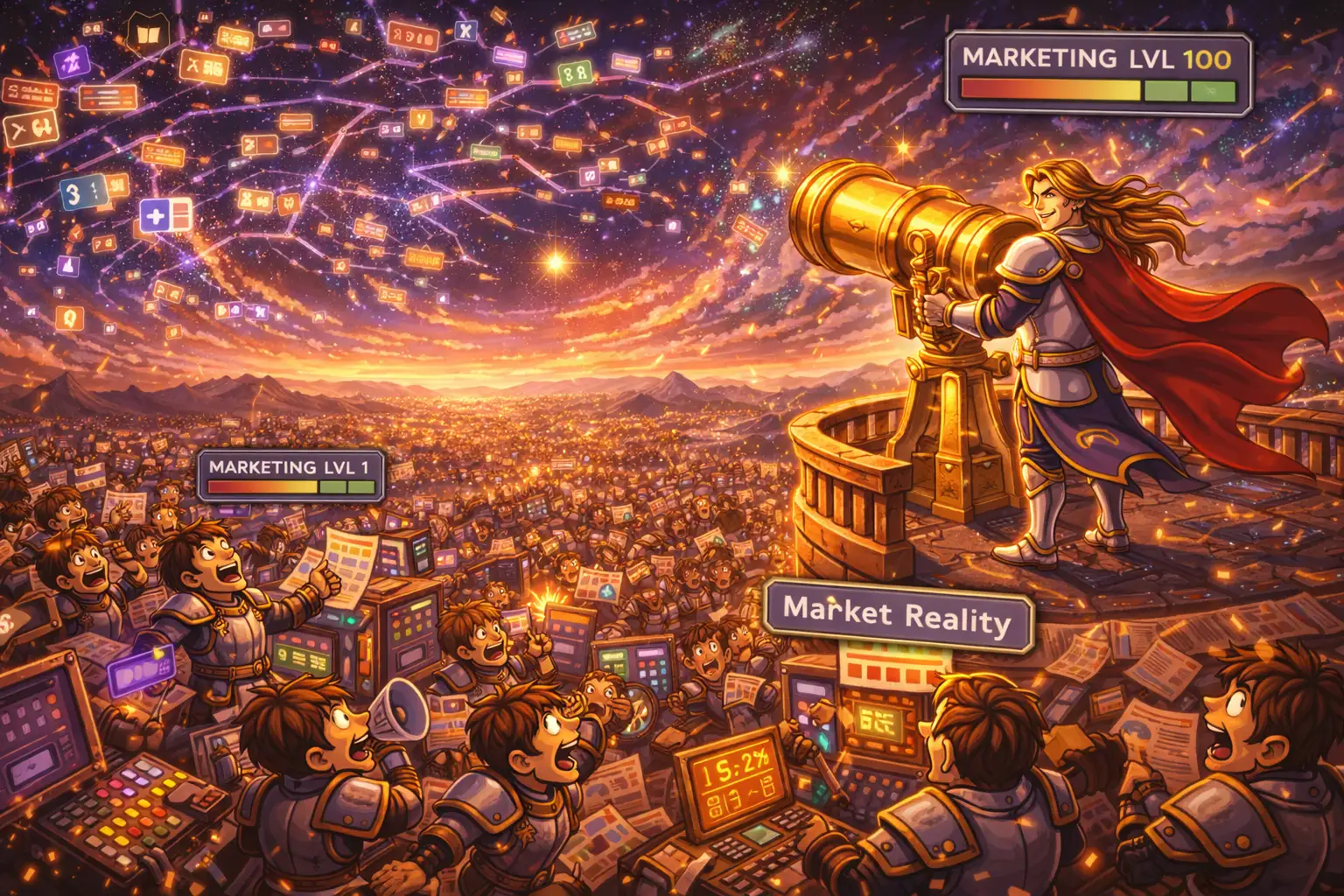
     

    Editorial illustration showing an alpha marketer seeing patterns, opportunities, and market signals that weaker marketers miss.

    Alpha marketers create leverage by seeing what the rest of the market fails to notice.


    10. The Marketers I Pay Attention To

    If you want to improve as a marketer, one of the most useful habits you can build is learning to pay attention to people who are clearly operating at a higher level than the industry average. That is true in every serious profession, and marketing should be no different. Over time I have built a habit of following marketers whose work consistently cuts through the clutter, earns attention on merit, and translates that attention into something commercially meaningful. What makes them useful to study is not that they all do the same thing. It is the opposite. They sell different products, think in different ways, and win through very different forms of execution, which is exactly why they are worth paying attention to.

    A lot of younger marketers, and a lot of managers supervising mediocre teams, end up learning from the wrong sources. They absorb frameworks from generic agency blogs, low-grade thought leadership, or content written primarily to generate leads rather than to teach anything real. I would rather study people whose work already demonstrates the qualities this article is arguing for: originality, clarity, strong execution, a clear point of view, and a track record of building things that keep earning attention long after publication. These are some of the people I pay attention to.

    • Rand Fishkin is worth following because he has spent years explaining how internet systems actually behave rather than repeating the comforting myths marketers tell themselves about them. Whether he was doing that through Moz in the SEO era or through SparkToro in audience research and zero-click analysis, the common thread has been intellectual honesty. He is unusually good at taking a system most people describe badly, stripping it back to what is actually happening, and explaining the commercial implications clearly enough that other marketers can adjust their thinking. That matters because attention increasingly goes to the people who can tell the truth about the platform before everyone else catches up, and Fishkin has built a durable reputation by doing exactly that.
    • Tim Soulo is one of the clearest examples of what happens when a company decides to build educational resources that are genuinely useful instead of flooding the web with generic SEO content. What Ahrefs has done under his leadership is not simply publish articles. It has built intellectual infrastructure for the industry. Their best work becomes reference material because it is deeper, more practical, and more durable than the average content produced by SaaS marketing teams, which is worth studying because it shows what happens when a brand chooses authority over volume and long-term trust over content churn.
    • Darren Shaw stands out because he built authority in local SEO through reliability and depth rather than noise. Local search is full of contradictory advice, recycled assumptions, and anecdotal claims dressed up as certainty, yet his work through Whitespark repeatedly brings structure and evidence to the conversation. That makes him valuable to follow because he demonstrates a version of alpha marketing that is less about being loud and more about becoming the source the rest of the market refers back to when it needs clarity, which in a noisy field is a very serious competitive asset.
    • Tycho Luijten is someone I pay attention to because he and his team understand that apathy is defeated by execution that actually deserves attention. Their work is well produced, well lit, sharply acted, and built around ideas that feel native to the internet rather than bolted awkwardly onto it. That matters in B2B especially, where a great deal of marketing is still painfully forgettable. What I admire is not just the polish. It is the willingness to do more work than the average marketer is prepared to do in order to make the message entertaining, memorable, and socially portable, which is exactly the kind of thinking that separates alpha marketing from the safe, forgettable content most brands produce.
    • Jeremy Moser is worth following because he consistently ties content, authority, and backlink strategy back to commercial outcomes rather than vanity metrics. A lot of SEO commentary still treats ranking, traffic, and publishing volume as though they were the end of the story. His work is more useful because it keeps returning to the harder question of how authority compounds and how visibility connects to revenue. In a part of the industry that is full of thin advice and recycled listicles, that commercial discipline stands out.
    • Ryan Law is someone I pay attention to because his work repeatedly moves past tactical chatter and into the systems that actually shape how marketing works inside companies. He is very good at making crowded topics interesting again by approaching them through clearer thinking, stronger structure, and more useful distinctions than the average content marketer brings to the table. That is worth studying because it shows that originality in marketing is not always about inventing a new channel or tactic. Sometimes it is about understanding the same material more deeply than everyone else and expressing it in a way that actually helps people think.


    The pattern worth studying

    What these marketers share is not a single channel, a single tactic, or a single style. They build things that solve real problems, teach something useful, or earn attention on merit, and their work generally travels further, lasts longer, and creates more trust than the average marketing content filling the web because it is built by people who understand their craft deeply enough to produce something that does not feel disposable. That is the standard I would urge younger marketers to study and that I would urge leaders to look for when they are deciding whose voice deserves weight. If you want better models, follow people whose work would still be worth consuming even if it did not contain a single sales pitch.


    11. How To Recognize an Alpha Marketer

    After everything discussed in this article, a practical question naturally follows: how do you actually recognize an alpha marketer in the real world? The answer is rarely found in a resume bullet point, a polished deck, or a certification badge. It appears in how someone thinks about problems, what they care about when performance is discussed, and whether their instinct is to move the conversation toward commercial reality or away from it.

    One of the clearest signals is the metric they instinctively care about first. Alpha marketers are ultimately thinking about revenue, demand, and the commercial outcomes that keep a business alive. They know, whether they say it elegantly or not, that their job is to help the business create customers and bring money into the bank. Peter Drucker’s line that the purpose of business is to create a customer remains useful here because it forces marketing back toward its real obligation. Strong marketers will happily discuss channels, creative, media, and execution, but they almost always frame those things as tools for creating a commercial result. If the conversation stays trapped in impressions, post volume, internal deadlines, or reporting hygiene without making its way back to revenue, trust, pipeline quality, or durable demand, you are usually looking at tactical marketing rather than alpha marketing.

    A second signal appears in the kinds of questions they ask. Strong marketers tend to step back and interrogate the situation before they rush into activity. What is the customer actually seeing when this post or advertisement appears in the feed? Why would this message earn attention instead of the dozens of other things competing with it at the same moment? What tension, desire, fear, status signal, or practical problem would make the audience care? Why would they trust this claim? Why does this deserve to rank, spread, or convert? These are not decorative questions. They are the questions that distinguish someone who is trying to understand the market from someone who is simply trying to keep a content plan moving.


    Commercial instinct is the first test

    Apathy marketers often optimize the visible machinery of marketing because it is easier to defend internally. They ask how many posts should go out each week, how quickly work can be turned around, whether a report was delivered on time, or whether campaign activity matched the plan. Alpha marketers are usually trying to answer a more important question: is this work likely to change the behavior of the market in a way that helps the business grow? That difference in instinct changes almost everything. The stronger marketer is trying to identify what puts money in the bank, what creates demand, what improves conversion quality, what strengthens trust, and what gives the business a real edge. The weaker marketer is often trying to prove that activity occurred.

    If you are trying to work out how to tell whether a marketer is good, commercially minded, or simply good at managing optics, that distinction is one of the fastest tests you can apply.

    This is also why alpha marketers tend to release, test, and refine rather than overprotect ideas inside the building. They understand that market feedback is more valuable than internal perfection. It is often better to launch something that exists, measure how people actually respond to it, and then scale or improve what proves promising than to spend months polishing work that never had a strong commercial case to begin with. This does not mean they are careless with quality. It means they understand that feedback from the market is more valuable than internal perfection.


    The questions great marketers can answer

    One practical way to evaluate a marketer is to ask them why they believe something will work and then stay in the conversation long enough to hear whether there is any depth behind the answer. Why does this content deserve to rank? Why would someone stop for this ad instead of scrolling past it? Why is this message more credible than the category average? What other creative or strategic options were considered and rejected? What assumptions could make the whole thing fail? Strong marketers usually have real answers to those questions because they have already put pressure on their own thinking before anyone else did. They can explain the trade-offs, the risks, the customer logic, and the competitive context. They are also comfortable admitting uncertainty, because marketing is probabilistic by nature and anyone pretending otherwise is usually overselling their own confidence.

    The same test applies if you are managing a team. When you ask why, do you get an answer rooted in customer behavior, commercial logic, and market context, or do you get an answer rooted in what other brands do, what a platform guide suggested, or what feels right inside the team? Alpha marketers are not immune from being wrong, but they are usually very good at showing their reasoning. They have thought through not only why an idea might work, but why it might fail and what signal would tell them to change course.


    They apply what they learn.

    A lot of people like to describe themselves as lifelong learners. The stronger signal is whether they can apply a lifetime of learning. Alpha marketers tend to absorb new ideas continuously and then test them against the real world. They update their thinking when the market changes. They are open to being wrong, open to borrowing better ideas from other disciplines, other industries, or other people on the team, and rarely so attached to a past success that they keep repeating it after the market has moved on. They are looking for better ways to solve the problem in front of them, not for excuses to keep recycling the same answer.

    That matters because passive learning accumulates information, while applied learning improves judgment. The best marketers are usually well read, culturally alert, and curious about far more than marketing. They read biographies, business history, psychology, storytelling, economics, technology, and whatever else helps them understand how people think and behave. They pay attention to entertainment, politics, fashion, memes, film, and status signals because culture shapes attention before attention shapes marketing results. That breadth of curiosity often makes them more articulate, more creative, and more useful across a team because they are not trapped inside one narrow professional vocabulary.

    They also tend to be comfortable across disciplines. A strong marketer may be creative and technical at the same time. They may understand analytics, sales psychology, product positioning, copy, media buying, and enough implementation detail to collaborate intelligently with developers, designers, salespeople, and founders. That does not mean they are the best specialist in every room. It means they are capable of translating across rooms, which is often where a great deal of business value gets created.


    They are looking for leverage, not just labor

    Another useful distinction is the way strong marketers think about effort. Average marketers often respond to uncertainty by doing more: more posts, more campaigns, more channels, more reporting, more activity. Alpha marketers usually look for leverage instead. They ask which insight, channel, message, offer, or piece of creative could produce disproportionate impact. They want to know where the market is underpriced, where attention is being misread, where the customer is underserved, or where the competition is making an obvious mistake. Once they find something that works, they push harder. Once they find something that clearly does not, they move on quickly.

    That mindset is part of why alpha marketers can feel uncomfortable inside slower organizations. They are often less interested in defending the current system than in improving it. They care about whether a strategy is right more than whether it is familiar. They may challenge the brief, question the KPI, reject the channel mix, or push back on brand rituals that are getting in the way of performance. To the wrong manager, that can look difficult. To the right manager, it looks like the behavior of someone trying to create a better result.


    A final note for leaders

    There is one final reality worth stating plainly: not every organization actually wants an alpha marketer. Some leaders prefer predictable reporting, tight process control, heavily predefined KPIs, and strategies that stay close to how they already think the business should be marketed. That is completely legitimate. It is their company, their capital, and their right to decide how the work gets done.

    But in that environment, they may not need an exceptional marketer. They may need a compliant operator who can execute a predefined system efficiently and report it back in the language leadership finds comfortable. Alpha marketers usually create the most value in environments where they are trusted to diagnose the market, shape the strategy, interpret imperfect signals, and pursue outcomes rather than merely activity targets. If that environment exists, they can be extraordinarily valuable. If it does not, their strengths will often remain underused, and both sides will end up frustrated.

    Understanding that difference can save a company a great deal of money and can save a strong marketer a great deal of wasted time.


    Rise of the Million‑Dollar Marketer

    The argument running through this article is simple: artificial intelligence will not distribute value evenly across the marketing profession. It will compress the value of average execution while dramatically expanding the leverage of the small group of operators who can actually move markets.

    For years, a large amount of marketing work survived because the effort required to produce it created the illusion that it must have been valuable. Writing content took time. Building research took time. Producing campaigns took time. AI is removing that protection. The same level of acceptable output can now be produced faster, cheaper, and at scale, which means the old defense of average work is collapsing. When average execution becomes abundant, judgment becomes the real differentiator.

    That shift changes the economics of the profession. Marketers who can identify real leverage inside a market—the ones who can diagnose demand, spot competitive blind spots, shape narratives that travel, and consistently produce commercial outcomes—will suddenly be able to operate with far more force than before. Research is faster. Drafting is faster. Testing is faster. Market analysis is broader. Execution teams move more quickly under their direction. In practical terms, that means the best marketers can influence more companies at the same time without diluting the quality of their thinking.

    I believe we will start seeing headlines very soon about individual marketers earning **more than one million dollars per year in personal take-home pay** from their work. Not from running an agency. Not from selling a company. From their direct marketing influence. Most marketers will never operate at that level, but the very best—the Ronaldos of the profession—will.

    The term million-dollar marketer will increasingly refer to individuals whose strategic influence, amplified by AI and modern tools, allows them to generate that level of personal income through direct marketing work rather than ownership or agency scale.

    The mechanism is straightforward. Instead of working inside a single organization, elite marketers will increasingly operate fractionally across multiple companies, shaping strategy while execution teams handle the operational work. Five companies. Maybe six. In some cases more. Each company gains access to elite strategic thinking that would previously have required a full-time executive, while the marketer gains leverage across multiple environments.

    This pattern already appears in other fields. Elite operators do not become less valuable when tools improve. They become more valuable because the tools amplify their advantage. The same thing happens in elite sport. When the sport globalizes, the best players do not earn less. They earn dramatically more because the world can now see the difference between average and exceptional performance. Marketing is moving into the same kind of market.

    As AI makes average marketing easier to produce, companies face a more uncomfortable competitive reality. Everyone will be able to generate respectable content, respectable campaigns, and respectable analysis. Respectable will stop being enough. In competitive markets, companies will need an edge, and that edge will come from the people who can interpret markets better than their competitors and turn that understanding into commercial movement. Those people will have options. Companies that want their expertise will have to compete for it.

    Some businesses will pay that cost directly by hiring elite marketers fractionally or compensating them at levels that previously sounded unrealistic. Others will pay the cost indirectly by losing ground to competitors who did. Either way, the economic pressure is the same. AI will not eliminate marketers. It will expose them, and the companies that understand the difference between motion and market-moving ability will be the ones that decide who the million-dollar marketers end up working for.


    Frequently Asked Questions


    >What is the difference between apathy marketing and alpha marketing?

    Apathy marketing is activity that looks organized and professionally managed from the inside but fails to create meaningful changes in attention, trust, demand, or revenue. Alpha marketing is strategic work that repeatedly produces outsized commercial outcomes across different environments and can explain why those outcomes occurred.


    Can AI replace marketers?

    AI can replace a growing amount of average marketing execution, especially work that is repetitive, generic, and easy to template. What it does not replace is judgment. The more AI compresses the value of average output, the more valuable strong strategic thinking becomes.


    Why do some marketing teams hit KPIs without growing the business?

    Because many teams are measured against activity metrics that are only loosely connected to revenue. Posting on schedule, publishing more content, or hitting traffic targets can all look impressive internally while leaving the market largely unmoved.


    How do you know if a marketer is commercially minded?

    Commercially minded marketers instinctively connect channels, content, and campaigns back to customer creation, demand, conversion quality, and revenue. They can explain how the work is supposed to put money in the bank, not merely how it satisfies a reporting framework.


    Why are the best marketers becoming more valuable in the AI era?

    Because AI makes respectable execution cheaper and easier to produce. Once that happens, respectable stops being enough. The marketers who can interpret markets better than competitors and repeatedly create outperformance become more valuable because their judgment now carries more leverage.


    Why is repeatable outperformance a better test than one big success?

    A single success can be explained by timing, market conditions, founder quality, or luck. Repeatable outperformance across different roles, industries, and constraints is much stronger evidence that the marketer, rather than circumstance alone, was part of the causal mechanism.


    Who should young marketers learn from?

    They should study operators whose work is clearly better than the market average and whose ideas continue to earn trust over time. In practice, that usually means learning from people who build durable resources, explain systems honestly, and connect their work back to real commercial outcomes rather than vanity metrics.


    Do all companies need an alpha marketer?

    No. Some companies want tightly controlled execution, predictable reporting, and strategies that stay close to leadership’s existing view of the market. In those environments, a compliant operator may be a better fit than an exceptional strategist. Alpha marketers create the most value where they are trusted to diagnose the market and shape the strategy around outcomes rather than activity targets.


    Sources and Further Reading

    AI and Content Production

    • Ahrefs — Marketers using AI publish more content — source for the figures on AI content adoption, publishing volume, review behavior, and lower production cost.

    Economics of Superstar Markets

    Attention Economy Data

    Attribution and Marketing Measurement

    Marketing Thought Leadership Referenced

    • Peter Drucker — selected writings and quotations — referenced for the line about the purpose of business being to create a customer.
    • Seth Godin — How to be remarkable — referenced for the argument that work must be remarkable enough to deserve attention.

    Notes on Methodology

    This article combines public research with long‑form editorial analysis based on professional experience working with marketing teams across multiple industries and international markets. The goal is not to present a single framework, but to synthesize observable patterns in marketing performance during the early AI era.

    The Aggregation Shift: Why AI Reshuffles the Marketing Value Chain

    Ben Thompson’s aggregation theory holds that durable business value accrues to whoever controls the relationship with the end user, because that control allows the aggregator to extract value from both sides of a market without being exposed to the costs of either. Applied to marketing, the theory predicts exactly the current moment: AI tools are disaggregating the value chain that gave marketing agencies their position between client and audience, and the marketers who survive will be the ones who find a new aggregator position in the reconfigured chain rather than defending the one that AI is dissolving.

    The old marketing value chain had two sources of defensible margin. The first was production cost: creating good-quality content required time, skill, and equipment that created genuine barriers to entry. The second was distribution access: knowing which channels worked for which audiences was tacit knowledge that took years to accumulate and couldn’t be quickly replicated. AI tools are compressing both. Production cost for competent content is approaching zero. Distribution access is being democratized through AI-powered analytics that can identify effective channels in days rather than years. The mediocre marketers who extracted margin from production cost and distribution expertise are watching both erosion events happen simultaneously.

    The marketers who are not being disrupted have something AI tools cannot easily replicate: the ability to understand what an audience actually needs before they know they need it. That capability requires genuine domain knowledge — not marketing knowledge, but knowledge of the specific audience’s problems, language, values, and decision processes. Friction is the silent churn driver in any product, and the marketers who can identify friction before it surfaces in churn data are the ones who understand the user at a level that precedes the metric. AI tools are excellent at optimizing toward a specified objective. They are not yet good at identifying whether the specified objective is the right one. That judgment requires domain knowledge that is hard to specify and impossible to fully capture in training data.

    The Chinese AI open-source push through DeepSeek and Qwen is accelerating this disruption by reducing the cost of AI marketing capability to near-zero. The CMO who was comfortable spending $200K per year on a content agency to produce competent-but-not-exceptional material now has a credible AI alternative at a small fraction of that cost. The agency that delivers competent-but-not-exceptional material on a production cost basis is now competing with a zero-marginal-cost substitute. The agency that delivers exceptional judgment on strategy, positioning, and audience insight — and uses AI tools to execute faster — is in an entirely different competitive position. The market is separating those two categories in real time, and the separation is accelerating.

    The enterprise AI adoption trajectory reveals the same pattern at the organizational level. The enterprises capturing the most measurable value from AI tools are not the ones that deployed AI across all marketing functions simultaneously. They are the ones that identified the specific workflows where AI capability exceeded the human baseline — content scaling, A/B testing, audience segmentation, personalization at scale — and concentrated AI deployment there while preserving human judgment in the functions where the baseline could not be reliably replicated. That targeted deployment approach requires the organizational judgment to distinguish between tasks where AI replaces human work and tasks where AI augments it. Most enterprises have not yet developed that judgment, which is why the measured gains from AI deployment in marketing are so unevenly distributed across companies that are, on paper, making similar investments.

    The corporate buyback signal is relevant here as an indirect proxy. US corporate capital return in 2026 is at record levels, which means that organizations with surplus cash are choosing to return it rather than invest it in marketing and growth. That is a signal that the expected return on incremental marketing spend is below the cost of capital for many companies — that more spending is not expected to produce more growth. AI marketing tools offer a different value proposition in that environment: not higher spending toward the same return, but the same or lower spending toward a higher return through better targeting and reduced waste. The enterprises that learn to extract that efficiency are accumulating a cost-structure advantage that compounds as AI capabilities improve.

    The Algebra of Disruption: Why AI Concentrates Marketing, Not Democratises It

    Scott Galloway’s framework for evaluating technology disruption identifies a pattern that is systematically misrepresented in tech journalism: the technologies marketed as democratising forces almost universally operate as concentrating forces once they mature. The printing press democratised the ability to produce text and concentrated the influence of the most compelling writers. Social media democratised the ability to publish and concentrated attention around the small number of creators who understood distribution better than anyone else. AI in marketing is following the same trajectory precisely.

    The attention economy constraint that AI does not change is the key variable: the supply of human attention is fixed while the supply of AI-generated content is approaching infinity. When content supply was artificially scarce, mediocre content could still capture attention through the mechanism of being present. When content supply is unbounded, mediocre content is filtered out before it reaches anyone. AI removes the scarcity that was previously protecting mediocre marketers from the consequences of their mediocrity.

    What rigorous alpha marketing actually looks like becomes the discriminating variable: the ability to generate an original insight about audience psychology or market structure, and then deploy AI tools to execute against that insight at scale, is rarer and more valuable than it was before AI. The tactical layer — copywriting, visual production, A/B test generation — is now essentially free. The strategic layer — identifying which insight is worth executing — has zero commoditised substitute. When execution cost approaches zero, insight becomes the entire source of competitive advantage.

    The attribution challenge deepens as AI expands attribution data. More channels, more touchpoints, and more AI-generated content create more attribution noise, not less. The marketers who will extract value from AI-expanded attribution are the ones who understood attribution structure before AI added complexity to it. The ones who were already confused now have access to more things to be confused about.

    The Web3 marketing mirage is an early case study for what AI-augmented mediocre marketing looks like in practice: more volume, more channels, more metrics, same absence of genuine audience insight. AI generates the additional content; the underlying problem — no clear understanding of who the audience is or what they actually want — is unchanged and unaddressed by the tooling.

    The restructuring wave at Cloudflare, Coinbase, and comparable companies is the empirical signal Galloway would point to: firms that understand AI’s concentrating dynamics are eliminating mid-tier marketing roles while retaining or expanding their highest-capability positions. That is not AI democratising the marketing function. It is AI concentrating it around the top decile.


  • AI Jobs Review: 300 Million Roles at Risk, but Distribution Matters More

    AI Jobs Review: 300 Million Roles at Risk, but Distribution Matters More

    The “300 million jobs at risk” line became the headline because it is dramatic, but it is not the whole argument. The harder and more useful question is whether AI-driven productivity gains, wage pressure, and retraining capacity arrive in the same places at the same speed.

    The real risk is distribution. AI can improve output and still leave workers worse off if companies capture the gains faster than institutions, managers, and labor markets adapt. So this is not just a threat-versus-opportunity debate. It is a transition problem about power, bargaining strength, and who keeps the upside when the work changes.


    A Double-Edged Sword: Disruption and Productivity

    AI’s impact on employment is often described as a double-edged sword. On one edge, AI threatens to automate tasks at an unprecedented scale. A 2023 analysis by Goldman Sachs estimated that generative AI advances (like ChatGPT) could “expose” 300 million full-time jobs to automation worldwide. Around two-thirds of occupations in the U.S. include tasks that could be at least partially automated by AI, and up to half of the work within those roles could technically be handled by machines. These numbers suggest a level of disruption that rightly grabs headlines.

    Yet the other edge of the sword is sharper than many realize: productivity and augmentation. AI may take over tasks, but that doesn’t always equate to taking over entire jobs. In fact, Goldman’s report was quick to note that “most jobs and industries are only partially exposed to automation and are thus more likely to be complemented rather than substituted by AI.” In other words, for the majority of occupations, AI will handle certain duties, allowing humans to focus on the rest. History supports this pattern. Technological revolutions tend to reallocate work rather than simply destroy it. For example, automated teller machines famously reduced the number of routine bank teller tasks but did not eliminate bank teller jobs, instead, human tellers shifted to more customer service and sales-oriented duties, and bank branches actually increased in number after ATMs were introduced. Each wave of automation has spurred fears of mass unemployment, and each time the economy has eventually adjusted, albeit not without pain in the transition.

    Recent data offers a cautiously optimistic view that this adjustment will happen again with AI. The World Economic Forum’s Future of Jobs analysis in 2020 predicted that while 85 million jobs may be displaced by automation by 2025, about 97 million new jobs could emerge, a net gain of jobs. Likewise, as of 2023, nearly 75% of companies surveyed plan to adopt AI, yet half of them anticipate it will create overall job growth in their firm, whereas only a quarter expect a net loss of jobs. This doesn’t mean the same jobs will remain; it means new roles and industries will arise. In the past 80 years, over 85% of employment growth in the U.S. came from the creation of entirely new occupations that technology made possible. As one study notes, about 60% of workers today are employed in occupations that did not exist in 1940 . From web designers to app developers and digital marketers, none of these roles would have been fathomed by our great-grandparents. AI could similarly spawn jobs we can barely imagine now.

    So, the promise is that AI-driven productivity gains will open doors even as it closes others. In pure economic terms, Goldman Sachs predicts AI could boost global GDP by 7% (almost $7 trillion) over the next decade. Productivity growth of that magnitude should create new wealth and, historically, new demand for labor in areas where humans are still needed. As Bridgewater founder Ray Dalio frames it, technology is a “two-edged sword”: it will raise output and efficiency, meaning we might not need to work as many hours for the same results, but it also raises a critical question of distribution. If a company can do twice the work with half the people thanks to AI, who benefits from that efficiency? Dalio observes that without careful societal management, the gains might accrue to a small group (e.g. tech owners and investors) while many workers feel the blade’s cut in the form of lost jobs or stagnant wages. In his words, AI is both a “super plus for productivity” and a “divider in who benefits and who doesn’t,” making it a social question as much as an economic one. The challenge ahead is ensuring the tailwind of AI’s progress isn’t overcome by the headwinds of inequality and social upheaval.


    Not Our First Rodeo: Lessons from Past Revolutions

    To understand what’s coming, it helps to step back and recall previous technological upheavals. The Industrial Revolution of the 18th–19th centuries mechanized physical labor, from weaving looms to steam shovels. Many manual jobs vanished, yet new industries – textiles, railroads, manufacturing – exploded. The 20th century’s automation and computer revolution again shifted the picture: farm labor plummeted as tractors arrived, but factories and service sector jobs grew; later, assembly-line work declined while entirely new fields in computing and information rose. Each era of disruption created new kinds of work even as old kinds faded.

    A key insight from economists is that humans are not horses. When automobiles and tractors debuted, the population of working horses collapsed (from 26 million in the U.S. in 1915 to only a few million by the 1950s), a horse can’t retrain to become a truck driver or a factory worker. Humans, by contrast, can learn and adapt. As one example, the rise of automobiles didn’t just put blacksmiths and carriage drivers out of work; it spawned entire new categories of employment that would have sounded like science fiction in 1900. “The horse-and-buggy drivers’ jobs were all gone,” notes economist Harry Holzer, “but the number of jobs that opened up in the auto industry… produced not just new categories of jobs, but enormous new numbers of jobs.” From assembly-line workers to auto mechanics, highway planners, motels, drive-thru restaurants, the car reshaped the economy in ways no one predicted. Similarly, when ATMs and online banking emerged decades later, pundits predicted bank tellers would disappear; instead, teller roles evolved and banks shifted employees into relationship-based roles (like financial advising and sales), and the banking sector continued to grow . The takeaway is that we’ve been here before, though perhaps not at this speed. AI is often dubbed the engine of a “Fourth Industrial Revolution”, one that may ultimately dwarf the previous ones in scope. You can already see this broader pattern in blockchain-powered supply chains and sustainability projects, such as our analysis of VeChain’s role in real-world logistics and emissions tracking. But as we face it, we carry the lessons (and scars) of past disruptions. One lesson is the importance of time. Past transitions often took decades for society to adapt. There was pain: old industries in decline, workers needing reskilling or suffering unemployment, and social unrest (think of the original Luddites, textile workers who smashed mechanical looms around 1811 in protest of job loss). Over time, however, new generations entered a labor market with entirely new assumptions and opportunities. The children of farmers became factory workers; the children of factory workers became programmers; each generation encountered a changed world of work.

    Will the AI revolution be faster and more jarring? Quite possibly. Unlike mechanical inventions that replaced muscle, AI targets the cognitive realm, the “white-collar” office jobs and even creative and decision-making tasks once seen as uniquely human. That broad reach has some experts concerned that this time could be different, compressing the upheaval into a shorter window and climbing the skill ladder. A recent study by OpenAI and University of Pennsylvania researchers found that a surprising range of jobs may be heavily affected by generative AI, not just routine clerical work, but roles like accountants, financial analysts, legal assistants, journalists, translators, and even software developers could see a large share of their tasks automated . Unlike past automation which hit factory workers or bank clerks first, this wave is intruding into work that requires a college education.

    However, even this has a precedent of sorts. When personal computers and the internet arrived, they dramatically changed office work, yet also created whole new occupations (IT managers, web admins, digital marketers) and boosted demand for high-skill workers (specialized developers, crypto lawyers, etc..). Many experts thus believe that, while AI will be profoundly disruptive, humans are unlikely to face a total “job apocalypse” in the near future . We will see churn: certain jobs declining, others growing. In fact, the World Economic Forum’s latest forecast for the next five years highlights this churn. Among the fastest declining roles due to AI and other trends are clerical jobs such as data entry clerks, secretaries, and bank tellers, positions involving routine paperwork and organization . By contrast, the fastest growing job titles are those like AI and machine learning specialists, data analysts, information security analysts, and digital transformation specialists, all expected to see demand surge by 30–40% (adding millions of jobs globally) . The economy is essentially reallocating work toward tech-centric and human-centric roles. The real question is not if enough new jobs will emerge, history suggests they will, but whether those losing jobs can transition into the new jobs readily, or whether we face a prolonged period of skill mismatches and social strain as the workforce adjusts.


    Humans + AI: Augmentation, Not Annihilation

    One hopeful path forward is to view AI not as a replacement for humans, but as a powerful tool to augment human productivity. In the phrasing popular among technologists: AI won’t necessarily replace you, but a person using AI may replace a person who doesn’t. Already, forward-thinking professionals are finding that partnering with AI can make them far more effective at their jobs. Consider some recent empirical findings:

    • Customer Support Augmentation: At a Fortune 500 software company, giving customer service agents an AI assistant (a tool that suggested responses and resources) boosted their productivity by 14% on average . Interestingly, the biggest gains were seen among junior or less-skilled workers, who with AI help could perform almost as well as more experienced agents . The AI leveled up their communication skills and knowledge, essentially compressing the learning curve. Rather than replacing support reps, the AI made each rep more productive and effective, a clear case of complementarity.
    • Faster (and Better) Writing: In another study, professionals in fields like marketing and HR were asked to use ChatGPT to help with writing tasks (drafting press releases, reports, emails). The result: those using the AI completed their tasks 40% faster than those who didn’t, and independent evaluators rated the AI-assisted work as 18% higher in quality on average . The AI acted like an on-demand editor and brainstorm partner, handling routine prose or giving suggestions so that the human could refine and add the final creative touch.
    • Freeing Up Higher-Level Work: Across multiple industries, workers report that AI tools are taking over menial parts of their job, freeing them to focus on more strategic or creative aspects. In a global survey, 93% of employees who actively use AI said it allows them to focus on higher-value tasks like problem-solving, strategy, and relationship-building . Rather than feeling threatened, these workers felt empowered, the tedious parts of their work (sorting data, initial drafting, routine analyses) could be offloaded to algorithms, giving them more time for decision-making and innovation.
    • Closing Skill Gaps: AI can also democratize expertise. The customer support example showed novices improved with AI aid. Another case is language translation, AI translation services can enable a businessperson who speaks only English to communicate with a client in Mandarin or Spanish, roughly bridging a skill gap that once required a human translator. While this does pose challenges for professional translators, it also opens opportunities (smaller companies can now do international business without hiring large translation teams, for instance). In general, when AI handles the heavy lifting of knowledge (scanning databases, generating boilerplate content, analyzing trends), it allows non-specialists to achieve results closer to specialists. This can raise overall productivity and potentially create new roles where human judgment plus AI output is what matters.

    Crucially, these examples highlight task automation rather than job automation. AI excels at specific tasks: crunching numbers, coding to a specification, generating text or images based on patterns, recognizing patterns in data. But most jobs are an amalgam of dozens of tasks, not all of which are easily automated. Many involve complex human interaction, tacit knowledge, and adaptability. As economist Harry Holzer emphasizes, the future likely won’t be black-and-white where an entire occupation is suddenly done by AI; instead, “every year, AI will get a little better and will replace human work on a certain set of tasks… and if a worker wants to keep their job, they will have to pivot to a different set of tasks that the machine cannot yet do.” In practice, this means continuous learning and adaptation will be the name of the game. The most resilient workers (and companies) will be those who constantly update their skill sets and redefine roles in partnership with AI.

    We’re already seeing the emergence of entirely new job categories centered on working with AI. For instance, companies are hiring “prompt engineers”, people who specialize in crafting the right queries and instructions to get the best results from AI models . Roles like AI ethicist, machine learning auditor, or data curator are popping up to ensure AI systems are fair and effective. Professional services firm Accenture suggests breaking down existing jobs into their component tasks to identify which tasks can be done by AI and which require humans, then upskilling employees to work alongside AI for the best outcomes . By doing so, organizations can redesign jobs in a way that maximizes human-AI collaboration, for example, a customer service job might be reimagined as “AI handles basic inquiries and paperwork; human agents focus on complex cases and empathetic connection with customers.” In fact, Accenture estimates that 65% of the time we currently spend on “language tasks” (reading, writing, communicating) could be transformed into more productive activity through AI augmentation . That implies huge efficiency gains if workers are trained to take advantage of AI.

    Far from rendering humans obsolete, AI could make human qualities more essential. A striking finding from a 2025 Workday research report: 83% of workers believe AI will actually elevate the importance of uniquely human skills like creativity, empathy, and leadership . The logic is that as AI handles the straightforward or analytical parts of work, the relative value of human insight and interpersonal skills goes up. Indeed, the skills considered least likely to be automated – things like ethical judgment, emotional intelligence, and conflict resolution – are the very skills many organizations now say are the most valuable in employees . Let AI crunch data; humans will design better questions and interpret the nuances. Let AI draft the report; humans will add strategic context and empathetic storytelling. This vision is essentially saying: the future of work is humans and AI working in tandem, each focusing on what they do best. It’s a “centaur” model (to borrow a term from chess, where human–computer teams proved stronger than either alone) applied to every industry. As one tech CEO put it, “By embracing AI for good, we can elevate what makes us uniquely human, our creativity, our empathy, our ability to connect, and build a workplace where these skills drive success.”


    Navigating the Transition: Challenges and Strategies

    Even with a fundamentally hopeful outlook, we must manage a potentially rocky transition. The benefits of AI will not be evenly distributed unless we make them so. Without conscious action, we risk exacerbating inequalities – between those who have the skills or capital to harness AI and those who don’t, and between different demographic groups. A 2023 McKinsey report noted that AI’s automation effects might hit some workers harder than others: roles in office support, customer service, and food service (often lower-paying jobs) are among the most likely to be displaced, and these roles disproportionately employ women and underrepresented minorities . On the flip side, high-skill roles may be more augmented than automated in the near term , meaning well-educated workers could see productivity increases and wage premiums, widening the skill gap. This pattern isn’t new – globalization and past tech booms had similar effects – but AI could intensify it by reaching further into the middle class. Society will need safety nets and bridges: policies to support those displaced and help them retrain into new careers, alongside stronger security and governance standards for the infrastructure we increasingly depend on.

    Policymakers and thought leaders are actively debating solutions. One bold idea gaining traction is the implementation of a universal basic income (UBI), a no-strings-attached regular payment to all individuals, meant to ensure basic livelihood even if traditional jobs are scarce. The logic is to decouple income from employment, at least partially, in an age where machines create tremendous wealth with less human labor. As a 2025 London School of Economics review notes, “a new social contract is needed to make sure technological progress and human welfare advance together, not at each other’s expense,” and UBI is a promising avenue to achieve that . Trials of UBI around the world (from Finland to Kenya to U.S. pilot programs) have shown it can reduce poverty and stress, though funding such a program at scale remains a challenge . UBI is not a panacea; critics argue it might disincentivize work or prove fiscally unsustainable. However, even tech luminaries in Silicon Valley have endorsed it as a potential buffer if AI truly upends the labor market. Whether through UBI or other means, what Dalio called for seems likely, a “new type of social contract” may be needed , one that might include shorter work weeks, re-skilling stipends, job transition programs, or profit-sharing models to ensure the AI dividends don’t just enrich a few.

    For businesses and entrepreneurs, there is also a strategic imperative: adapt or fall behind. Just as companies that ignored the internet in the 2000s were left in the dust, organizations that ignore AI risk obsolescence. But embracing AI is not simply about automating for cost-cutting; it’s about reimagining work to amplify human creativity and insight.. Smart companies are already reorganizing teams to maximize human-AI collaboration – for example, pairing domain experts with data scientists and AI specialists, or training all staff on basic AI tool use. They are also revisiting their hiring: instead of replacing departing employees with similar profiles, forward-looking firms are asking, “Can we hire someone with AI expertise, or someone with exceptional interpersonal skills, to complement what our algorithms do?” The future belongs to organizations that can harness the best of both worlds – the speed and scale of AI and the flexibility and empathy of humans.

    From an individual perspective, everyone in the workforce can take proactive steps to thrive in the AI era. Here are a few strategies experts recommend, echoing the insights of tech visionaries and futurists:

    • Embrace Lifelong Learning: Treat your career as a continuous learning journey. Update your skills regularly through online courses, workshops, and self-directed projects. Learning how to learn is itself a key skill – those who can rapidly pick up new tools (like the latest AI platform) will stay ahead . Don’t be afraid to venture outside your comfort zone; a marketing professional might learn some basics of data analytics, or a finance analyst might pick up some programming. Breadth can be as important as depth when roles are evolving.
    • Use AI as Your Assistant, Not Your Enemy: Identify AI tools that can make your work more efficient or creative, and master them. Writers are using AI for brainstorming ideas and drafting content; programmers use AI to generate and debug code; salespeople use AI to prioritize leads or personalize outreach. By being the person in your team who is adept with these tools, you make yourself more valuable, not less . This might mean investing time to experiment with AI APIs, generative art programs, or whatever is emerging in your field. Remember that AI is a tool – just as spreadsheets didn’t eliminate accountants but made math faster, AI can handle grunt work and amplify your impact.
    • Cultivate Uniquely Human Skills: Double down on the skills AI can’t easily replicate. These include empathy, communication, leadership, teamwork, creativity, and critical thinking. In an AI-rich workplace, your ability to build trust with a client, motivate a team, or come up with an out-of-the-box strategy will set you apart. As one workforce study found, skills like relationship-building, ethical judgment, and conflict resolution are seen as critical for success in an AI-driven economy . Such skills are harder to quantify on a resume, but they shine through in interviews and on the job. Look for opportunities to develop them – whether through public speaking (to hone communication), volunteering or mentoring (to build empathy), or simply soliciting feedback and self-reflection to improve your emotional intelligence.
    • Stay Agile and Open to Change: The career ladder of the past (a linear climb in one field) may give way to a “career lattice” – lateral moves, periodic career changes, and hybrid roles. Be open to pivoting as your industry changes. If AI threatens to automate many tasks of your current role, proactively seek the next iteration of your role. For instance, some graphic designers are learning AI image generation tools and rebranding as “AI-assisted designers” rather than competing with algorithms . Many journalists now use AI for research or even to generate basic articles, focusing their energy on high-level analysis and investigative pieces. Don’t cling to a static job description – think in terms of your talents and how they can be applied in new ways.
    • Focus on the Big Picture (Problem-Solving and Strategy): AI can provide data and options, but humans still excel at defining which problems should be solved and why. Developing your strategic thinking will make you the person who can see the forest when everyone else sees trees. This might involve learning about domains outside your specialty, understanding business fundamentals, or improving your decision-making frameworks. As AI handles micro-tasks, humans will add most value in macro-judgments. For entrepreneurs especially, the ability to envision how to use AI to create value – identifying unmet needs and imagining new solutions – will be gold. Entirely new business models will emerge from creative applications of AI (just as the internet gave us companies like Uber or Airbnb that reimagined existing services). Train yourself to ask, “How can AI X be used to solve problem Y in my community or market?” The answers could be the seeds of a new venture.


    A New Age of Work: Threat or Renaissance?

    Standing at this crossroads, it’s clear that AI will fundamentally reshape the future of work. But whether that future is one of widespread prosperity or deepening inequality depends largely on human choices – in business strategy, in government policy, and in individual mindset. Yuval Noah Harari’s warning of an AI-induced “useless class” is a provocative cautionary tale , but it is not an inevitable destiny. It’s a call-to-action to ensure we don’t let millions of people fall by the wayside. We must remember that technology’s impact is not deterministic; it’s guided by how we deploy it and the standards we build around it to signal trust, transparency, and accountability. AI might end the era of some jobs, but it could also liberate us from work we hated and open up time and resources to focus on what we find meaningful. As one tech optimist noted, the narrative around AI doesn’t have to center on fear – “we see it as an incredible opportunity… to build a future that prioritizes skills like empathy, ingenuity, and our shared humanity.” In this telling, AI is less a terminator of jobs and more a transformer – terminating tasks that bog us down, while helping us redefine work itself toward something more creative and human-centric.

    Getting to that hopeful outcome will require intentional effort. It will require leadership with vision – in companies, to invest in people even as they invest in technology; and in governments, to update education and social support for a new reality. It will require that we, the workforce, embrace change rather than resist it, much as uncomfortable as it can be. And it will demand a willingness to experiment with new ideas (like UBI or novel education models) to ensure no one is left behind. In short, the age of AI could be a perilous time of displacement or the dawn of a new renaissance of human potential. The deciding factor is not AI’s code, but our collective wisdom in wielding it.

    As we work through this transition, perhaps the most important thing to hold onto is the essence of what work provides beyond a paycheck: purpose, connection, growth. If AI takes over mundane tasks, we have an opportunity to reorient work around these human needs. We may find ourselves with more time to solve hard problems, to care for each other, to chase curiosity, or to simply live our lives outside of work. The optimists dare to envision a future where technological abundance gives rise not to idleness, but to a flourishing of human creativity and well-being. The road to get there is undoubtedly challenging – but it is a future worth striving for.

    In the words of an ancient proverb often cited in times of great change: “The best time to plant a tree was 20 years ago. The second-best time is now.” The AI revolution has already begun; the best time to prepare was yesterday, but the next best is today. By understanding the forces at play and actively shaping them, we can ensure that AI augments humanity rather than diminishes it. The story of work has always been one of adaptation. This chapter may be the most dramatic yet – but with wisdom and will, it can also be one of our finest, unleashing human talent as never before.


    Who Gains, Who Loses in the AI Jobs Shift?

    When people ask whether AI will steal our jobs, they are often really asking a more specific question: whose jobs? Recent research suggests the impact will be uneven. Advanced economies, where a large share of work is knowledge and service based, are more exposed than lower-income economies that still rely heavily on manual and agricultural labour. Some studies estimate that around 40% of jobs in advanced economies could be affected by AI in some way, compared with closer to 25% in many emerging markets.

    Within countries, the picture is also mixed. Roles with a high share of routine, predictable tasks—think data entry, basic customer support, office admin, and some types of production and food service—are highly exposed to automation. At the same time, mid- and high-skill white-collar roles in finance, law, software development and media are seeing a different pattern: not full replacement, but heavy task-level automation and pressure to adapt quickly. AI eats the most repetitive parts of these jobs while boosting the productivity of those who learn to use it well.

    There is a growing worry about entry-level work in particular. Surveys of business leaders show many are already using AI to reduce headcount in junior and clerical roles, which can make it harder for young people and career-changers to get that crucial first step on the ladder. At the same time, international organisations highlight a new kind of “AI divide”: workers and regions with access to capital, connectivity, and training are able to ride the AI wave, while others risk being left behind, just as we see uneven regulation and adoption in digital assets and blockchain across markets like South Korea and beyond.

    In other words, the question is less “Will AI eliminate work for everyone?” and more “Who will be empowered by AI, and who will be squeezed?” That is why policy discussions now focus not just on job counts, but on job quality, wage effects, bargaining power, and the strength of safety nets. If societies invest in reskilling, education, and fairer distribution of AI’s gains, the technology can be a net positive. If they don’t, the same tools that boost productivity could deepen inequality.


    FAQ: AI, Jobs, and the Future of Work

    Will AI steal our jobs?

    AI is far more likely to steal tasks than entire jobs. Major studies from banks, international organisations and think tanks all point in the same direction: millions of roles will be disrupted, and some will disappear, but most jobs will be reshaped rather than wiped out. New occupations and industries will also emerge as AI lowers the cost of creating products and services.

    How many jobs could AI impact?

    Estimates vary, but they are all large. Some analyses suggest that hundreds of millions of full-time roles worldwide are “exposed” to automation in the sense that a significant share of their tasks could be done by AI. Others forecast that around 40% of jobs in advanced economies will be affected in some way, from partial task automation to full redesign of the role.

    Which jobs are most at risk from AI?

    Jobs built around routine, repeatable tasks are most vulnerable. This includes many clerical and administrative roles, basic customer service and call centre work, some back-office finance tasks, and parts of manufacturing, logistics and food service. In these fields, AI and software can take over large chunks of the workflow with minimal human oversight.

    Which jobs are AI likely to create or strengthen?

    AI is already creating demand for machine learning engineers, data scientists, AI product managers, prompt engineers and AI ethics or compliance specialists. It also strengthens hybrid roles such as AI-assisted designers, analysts who pair domain expertise with AI tools, and managers who can orchestrate human-AI collaboration inside teams.

    How can I future-proof my job against AI?

    The strongest strategy is to learn to work with AI rather than against it. That means building fluency with the tools in your field, while doubling down on uniquely human strengths—communication, leadership, empathy, creativity, critical thinking, and ethical judgment. Workers who can combine domain expertise, soft skills and AI literacy are best positioned in almost every scenario.

    What are governments and organisations doing to manage AI’s impact on jobs?

    Policy proposals range from large-scale reskilling programmes and stronger unemployment protection to tax reforms and, in some countries, experiments with universal basic income. Many international bodies argue that the focus should be on helping workers transition into new roles, not on freezing technology in place, and on ensuring AI’s gains are shared broadly rather than captured by a small minority.

    Sources:

    • Harari, Yuval Noah. The Guardian, AI’s threat of a “useless class”
    • Goldman Sachs Economic Report, Generative AI’s impact on jobs and productivity
    • World Economic Forum, Future of Jobs Report 2023, Emerging vs. declining roles, and AI adoption outlook
    • Chicago Booth Review (2023), Synthesis of AI labor market studies and historical data
    • Dalio, Ray (2023 interview), Perspective on productivity vs. inequality from AI (Moonshots Podcast)
    • Brynjolfsson et al. (2023), Study on AI assistance boosting customer support productivity
    • Noy & Zhang (2023), Experiment on ChatGPT improving writing efficiency and quality
    • Accenture Analysis via WEF, 40% of work hours impacted by LLMs, need for reskilling and task redesign
    • Workday Research (2025), Survey finding AI increases focus on meaningful work and human skills
    • LSE Business Review (2025), Discussion of UBI as social contract in AI era


    The Historical Frame the Displacement Numbers Need

    The “300 million jobs at risk” figure is a contemporary estimate applied to a civilisational transition that has happened before in different forms. The agricultural revolution displaced hunter-gatherer subsistence patterns over millennia. The industrial revolution displaced artisan craft over decades. In each case, the displacement was real, the transition costs were significant and unevenly distributed, and the post-transition world contained more economic activity — not less — than the world that preceded it. The historical pattern does not guarantee the same outcome for AI. But it does suggest that the headline number, while analytically useful for policy planning, is a poor frame for understanding what is actually at stake.

    What history suggests is that the deciding variable is not how many roles disappear but whether the institutions responsible for managing the transition — governments, corporations, education systems, social safety nets — are structured to distribute the transition costs broadly or to concentrate them on the least-protected workers. The agricultural revolution’s worst transition outcomes were concentrated in communities that had no buffer against rapid subsistence displacement. The industrial revolution’s worst outcomes were concentrated in craft workers who had no access to the capital and retraining that the new economy required. AI’s worst-case scenario is the same pattern: a transition that concentrates displacement costs on workers who lack portable skills, savings buffers, and institutional support, while distributing productivity gains to capital holders and high-skill workers. The 300 million number describes the scale of the civilisational moment. What it does not tell you is who bears the cost of getting through it — and that question is determined by choices that are still being made.

    The Disruption Theory Correction: Why AI’s Job Impact Looks Like Every Previous Disruption Wave Until It Doesn’t

    Clayton Christensen’s disruption theory makes a prediction that is uncomfortable for both the AI optimists and the AI pessimists: the technology that disrupts an industry does not typically destroy all the jobs in that industry — it destroys the jobs organised around the industry’s old performance trajectory and creates new jobs organised around the new performance trajectory, in ways that are invisible until the transition is substantially complete. The 300 million jobs at risk figure is not a Christensen-style disruption prediction — it is a sustaining technology estimate, which asks “how many of the current tasks could an AI system perform?” Disruption theory asks a different question: “which new performance trajectories does AI enable that didn’t exist before, and what jobs do those trajectories require that don’t exist today?”

    Christensen’s historical record on disruption-era job impact is consistent: the disruption always looks worse in the period between the technology becoming viable and the new job categories becoming legible. The transition from mainframe to minicomputer to personal computer to internet destroyed visible job categories at each stage — keypunch operators, mainframe system programmers, retail travel agents — while creating new categories that were not predictable from the pre-disruption vantage point. The person who predicted in 1995 that the internet would displace travel agents would have been correct. The person who also predicted that the internet would create a category of human whose primary job skill was optimising content for algorithm-driven search engines would have been dismissed as science fiction. Christensen’s disruption theory says both predictions are part of the same process, and the second is always less visible than the first at the moment of disruption.

    The specific Christensen prediction for AI’s disruption wave is that the new job categories it creates will be organised around the tasks that AI cannot do reliably at low cost, and that the market for those tasks will expand rather than contract as AI makes adjacent tasks cheaper. If AI reliably drafts routine legal documents, the market for lawyers who review, negotiate, and strategise above the draft grows — not because the AI document is bad but because the lower cost of drafting increases the volume of situations where parties seek legal advice at all. The same logic applies in medical diagnosis, financial advice, software debugging, and every other domain where AI performs competently at the routine tier: the routine tier’s cost compression expands the market for the judgment tier that AI cannot serve. Enterprise AI’s 3.3% penetration is the evidence that the disruption is still early — we are in the period where the routine-tier displacement is beginning but the new job categories at the judgment tier have not yet been named, let alone filled.

    Christensen’s most important diagnostic tool for evaluating disruption trajectories is the performance overshoot test: when the disrupting technology’s performance exceeds what the mainstream market actually needs, the disruption phase is complete and the consolidation phase begins. AI has not yet overshot the mainstream market’s requirements in any category — the gap between what AI can do reliably and what the mainstream enterprise buyer needs is still being closed rather than exceeded. This means the disruption is in its early phase, the new job categories are not yet visible, and the estimates of displacement that dominate the current conversation are systematically missing the second half of the Christensen cycle. Developer platform disruption is the most accessible current case: Microsoft’s GitHub Copilot and developer tool monetisation is a sustaining technology move against the existing developer job category, not a disruption — the disruption comes later, when the AI-native development environment enables a performance trajectory that makes today’s developer workflow look like the mainframe programming that personal computers disrupted. Friction in AI adoption is the specific mechanism that makes the disruption slower than the capability pace would suggest: each friction point in the enterprise AI deployment chain is a delay between the technology becoming capable and the market reorganising its job categories around the new capability. Record corporate buyback programs are the capital allocation signal that runs counter to the AI disruption narrative: companies returning record capital rather than investing in AI-driven workforce transformation are, implicitly, betting that the disruption is slower than the narrative suggests.

  • Maple Finance Review: SYRUP Token, On-Chain Credit, and 2026 Key Risks

    Maple Finance Review: SYRUP Token, On-Chain Credit, and 2026 Key Risks


    Last updated: January 2026. This article reflects Maple Finance disclosures, market data, and regulatory developments available as of early 2026.


    TL;DR

    While crypto markets hemorrhaged value and Solana’s user base collapsed by 63%, one protocol reported a 400%+ surge in assets under management. Maple Finance isn’t just surviving the bear market—it highlights why many DeFi projects struggle to sustain growth.


    Maple Finance Review: On-Chain Credit, SYRUP Performance, and Risks in 2025

    Maple grew materially during a difficult market, but its performance was not linear: SYRUP saw sharp drawdowns and the business remains exposed to credit-cycle and regulatory risk. This review focuses on what can be supported by disclosed metrics and where uncertainty remains.


    Abstract illustration of a stable financial platform riding ocean-like ledger waves with an amber ribbon flowing through it, representing institutional on-chain credit and sustained liquidity in volatile markets


    Executive Summary: Why Maple Finance Matters in 2025

    Maple Finance at a glance (early 2026)
    • Assets under management: ~US$4–5B (reported; time-sensitive)
    • Protocol revenue: ~$2–3M per month (run-rate basis; reported)
    • Token performance (SYRUP): +160%+ over 2025, with meaningful intra-year drawdowns
    • Buyback mechanism: ~20–25% of protocol revenue allocated to token buybacks (governance-directed)
    • Primary risks: Credit-cycle losses, liquidity stress during withdrawals, and ongoing legal/regulatory exposure

    In a year when Bitcoin slipped 2% and altcoins averaged -15%, Maple’s SYRUP token finished up +162%—after a bruising ride (-23% in Q1, -39% in Q3). Over the same period, Maple says it scaled from hundreds of millions to $4+ billion in assets under management. Here’s what’s powering that growth in institutional on-chain credit, how SYRUP is designed to accrue value, and the failure modes that matter.

    This analysis does not assess token valuation relative to future cash flows, nor does it constitute an investment recommendation.

    Key Findings:

    • SYRUP token: +162% YTD vs -15% altcoin average
    • TVL growth: 363% in 2024, 5x in 2025 to $4B+
    • Revenue: $1M+ monthly with 99% repayment rates
    • Team: Former JPMorgan, Bank of America, Deutsche Bank executives
    • Risk: Legal disputes and regulatory scrutiny pose ongoing challenges

    Risk framing upfront: Maple’s institutional focus raises the stakes. Credit-cycle losses, withdrawal bottlenecks, and legal/regulatory headlines can hit faster than the narrative updates. And because credit decisions rely on off-chain delegates, underwriting may improve—while transparency and incentive alignment become the real variables to watch.


    Maple Finance and SYRUP in 2025: Performance, Drawdowns, and What Drove the Move

    Maple’s reported metrics are unusual relative to much of DeFi in 2024–2025, particularly for institutional on-chain credit, but the signal should be interpreted carefully.

    Q2 2025 Breakout Performance:

    • April: SYRUP bottomed at $0.093
    • June: Token peaked at $0.657 (606% gain in 3 months)
    • December: Stabilized around $0.41 (162% YTD)

    What actually drove SYRUP’s 2025 move

    CatalystTimingWhy it mattered
    Token migration completionQ1–Q2 2025Reduced supply uncertainty and removed a conversion overhang
    Binance listingMay 2025Improved liquidity and expanded exposure during a weak altcoin regime
    Reported AUM expansionQ2–Q4 2025Signalled institutional demand beyond retail speculation narratives
    Revenue-linked buybacksMid–late 2025Created mechanical token demand tied to lending activity rather than sentiment alone

    These catalysts explain why SYRUP outperformed. They don’t guarantee it keeps doing so.

    What would invalidate the bullish interpretation? Sustained AUM outflows, rising borrower defaults during a credit downturn, or regulatory constraints that limit Maple’s ability to originate new institutional loans would undermine the revenue-linked thesis, regardless of prior token performance.


    Abstract illustration of an amber syrup ribbon climbing along an upward trend line over a subtle ledger grid, representing SYRUP momentum driven by revenue and adoption


    This performance occurred against a backdrop of industry-wide devastation. Solana’s daily active wallets collapsed from 32 million to under 2 million. The altcoin market cap remained 20% below its previous cycle peak despite four years of supposed innovation. Bitcoin’s dominance rose as investors fled speculative assets.

    Comparative Performance Analysis:

    PeriodSYRUPBitcoinCMC Top 100
    Q1 2025-23%+6%-8%
    Q2 2025+606%+12%+5%
    Q3 2025-39%-15%-18%
    Q4 2025+2.5%-10%-6%
    YTD+162%-2%-12%

    One strong cycle is a data point—not a moat.

    Maple is unusual in 2025, but it is not the only outlier; for a comparable example of relative resilience, see our WeFi performance analysis.

    The protocol’s Total Value Locked (TVL) tells part of the story. Starting 2024 under $100 million, Maple reached $445 million by year-end (363% growth). In 2025, reported assets under management expanded to $4+ billion—placing Maple among the largest on-chain credit managers during 2025.


    Maple Finance Team: Traditional Finance Background and Why It Matters for On-Chain Credit

    Behind Maple Finance‘s contrarian success stands a founding team whose Wall Street credentials would typically invite skepticism from crypto purists. Yet Sid Powell and Joe Flanagan’s institutional backgrounds appear to have been a contributing advantage to build what most DeFi protocols have failed to achieve: a sustainable lending business that generates real revenue from institutional clients.


    Abstract editorial illustration of an amber syrup ribbon flowing through three geometric founder silhouettes above ledger lines, symbolizing leadership, governance, and value flow in Maple Finance


    Sidney Powell (Co-Founder & CEO): The $3 Billion Banker

    Powell’s career trajectory explains Maple’s institutional DNA. At National Australia Bank, one of Australia’s “Big Four” banks, he participated in over $3 billion of corporate bond issuance during the post-2008 recovery period. NAB maintained steady profits of AUD 5-6 billion annually while expanding internationally, giving Powell exposure to institutional credit markets at scale.

    His subsequent role as Treasurer at Angle Finance, a commercial lending fintech, provided direct experience with the inefficiencies Maple would later solve. “During my career in traditional finance, I established and ran a $200 million+ bond funding program,” Powell noted in regulatory filings. “I saw firsthand how blockchain could remove time and cost frictions in debt capital markets.”

    Key Insight: Powell’s transition from banking to crypto wasn’t ideological—it was practical. He understood exactly where institutional lending broke down and built technology to fix it.


    Joe Flanagan (Co-Founder & Executive Chairman): The Big 4 Strategist

    Flanagan brings complementary expertise from accounting and corporate finance. His Big 4 consulting experience (likely EY, given the timeline and focus) occurred during a period when these firms maintained 7-10% annual revenue growth amid increasing audit demands. As CFO of Axsesstoday, an ASX-listed fintech, he managed an IPO and debt/equity transactions exceeding $400 million.

    Educational Foundation: Bachelor’s in Accounting from Saint Louis University, with additional studies in IT and coding—explaining Maple’s technical sophistication.


    The Extended Team: Wall Street Meets Crypto

    Maple’s 46+ person team includes alumni from:

    • Traditional Finance: J.P. Morgan, Bank of America, Deutsche Bank, Blackrock, PIMCO
    • Crypto Native: BlockFi, Kraken, MakerDAO, Gemini
    • Tech Giants: Amazon, Meta

    Talent Acquisition Analysis: While crypto competitors struggle to recruit experienced professionals wary of regulatory uncertainty, Maple’s hiring spree (46+ open positions as of December 2025) suggests they’ve solved for institutional credibility. Recent hires include a Hong Kong team member for Asia expansion, indicating global scaling capabilities.

    Tough Question: In a year where crypto talent fled the industry (Solana wallets down 63%), why are experienced professionals choosing Maple over traditional finance or tech? The answer appears to be sustainable business fundamentals—revenue, compliance, and institutional relationships—that most crypto projects lack. This stands in contrast to the broader market, where inexperienced Web3 teams remain a common failure mode.


    Maple Finance Architecture: Smart Contracts, Security Controls, and Institutional Credit Workflow

    Maple’s technical architecture helps explain why some institutions have allocated significant capital to the protocol. The architecture balances transparency with security, addressing the exact pain points that prevent traditional lenders from adopting DeFi.

    This approach prioritises credit assessment and institutional risk controls in on-chain credit over maximal decentralisation, a trade-off that may limit appeal to some DeFi-native participants.


    Core Smart Contract Infrastructure

    Modular Design Philosophy:

    • PoolManager: Handles lender deposits/withdrawals with ERC-4626 compliance
    • LoanManager: Manages borrowing terms, repayments, and interest accrual
    • WithdrawalManager: Processes queued redemptions during volatility

    How withdrawals work during stress (and why it matters)

    Maple’s WithdrawalManager is designed for queued redemptions rather than instant exits. That design can protect pools from bank-run dynamics, but it also means liquidity becomes a process—not a button—when markets turn.

    1. Requests are queued: lenders submit a withdrawal request that enters a queue rather than settling immediately.
    2. Liquidity is matched over time: redemptions are satisfied as loans repay, as idle liquidity is available, or as pool managers rebalance.
    3. Delays can widen under pressure: during volatility, queue durations can extend if repayments slow or if available liquidity is already allocated.

    Why this matters: in a downturn, the risk isn’t only defaults. It’s defaults plus a redemption queue that stretches out just as confidence cracks.

    Multi-Chain Deployment Strategy:

    • Ethereum Mainnet: Primary institutional liquidity
    • Base & Arbitrum: Scalability and reduced fees
    • Plasma: Experimental high-throughput environment

    Security Framework:

    • Multiple independent audits (Cyberscope, others) completed 2025
    • $100,000+ bug bounty program on Immunefi
    • No major breaches despite $3+ billion in industry-wide hacks
    • Smart contract risks despite multiple audits
    • 99% repayment rate across $12+ billion in cumulative loans


    The Critical Innovation: On-Chain Verification with Off-Chain Expertise

    Unlike purely automated protocols, Maple combines blockchain transparency with institutional credit assessment. While all loans and collateral remain verifiable on-chain, credit decisions rely on experienced delegates who understand institutional risk management.

    Example Implementation: syrupUSDC integrates with Aave for additional yield layers while maintaining Maple’s institutional credit standards. This hybrid approach coincided with approximately $391 million in reported supply growth from January to April 2025.

    Vulnerability Assessment: The protocol’s reliance on delegate expertise introduces off-chain opacity that pure DeFi protocols avoid. However, this trade-off enables the sophisticated credit assessment that institutions require—a calculated risk that appears to be paying off.


    Delegate incentives and accountability

    Credit delegates are central to Maple’s performance and represent both its strongest differentiator and a key risk vector. Delegates are incentivised through economics, reputation, and governance oversight—not guaranteed outcomes.

    • Economic incentives: delegates earn fees tied to pool activity and loan performance.
    • Reputational exposure: poor underwriting damages delegate credibility and future capital allocation.
    • Governance accountability: delegates can be replaced or constrained through governance and pool-level decisions.

    Why this matters: historical repayment rates reflect discipline in benign markets. Durability depends on incentive alignment holding during downturns.


    SYRUP Token Analysis: Price Volatility, Value Accrual, and Buyback Mechanics

    SYRUP’s price action in 2025 is a useful case study in how markets can reward revenue-linked narratives during a weak cycle, but it also illustrates how quickly crypto assets can draw down. Any attempt to attribute performance to fundamentals should account for liquidity, listings, and broader market regime changes. This analysis should be read alongside the protocol’s exposure to credit losses, liquidity stress, and regulatory uncertainty.


    Key Performance Catalysts

    Phase 1: Migration Uncertainty (Nov 2024 – Mar 2025)

    • Started at $0.24 post-migration
    • Declined to $0.156 by year-end amid conversion uncertainty
    • Bottomed at $0.093 in April before reversing higher

    Phase 2: Institutional Adoption (Apr – Jun 2025)

    • Migration completion removed supply uncertainty
    • Binance listing in May provided liquidity boost
    • TVL growth from $445M to $2B+ drove fundamental demand
    • Peak: $0.657 on June 25 (606% gain from April lows)

    Phase 3: Market Maturation (Jul – Dec 2025)

    • Pullback to $0.40 range (-39% from ATH)
    • Stabilization amid revenue growth and partnership announcements
    • Q4 buyback program added $2M+ in token demand


    Value Accrual Mechanism: Real Revenue, Real Buybacks

    Unlike most governance tokens, SYRUP captures protocol value through:

    • 25% of revenue directed to token buybacks
    • Staking rewards from actual lending activity
    • Governance rights over protocol parameters and fee structures

    2025 Buyback Impact: $2+ million in programmatic buybacks provided consistent buying pressure independent of speculative flows.

    Buybacks can reduce circulating supply, but they do not guarantee price stability during periods of broader market stress.


    Supply Dynamics and Dilution Risks

    Current Metrics (December 2025):

    • Circulating Supply: ~1.14 billion
    • Maximum Supply: 1.21 billion (with vesting schedule)
    • Market Cap: $400+ million
    • Fully Diluted Valuation: $450+ million

    Dilution Concern: While vesting schedules create potential supply pressure, the protocol’s revenue growth has offset dilution through buyback mechanics—a sustainable model most token projects lack.


    Maple Finance Regulation: Compliance Approach, Legal Risk, and Jurisdiction Exposure

    Maple’s regulatory approach represents a deliberate departure from crypto’s typical “ask forgiveness, not permission” mentality. The protocol’s compliance-first strategy has enabled institutional adoption while competitors face regulatory uncertainty.


    Multi-Jurisdictional Compliance Framework

    Implemented Measures:


    Abstract illustration of an amber syrup pool contained inside a transparent cube with circuit-like ledger details, representing compliance boundaries around institutional on-chain credit


    Strategic Advantage: While US-based DeFi protocols grapple with SEC enforcement actions, Maple’s offshore compliance strategy enables continued institutional onboarding without regulatory overhang.


    The Core Foundation Legal Dispute

    Current challenge (reported): Maple has faced a Cayman Islands injunction connected to a dispute involving Bitcoin yield products. For an institutional credit platform, legal disputes are not just PR—they can constrain counterparties, product rollout, and governance options.

    What’s at stake: the dispute matters because it touches product IP, partnership dynamics, and how “institutional-grade” crypto credit products are structured across jurisdictions. Even if the dollar impact is manageable, the precedent can influence future integrations and risk committees.

    Potential impact channels:

    • Product constraints: delayed rollouts or changes to how BTC-yield strategies are packaged and distributed.
    • Counterparty friction: institutional allocators may pause deployments while legal uncertainty persists, even when on-chain performance metrics remain strong.
    • Governance and treasury limits: injunction terms can affect what assets can be moved or how programs are executed (even temporarily).

    What to monitor: (1) whether the injunction is modified or lifted, (2) whether Maple publishes updated terms, disclosures, or product architecture in response, and (3) whether institutional partners reference the dispute in risk commentary.

    Note: this section summarises a reported dispute at a high level. Readers should consult primary filings and official statements for the most current facts and language.

    Tough Question: Is Maple’s regulatory strategy actually sound, or does it rely on offshore jurisdictions to avoid stricter US oversight? The answer may determine long-term sustainability as global crypto regulation converges.


    Maple Finance vs Aave vs Morpho: DeFi Lending Comparison and Institutional Positioning

    Maple’s market positioning reveals why traditional DeFi protocols struggle with institutional adoption while Maple scales to billions in assets.

    These comparisons necessarily reflect surviving protocols and may understate the failure rate across earlier institutional DeFi experiments.


    At-a-glance comparison (what institutions actually care about)

    DimensionMapleAaveMorpho
    Primary borrower typeInstitutional / curated borrowersRetail + permissionless borrowers (overcollateralised)Retail + vault allocators (efficiency-driven)
    Underwriting modelOff-chain credit assessment + on-chain enforcementOn-chain risk parameters + collateral liquidationVault strategy + peer-to-peer optimisation
    Liquidity & withdrawalsQueued redemptions; liquidity is managed over timeTypically instant (subject to utilisation)Depends on vault design and utilisation
    Compliance posturePermissioned pools + KYC/AML optionsPrimarily permissionlessPrimarily permissionless
    Key riskCredit-cycle losses + delegate/incentive riskOracle/liquidation risk + market shocksVault risk + allocator/strategy risk

    Bottom line: Maple optimises for institutional credit outcomes; Aave and Morpho optimise for permissionless liquidity and on-chain efficiency.


    Maple vs. Aave: Institutional Curation vs. Retail Accessibility

    Aave’s Model: $20B+ TVL, broad asset support, flash loans for retail traders

    Maple’s Advantage: Expert-managed pools with 99% repayment rates targeting institutional credit markets

    Key Differentiator: While Aave optimizes for retail accessibility, Maple focuses on institutional requirements—credit assessment, compliance documentation, and relationship management.


    Maple vs. Morpho: Efficiency vs. Expertise

    Morpho’s Strength: $3.9B TVL with 38% YTD growth through peer-to-peer rate optimization

    Maple’s Edge: Institutional curation and real-world credit expertise

    Market Reality: Pure efficiency improvements attract retail capital, but institutions pay premiums for expertise and risk management.


    Positioning proof: what to validate (not just what to believe)

    “Institutional DeFi” is an overused phrase. The only positioning proof that matters is measurable: persistent AUM, repeat borrowers, stable revenue, and behaviour under stress.

    • AUM persistence: does capital stay through volatility, or leave at the first sign of legal or credit headlines?
    • Revenue quality: is revenue diversified across pools/borrowers, or concentrated in one dominant product?
    • Credit outcomes: how does performance look in a tightening cycle (late repayments, restructures, impairments), not only in growth phases?
    • Liquidity behaviour: how long do withdrawal queues extend during spikes in redemption requests?

    Practical takeaway: if Maple is truly institutional-grade, these metrics should stay resilient when the market gives investors a reason to panic.


    The Private Credit Opportunity

    Maple’s 67% market share in active loan growth is presented as evidence of demand for institutional on-chain credit. While competitors focus on retail speculation, Maple serves the $1.2 trillion private credit market transitioning to blockchain infrastructure.

    Sustainable Competitive Advantage: Real-world relationships, credit expertise, and institutional trust may represent advantages that are difficult for purely code-based protocols to replicate.


    Maple Finance Risks: Credit Losses, Liquidity Stress, Smart Contract Risk, and Regulation

    Maple’s exceptional performance doesn’t eliminate fundamental risks that could derail growth. Understanding these challenges is crucial for evaluating long-term sustainability.


    Immediate Risk Factors

    1. Yield SustainabilityMarket-dependent APYs (5-8% average in 2025)Competition could compress lending spreadsMacroeconomic shifts affecting credit demand
    2. Regulatory UncertaintyCore Foundation lawsuit creates ongoing legal exposureMulti-jurisdictional compliance costs could escalatePotential restrictions on institutional crypto products
    3. Technical VulnerabilitiesSmart contract risks despite multiple auditsOff-chain delegate decisions introduce opacityIndustry-wide hack losses ($3B+ in 2025) highlight systemic risks

    Case study: credit losses can happen (the Orthogonal default lesson)

    Maple’s 2025 metrics are often framed around repayment rates, but institutional credit platforms are ultimately judged by how they behave when something breaks. A useful historical reference is Maple’s earlier exposure to a borrower default (widely discussed in 2022), which resulted in losses for one of its lending pools.

    Why this case matters for 2025–2026 readers:

    • It demonstrates that “institutional” does not mean “no defaults”—credit underwriting reduces risk; it does not erase it.
    • It clarifies loss pathways: when a borrower defaults, the key questions are who takes the loss first, what recovery mechanisms exist, and what disclosures are provided to lenders.
    • It pressure-tests incentives: default events reveal whether delegates are meaningfully aligned, and whether governance responds with tighter standards or cosmetic changes.

    Practical takeaway: when evaluating Maple, treat historical repayment rates as a signal, then validate the downside: default handling, recovery processes, and withdrawal behaviour under stress.


    How defaults are handled on Maple (simplified)
    1. Payment failure: a borrower misses scheduled interest or principal.
    2. Delegate response: credit delegates engage the borrower and assess restructuring or enforcement options.
    3. Recovery process: collateral liquidation, legal recovery, or negotiated repayment where applicable.
    4. Loss allocation: losses are absorbed by lenders in the affected pool only; they are not socialised.
    5. Disclosure: default status and recovery progress are communicated via protocol updates and on-chain data.

    Key point: underwriting reduces default frequency but does not eliminate credit loss. Pool isolation limits contagion, not loss.


    Long-term Challenges

    1. Scalability ConstraintsMaintaining credit quality at $10B+ scaleDelegate capacity limitationsInstitutional onboarding bottlenecks
    2. Competitive PressureTraditional finance entrants (JPMorgan, Goldman Sachs blockchain initiatives)DeFi protocols pivoting to institutional marketsMargin compression from increased competition
    3. Market Cycle DependencyCredit demand fluctuates with economic conditionsInstitutional risk appetite varies dramaticallyCrypto market correlation during extreme volatility


    Is Maple an Outlier or an Early Signal?

    Maple’s success raises fundamental questions about crypto’s direction. Is this sustainable institutional adoption, or temporary advantage before traditional finance replication?

    Bull Case: Maple represents the maturation of DeFi—real utility driving real value creation, proving blockchain technology can improve existing financial markets.

    Bear Case: The protocol’s success depends on temporary regulatory arbitrage and first-mover advantage that traditional institutions will eventually replicate with superior resources.


    DeFi Context in 2025: Why Maple Stands Out and What It Does Not Prove

    Maple’s exceptional performance becomes more significant when positioned against broader crypto industry failures. The protocol’s success highlights exactly what most projects have gotten wrong.


    The Retail Exodus Reality Check

    Solana’s Collapse: Daily active wallets dropped from 32 million to under 2 million—a 94% decline that signals fundamental user abandonment.

    Altcoin Performance: Despite four years of innovation, the altcoin market cap remains 20% below previous cycle peaks, with most projects down 70-90% from highs. One illustration of how far large-cap narratives can fall is Kadena’s decline from prior peak expectations to minimal market relevance.

    The Uncomfortable Truth: Crypto optimized for retail speculation while ignoring institutional requirements. Maple’s growth proves institutions want different products—transparency, risk management, and compliance over leverage and meme coins.


    Institutional Adoption: The Narrative vs. Reality

    While crypto Twitter debates whether institutions are “finally here,” Maple reported approximately $4 billion in assets under management serving institutional clients. The protocol demonstrates that:

    • Institutions want improved versions of existing products, not revolutionary replacements
    • Compliance and risk management matter more than decentralization purity
    • Sustainable business models beat speculative narratives

    The Implication: Crypto’s institutional adoption narrative was correct in principle but wrong in execution. Institutions don’t want decentralized casinos—they want better financial infrastructure.


    Maple Finance 2026 Outlook: Scenarios, Key KPIs, and What to Monitor

    Projecting Maple’s trajectory requires balancing exceptional fundamentals against mounting challenges. The protocol’s 2026 performance will likely determine whether this represents sustainable value creation or peak institutional crypto adoption.


    Bullish Scenario: $0.72-$2.00 SYRUP Price Target

    Requirements:

    • $10B+ AUM achievement
    • Revenue scaling to $100M+ annually
    • Regulatory clarity providing expansion clarity
    • Traditional finance partnership announcements

    Probability: 35-40% based on current momentum and market conditions


    Base Case: $0.35-$0.50 Range

    Assumptions:

    • Continued growth but at decelerating rates
    • Regulatory challenges resolved favorably
    • Competition intensifies but doesn’t displace
    • Market conditions remain challenging

    Probability: 45-50% most likely outcome


    Bear Case: $0.15-$0.25 Correction

    Triggers:

    • Major regulatory setback
    • Credit losses from economic downturn
    • Traditional finance competitive pressure
    • Technical exploit or security incident

    Probability: 15-20% but significant downside risk


    Key Performance Indicators for 2026

    • Revenue Growth: Target $100M annual run rate by year-end
    • AUM Expansion: $8-10 billion across institutional and retail products
    • Geographic Expansion: Asia and Europe market penetration
    • Partnership Development: Traditional finance institution integrations
    What to monitor monthly
    • AUM: net inflows/outflows and concentration by product/pool
    • Revenue: trailing 30/90-day run rate and any step-changes from product launches
    • Credit health: late payments, restructures, and any disclosed impairments
    • Withdrawal queues: average and max redemption wait times during volatility
    • Legal/regulatory: updates to the Core dispute, jurisdiction changes, or new restrictions
    • Buybacks: amounts executed vs announced, and any changes to revenue allocation

    If Maple is durable, these numbers should hold up even when SYRUP doesn’t.


    Conclusion: What Maple Finance Suggests About On-Chain Credit in DeFi

    Maple Finance’s 2025 performance is a meaningful data point for DeFi’s “utility over narrative” debate, but it should not be overstated. The protocol expanded materially and SYRUP finished the year higher, yet the path included significant volatility and the model remains exposed to credit-cycle and regulatory risk.

    The Uncomfortable Truth: Maple’s growth suggests that crypto’s future might look more like traditional finance than most participants want to admit. Sustainable value creation requires abandoning revolutionary rhetoric for pragmatic improvement of existing markets.

    The Critical Question: Can the industry accept that institutional adoption requires institutional compliance, or will ideological purity prevent the maturation necessary for mainstream acceptance?

    For investors, SYRUP’s performance provides a template for evaluating crypto investments: demand real utility, measurable revenue, and sustainable competitive advantages. The token’s 162% gain while altcoins averaged -15% returns wasn’t luck—it was the market recognizing genuine value creation.

    Final Assessment: Maple Finance isn’t just surviving crypto’s bear market—it suggests that blockchain technology may be capable of creating sustainable value when applied to real business problems. Whether this represents an exceptional case or the beginning of industry maturation will determine crypto’s trajectory over the next decade.

    Risk Disclosure: This analysis is based on publicly available information as of January 2026. Cryptocurrency investments carry significant risk including total loss of capital. Past performance does not indicate future results. Conduct independent research before making investment decisions.

    Sources: All data compiled from Maple Finance official reports, blockchain analytics platforms, regulatory filings, and industry research as of January 2026.


    FAQ: Maple Finance, On-Chain Credit, and SYRUP

    What is Maple Finance? Maple Finance is an on-chain credit platform often described as an on-chain asset manager. It connects capital providers with institutional borrowers through structured lending pools that combine on-chain enforcement with off-chain credit assessment.

    How is Maple Finance different from Aave or other DeFi lending protocols? Most major DeFi lending protocols prioritize permissionless access and retail liquidity. Maple takes a different approach by curating borrowers through credit delegates and focusing on institutional credit markets. This can improve underwriting quality, but it also introduces reliance on off-chain processes.

    Is Maple permissioned or permissionless? Maple supports both approaches depending on the pool and product. Its institutional strategy often relies on permissioned pools with KYC/AML controls, while other components can be more open. The trade-off is simple: tighter access controls can improve compliance and reporting, but reduce composability and retail participation.

    What happens if a borrower defaults? In simplified terms, default handling flows through delegate intervention, restructuring or enforcement steps, recovery efforts, and then pool-level loss allocation. Credit losses are typically contained to the affected pool rather than socialised across the entire protocol. Investors should verify how each pool is structured before assuming isolation.

    What is the WithdrawalManager / redemption queue? Maple’s withdrawal system is designed for queued redemptions rather than instant exits. In calm markets this may feel invisible. In stressed markets it becomes a critical variable, because queue length can expand if repayments slow or if liquidity is already deployed.

    What is the Core Foundation dispute and does it affect SYRUP? The dispute has been reported as connected to BTC-yield products and has included injunction-related uncertainty. Whether it affects SYRUP depends less on headlines and more on second-order effects: product rollout constraints, partner behaviour, and whether institutions pause deployments during legal uncertainty.

    Why did SYRUP outperform most altcoins in 2025? SYRUP’s relative outperformance is commonly attributed to fundamentals: Maple’s rapid AUM/TVL growth, recurring protocol revenue, and token buybacks linked to that revenue. Token price alone does not prove durability, but markets often reprice assets that demonstrate cashflow-like mechanics.

    Does SYRUP have real revenue or value accrual? Maple has reported recurring protocol revenue derived from lending activity, with a portion allocated to token buybacks and staking incentives. Sustainability depends on continued loan demand, borrower quality, and credit performance, so readers should verify flows via official disclosures and on-chain data where available.

    Is Maple Finance centralized? Maple operates a hybrid model: loan enforcement and accounting occur on-chain, while credit decisions are made off-chain by delegated experts. This reduces “pure decentralization,” but can better match institutional requirements for underwriting and relationship-driven onboarding.

    What are the biggest risks with Maple Finance? Key risks include credit-cycle risk (defaults rising in downturns), liquidity stress during withdrawals, legal/regulatory exposure, and smart-contract vulnerabilities. Reliance on off-chain delegates can also introduce opacity. Strong historical repayment performance reduces—but does not eliminate—these risks.

    How exposed is Maple Finance to regulation? Maple’s institutional footprint increases its regulatory surface area. A compliance-first posture can unlock larger pools of capital, but also introduces jurisdictional complexity and legal costs. Any ongoing disputes or enforcement developments should be treated as material until clearly resolved.

    Is Maple sustainable, or just a cycle-dependent outlier? That is the central debate. The bullish case is that Maple demonstrates DeFi can mature into revenue-generating credit infrastructure. The bearish case is that institutional crypto credit may remain cyclical and vulnerable to regulation and confidence shocks. Durability is best judged through KPIs such as revenue persistence, repayment performance, diversification, and regulatory clarity.

    Does institutional adoption mean Maple is “safer” than other DeFi protocols? Not necessarily. Institutional participation can improve reporting standards and risk governance, but it does not remove smart-contract risk, market risk, or the possibility of credit losses. Maple should not be treated as low-risk simply because it serves institutions.

    What does Maple’s success suggest about the future of DeFi? Maple’s growth supports a broader shift from narrative-driven tokens toward utility, revenue, and risk-managed infrastructure. Whether the wider DeFi market follows that path remains uncertain, but the model highlights what tends to attract institutional capital: transparency, underwriting, and compliance.


    Sources & Notes

    All figures and claims in this article are derived from publicly available sources and disclosures available at the time of writing. Where specific figures are cited, readers are encouraged to consult original source materials for context and updates.


    • Tier 1 (Market Data): CoinGecko, CoinMarketCap, Yahoo Finance.
    • Tier 2 (Official/Reports): Maple.finance, Modular Capital, Reflexivity Research.
    • Tier 3 (Analyses/News): Nasdaq, The Block, DL News, Brookings, CoinLore, 99Bitcoins, StealthEX, Crypto.news, 21Shares, Our Crypto Talk, TokenMetrics, iDenfy, KYC-Chain, Rapidz, Elwood, CoinDesk, MarketWatch, Finance.Yahoo, FXNewsGroup, CrowdFundInsider, FinanceFeeds, MEXC, BlockchainAppFactory, Artemis, InvestingNews, Bitget, Consensys, Morningstar, OKX, Intellectia, Cyberscope, 23stud, 3commas, Kraken, CoinCodex, Binance, Coinbase, Bitscreener, Beincrypto, Margex, LBank, DigitalCoinPrice.


    Evidence standard and sourcing note

    This article intentionally separates sources into tiers (market data, official/protocol materials, and secondary analyses). Where only secondary sources were available for a claim (for example: user counts, yield ranges, legal interpretations, or projections), the wording is framed as “reported” and the claim is not treated as verified. Readers should assume that terms, yields, programme availability, and regulatory posture can change quickly in crypto credit products and should always check current terms and jurisdiction-specific disclosures before relying on any statement.

    This article is not investment advice.

    A Probabilistic Read On Maple’s 2026 Risk Surface

    The thing worth doing with a risk write-up like this one is not to add more risks to it — the list is already long — but to ask, of each risk listed, what the rough probability is and how the probabilities correlate. A risk surface is not a list. It is a joint distribution, and most of the analytic value comes from getting the correlations approximately right rather than the individual probabilities precisely right.

    On Maple’s surface specifically, the credit-event risk and the liquidity-event risk are heavily correlated. Either both happen together or neither does, because the conditions that produce one (sharp market drawdown, institutional borrower stress) produce the other (lender flight, withdrawal queue formation). Treating them as independent risks in the model — adding 5% to each and getting to 10% combined — understates the joint probability meaningfully. The correct joint estimate is closer to the larger of the two, not the sum.

    The smart-contract risk and the governance risk are uncorrelated with the credit risk and with each other, which is actually the better diversification story than the article gives credit for. The total surface looks worse when the risks are listed and looks more manageable when they are joined, because the correlation structure clusters the bad outcomes rather than spreading them. The probabilistic read is that Maple’s 2026 is bimodal — either the credit cycle holds and most of the risks turn out to be priced correctly, or it does not and most of them realise simultaneously. There is less middle than the linear-list framing implies, and the position-sizing that follows from a bimodal distribution is different from the position-sizing that follows from a Gaussian one.

    The Integrative Thinking Model: When Two Competing Credit Frameworks Both Have to Be Right

    Roger Martin’s integrative thinking methodology identifies a specific failure mode in strategy: choosing between two models when the right answer requires holding both simultaneously and resolving the tension into a superior position. Applied to Maple Finance and on-chain credit broadly, the competing models are traditional institutional credit discipline—documentation, covenant monitoring, relationship history—and DeFi permissionless access—overcollateralization, transparent on-chain enforcement, protocol-level automation. The failure mode is choosing one and abandoning the other. The integrative resolution is a structure that preserves the essential elements of both.

    The salient tensions are clear. Institutional credit discipline produces lower default rates by relying on information that only exists in the off-chain relationship layer: borrower reputation, management quality, covenant compliance history. DeFi credit automation produces lower operational cost and higher transparency by pushing enforcement to the protocol layer where it cannot be negotiated away. RWA private credit on-chain is the current arena where this tension plays out in real capital: funds trying to encode institutional credit discipline into smart contracts quickly discover that the contract can only enforce what is verifiable on-chain, while the information that actually predicts default is mostly off-chain.

    Martin’s integrative resolution asks: what model contains both? The answer is conditional credit access: protocol-enforced collateral requirements that protect the permissionless layer, combined with off-chain underwriting that qualifies borrowers for higher LTV access based on institutional information the protocol cannot see. The Sky modular DeFi transformation attempts something structurally similar: separating base-layer stability properties from the higher-yield application layer, so that essential properties of each model are preserved at the appropriate layer rather than compromised in a hybrid that inherits neither model’s advantages.

    The token question is where integrative thinking breaks down most visibly in practice. SYRUP value accrual attempts to give holders exposure to protocol credit performance—a TradFi-like return profile—while preserving the liquidity properties of a DeFi token. These are not trivially compatible. Credit exposure is long-duration and illiquid by nature; DeFi token liquidity is the product of a market that treats the token as a speculative instrument as much as a yield instrument. EIP-7702 account abstraction changes the cost of interaction at the margin but does not change the fundamental tension between token liquidity and credit illiquidity.

    The yield environment is the third salient tension. Stablecoin yield competition creates a floor below which on-chain credit cannot price without taking on risk inconsistent with institutional mandates. Maple’s comparative advantage is not yield—it is the information quality of the underwriting process, which allows it to price risk more precisely than the permissionless layer can. The integrative model would suggest making this the guiding structure: the competitive position is information quality, and every product design decision should reinforce information quality rather than chase yield to stay competitive with protocols that have no underwriting overhead.

    The emerging AI agent economy on-chain creates a new dimension to this tension that the current model does not address: when the borrower is an autonomous agent rather than a human institution, the off-chain relationship layer that provides the information advantage may not exist. The integrative resolution in that scenario requires a new model—not an extension of either current framework but a new structure that treats agent counterparties as a distinct credit category. That model does not yet exist in deployed form, and whoever builds it first will have an asymmetry that is difficult to replicate quickly.

  • BabyDoge Review: Hype, Products, and the Trust Gap

    BabyDoge Review: Hype, Products, and the Trust Gap

    TL;DR

    BabyDoge is no longer best described as a token with literally no product surface. The harder and more defensible claim in 2026 is narrower: it has built enough ecosystem furniture to escape the old “nothing there” critique, but not enough disclosed usage, trust, or accountability to justify the scale of the hype around it.

    Abstract illustration of a meme-brand token presenting a broad product surface over a thin proof base

    Key Takeaways

    • Search demand for this page is highly specific: users are looking for Ábel Czupor, BabyDoge reflections, tax history, and RWA-partnership claims, not just generic meme-coin outrage.
    • The old 10% tax and reflections model matters because it explains the project’s original incentive design, but current BabyDoge messaging is more complicated than the legacy framing alone.
    • BabyDoge now presents a broader product surface, including swap, integrations, partner pages, and real-estate or payments-adjacent claims, but disclosed proof of meaningful usage remains thin.
    • The main trust problem is not “no product” but “too little verifiable product value for the scale of the narrative”.
    • Ábel Czupor matters as a signaling question: the public marketing posture fits the hype-first Web3 archetype more than the accountability-first one.
    • The verdict only improves if BabyDoge shows measurable product demand, clearer disclosures, and stronger verification markers.

    The old BabyDoge critique was easy to phrase and too crude to keep unchanged: hype, no product. That was emotionally satisfying, but the stronger 2026 version needs more discipline. BabyDoge now has enough visible product surface that “no product” undershoots the case. The harder problem is that the product layer still does not look strong enough, transparent enough, or commercially legible enough to carry the scale of the attention wrapped around it.


    Disclosure: this article uses the page’s latest Google Search Console query profile, public BabyDoge materials, market and security trackers, and supporting business-media reporting through March 19, 2026. The point is not to prosecute a meme coin emotionally. It is to assess what can actually be defended.


    Why This Page Needed A Harder Rewrite

    The most recent GSC export for this page is revealing. The query set is not mainly “is BabyDoge a scam?” It is much narrower: Ábel Czupor, BabyDoge reflections, BabyDoge tax, and BabyDoge RWA partnership. That matters because those searches point to a better editorial job than another generic meme-coin takedown.

    Users are trying to verify specific claims. They want to know how the legacy token design worked. They want to know what changed. They want to know whether the hype-first public face around BabyDoge changes the trust profile. And they want to know whether the newer “ecosystem” and real-world-asset-style claims amount to anything durable.

    That means the strongest version of this page cannot just repeat “no product” and move on. It has to answer the retrieval questions directly, then explain why the trust gap still remains even after the project built more surface area than critics sometimes admit.


    The Short Verdict

    BabyDoge does have products and integrations in the shallow sense: a swap, partner pages, token integrations, payments-adjacent claims, and a broader ecosystem narrative than it had in 2021. That is the part critics should now concede.

    But conceding that point does not rescue the project. The deeper issue is that the existence of product surfaces is not the same thing as proof of meaningful product value. The trust problem is not absence alone. It is the gap between what the brand implies and what the evidence actually supports.

    That is why the better verdict is this: BabyDoge outgrew the phrase “no product,” but it has not outgrown the charge that hype still runs much further ahead than accountable, measurable utility.


    What BabyDoge Was Originally Built To Do

    The original BabyDoge design matters because it tells you what the system was optimized for before the later ecosystem claims arrived. In its early form, the token was not built like neutral infrastructure or like a payments rail trying to minimize friction. It was built around friction.

    The legacy model relied on a steep transaction tax and reflection logic. Trading activity fed holder rewards and liquidity support, while selling became economically painful. That is not a neutral design choice. It pushes the token toward retention psychology and away from ordinary utility. A system built that way is usually optimized for viral distribution, holder loyalty, and narrative persistence long before it proves open-market usefulness.

    That is why the BabyDoge tax and reflections queries matter so much. They are not trivia. They point straight at the original economic design of the project. If you want to understand the BabyDoge brand honestly, you start there.


    What Changed Since The Original Tax Era

    The 2026 review has to acknowledge something the earlier version did not stress enough: BabyDoge’s current messaging is broader than the old toll-booth framing alone. The official site now presents the token as part of a larger Web3 consumer brand and even includes a direct disclaimer that Baby Doge is a parody joke token with no intrinsic value or expectation of financial return. That disclaimer is notable. It lowers one kind of legal or promotional overreach while raising a different question: if the token formally denies investment expectations, what exactly should serious users believe the project is worth?

    There are also signs that the fee story evolved after launch. Community discussions and legacy materials show how prominent tax and reflections were in the original framing, while newer marketing focuses much more on products, integrations, and utility-adjacent announcements than on pure reflection mechanics.

    That does not erase the legacy model. It means the article now has to distinguish between the origin story and the current presentation. BabyDoge is not frozen in 2021. But the burden of proof got harder, not easier, once the project started implying broader product relevance.


    Does BabyDoge Have Products In 2026?

    Yes, in the literal sense. That point should not be avoided just because the sharper conclusion remains negative.

    BabyDoge’s official materials now point to a wider product surface: swap functionality, partner and integration directories, merchant and payment claims, gaming or NFT-linked integrations, and messaging around real-estate or real-world purchase options. That is more than a whitepaper and a mascot.

    But this is exactly where a lot of weak crypto analysis goes wrong. It treats presence as proof. A page that lists products, bridges, integrations, or partnerships is not automatically showing durable demand. It is showing surface area. Those are different things.

    The real editorial question is not “does anything exist?” It is “what gets used enough, by enough real participants, under clear enough economics, to count as meaningful?” That is where BabyDoge still looks weak relative to the size of the narrative.

    BabyDoge Review: Hype, Products, and the Trust Gap


    Why “Product Surface” Is Not The Same As “Product Value”

    Crypto projects often try to mature by accumulating interfaces. A swap here, a partner page there, some bridge messaging, some merchant integrations, some metaverse or RWA language, and suddenly the project can claim it is building an ecosystem rather than just sustaining a token. Sometimes that transition is real. Sometimes it is mostly narrative insulation.

    BabyDoge still looks much closer to the second category than the first. The project has enough moving parts to complicate the old “no product” frame, but not enough visible evidence to make the product layer the core reason for attention. The center of gravity still looks like brand, distribution, community identity, and hype maintenance.

    That distinction matters because strong crypto products do not just add more nouns to the website. They start producing clearer usage signals, better disclosure, and a more legible business reason for existing. BabyDoge’s problem is that the ecosystem narrative expanded faster than the proof base did.


    The RWA Partnership Question

    The query BabyDoge RWA partnership is one of the clearest examples of implication outrunning evidence. Once a meme-driven token starts borrowing the vocabulary of real-world assets, property, or “buying real estate in Dubai with crypto,” the tone of the story changes. The project is no longer merely joking with the market. It is asking to be read against a more serious commercial template.

    That raises the proof threshold immediately. Readers should want to know:

    • what exactly the partnership is,
    • which entity is responsible for delivery,
    • whether the token is central or incidental to the actual transaction path,
    • and whether the announced capability changes measurable demand for the products.

    Without that level of clarity, RWA-style language functions more like maturity theater than like real product evidence. The page should therefore treat the claim carefully: not as proven irrelevance, but as an area where implication currently runs ahead of demonstrated public proof.


    Ábel Czupor And Why The Search Interest Makes Sense

    Ábel Czupor matters because he sits at the intersection of brand virality and Web3 credibility. Public profiles and media coverage present him as a marketer comfortable with high-velocity, internet-native attention tactics. That style can work in consumer marketing. In crypto, it creates a different question: are we looking at a business trying to build durable value, or at a narrative machine that keeps repackaging visibility as progress?

    This is not a personal allegation. It is an evaluation of what the leadership archetype signals. In markets already skeptical of meme tokens, a hype-first public face increases the burden on the product and trust layer. If the marketing style is loud, the proof layer has to be stronger, not weaker.

    That is exactly why the Czupor query is a useful retrieval signal. Searchers are not just looking for biography. They are trying to understand whether the marketing DNA around BabyDoge changes how seriously the project should be taken. The fair answer is yes. It does. A virality-first brand leader is not inherently disqualifying, but it makes the absence of stronger proof much harder to ignore.


    The Trust Gap Still Looks Structural

    This is where the article’s core thesis survives the rewrite. Even if BabyDoge has more product surface than the old phrase “no product” suggests, the baseline trust markers are still weaker than they should be for a project of this scale. Certification, verification posture, public accountability, and measurable operating proof do not look strong enough to close the gap between hype and legitimacy.

    The official site’s disclaimer that Baby Doge has no intrinsic value is useful honesty in one sense. But it also creates a strange strategic loop. The project wants the freedom and reach of a meme brand, the aura of a growing ecosystem, and the cultural benefits of a community movement, while avoiding the stricter evidentiary obligations that more serious financial or infrastructure projects face. That position may be commercially convenient. It is not the same thing as maturity.

    This is why BabyDoge remains a credibility story more than a product story. It shows how far a token can travel on distribution, symbolism, and ecosystem adjectives without fully earning the confidence that its visibility appears to invite.


    Counterpoint: Why “No Product” Was Always Too Easy

    There is a legitimate counterargument to the old framing, and this rewrite takes it seriously. If a project has shipped swap functionality, partner integrations, payment claims, gaming tie-ins, and a broader consumer-brand surface, then calling it “no product” is too blunt. Critics should not cling to a weaker accusation when the stronger one is available.

    But that stronger accusation is exactly the point. BabyDoge does not need to be literally empty to still fail a serious credibility test. A weak product stack, thin proof of usage, hype-led leadership posture, and low verification comfort are enough. You do not need the project to be nonexistent. You only need the evidence to remain too soft for the level of attention being requested.


    What Would Change The Verdict

    The verdict improves only if BabyDoge starts producing the kind of signals that stronger projects can survive on:

    • clearer public evidence on product usage, not just product availability,
    • better disclosure around partner and RWA-style claims,
    • more credible trust markers and verification posture,
    • proof that the product surface matters for more than hype maintenance,
    • and a cleaner explanation of how value is created without leaning on legacy speculation mechanics.

    Until then, BabyDoge remains easier to describe as a well-distributed consumer meme brand than as a serious product business. That is a more current and more defensible judgment than the old “no product” line.


    FAQ

    Does BabyDoge still have a tax or reflections model?The legacy BabyDoge design relied heavily on transaction tax and reflections. Current public messaging is broader and more product-led, but the legacy model still matters because it explains how the token originally created holder incentives.


    Does BabyDoge have products now?

    Yes, in the literal sense. The official product surface now includes swap and integration surfaces. The harder question is whether those products show enough verified usage and value to support the scale of the hype.


    Why is Ábel Czupor relevant to BabyDoge?

    Because he represents a hype-first, internet-native marketing archetype. That raises the stakes for the proof layer. When branding is loud, the evidence has to be stronger.


    What about the BabyDoge RWA partnership chatter?

    It should be treated cautiously. Claims that borrow the language of real-world assets or real-estate utility need much stronger public proof than meme-coin communities usually demand.


    So is the old “hype, no product” thesis wrong?

    It is too blunt now. The stronger 2026 version is that BabyDoge has some product surface, but still too little disclosed product value and accountability for the scale of the narrative wrapped around it.


    Conclusion: The Gap Is Narrower, But It Still Exists

    BabyDoge no longer fits the laziest critique. It is not best described as pure emptiness. It has accumulated enough interfaces, integrations, and ecosystem claims to complicate that argument.

    But the harder and more useful conclusion is not kinder. BabyDoge still looks like a project whose distribution, branding, and narrative velocity outpace its publicly demonstrated product value and trust posture. That is why the page still matters. The issue was never only whether something existed. It was whether the thing that existed deserved the confidence implied by the hype.

    Sources & Notes

    Connecting The Dots Backwards On What BabyDoge Actually Was

    You cannot connect the dots looking forward. You can only connect them looking backward. The BabyDoge story is one of those that becomes clearer in retrospect than it was at any point during the project’s most active period — and the lesson hidden in the retrospect is not about meme coins. It is about how categories of business get evaluated in cycles where the evaluation framework has not yet stabilised.

    At the time of the project’s peak attention, BabyDoge was evaluated through the meme-coin framework — community sentiment, holder count, social-media engagement, token-price momentum. Under that framework the project looked unusually successful. The reasons it later looked less successful had less to do with what BabyDoge did and more to do with the framework against which it was being evaluated. When the meme-coin framework lost credibility — and it did, slowly through 2024, sharply through 2025 — the projects that had been evaluated on it were re-evaluated against a different framework, and BabyDoge under the new framework looked different than it had under the old one.

    The retrospective lesson is that the evaluation framework determines the verdict more than the underlying behaviour does, and the framework changes faster than the projects can re-position against it. Anyone who held BabyDoge through the framework transition lived this directly. Anyone who is currently holding a project that is being evaluated through the framework of 2026 should ask which framework will be used to re-evaluate it in 2028, and whether the project’s underlying behaviour would still look strong against that framework. The dots backwards on BabyDoge connect to a specific dot forward for whatever holds the same structural position in the current cycle. The framework moves. The projects rarely move fast enough to keep up.

    What A Probabilistic Reading Of The BabyDoge Evidence Actually Shows

    The mistake most crypto reviewers make with projects like BabyDoge is collapsing a probability distribution into a verdict. The bull case gets stated. The bear case gets stated. A winner is declared. But the more useful output of a careful evidence review is not a verdict — it is a probability distribution across outcomes, and that distribution looks quite different from either the enthusiast or the critic’s framing.

    Here is what the evidence actually supports, separated from what the evidence does not support. The evidence supports: BabyDoge has a real community measured by any consistent historical metric. The evidence supports: the product surface exists — Swap, integrations, and partner pages are live infrastructure, not vaporware. The evidence supports: Abel Czupor’s marketing posture is optimized for attention, not for the kind of verifiable operational disclosure that institutional-grade evaluators require. None of these three data points is in serious dispute.

    What the evidence does not support is a confident verdict in either direction. The bull narrative — “BabyDoge is building real product value and the community is the moat” — requires assuming that usage disclosure will arrive and will show the numbers the narrative implies. The bear narrative — “BabyDoge is a hollow hype vehicle” — requires assuming that the disclosed product surface generates no meaningful real-world usage, which is an empirical claim that nobody has yet been in a position to make with authority.

    The calibrated reading sits between both: call it a 30–40% probability that BabyDoge’s product claims eventually resolve to something defensible by institutional-capital standards, and a 60–70% probability that the usage data, if it ever becomes public, confirms that the product surface is thinner than the marketing implies. That is not a confident verdict. It is an honest one. And it is more useful than either the community’s preferred narrative or the critic’s preferred conclusion, because it gives a reader who is actually evaluating the project something to update against as real disclosure arrives. The moment the usage data becomes available, the distribution narrows sharply. Until then, anyone claiming high confidence in either direction is substituting conviction for calibration.

    The Baloney Detection Kit: Applying Sagan-Standard Skepticism to BabyDoge Evidence

    Carl Sagan’s baloney detection kit was a set of tools for evaluating extraordinary claims: require extraordinary evidence, distinguish correlation from causation, test for confirmation bias, and apply Occam’s Razor to competing explanations. Applied to BabyDoge’s 2026 evidence base, the kit produces a methodical output that is neither the enthusiast case nor the dismissal case, but something more uncomfortable: a probabilistic assessment that most of the evidence being cited is interpretable under multiple competing explanations, only some of which support the bull case.

    The extraordinary claim at the center of the BabyDoge thesis is that community-driven memecoins can develop genuine product value without the traditional startup trajectory of: idea, product development, market validation, revenue. This would be extraordinary if true—it would imply that brand and community alone can substitute for the value-creation process that every other category of financial instrument has required. Extraordinary claims require extraordinary evidence, and the $328M fraud prosecution that defines the worst-case memecoin outcome is useful here not as an analogy but as a base rate: what fraction of projects that claimed community-driven value creation turned out to be building genuine utility versus extracting community capital?

    The confirmation bias test is the most important tool for BabyDoge specifically. The project has a large, motivated community whose economic interest is aligned with the bull interpretation of every piece of evidence. Partnership announcements are interpreted as product validation. Trading volume is interpreted as adoption. Social media engagement is interpreted as brand equity. Sagan would require an adversarial reading of each data point: what is the most skeptical interpretation consistent with the evidence? For trading volume: wash trading is not distinguishable from organic volume without forensic analysis. For partnership announcements: the value capture question is whether the partnership creates genuine fee-generating activity or functions as a co-marketing arrangement with no underlying economics.

    Occam’s Razor applied to BabyDoge’s price history produces a simpler explanation than the product narrative: the price reflects the community’s conviction, which in turn reflects the availability heuristic (people who have been in the community a long time can point to many past moments of community growth) and the sunk-cost dynamic (community members who hold tokens are motivated to interpret evidence favorably). This is not a dismissal—it is a prior that has to be updated by evidence that is not equally consistent with the simpler explanation. When counterparties cannot be charmed by narrative, the simpler explanation wins by default.

    The governance structure question applies to BabyDoge in a specific way: in the absence of named, accountable decision-makers whose personal reputations are attached to product commitments, the community has no mechanism for distinguishing roadmap commitments that are genuine from ones that are aspirational. Sagan’s test here would be: is the commitment falsifiable? Does it specify conditions under which the team would acknowledge that the commitment was not met? The answer to that question is more informative than the commitment itself.

    The baloney detection kit does not produce a sell signal. It produces a calibration signal: the evidence available for BabyDoge in 2026 is consistent with the bull case, consistent with the base-case, and consistent with continued decline, which means it is not strong evidence for any of them. The three jobs of a compliance framework apply here by analogy: the evidence set would need to do a different job—not just signal momentum but actively rule out competing explanations—before a Sagan-standard assessment could move off the prior that community tokens without product-level unit economics follow the historical distribution of similar instruments.