Algorithmic assessment of a project’s transparency level, using multiple public data points to measure its commitment to compliance, documentation, and clarity in communication.
Transparency Score
30/100
?
Category Rank
A ranking that positions the organization among its industry peers, evaluating its relative performance based on key compliance, credibility, and transparency indicators.
Category Rank
NNN vs Experiences
TOP 10%percentile
?
VaaSBlock Rank
A global ranking that compares the organization against all entities listed on VaaSBlock, reflecting its overall credibility, transparency, and operational performance versus the full Web3 ecosystem.
VaaSBlock Rank
NNN vs All Listed Organizations
TOP 40%percentile
Transparency
Transparency Score
?
Transparency Score
Algorithmic assessment of a project’s transparency level, using multiple public data points to measure its commitment to compliance, documentation, and clarity in communication.
30/100
Category Rank
NNN vs Experiences
?
Category Rank
A ranking that positions the organization among its industry peers, evaluating its relative performance based on key compliance, credibility, and transparency indicators.
TOP 10%percentile
VaaSBlock Rank
NNN vs All Listed Organizations
?
VaaSBlock Rank
A global ranking that compares the organization against all entities listed on VaaSBlock, reflecting its overall credibility, transparency, and operational performance versus the full Web3 ecosystem.
The verification of fundamental governance, organizational structure, including verifying the entity’s legal registration and adherence to local laws and regulations.
Corporate Governance
?
Team Proficency
Evaluation of an organization’s personnel, ensuring that crucial team members possess the expertise and dedication necessary to execute current business models and scale effectively.
Team Proficiency
?
Technology & Security
Assessment of the organization’s technological framework, including blockchain integrations (where relevant), system architecture, and overall IT infrastructure.
Technology & Security
?
Revenue Model
Comprehensively evaluation of a company’s income-generating strategies (how do they make or intend to make money), ensuring financial robustness and sustainability.
Revenue Model
?
Results Delivered
The Results Delivered component of the RMA™ audit comprehensively evaluates an organization’s ability to achieve its goals and honor its commitments.
Results Delivered
?
Planning & Transparency
The Planning and Transparency component of the RMA™ audit offers a thorough assessment of how an organization manages its workflow and prepares for unexpected challenges.
Planning & Transparency
Business Registration
This badge is active
Registration Country – KR
Document Sited – Business Registration Certificate (사 업 자 등 록 증)
The Nifty Nerds Network (NNN), a Web3 gaming launchpad and DAO operating on the TON blockchain, has successfully earned the RMA™ (Risk Management Authentication) badge from VaaSBlock. This achievement… [Read More]
Organization Representative
Mindy Suh, CEO & Founder of NNN
Quote
“[…] As we continue to drive forward, this achievement underscores our efforts to build a trusted ecosystem that will propel the next wave of blockchain-based gaming adoption.”
VaaSBlock provides estimations to the impact that traditional digital media can have on a project. This is an early release; more areas of PR are planned in future versions.
Search Terms
?
Search Terms
These are the terms we discovered the article for on page one of Google.
Est. Traffic
?
Estimated Traffic
We estimate how much traffic an article will get. Generally, our estimations are slightly higher than those of more established tools. We are working on the algorithm all the time, and results could change.
Est. Value
?
Estimated Value
Based on the estimated traffic we generate an estimation for what this traffic would have cost to generate if you tried to target these users with ads. The positions for the article on google and the location of the traffic are the major factors in this estimation.
Disclosure: VaaSBlock operates this directory and has also issued the RMA™ certification on this profile.
Start with the name, because it matters to the record: NNN, short for Nifty Nerds Network, shares its three letters with an unrelated internet phenomenon and with a Korean news outlet — a brand-SERP collision that any due-diligence search on this project needs to route around. The company itself is a Seoul-headquartered Web3 gaming launchpad and DAO built for the TON blockchain and Telegram's mini-app ecosystem, operating under the corporate umbrella… Yaylabs. Business registration was confirmed in South Korea on 17 January 2024.
CEO and Founder Mindy Suh is identity-verified in the VaaSBlock registry and named as Organisation Representative; Co-Founder Patric Krehak and CSO Radim Kolmas are named but not independently verified. Employee count is 2–10. The RMA™ status is Active — VB1 Business Registration Verified, all six operating pillars at Standard Met — earned via RMA-certified projects. VBTransparencyScore 30.31 at the 93.41st percentile, ranked 3rd of 66 in the Experiences category, an unusually strong governance record for a 2–10 person studio still building out its core product.
What the record does not yet show is proportionate to that governance strength: no token has launched despite the About copy describing a "game-revenue-backed token-burn mechanism," and the achievement log lists only company creation in 2022 — a single entry that understates whatever work has actually shipped, including the reported ≈174,000-subscriber Telegram mini-app bot and the "My Cat is Fishing Star" and "Rumble Royale" titles the project names as live integrations. X carries 13,210 certified followers. A studio with verified leadership and a passed governance audit should have an achievement record that matches the scale of what it's already built; this one currently doesn't.
The gaming loyalty and retention economics question sits at the center of NNN's actual business model: whether Telegram-native mini-app distribution converts casual quest-completion into durable player retention, or whether it produces the same churn that subscription-gaming services have struggled with elsewhere. The RMA™ badge confirms the operator is accountable. It doesn't yet confirm the games keep people playing.Read More
Algorithmic assessment of a project’s transparency level, using multiple public data points to measure its commitment to compliance, documentation, and clarity in communication.
Transparency Score
40/100
?
Category Rank
A ranking that positions the organization among its industry peers, evaluating its relative performance based on key compliance, credibility, and transparency indicators.
Category Rank
Armor Wallet vs Artificial Intelligence (AI)
TOP 5%percentile
?
VaaSBlock Rank
A global ranking that compares the organization against all entities listed on VaaSBlock, reflecting its overall credibility, transparency, and operational performance versus the full Web3 ecosystem.
VaaSBlock Rank
Armor Wallet vs All Listed Organizations
TOP 25%percentile
Transparency
Transparency Score
?
Transparency Score
Algorithmic assessment of a project’s transparency level, using multiple public data points to measure its commitment to compliance, documentation, and clarity in communication.
40/100
Category Rank
Armor Wallet vs Artificial Intelligence (AI)
?
Category Rank
A ranking that positions the organization among its industry peers, evaluating its relative performance based on key compliance, credibility, and transparency indicators.
TOP 5%percentile
VaaSBlock Rank
Armor Wallet vs All Listed Organizations
?
VaaSBlock Rank
A global ranking that compares the organization against all entities listed on VaaSBlock, reflecting its overall credibility, transparency, and operational performance versus the full Web3 ecosystem.
The verification of fundamental governance, organizational structure, including verifying the entity’s legal registration and adherence to local laws and regulations.
Corporate Governance
?
Team Proficency
Evaluation of an organization’s personnel, ensuring that crucial team members possess the expertise and dedication necessary to execute current business models and scale effectively.
Team Proficiency
?
Technology & Security
Assessment of the organization’s technological framework, including blockchain integrations (where relevant), system architecture, and overall IT infrastructure.
Technology & Security
?
Revenue Model
Comprehensively evaluation of a company’s income-generating strategies (how do they make or intend to make money), ensuring financial robustness and sustainability.
Revenue Model
?
Results Delivered
The Results Delivered component of the RMA™ audit comprehensively evaluates an organization’s ability to achieve its goals and honor its commitments.
Results Delivered
?
Planning & Transparency
The Planning and Transparency component of the RMA™ audit offers a thorough assessment of how an organization manages its workflow and prepares for unexpected challenges.
Vaasblock, a leading authority in blockchain credibility and security, proudly announces that Armor Wallet, a state-of-the-art digital asset storage solution, has been awarded the prestigious RMA™ (Ri… [Read More]
Organization Representative
Stefan Savevski, Co-founder of Armor Wallet
Quote
“We’re proud to be working with the Vaasblock team to ensure all of our security practices are up to date and align with the industry standards in the Web3 space.”
Technology
Website
Domain First Registered – April 2024
SSL Status – ✘ Not secure
Source Code
N/A
Marketing
?
Marketing Effectiveness
This score assesses the impact of detected marketing activity and the corresponding price movement of a token. The score understands whole market movements to ensure tokens are assessed fairly against peers.
Marketing Effectiveness
4/100
?
Confidence Index
This index determines our confidence in the score we have given. Generally, as more data is collected, the confidence index will increase. If a project has lots of activity, this confidence is earned faster.
Confidence Index
Low
?
VaaSBlock Rank
This identifies where a project sits compared to all projects accessed for Marketing Effectiveness.
VaaSBlock Rank
Armor Wallet vs All Listed Organizations
LOWER 10%percentile
Marketing Effectiveness
?
Marketing Effectiveness
This score assesses the impact of detected marketing activity and the corresponding price movement of a token. The score understands whole market movements to ensure tokens are assessed fairly against peers.
4/100
Confidence Index
?
Confidence Index
This index determines our confidence in the score we have given. Generally, as more data is collected, the confidence index will increase. If a project has lots of activity, this confidence is earned faster.
Low
VaaSBlock Rank
Armor Wallet vs All Listed Organizations
?
VaaSBlock Rank
This identifies where a project sits compared to all projects accessed for Marketing Effectiveness.
VaaSBlock provides estimations to the impact that traditional digital media can have on a project. This is an early release; more areas of PR are planned in future versions.
Search Terms
?
Search Terms
These are the terms we discovered the article for on page one of Google.
Est. Traffic
?
Estimated Traffic
We estimate how much traffic an article will get. Generally, our estimations are slightly higher than those of more established tools. We are working on the algorithm all the time, and results could change.
Est. Value
?
Estimated Value
Based on the estimated traffic we generate an estimation for what this traffic would have cost to generate if you tried to target these users with ads. The positions for the article on google and the location of the traffic are the major factors in this estimation.
Disclosure: VaaSBlock operates this directory and has also issued the RMA™ certification on this profile.
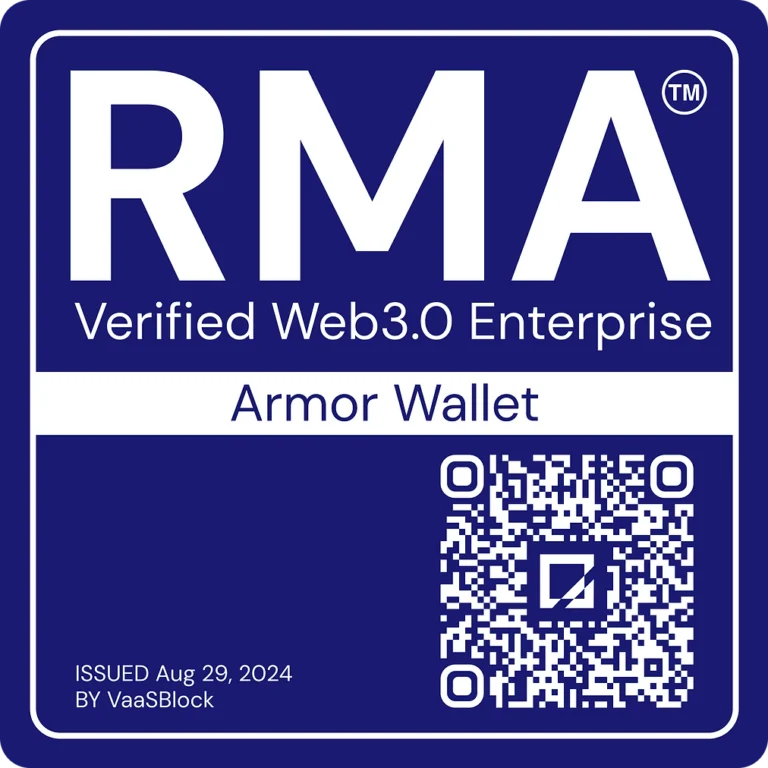
Armor Wallet, based in the British Virgin Islands and live since 2024, is an AI-driven crypto wallet — its RMA™ certification, granted August 29, 2024, makes this one of the cleanest-reviewed profiles in this entire sweep.
RMA™ status is Active: VB1 Business Registration reads Verified, five pillars read Standard Met, and Planning and Transparency reads Standard Exceeded. VBTransparencyScore 40.42 at the 98.68th percentile, ranked 2nd… of 41 in AI — near the very top of its category. Co-founder Stefan Savenski is identity-verified; CTO Nathaniel Gibson is named but not. The $ARMR token exists but carries no populated market-cap data in this review. X carries 8,021 certified followers.
The achievement log runs a genuine 2024-2025 buildout: a public beta launched on Ethereum and Base in 2024, followed in 2025 by an MCP integration, a published whitepaper, and Beta Access rollout. Coverage includes AtomicWallet and Colosseum hackathon pages. Standards-based verification behind the cleanest RMA reading in this sweep is exactly what a near-top score paired with zero auto-detected risk signals is meant to represent.Read More
Algorithmic assessment of a project’s transparency level, using multiple public data points to measure its commitment to compliance, documentation, and clarity in communication.
Transparency Score
34/100
?
Category Rank
A ranking that positions the organization among its industry peers, evaluating its relative performance based on key compliance, credibility, and transparency indicators.
Category Rank
Dawnshard vs Experiences
TOP 10%percentile
?
VaaSBlock Rank
A global ranking that compares the organization against all entities listed on VaaSBlock, reflecting its overall credibility, transparency, and operational performance versus the full Web3 ecosystem.
VaaSBlock Rank
Dawnshard vs All Listed Organizations
TOP 40%percentile
Transparency
Transparency Score
?
Transparency Score
Algorithmic assessment of a project’s transparency level, using multiple public data points to measure its commitment to compliance, documentation, and clarity in communication.
34/100
Category Rank
Dawnshard vs Experiences
?
Category Rank
A ranking that positions the organization among its industry peers, evaluating its relative performance based on key compliance, credibility, and transparency indicators.
TOP 10%percentile
VaaSBlock Rank
Dawnshard vs All Listed Organizations
?
VaaSBlock Rank
A global ranking that compares the organization against all entities listed on VaaSBlock, reflecting its overall credibility, transparency, and operational performance versus the full Web3 ecosystem.
The verification of fundamental governance, organizational structure, including verifying the entity’s legal registration and adherence to local laws and regulations.
Corporate Governance
?
Team Proficency
Evaluation of an organization’s personnel, ensuring that crucial team members possess the expertise and dedication necessary to execute current business models and scale effectively.
Team Proficiency
?
Technology & Security
Assessment of the organization’s technological framework, including blockchain integrations (where relevant), system architecture, and overall IT infrastructure.
Technology & Security
?
Revenue Model
Comprehensively evaluation of a company’s income-generating strategies (how do they make or intend to make money), ensuring financial robustness and sustainability.
Revenue Model
?
Results Delivered
The Results Delivered component of the RMA™ audit comprehensively evaluates an organization’s ability to achieve its goals and honor its commitments.
Results Delivered
?
Planning & Transparency
The Planning and Transparency component of the RMA™ audit offers a thorough assessment of how an organization manages its workflow and prepares for unexpected challenges.
Planning & Transparency
RMA™ Announcement
Dawnshard has been issued with its first RMA™ badge from VaaSBlock, which provides the organization with additional credibility after meeting the required standards in all six audited areas. This audi… [Read More]
Organization Representative
Federico Gallucci, Founder & CSO of Deep Monolith
Quote
“Partnering with VaaSBlock and earning the RMA badge is a testament to our team’s dedication to excellence and security. This milestone not only validates our commitment to creating an exceptional game but also reinforces our trustworthiness in the Web 3.0 space. We’re thrilled to be recognized alongside the best and are more motivated than ever to deliver a game that players will love.”
VaaSBlock provides estimations to the impact that traditional digital media can have on a project. This is an early release; more areas of PR are planned in future versions.
Search Terms
?
Search Terms
These are the terms we discovered the article for on page one of Google.
Est. Traffic
?
Estimated Traffic
We estimate how much traffic an article will get. Generally, our estimations are slightly higher than those of more established tools. We are working on the algorithm all the time, and results could change.
Est. Value
?
Estimated Value
Based on the estimated traffic we generate an estimation for what this traffic would have cost to generate if you tried to target these users with ads. The positions for the article on google and the location of the traffic are the major factors in this estimation.
Disclosure: VaaSBlock operates this directory and has also issued the RMA™ certification on this profile.
Dawnshard is a Turin, Italy-based free-to-play multiplayer card game for PC and mobile devices, developed by Deep Monolith, founded in 2022. Co-Founder and CEO Federico Gallucci and Co-Founder and CSO Andrea Gallucci are both identity-verified in the VaaSBlock registry. Employee count is 2–10. No token is currently listed in the registry.
VBTransparencyScore 34.24 at the 93.85th percentile, ranked 2nd of 66 in the Experiences category. The… RMA™ status is Active, with Corporate Governance, Team Proficiency, Technology and Security, Revenue Model, Results Delivered, and Planning and Transparency all at Standard Met. VB1 Business Registration is Unverified. Two verified co-founders in the same registry for a 2-10 person studio is a relatively high identity-verification density for early-stage game projects. X carries 5,807 uncertified followers.
The combination of play-to-earn mechanics, a card game format, and RMA Active certification raises a question about what verification means at the intersection of entertainment and finance. A card game that awards blockchain tokens for competitive play is simultaneously a creative product, a collectibles market, and a yield mechanism. What gets certified in an RMA audit of this kind of product is primarily the operator layer — governance structure, business registration, team identity — not the game balance or the tokenomics long-term sustainability.
The blockchain gaming asset yield mechanics question is the structural challenge for play-to-earn card games: whether in-game assets generate genuine yield depends on whether new players enter the game to compete with existing players, or whether existing players hold assets primarily to sell to future players. That distinction — competitive game versus yield-farming vehicle — is not resolvable from the current VaaSBlock record, and it is the most important question for any counterparty considering asset positions in the Dawnshard ecosystem.Read More
London, United Kingdom – November 21, 2024 – Hakflow, a leading cybersecurity firm specializing in penetration testing and blockchain auditing services, has been awarded the prestigious RMA™ (Risk Management Authentication) certification by VaaSBlock. This recognition underscores Hakflow’s commitment to maintaining the highest standards of security and compliance within the blockchain industry.
Hakflow’s expertise spans penetration testing and blockchain auditing, with a particular focus on smart contract security. Their mission is to ensure robust security measures and compliance for organizations, staying ahead of emerging threats and helping clients navigate the complexities of the cybersecurity landscape.
Dimitris Pallis, Director of Hakflow, commented: “Earning the RMA™ certification from VaaSBlock highlights our dedication to providing top-tier security solutions for our clients. This recognition further validates our efforts and strengthens the trust our partners and clients place in Hakflow.”
Ben Rogers, CEO of VaaSBlock, stated: “We’re excited to welcome Hakflow into the RMA™ network. Their expertise in smart contract auditing and cybersecurity aligns perfectly with our mission to drive trust and security in the blockchain space. This certification is a key milestone in our collaboration, and we look forward to continuing to raise industry standards together.”
In the coming weeks, Hakflow and VaaSBlock will announce a co-branded offering that packages Hakflow’s smart contract auditing services with VaaSBlock’s organizational verification products. This partnership aims to provide blockchain projects with a comprehensive security and compliance solution, ensuring trust and reliability across the ecosystem.
For more information about Hakflow’s services, visitHakflow’s Website.
About Hakflow
Hakflow is a cybersecurity company specializing in penetration testing and blockchain auditing services. Their mission is to ensure robust security measures and compliance for organizations, staying ahead of emerging threats while fostering trust in the blockchain industry.
This Artificial Intelligence (AI) notice for VAASBLOCK PTY LTD (“we,” “us,” or “our”), describes how and why we might integrate AI-generative, AI-enhanced and AI-empowered tools and processes as part of our services (“Services”).
VaaSBlock integrates AI into every workflow, enhancing speed, efficiency, and customer service while reducing costs.
AI bots, streamline audits, training, and onboarding processes, ensuring continuous knowledge retention.
AI tools assist with development, compliance, and customer interaction, enabling faster product iterations and setting new standards for blockchain operations.
VaaSBlock follows an AI-first hiring policy, using AI to handle repetitive tasks so human talent can focus on innovation and customer engagement.
VAASBLOCK AND AI: DRIVING BLOCKCHAIN INNOVATION THROUGH SMART COLLABORATION.
Our company is committed to serving our customers by providing frameworks and products that lead to a more secure and reputable blockchain industry. Our timing couldn’t have been better—not only did we launch during a pivotal moment in crypto, but also at a time when artificial intelligence (AI) has begun reshaping industries and roles across every sector.
This perfect confluence of blockchain and AI has empowered us to grow without disruption—no layoffs, no redundant roles, only enhanced customer value. At VaaSBlock, we believe AI is more than just an enabler; it is a core principle in our operations, used in every workflow, enhancing speed, efficiency, and innovation across our organization. As the company expands, AI will remain essential to building innovative, faster and smarter products. We are committed to transparent AI adoption—ensuring every AI tool we deploy benefits our team and customers.
LLMs TO ENSURE AUDITS STAY FAIR AND CONTINUOUSLY IMPROVE.
Large Language Models (LLMs) play a pivotal role in VaaSBlock’s audit processes by analyzing collected data while maintaining strict confidentiality. These models enhance consistency by standardizing the evaluation of answers, ensuring fairness and reliability across audits.
Beyond scoring responses, LLMs enable us to improve our data collection practices, identifying gaps in our frameworks and suggesting ways to refine our models. They also help us expand verification standards, ensuring we meet the specific needs of new industries, markets, and regions.
In collaboration with our consulting team, LLMs assist in drafting comprehensive audit reports. This partnership allows us to deliver precise, insightful documentation that reflects both technical expertise and the nuances of each project.
AI BOTS IN EVERY DEPARTMENT.
In partnership with Sensay, AI-powered bots are already assisting in audit reviews and staff training, ensuring seamless onboarding for new employees and continuous knowledge retention. Every department will eventually have at least one AI team member available 24/7, to help manage workloads, facilitate handovers, and maintain institutional knowledge. Further down the road,, these bots can function without human involvement, providing exceptional scale and speed for clients. For now, these bots prevent knowledge loss, ensuring customers always receive the best service—regardless of internal staff changes.
Bots also refine internal processes by analyzing how new hires adapt, sharing insights with other AI tools, and recommending ways to optimize onboarding. With this structure, VaaSBlock can always ensure operational consistency and expertise.
AI-ENHANCED CLIENT SUPPORT AND COMPLIANCE.
AI-powered tools engage directly with customers, answering queries, and offering strategic guidance. As legislation and compliance requirements evolve rapidly, AI will monitor regulatory changes and notify clients of necessary actions to stay ahead.
In customer support, AI bots deliver fast, high-quality assistance 24/7, ensuring minimal wait times and maximum satisfaction. This capability elevates our service standards, with AI bots trained to replicate human interaction, providing personalized responses at scale.
AI-DRIVEN PRODUCT DEVELOPMENT AND CONSULTING.
Our development and consulting teams collaborate with AI to accelerate product iterations, compliance audits, and reporting. This AI-driven approach ensures that VaaSBlock stays ahead of industry trends, delivering innovative products swiftly and maintaining a competitive edge.
With AI involved in every phase—from brainstorming to execution—our teams can iterate quickly, developing new standards, training materials, and solutions that meet evolving market needs.
AI-FIRST GROWTH STRATEGY.
Before hiring new staff, we first evaluate how AI can fill gaps, allowing us to focus on bringing in high-EQ individuals who complement our culture and mission. By offloading repetitive tasks to AI, our human talent can concentrate on innovation, leadership, and customer engagement.
This strategy ensures that VaaSBlock remains agile and efficient while fostering a dynamic, forward-thinking work environment that aligns with our core values.
AI FOR SALES: A PROMISING COLLABORATION FOR THE FUTURE.
At VaaSBlock, every team member plays a role in sales to ensure products remain aligned with market needs. While AI is not yet closing deals, it will soon become a key player in market outreach, driving conversations and influencing decisions. This principle reflects CEO Ben Rogers’ philosophy of avoiding “bubble thinking”—ensuring we build products the market truly needs.
EVOLVING WITH -AND FOR- THE INDUSTRY.
This article reflects our commitment to transparency and innovation. As technology evolves, we will update our AI strategy and share insights openly. This article, like all VaaSBlock content, was co-written with AI, embodying our belief in the future of AI-human collaboration.
–
For more information on VaaSBlock’s Data Protection and Privacy Notice, please read our Privacy Policy.
In 2018, the General Data Protection Regulation (GDPR) was introduced to protect people’s privacy as the digital world became more complex. GDPR sets important rules to ensure personal information is handled safely. However, many Web3 organizations find it hard to comply with GDPR, especially when using decentralized systems like blockchain. By understanding what GDPR covers, its limitations, and how it can be improved, tech professionals and blockchain projects can better protect users and be more transparent. Here are five key questions to help improve data privacy today.
TL;DR
The GDPR was introduced in 2018 to protect internet users’ privacy across the EU and, by extension, globally. As new technologies such as decentralized systems and blockchain evolve rapidly, the regulation struggles to keep pace. While it covers data collection and consent, enforcement is inconsistent, and its global reach is limited. GDPR Compliant projects are able to signal adherence to basic rules, but it does not represent a trusted sign of security. GDPR’s decentralized enforcement weakens its effectiveness, and its reactive nature means it often addresses issues after they occur. Decentralized projects and Web3 Service Providers often consider more comprehensive solutions, like the RMA™ Certification, to ensure a fair and adapted audit to demonstrate their compliance and transparency.
1. What Does GDPR Really Cover?
The GDPR protects personal data and applies to businesses worldwide that handle data from EU residents. It covers how data is collected, used, and stored, giving people rights like the right to delete their data and requiring their consent for data use. However, GDPR has some limits, especially for decentralized technologies like blockchain. It doesn’t have a global enforcement system, and its rules can be slow to keep up with fast-changing technology.
2. What Do You Learn from a “GDPR Compliant” Website?
A “GDPR Compliant” badge means a website follows rules about transparency and user consent, showing how data is collected and used. While this is reassuring, enforcement can be inconsistent because Data Protection Authorities (DPAs) often lack resources. Users might also experience “consent fatigue,” agreeing to terms without fully understanding them. The RMA™ Badge goes further by evaluating a project’s overall compliance and transparency, giving extra assurance to users and partners.
3. Who’s in Charge of GDPR Enforcement?
GDPR enforcement is handled by different DPAs in each EU country, which can lead to uneven application of the rules. In cases involving multiple countries, it can be hard to determine which DPA has authority. Many DPAs also struggle with limited resources, making it difficult to thoroughly investigate violations or guide businesses. This fragmented approach weakens GDPR’s effectiveness and leaves some user protections incomplete.
4. Is GDPR Proactive or Reactive? – The Cambridge Analytica Example
GDPR was created in response to scandals like Cambridge Analytica, which exposed flaws in data protection. This reactive approach means GDPR often addresses problems after they arise instead of preventing them. As technology advances, laws need to be more forward-thinking. Blockchain projects should go beyond just following GDPR and work on building trust and transparency from the start. Certifications like RMA™ help companies show they are leaders in data privacy, not just compliant with regulations.
5. Should GDPR be Extended?
While GDPR is a good start, its strict rules and lack of a central enforcement body leave room for improvement. As technology grows, we need more flexible laws to handle new challenges like decentralized platforms, artificial intelligence, and smart contracts. VaaSBlock’s RMA™ Certification adds to GDPR by including independent audits and keeping up with new tech developments. This makes RMA™ ideal for Web3 projects and blockchain companies looking to show they are serious about data protection now and in the future.
Frequently Asked Questions
1. How do businesses obtain valid consent under GDPR?
Consent must be freely given, specific, informed, and unambiguous, with clear opt-in mechanisms. Users should also be able to withdraw consent easily at any time.
2. What are the consequences of non-compliance with GDPR?
Non-compliance can result in heavy fines, up to €20 million or 4% of the company’s annual global turnover, whichever is higher.
3. How does the RMA™ badge use blockchain technology?
The RMA™ badge is tokenized on the blockchain, providing a transparent, immutable proof of certification. This allows anyone to verify the authenticity of a badge by scanning its QR code and checking it against the blockchain record.
4. Does the RMA™ badge replace the need for traditional regulation like GDPR?
No, the RMA™ badge complements traditional regulations like the GDPR. While the GDPR covers data security and users privacy, RMA™ addresses blockchain-specific areas, making them effective when combined.
Asking The Five Questions GDPR Cannot Answer
The standard GDPR conversation is structured to make the right questions impossible to ask. The framework treats data protection as a compliance exercise — a checklist a website passes or fails — when the underlying issue is a power asymmetry the checklist was never designed to address. Working through GDPR enforcement records over the last five years, five questions become unavoidable. Each one points at a gap the regulation has not closed, and each gap matters more in 2026 than it did when GDPR was drafted.
First, who decides what constitutes meaningful consent? The answer in practice is the platform that benefits from the consent. The platform writes the consent form, the platform designs the friction around the consent decision, the platform measures whether the consent rate is “acceptable” by its own commercial metrics. The user is presented with a binary choice that has been engineered to produce the platform’s preferred outcome. GDPR formally requires consent to be freely given; it does not address the entire infrastructure of pressure that determines what “freely” means in practice.
Second, who has standing to enforce when a violation occurs? The answer in most jurisdictions is the regulator, not the affected user. The user whose data was misused has limited individual recourse; the regulator has authority but limited enforcement capacity. The structural result is that even confirmed violations produce settlements that are smaller than the commercial value of the violation, paid to a regulator who returns nothing to the affected individuals. The user is technically protected and substantively unprotected.
Third, what happens when the data has already left the jurisdiction? GDPR’s extraterritorial reach is real in legal theory and weak in operational practice. A company headquartered outside the EU that processes EU-citizen data through infrastructure outside the EU faces meaningful enforcement risk only if the EU regulator chooses to pursue it, and meaningful pressure on the company’s commercial activity only if the company has EU-located assets the regulator can act against. The companies most aggressive about data extraction have learned to structure themselves to minimise EU exposure precisely because the framework can be navigated.
Fourth, who audits the auditors? GDPR depends heavily on a self-attestation framework in which companies declare their compliance posture and present documentation when challenged. The audit firms that produce the documentation are commercial vendors paid by the companies they audit. The conflict of interest is structural, well-documented, and unaddressed. Regulators rely on the audit output despite knowing the audit incentive is corrupted, because the alternative — direct technical inspection at scale — is not resourced.
Fifth, what is GDPR for? The framework was designed for a data economy in which data collection was a side effect of providing a service. The contemporary data economy is one in which data collection is the service, and the user-facing offering is the surface that produces the data. GDPR’s underlying mental model — that consent at the moment of collection meaningfully constrains downstream use — does not match the architecture of the systems it now applies to. The framework has not been updated to reflect this. The companies operating under the framework have updated their practices to exploit the mismatch.
The serious answer to “should GDPR be extended” is probably yes, but the more pressing answer is that the framework needs to be re-conceived around the architecture of contemporary data systems rather than the architecture of 2018. The questions above are not academic. They are the operational gaps that an updated framework would have to close, and any extension that does not address them is extension in form without effect.
The harder political question that follows from these five gaps is whether the regulatory architecture that produced GDPR is capable of producing a successor. The original framework emerged from a particular European political moment in which data protection had cross-party support, public-interest momentum, and a regulatory community that genuinely believed in the principle being legislated. None of those three conditions holds as strongly in 2026, in any major jurisdiction. The political coalitions that produced GDPR have fragmented. The public attention that sustained the policy push has moved to adjacent issues — AI safety, content moderation, platform accountability — that compete for the same legislative oxygen. The regulatory community has absorbed institutional knowledge that the framework can be navigated, which has tempered the appetite for an updated framework that would still be navigable by the same techniques.
The realistic forecast is therefore not that GDPR gets extended in 2026 or 2027, but that the gaps it leaves open get partially filled by adjacent frameworks — AI legislation, platform-specific regulation, sectoral rules in finance and healthcare — that address specific aspects of the data economy without claiming to update GDPR itself. This is the same pattern that has historically produced regulatory drift in other domains: the comprehensive framework remains formally authoritative while practical authority shifts to a patchwork of specific rules that close the most visible gaps without addressing the architectural mismatch underneath. The result is regulation that is harder for citizens to understand, harder for regulators to enforce, and easier for sophisticated operators to navigate than either the original comprehensive framework or a properly updated one would be.
The five questions above will therefore continue to be unanswered, in the formal sense, for the foreseeable horizon. The substantive responses will come not from regulators but from the constituencies that have to navigate the gaps directly: data subjects who learn to use the limited tools they have, journalists who report on enforcement failures, technical communities that build privacy infrastructure outside the regulatory framework. None of these is a substitute for an updated regulation. All of them, together, are what the data economy will rely on while the regulation continues to age toward irrelevance.
The compact version of this argument is that frameworks age, and the cost of a framework that has aged badly falls disproportionately on the citizens it was supposed to protect. GDPR has aged badly in the specific ways the five questions above identify. The reasonable response is neither to abandon it nor to defend it as if it still functioned as designed, but to read it for what it actually does in 2026 and to build the surrounding infrastructure that makes its formal protections meaningful in practice. That work falls primarily on the parties with the least authority and the most exposure. They are doing it anyway, because the alternative is acquiescence to a framework that no longer serves its stated purpose.
The honest close is that GDPR is not the worst possible framework, and a worse one is not the threat worth focusing on. The threat is the slow drift toward a regulatory environment in which the formal rules continue to exist while the practical protections fade. That drift is happening now, visible in the enforcement statistics and in the language regulators have begun using to describe their capacity limitations. The five questions above are the diagnostic for whether the drift has reached the point where the framework can no longer be read as protective in any meaningful sense. By those five tests, the drift is already further along than the public conversation suggests.
What Disruption Theory Predicts About Privacy Regulation’s Next Phase
Clayton Christensen’s disruption framework applied to regulation produces a specific prediction: the regulatory framework that achieves the widest adoption is rarely the most technically comprehensive one. It is the one that addresses the simplest version of the user’s problem clearly enough to become the default, and then improves incrementally from that position. GDPR achieved widespread adoption not because it was technically optimal — it has well-documented compliance burdens that created significant friction for smaller companies — but because it established a clear enough baseline that organizations could build compliance programs around it without requiring complete certainty about every edge case. The framework became the standard by being legible, not by being perfect.
The five questions the article poses are the right questions to ask because they reveal the gap between GDPR’s minimum compliance bar and what genuine user protection actually requires. GDPR establishes the right to access, the right to erasure, and the right to object. It does not establish a right to understand what your data is actually being used for in the AI context, which is where the gap has become most consequential. An organization can be fully GDPR-compliant while running AI inference on user data in ways that produce discriminatory outputs, build behavioral profiles that users never consented to, and feed training datasets whose scope was not contemplated at the time of consent. The compliance checkbox is checked. The user is not protected.
Christensen’s framework predicts that the disruption of GDPR will come not from a more comprehensive regulation that addresses all five gaps simultaneously, but from a narrower framework that addresses one gap clearly and builds from there. The most likely candidate is AI-specific transparency: a requirement that users be told when AI systems are making consequential decisions about them, what inputs those decisions use, and what recourse is available when the decision appears incorrect. That is a narrower requirement than GDPR’s full scope, but it addresses the highest-value gap between current compliance and current user protection. Enterprise AI adoption is creating the demand for this framework faster than regulators are producing it, which means organizations that build the internal capability now are building a competitive differentiator rather than a compliance cost.
The crypto privacy parallel is instructive. Independently validated risk frameworks like the RMA have demonstrated that organizations adopting a clear, externally recognized standard gain institutional credibility that organizations with proprietary compliance frameworks cannot manufacture. The same dynamic applies to privacy: an organization that can point to a recognized external framework — not just internal policies — for AI transparency has a credibility signal that procurement processes, regulators, and consumers can act on. The external recognition is not just a badge. It is a coordination mechanism that reduces the cost of trust for every party evaluating the organization’s privacy posture.
The disruption risk that the article’s five questions implicitly identify is to the GDPR compliance industry itself: the lawyers, consultants, and tooling vendors who have built businesses around GDPR compliance. That industry has the same structural incentive as any incumbent facing disruption — to preserve the complexity of the existing standard, because complexity creates recurring consulting revenue, and to slow the adoption of simpler standards that would reduce the need for ongoing compliance support. Christensen would predict that the organizations most likely to adopt the simpler AI transparency standard first are the ones that have not yet built extensive GDPR compliance bureaucracies — smaller companies, newer entrants, and organizations in categories where GDPR compliance was never the primary regulatory concern. Newer blockchain infrastructure building regulatory compliance into architecture from the beginning is following exactly that pattern: the blank-slate advantage of building without legacy compliance debt. On-chain credit protocols that built transparency into their core architecture have a structural advantage over traditional credit platforms retrofitting transparency onto existing infrastructure. The pattern repeats: simplicity adopted early compounds into structural advantage over complexity accumulated over time.
The Compliance Trap That Prevents Builders From Thinking Clearly About Privacy
Paul Graham has an instinct that applies directly to privacy compliance: when something feels like it should make things better but consistently makes things worse, you are probably measuring the wrong thing. GDPR compliance, as implemented by the median organization, is a case study in this failure mode. The regulation was designed to give users meaningful control over their data. What it produced, in most cases, is a cookie banner that trains users to click without reading and a legal team that signs off on practices the regulation was written to prevent.
The structural problem is that compliance is a lagging indicator optimized by people who are not the builders. When a startup asks ‘are we GDPR compliant?’ the answer almost always comes from counsel, not from the engineer who knows where the data actually goes. This separation produces the same failure that the three jobs of MiCA analysis identifies: a framework doing a compliance job, a counterparty-diligence job, and a trust-signaling job simultaneously, but organizations only optimizing for the first, failing at the second, and mistaking the absence of enforcement for success on the third.
The comparison that clarifies this is RMA versus ISO 27001. ISO 27001 is a certification framework with a jobs-to-be-done character: it tells procurement teams something true about operational security. GDPR is a rights framework with an enforcement character: it tells regulators something actionable about violations. Builders who conflate these are using a rights framework as an operational guide, which is why they keep arriving at processes that satisfy the auditor without changing user outcomes.
On-chain verification represents a more honest approach to the underlying problem. The drift between snapshots—the gap between what a compliance document asserts and what the system actually does—is the core failure mode that GDPR compliance almost never catches. Asserted state and actual state diverge continuously in any operating system, and a framework that conducts periodic audits cannot observe that divergence in real time. The audit tells you that the system was compliant at the moment it was audited, which is a narrow and often misleading claim.
The three rules of framework discipline apply here: a framework should describe operating capability, not just assert it; it should generate actionable evidence, not just documentation; and it should be readable by the people whose decisions it is supposed to inform. GDPR compliance documentation fails all three tests for the users whose data it governs. They are the intended beneficiaries, but they are the last people who can interpret the compliance artifacts produced on their behalf.
The harder question Graham would ask is whether the compliance infrastructure is a proxy for trust or a substitute for it. Enforcement reveals what substitution looks like when it fails: organizations that used compliance signaling as a trust proxy are exposed when enforcement pressure forces actual behavior into view. The builders who avoid this trap start with ‘what would a user actually want to know about how we handle their data?’ and build the compliance layer on top of a genuine answer. Starting from the compliance layer and working backward produces documentation, not privacy.
Seoul, Korea — October 9, 2024 — INFCL, a leading consulting firm in Korea, has been awarded the prestigious RMA™ (Risk Management Authentication) badge from VaaSBlock. This certification demonstrates INFCL’s adherence to the highest standards of operational integrity and transparency, reinforcing its reputation as a trusted partner in digital innovation and blockchain consulting. INFCL collaborates with major Web2.0 clients, including Hana Securities, KB Securities, and Korea Investment & Securities, as well as prominent Web3.0 projects like Uniswap, SUI, and Aethir, to facilitate the seamless integration of Web2.0 and Web3.0 technologies.
As a company committed to supporting businesses in navigating the complexities of digital transformation, INFCL’s achievement of the RMA™ badge confirms its readiness to guide enterprises through the integration of blockchain solutions and Web3 technologies. With a deep understanding of compliance and security, INFCL is well-positioned to support businesses across finance, public sector, and technology, addressing the unique challenges of blockchain adoption.
Ben Rogers, CEO of VaaSBlock: “INFCL’s success in earning the RMA™ badge is a testament to their proactive approach in building trust and setting new standards for blockchain adoption. Their leadership in the industry will undoubtedly serve as a beacon for other organizations looking to enhance their reputation in the rapidly evolving digital landscape.”
Teo Oh, CEO of INFCL, stated: “We are honored to collaborate with an excellent partner like VaaSBlock on risk assessment and certification, which are often seen as vulnerabilities in the Web3 industry. As Korea’s leading accelerator, INF CL is committed to building sustainable businesses, ensuring that blockchain technology is used in the most impactful and transformative ways possible for a better and more disruptive innovation.”
The Impact of RMA™ Certification for INFCL and Their Clients
The RMA™ certification distinguishes INFCL as a reliable partner for businesses aiming to incorporate blockchain technologies in a secure and compliant manner. Although INFCL does not plan to integrate the RMA™ API, they recognize the badge as a mark of credibility. INFCL looks favorably on organizations holding the RMA™ badge, potentially accelerating collaborative opportunities with projects that demonstrate robust risk management and transparency.
For more information about INFCL, please visit the INFCL Website.
For more details on VaaSBlock’s RMA™ badge, visit VaaSBlock.
About INFCL
INF CL is a leading Web3 accelerator in South Korea. Our vision is to lead the next gen of the Internet by using blockchain as a technology material for more sustainable and more impactful use. We provide consulting and GTM strategies for Web3 industry with many legacy companies, including large securities firms, and have created many success cases.
VaaSBlock audited Armor Wallet, an AI-empowered wallet solution and delivered an RMA™ badge to assess their credibility and compliance. Read how Armor Wallet overcame security challenges in the digital asset space, implementing advanced measures to build trust and reliability.
Introduction
In the rapidly expanding digital asset industry, the security and trustworthiness of digital wallets are paramount. Users entrust their valuable cryptocurrencies to these platforms, expecting robust protection against hacking, fraud, and data breaches. However, many digital wallets struggle to balance user convenience with stringent security measures, leaving them vulnerable to sophisticated cyber threats. This challenge not only jeopardizes user assets but also undermines the overall credibility of the decentralized finance (DeFi) ecosystem.
The Challenge: Strengthening Security in Digital Wallets
As digital asset adoption surges, the demand for secure and efficient wallets intensifies. Traditional payment systems have established trust through rigorous security protocols and regulatory compliance, but the decentralized nature of blockchain presents unique obstacles. Digital wallets must navigate issues such as volatile market conditions, regulatory uncertainty in Web3 markets, and evolving cyber threats while maintaining an intuitive user experience.
Armor Wallet identified these critical gaps and sought to develop a solution that not only enhances security but also fosters trust among its user base. The platform aimed to implement advanced security features without compromising ease of use, addressing a fundamental pain point in the digital wallet space.
The Solution: Comprehensive Security Measures and Independent Validation
To address these challenges, Armor Wallet embarked on a mission to fortify its security infrastructure. The platform integrated multi-layered security systems, including hardware security modules (HSM), biometric authentication, and state-of-the-art encryption protocols. These measures were designed to provide robust protection against unauthorized access and cyber threats while ensuring a seamless user experience.
In practical terms, a layered approach like this helps reduce different categories of risk. HSMs are used to keep private keys in hardened environments, biometric checks help prevent unauthorised access from a lost or shared device, and encryption protects data in transit and at rest. If one control is bypassed or fails, the others are intended to limit the blast radius and make it significantly harder for an attacker to move further.
Recognizing that technical enhancements alone were insufficient to build comprehensive trust, Armor Wallet sought an independent validation of its security and operational practices. This led to the collaboration with VaaSBlock to pursue the prestigious RMA™ (Risk Management Authentication) certification. The RMA™ certification process provided a holistic evaluation of Armor Wallet’s governance, revenue models, planning and transparency, and technology security, ensuring that the platform met the highest standards of credibility and compliance within the Web3 ecosystem.
Independent reviews of this kind typically give teams a clearer picture of their overall risk posture. Rather than only confirming that controls exist on paper, they highlight which areas are strongest, where documentation or processes may need to mature, and which technical or operational risks should be prioritised. The outcome is not just a badge, but a structured roadmap for ongoing improvement.
Earning the RMA™ Certification: A Milestone in Trust and Security
The RMA™ certification process is renowned for its rigorous assessment criteria, which encompass various facets of a blockchain project’s operations. For Armor Wallet, achieving this certification involved a comprehensive audit that scrutinized the following key areas:
Corporate Governance and Transparency: Examination of leadership practices, decision-making frameworks, and the platform’s transparency in communicating updates or changes to users.
Revenue Models and Monetization: Analysis of Armor Wallet’s business model to ensure sustainability and compliance with industry standards.
Technology and Security: Assessment of encryption methods, secure key management, and platform stability to safeguard against external threats.
Results Delivered and User Impact: Evaluation of Armor Wallet’s growth metrics, customer feedback, and market adoption to verify alignment with operational and strategic goals.
Team Proficiency: Examination of team qualifications, roles, and strategic capabilities to ensure the organization is equipped for growth.
Planning and Transparency: Review of operational workflows, strategic planning, and crisis management protocols.
Through this meticulous evaluation, Armor Wallet demonstrated its commitment to maintaining high-security standards and operational excellence. The successful attainment of the RMA™ certification not only validated Armor Wallet’s existing security practices but also highlighted areas for continuous improvement and strategic development.
Key Achievements and Impact
Enhanced Credibility: The RMA™ badge distinguishes Armor Wallet from competitors, establishing it as a trustworthy provider in a crowded market. This evidence-backed reputation is crucial for attracting new users and giving existing ones greater confidence in the platform’s safeguards.
Community Confidence: The certification reassures users and investors that Armor Wallet has subjected its controls and governance to external scrutiny. For communities that have seen high‑profile failures in the sector, this kind of third‑party review can make it easier to trust a new wallet provider.
Strategic Partnerships: RMA™ certification can help streamline conversations with institutional investors, exchanges, and other RMA™‑certified projects that rely on external evidence when evaluating counterparties. Clear, documented assurance around security and governance lowers friction when exploring new collaborations.
Operational Excellence: The comprehensive evaluation process encourages Armor Wallet to maintain high standards across all operational facets, ensuring long-term sustainability and resilience.
Market Differentiation: By achieving RMA™ certification, Armor Wallet sets a benchmark for other wallet providers, demonstrating that rigorous certification can significantly enhance market positioning and user trust.
Real-World Applications: Leading by Example in Crypto Security
Armor Wallet’s dedication to maintaining high-security standards makes it a benchmark for other wallet providers seeking to enhance their credibility. By earning the RMA™ badge, Armor Wallet exemplifies how rigorous certification can be leveraged to build user trust, attract strategic partnerships, and ensure long-term sustainability. This achievement aligns Armor Wallet with other leading projects like Trugard case study and Fuzzland security platform, showcasing the value of independent verification in establishing blockchain credibility.
Moreover, Armor Wallet’s integration of AI-driven trading capabilities and secure payment solutions serves as a model for how digital wallets can innovate while maintaining stringent security measures — a reminder of how teams adopt emerging technology responsibly. AI‑enabled features introduce additional considerations around data handling, model access and decision transparency, so they are often reviewed alongside core wallet controls to ensure they do not create new blind spots. This balance of innovation and security is essential for the continued growth and acceptance of cryptocurrencies in mainstream financial activities.
Future Directions: Expanding the RMA™ Ecosystem
Earning the RMA™ badge marks the beginning of Armor Wallet’s ongoing collaboration with VaaSBlock. The company plans to leverage this certification to forge strategic partnerships, attract institutional investors, and continue innovating in the realm of crypto payments. As the RMA™ Network expands, Armor Wallet will collaborate with other certified companies to further elevate standards of credibility and security within the blockchain space.
Additionally, Armor Wallet’s Ethereum-based Sensei token will be integrated into the forthcoming RMA™ API, enabling exchanges and other platforms to verify that the Sensei token meets the stringent requirements of the RMA™ certification. This integration adds an extra layer of credibility and transparency, further solidifying Armor Wallet’s position as a leader in the digital asset space.
Which Certification is Right for You?
For organizations focused on crypto payments or blockchain integration, achieving the RMA™ badge should be a priority. Web3 teams evaluating broader security frameworks can also explore ISO 27001 benefits for Web3 companies to understand how traditional infosec standards complement blockchain‑native certifications. Additionally, platforms handling significant amounts of user data or providing financial services may benefit from pursuing SOC2 certification alongside RMA™. Armor Wallet’s experience demonstrates that dual certification can enhance security credentials and streamline the RMA™ audit process, as RMA™ auditors can utilize SOC2 results to expedite the security evaluation.
If your organization handles sensitive user data or is a SaaS provider, SOC2 is highly recommended to demonstrate robust security and data privacy controls.
If you are a blockchain project, DeFi platform, or Web3 service provider, the RMA™ badge is better suited as it addresses the complexities of decentralized operations, token management, and governance.
To help teams compare traditional and blockchain‑native standards, our guide on SOC 2 vs RMA™ outlines how each framework addresses different dimensions of operational trust.
Frequently Asked Questions
» What is a crypto wallet security assessment?
A crypto wallet security assessment is a structured review of a wallet’s architecture, key management, update mechanisms, and operational controls. It is designed to identify weaknesses before they can be exploited and to give users, partners, and investors a clearer view of the project’s risk posture, usually through a written report and a set of recommended remediation steps.
» Why did Armor Wallet pursue independent assessments so early?
Armor Wallet’s founders recognised that in a market shaped by hacks and scams, they needed more than claims to earn trust and demonstrate their commitment publicly. By engaging in audits and an RMA™ review early, they aimed to demonstrate maturity and seriousness to both users and potential investors.
» Does a security assessment or RMA™ badge guarantee a wallet is safe?
No assessment can guarantee absolute safety. However, independent reviews significantly improve transparency by showing that a project has subjected itself to external scrutiny and addressed identified weaknesses. They reduce unknowns and help users make more informed decisions.
» What can other Web3 startups learn from Armor Wallet’s journey?
Armor Wallet’s story illustrates that trust cannot be bolted on later; it must be built in from the start. Early investment in governance, documentation, and security assessments may not guarantee explosive growth, but it increases the odds of surviving long enough to find product–market fit in a cautious market.
» How is a crypto wallet security assessment different from a smart contract audit?
A crypto wallet security assessment looks at the full wallet stack and how it is operated day to day. In contrast, a smart contract audit typically focuses on specific pieces of on-chain code. In practice, they answer related but different questions:
Wallet security assessments examine key management, signing flows, front-end behaviour, update governance, and operational processes around the product.
Smart contract audits review the logic and implementation of on-chain code to reduce the risk of exploitable bugs in deployed contracts.
Most mature projects eventually need both types of review. Independent security reviewers like DeFiSafety also help projects validate their operational processes and transparency practices beyond code-level audits.
» How can a Web3 startup build credibility before it has many users?
Early-stage teams can build credibility by publishing clear documentation, being transparent about risks, running independent security assessments, and aligning with recognised frameworks such as RMA™. These steps signal that credibility and Web3 trust-building are core priorities rather than afterthoughts.
» Do VC investors care about security assessments for early-stage crypto wallets?
Yes. In a cautious market, many investors now treat security posture and operational discipline as key trust signals. A documented crypto wallet security assessment, combined with well-governed operations, can help early wallets stand out during Web3 VC due diligence — especially when paired with early reputation-building efforts such as building credibility early in Web3.
» When is the right time for a project to schedule a crypto wallet audit?
Ideally, a project should schedule a security assessment or crypto wallet audit before a major public launch, token listing, or marketing push. Fixing architectural issues early is cheaper and more impactful than retrofitting security after users and assets are already at risk.
Conclusion: Proof Beats Promises
Armor Wallet’s attainment of the RMA™ certification underscores its leadership in the digital asset space. As the blockchain industry evolves, wallet providers must adopt stringent security and governance standards to meet user expectations and regulatory demands. Armor Wallet’s success story serves as an inspiration for other blockchain projects to pursue certifications that validate their practices and enhance their credibility.
With the RMA™ badge, Armor Wallet is well-positioned to continue advancing wallet security standards and setting new benchmarks within the industry. This certification will facilitate entry into new markets, foster strategic partnerships, and drive the introduction of innovative solutions that redefine digital asset management.
Singapore – August 30, 2024 – Vaasblock, a leading authority in blockchain credibility and security, proudly announces that Armor Wallet, a state-of-the-art digital asset storage solution, has been awarded the prestigious RMA™ (Risk Management Assessment) certification. This recognition highlights Armor Wallet’s outstanding commitment to secure and reliable digital asset management through their advanced multi-layered security infrastructure and user-centric design.
Armor Wallet has gained significant acclaim for its unparalleled focus on safeguarding digital assets with robust encryption protocols, hardware security modules (HSM), and biometric authentication. Their continuous efforts to integrate the latest security technologies and maintain user privacy have set new benchmarks in the realm of blockchain wallets. The RMA™ certification comes after a comprehensive assessment of Armor Wallet’s security practices and its proven ability to prevent unauthorized access and breaches.
“Armor Wallet’s innovative approach to digital asset security and user experience is truly commendable, and we are excited to award them the RMA™ certification,” said Ben Rogers, CEO of Vaasblock. “Their commitment to pushing the boundaries of wallet security aligns perfectly with our mission to foster trust and reliability within the blockchain ecosystem.”
“We’re proud to be working with the Vaasblock team to ensure all of our security practices are up to date and align with the industry standards in the Web3 space”, said Stefan Savevski, cofounder of Armor Wallet.
The RMA™ certification underscores Armor Wallet’s dedication to proactive security measures, ensuring users have full control over their assets without compromising safety. As the digital asset industry expands, the need for secure and reliable wallet solutions becomes increasingly critical, positioning Armor Wallet as a leader in this crucial sector.
Looking forward, Vaasblock and Armor Wallet are eager to explore opportunities for deeper collaboration, including developing new solutions tailored to meet the growing needs of the digital asset community. This partnership aims to set new standards in digital asset security and promote the safe and sustainable adoption of blockchain technologies.
The verifiable NFT can be confirmed here(Eth) | here(Base) issued at 29082024.
About Armor Wallet:
Armor Wallet is an AI-powered web3 wallet that helps take the emotion out of crypto investing. A non-custodial wallet using AI agents to trade across multiple blockchains and execute complex trades quickly and easily. A new generation web3 tool powered by AI capable of learning from users, processing enormous amounts of data from the market to insights, and providing tailored recommendations and insights for investing.
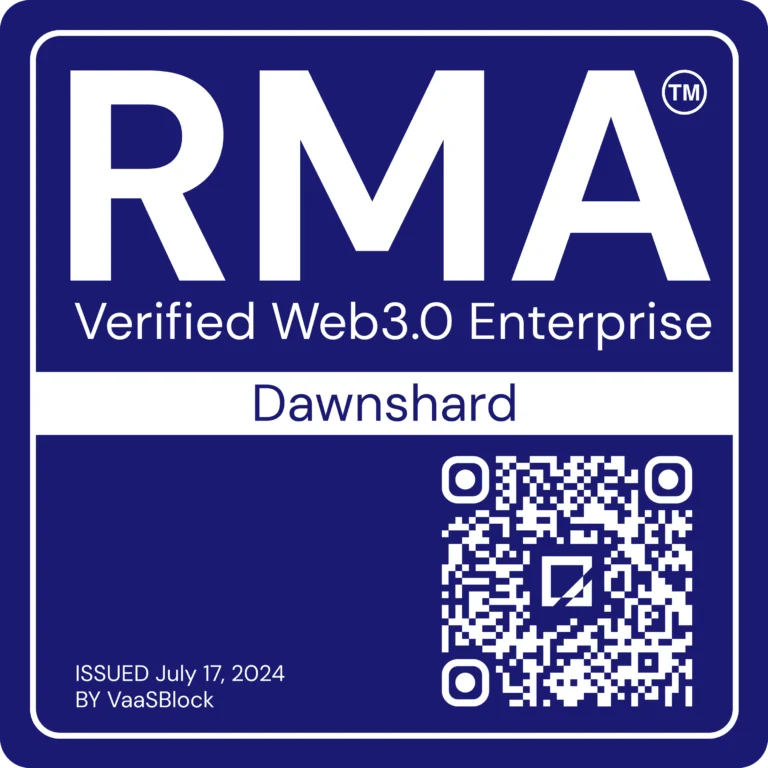
Turin, Italy, July 17th, 2024: Dawnshard has been issued with its first RMA™ badge from VaaSBlock, which provides the organization with additional credibility after meeting the required standards in all six audited areas. This audit covered corporate governance through to the crisis planning and security policies of their business.
Dawnshard is the first GameFi and European based project to be awarded an RMA™ badge by the VaaSBlock team. Dawnshard joins a small group of the best organizations in the Web 3.0 space, verified as a service by VaaSBlock. A project holding an RMA™ badge strongly indicates that the team is sincere and capable of delivering their product or service.
While this is the team’s first GameFi venture, the core team from Dawnshard all have strong roots in the gaming industry and have advisors that are well respected in the Italian gaming industry as well. Team is a vital component for a successful VaaSBlock audit and we are delighted to report they pass this category with a very high score for a project in the pre launch stage. The team’s awareness of potential threats to their security and the impact this would have on users impressed the VaaSBlock team as well. They are certainly thinking ahead and planning for events outside of their control.
As a result of reaching the required score, Dawnshard can proudly display their verifiable RMA™ badge wherever they see fit, including on social media, their websites, and pitch decks, to enhance their credibility further.
On awarding the RMA™, Ben Rogers, head of growth at VasSBlock, said, “Congratulations to the Dawnshard team on this milestone. They stand out from other GameFiprojects having completed an independent audit of their organization. I was impressed with how well run their operation is run and believe in this team to deliver a fun game. I will play it myself when I can.”
Federico Gallucci, CEO of Dawnshardsaid “Partnering with VaaSBlock and earning the RMA badge is a testament to our team’s dedication to excellence and security. This milestone not only validates our commitment to creating an exceptional game but also reinforces our trustworthiness in the Web 3.0 space. We’re thrilled to be recognized alongside the best and are more motivated than ever to deliver a game that players will love.”
The verifiable NFT can be confirmed here and issued at 17072024.
About Dawnshard
Dawnshard is a free-to-play multiplayer card game for PC and Mobile devices, where players compete in epic matches with algorithmically-generated decks. The procedural generation makes each game different and fun, fostering a dynamic gameplay in which you’re the only one that can find the best combos between your cards. Twitter |Discord | Farcaster |YouTube | Website


 This badge is active
 EQDpGje-…1KplRQtc
 EQDpGje-…plRQtc



 0x4e83be…57deb873




 Experiences
 irmaAI