
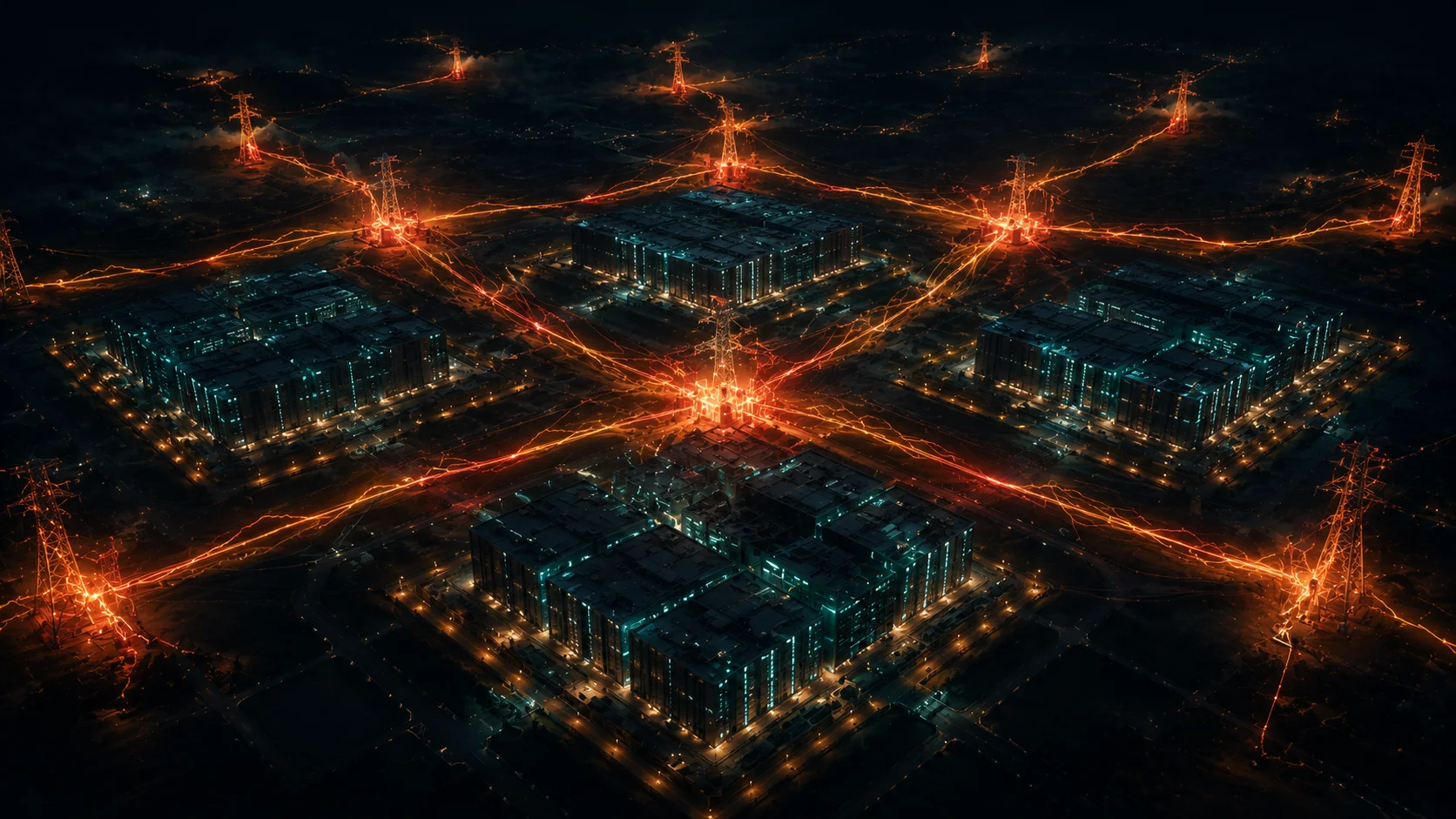
The defining infrastructure story of the AI build-out in 2026 is not chips or data centers in the abstract — it is electricity. The combined capital expenditure commitments of Amazon, Microsoft, Google, Meta, and Oracle for AI infrastructure over 2025 and 2026 exceed $300 billion, with most of that capital flowing into data center construction. The data centers being built are dramatically more power-intensive than the previous generation of cloud infrastructure: a single AI training facility can require 100 to 500 megawatts of continuous power, comparable to the electricity demand of a small city. The aggregate impact on US electrical demand has shifted from a marginal increase to a structural acceleration that the grid was not designed to support, and the consequences for utilities, real estate investment trusts focused on data centers, and the broader power sector are substantial.
Understanding the implications requires looking at the actual constraints in the US electrical system, the timeline for resolving them, and the financial sector responses that are already developing around the bottleneck. The investment story here is genuinely different from the broader AI investment narrative — it is not about chip designers or model developers but about the slower-moving, more capital-intensive, more regulated industries that have to physically provide the electricity that AI compute requires.
What Hyperscaler Power Demand Actually Looks Like
The power consumption profile of modern AI data centers is qualitatively different from the cloud infrastructure that preceded it. Traditional cloud data centers serving web applications, databases, and conventional compute workloads operated at power densities of 5 to 15 kilowatts per server rack. Modern AI training facilities operate at 50 to 100 kilowatts per rack — five to ten times the power density — driven by the high-end GPUs that AI workloads require, the cooling infrastructure these GPUs need, and the high-bandwidth networking equipment that connects them.
The aggregate effect on US electricity demand is visible in utility planning documents and ISO grid forecasts. Electricity demand growth in the US had been roughly flat or modestly increasing for two decades as efficiency improvements offset population and economic growth. The data center segment has shifted this dynamic decisively: forecasts for US electricity demand growth over the next decade have been revised upward significantly, with data centers projected to account for a meaningful share of total US electricity consumption by 2030.
The capacity constraints are most acute in regions where hyperscaler data centers cluster. Northern Virginia — the largest single concentration of data center capacity globally — has seen sustained power supply pressure as utility approvals, transmission capacity, and generation expansion have struggled to keep pace with the build-out. Phoenix, Atlanta, central Ohio, and Iowa face similar pressures as hyperscalers expand outside the Northern Virginia corridor. The result is that data center projects that would otherwise be financially attractive are being delayed by their inability to secure power supply on acceptable terms and timelines.
The compute side of the AI buildout can be addressed by manufacturing more chips. The power side cannot be addressed by manufacturing more electricity — it requires building generation capacity, transmission infrastructure, and substations on multi-year timelines that do not respond to short-term demand signals the way chip production does.
The Utility Response and the Investment Cycle
Regulated electric utilities — the companies that own the transmission and distribution networks that deliver power and that operate generation in many markets — are responding to AI demand with the most significant capital expenditure cycle the sector has seen since the post-war electrification of the US economy. Utility capital expenditure budgets have been revised upward across most major investor-owned utilities, with multi-year capital plans that involve new generation capacity, transmission upgrades, and grid modernisation investments.
The investor implication is that utilities — historically valued as defensive, slow-growth income stocks — are entering a period of accelerated capital deployment that should drive rate base growth and earnings growth at levels above the long-term trend. Utilities like Dominion Energy (serving the Northern Virginia data center cluster), Southern Company (serving Atlanta and the Southeast), Duke Energy (serving the Carolinas), and several others have specifically identified data center demand as a driver of their growth outlook.
The natural gas generation sector is benefiting because natural gas turbines are the most readily deployable large-scale generation technology, with construction timelines of two to three years compared to five to seven years for nuclear or longer for offshore wind. The hyperscalers’ desire to secure firm, reliable power has driven gas generation orders from manufacturers like GE Vernova and Siemens Energy that have produced order backlogs at multi-year highs. The carbon intensity implications of this gas-led generation buildout sit awkwardly with the hyperscalers’ net-zero commitments, but the short-term power requirements have largely overridden the longer-term decarbonisation pathway.
Nuclear has been an unexpected beneficiary of the AI power demand story. The combination of carbon-free baseload generation and the political shift toward viewing nuclear as a strategic asset has led to existing reactor life extensions, the restart of previously closed reactors (Three Mile Island Unit 1 reopening under Microsoft’s purchase agreement is the headline example), and serious commercial development of small modular reactor technology that several hyperscalers have committed to. The nuclear development cycle is slow — even SMRs are 2028-2030 commercial reality at the earliest — but the long-term direction of the sector has shifted favourably.
Data Center REITs and the Real Estate Angle
Data center real estate investment trusts — Equinix, Digital Realty, and several smaller specialist REITs — are positioned to benefit from the AI demand build-out as the landlords and operators of the colocation facilities that serve hyperscalers and enterprises building AI workloads. The unit economics of data center REITs in the AI era are significantly more attractive than the previous cloud computing era: rental rates per square foot or per megawatt have increased substantially, lease terms have lengthened, and tenant credit quality has improved as hyperscaler customers represent the largest counterparties in the market.
The constraint for data center REITs is that the bottleneck has shifted from real estate to power. A data center REIT that has acquired land and built a facility but cannot secure power supply has built an empty building. The competitive advantage in 2026 belongs to operators who have secured power supply agreements with utilities, who own existing facilities in power-constrained markets where new entrants cannot enter, and who have the relationships with utilities to plan for power supply on multi-year horizons that align with hyperscaler facility planning.
Equinix’s interconnection business — the carrier-neutral colocation that allows different network operators and cloud providers to interconnect within a single facility — provides a moat that is structurally different from raw data center capacity. The interconnection density and the network effect of having most major networks present in Equinix facilities is hard to replicate for new entrants. Digital Realty’s larger-scale hyperscale colocation business is more capacity-driven and faces the power constraint more directly.
The broader real estate sector has also been affected by AI data center demand in ways that have not received proportionate attention. Land prices in primary data center markets have appreciated substantially as land suitable for data center development — flat topography, proximity to fibre infrastructure, available water for cooling, and within reasonable distance of transmission capacity — has become scarce relative to demand. Local zoning processes for new data centers have become contested in several markets as communities have pushed back against the noise, traffic, and electricity demand impacts of large facilities.
The Renewables Investment Cycle and Its Limitations
The hyperscalers’ commitment to renewable energy procurement for their AI infrastructure has produced a significant power purchase agreement market for solar and wind generation. Microsoft, Google, Meta, and Amazon have collectively contracted for tens of gigawatts of renewable generation over the past several years, providing capital and credit support that has accelerated renewables development.
The limitation of this renewables-driven response is the intermittency mismatch with AI compute demand. AI training workloads require continuous power for weeks or months; AI inference workloads require continuous availability for production deployments. Solar generation produces during daytime hours; wind generation varies with weather. The mismatch means that renewable generation alone cannot supply AI data center power needs — it must be combined with storage, with firm generation backup, or with grid imports that can be balanced across the renewable supply schedule.
Battery storage has been a significant beneficiary of this dynamic. Utility-scale battery storage deployment has accelerated as the economics of pairing renewables with batteries have improved and as utilities and developers have invested in the integrated solar-plus-storage projects that can provide more dispatchable renewable capacity. The storage value proposition for AI data center power is genuine but the scale required to substitute for firm generation is substantial — multi-day duration storage at gigawatt scale remains technically challenging at acceptable cost.
What the Investor Should Actually Do
The investment implications of the AI power constraint are most actionable in three categories. Regulated utilities serving data center concentration markets benefit from rate base growth driven by demand they did not anticipate when their long-term capital plans were last set. Independent power producers and natural gas turbine manufacturers benefit from the firm generation demand that hyperscalers cannot fully satisfy with renewables alone. Data center REITs benefit from rental rate inflation and tenant credit quality improvement, with the largest beneficiaries being operators with power-secured facilities in supply-constrained markets.
The risk factors that should temper this investment thesis include the possibility that AI compute demand growth moderates as inference efficiency improves and as model deployment matures (reducing the marginal demand for additional training compute), the possibility that grid reliability constraints become severe enough to force significant facility delays that affect the entire data center sector negatively, and the regulatory risk that utility rate cases shift the cost of grid upgrades onto utility customers in politically unsustainable ways.
The hyperscalers’ own capex commitments provide the demand signal that supports the entire investment thesis, and those commitments are subject to revision if AI revenue does not materialise at the levels that justify the spending. A scenario where AI revenue disappoints and hyperscalers reduce capex would propagate through utility growth forecasts, data center REIT occupancy, and power generation demand. The current investment cycle is real and significant, but it is also closely coupled to assumptions about AI commercial outcomes that are themselves uncertain.
The honest position is that the power constraint is the most consequential structural feature of the AI infrastructure build-out that has received the least proportionate attention. Investors who are positioning portfolios for the AI era through chip designers and model providers are capturing one part of the value chain; investors who recognise that the build-out also requires substantial capital deployment into the unglamorous, slow-moving, regulated power infrastructure sector are capturing a different and potentially more durable part. The relative attractiveness of the two depends on entry valuations, but the structural case for the power sector exposure is genuine and underrepresented in most AI-focused portfolios.
The Monopoly Nobody Is Naming: Why Infrastructure Control Is the Real AI Prize
There is a mistake investors make when they frame the AI power constraint as a problem to be solved. The bottleneck is not a problem. It is a moat in formation. Every month that new data center construction waits on utility approvals, transmission capacity, and grid infrastructure is a month that the operators who already secured power supply extend their unassailable lead. The question that the “infrastructure investment thesis” misframes is this: who actually wins when a critical resource becomes structurally scarce?
Competition is supposed to be good for markets. But competition requires entrants. When the limiting factor is physical — kilometres of transmission line, megawatts of generation capacity permitted by a state utility commission, substations that take three years to approve — the result is not efficient market allocation. It is capture. The utilities are not neutral infrastructure providers in this story. They are gatekeepers. And gatekeepers eventually extract rents proportional to the value of what they control.
The vertically integrated operator who owns the power contract, the data center, and the AI model deployment layer is not building a better product. It is building the only product. This is the structure that produces the kind of returns that do not normalise over time. The enterprise AI deployment failure rate — most pilots never reach production — is directly downstream of this power-layer concentration. Enterprises that cannot secure their own power at scale will deploy AI on whoever’s infrastructure is available, on terms they do not set.
The contrarian position is not that utilities are bad investments. It is that utilities are too small a framing. The real capture happens at the layer above: whoever controls the power-to-compute interface at sufficient scale controls the entry conditions for every enterprise AI workload in their region. That is not a utility story. That is a monopoly story told in the language of infrastructure investment. The investors who see the former and miss the latter will earn utility-sector returns in a period when the underlying prize is something considerably larger.
Aggregation Theory in Power Infrastructure: Why Interconnection Beats Generation When AI Is the Customer
Ben Thompson’s Aggregation Theory describes what happens when a platform intermediates between an unlimited pool of suppliers and an aggregated pool of consumers: distribution costs fall, the platform captures consumer relationships at scale, and suppliers are progressively commoditized as their differentiation becomes invisible to the end user. The framework was developed to describe digital platforms — Google aggregating information, Netflix aggregating content — but its underlying logic applies wherever demand consolidation asymmetrically advantages the entity controlling access to that demand.
In the AI power infrastructure buildout, the aggregating demand is hyperscaler compute construction: three or four entities — Microsoft, Google, Amazon, Meta — are responsible for an estimated 70% of incremental data center construction in the United States in 2025–2026. This is demand concentration that would not have existed in any prior infrastructure investment cycle. It creates the structural conditions for Aggregation Theory’s supplier-side prediction: as hyperscalers consolidate demand, the suppliers of power inputs compete for their attention rather than the reverse, and the terms shift accordingly.
The commodity layer in this system is electricity generation itself. A megawatt of capacity from a gas peaker, a nuclear plant, and a utility-scale solar facility is interchangeable at the point of delivery — electrons are fungible. The hyperscaler signing a 20-year power purchase agreement is not selecting a generation technology for its intrinsic quality; it is securing a supply commitment at a price, location, and delivery timeline that matches its build schedule. Generation is the commodity supplier relationship in Aggregation Theory: the aggregator extracts margin precisely because the suppliers have no differentiated position.
What cannot be commoditized is interconnection. A data center campus requiring 500 megawatts of continuous power needs a physical connection to the transmission grid that accommodates that load — and the queue to obtain that interconnection in the high-demand regions of Northern Virginia, Texas, and Ohio currently stretches five to seven years. No amount of generation capacity solves this problem without the interconnection access. This is the layer where Aggregation Theory’s logic inverts: the entity that controls the interconnection point is not competing on price with a dozen fungible alternatives. It holds a position the aggregated customer cannot route around.
REITs that own strategically located land with existing or contracted transmission interconnection access are not utilities in the traditional sense. They occupy a position between hyperscaler demand and the grid access that demand requires — the same structural position an aggregator holds between consumers and suppliers. The pressure that AI capex is already placing on S&P 500 earnings demonstrates that hyperscalers are willing to accept significant capital expenditure obligations to secure this access — the revealed preference for locking interconnection rights is the strongest possible signal of its scarcity value.
The PPA structure that hyperscalers are signing with power providers is being misread by analysts focused on the energy transition angle. These are not primarily clean energy commitments. They are access agreements that lock the counterparty into providing interconnection services at scale for the duration of the AI buildout. Microsoft’s AI infrastructure strategy is instructive: the diversification away from OpenAI exclusivity is partly a recognition that model access commoditizes faster than compute and power access. The long-dated fixed commitments are concentrated on the physical layer. NVIDIA’s pricing power in the AI infrastructure buildout illustrates the same dynamic from the compute side: the company’s advantage comes from its position as the bottleneck between AI compute demand and the capacity that produces it. Power infrastructure near AI clusters is the physical-layer parallel — the bottleneck is the interconnection, not the electrons.
The semiconductor supply chain buildout in the United States is creating a parallel demand wave — TSMC’s Phoenix fab requires reliable grid access at scale, as do the leading-edge packaging facilities being built alongside it. This is a secondary demand source that compounds interconnection scarcity in the same geographic nodes where data center demand is already highest. Google’s AI infrastructure commitments span both the data center and the fab support context, making its power strategy one of the most aggressive expressions of Aggregation Theory’s prediction: capture the relationship with the infrastructure operator before capacity is fully committed, and the surplus from AI compute flows toward whoever controls the physical choke point.
The Grid as an Attack Surface, Not Just a Constraint
Bruce Schneier’s security framework treats any critical, centralized system as an attack surface whose risk profile changes as its importance grows — a power grid that AI data centers were a minor customer of is a different security object than one where those same data centers represent a load-bearing share of demand, because the incentive to disrupt it, deliberately or through cascading failure, scales with what depends on it.
The buildout this article documents is being planned primarily around capacity and permitting timelines, which is the right immediate question but not the only one that will eventually matter. Schneier’s discipline would add a second column to every buildout plan: what is the blast radius if this specific new load-bearing node fails, and has anyone actually modeled the cascading failure mode rather than just the capacity-adequacy one? Grids that scale without that second analysis tend to discover the gap during the first genuine stress event, not before.