
Hamilton Helmer’s 7 Powers framework identifies Switching Cost power as one of the most durable competitive advantages available: when a customer has made decisions that embed a supplier’s product into their operations such that the cost of switching exceeds the value of any alternative, the supplier can sustain price premium indefinitely. AI data center infrastructure presents a specific version of that switching cost structure. Liquid cooling architecture decisions made for a hyperscaler’s 2024-2026 buildout cycle are not reversible on a 12-month timeline: the rack layout, the thermal management integration, the facility design, and the maintenance protocols are all structured around the chosen cooling technology. Vertiv, Eaton, and Schneider are competing to be the supplier that earns that embedded position — because the customer who designed their facility around Vertiv’s integrated cooling solution at rack power densities above 50kW faces a switching cost that exceeds the performance premium any competing vendor could credibly offer in the same refresh cycle. The S&P 500 AI capex divergence data shows that hyperscaler capital allocation into this buildout cycle is real and sustained — the installed base of decisions that creates switching cost power for the equipment incumbents is being built now, at scale, in the same facilities where the differentiation between equipment suppliers is determined for the duration of the buildout.
The AI infrastructure investment discussion has been dominated by the most visible components of the value chain — Nvidia and the broader semiconductor ecosystem, the hyperscaler cloud providers building the data centers, and the utilities and REITs that have benefited from the power demand and the colocation revenue. Beneath these headline beneficiaries is a category of equipment manufacturers that provide the cooling systems, power distribution infrastructure, uninterruptible power supplies, and the broader electrical equipment that allows data centers to actually operate at the scales that AI workloads require. The companies in this category — Vertiv Holdings, Eaton Corporation, Schneider Electric, ABB, and a handful of more specialised manufacturers — have produced strong returns over the past several years but remain underrepresented in most AI infrastructure investment frameworks.
The structural case for sustained exposure to this picks-and-shovels segment is supported by the specific demand dynamics that AI infrastructure creates. The cooling systems for AI chips that operate at multiples of traditional server power densities require purpose-built liquid cooling and air cooling infrastructure that the equipment manufacturers are positioned to provide. The power distribution infrastructure within data centers requires more sophisticated electrical equipment as the rack power densities increase. The transition from traditional air-cooled servers to the liquid-cooled AI chip configurations represents an architectural shift that benefits the manufacturers who have invested in the relevant capabilities.
Understanding which specific companies have the strongest competitive positions, what the actual demand drivers look like at the operating level, and where the structural questions about the cycle’s sustainability sit provides important context for evaluating this often-overlooked segment of the broader AI infrastructure investment thesis.
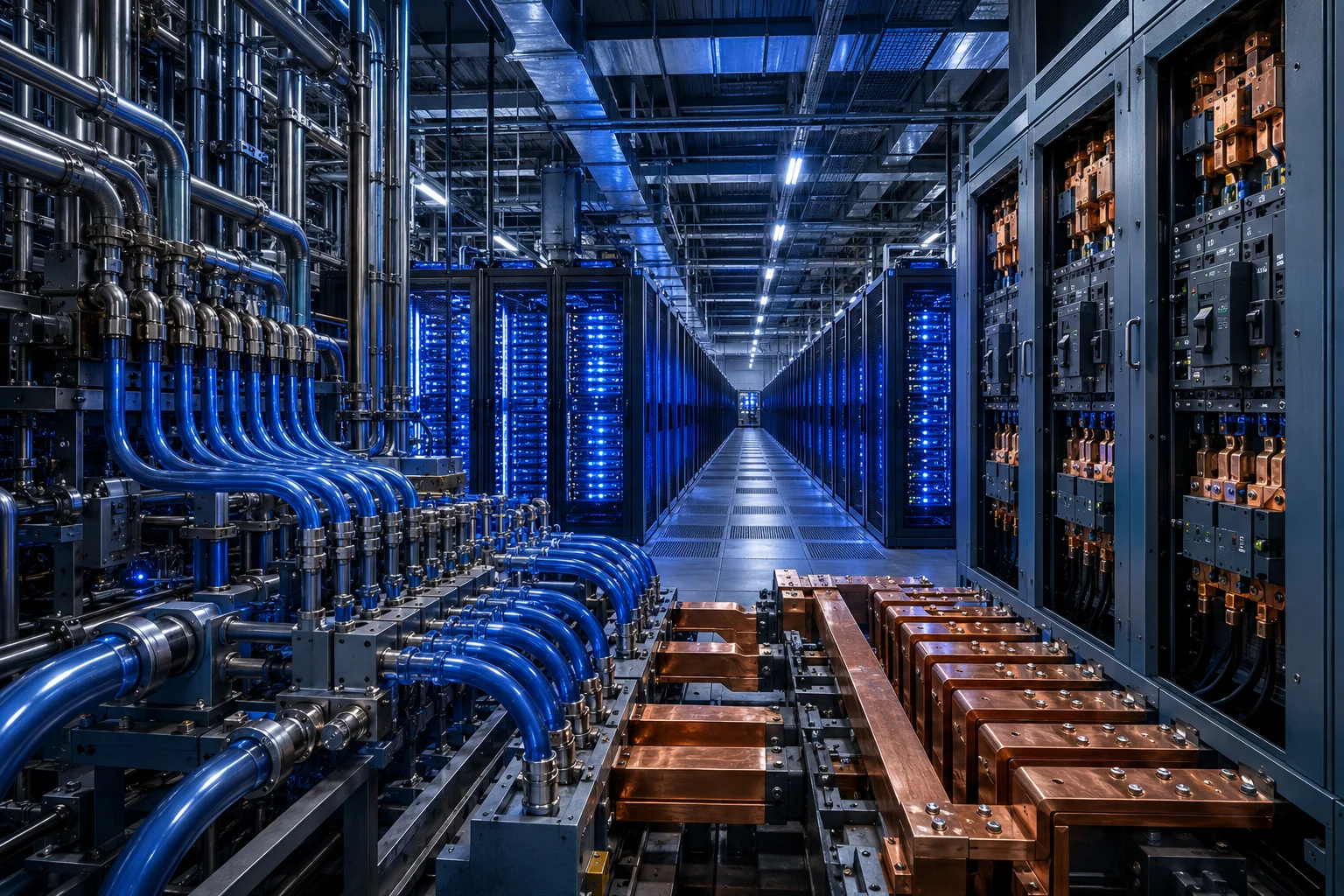
The Cooling Architecture Shift
The transition from traditional air-cooled data center architecture to liquid-cooled configurations has been one of the most consequential infrastructure shifts in the AI buildout. The earlier generation of data center cooling relied primarily on air conditioning systems that managed the thermal output of relatively low-density server configurations. The current generation of AI chips — Nvidia H100, H200, B100, and the broader high-end AI accelerator family — produces thermal output per chip that exceeds what air cooling can manage at the rack densities that AI workloads require.
The result is that liquid cooling has shifted from a specialised application used in supercomputing and specific high-performance computing environments to a mainstream requirement for AI data center deployment. The specific liquid cooling architectures vary across deployments (direct-to-chip liquid cooling, rear-door heat exchangers, immersion cooling for the most demanding configurations) and each architecture has specific equipment requirements and operational characteristics.
Vertiv Holdings has been one of the strongest competitive positioning beneficiaries of the liquid cooling shift. The company has invested aggressively in liquid cooling product development and has produced an integrated cooling product portfolio that addresses the various deployment requirements that AI data centers face. The financial results have reflected this competitive positioning, with Vertiv revenue growth substantially exceeding broader equipment manufacturer rates and with strong operating leverage as the AI-related demand has scaled.
The competitive picture in data center cooling includes several other significant players. Schneider Electric has its own cooling product portfolio that has been positioned for the AI deployment requirements. Stulz, a German specialised cooling manufacturer, has captured share particularly in the European market. Various specialised liquid cooling companies (CoolIT Systems, Submer for immersion cooling, Iceotope, several others) have captured share in specific niche applications.
The Power Distribution Equipment Demand
The power distribution infrastructure within data centers has been substantially affected by the AI buildout in ways that benefit the specialised electrical equipment manufacturers. The higher power densities at the rack level (50-100 kilowatts per rack vs the 5-15 kilowatts per rack of traditional configurations) require more sophisticated power distribution units, more robust electrical infrastructure within the rack, and the broader electrical safety and management equipment that operates at these higher power levels.
Eaton Corporation has been particularly well positioned for this segment of the AI equipment opportunity. The company’s power distribution products, uninterruptible power supplies, and the broader electrical infrastructure portfolio have benefited from the AI data center demand. The Eaton revenue growth has been strong across multiple quarters as the order book has continued to expand with AI-related procurement.
The competitive landscape in power distribution includes Schneider Electric (which competes with Eaton across multiple electrical equipment categories), ABB (which has specific strengths in industrial-scale electrical equipment), Siemens (which has substantial electrical infrastructure capabilities through Siemens Energy and other divisions), and various more specialised players. The competitive dynamics across these manufacturers reflect both the specific product positioning each has chosen and the broader customer relationships that influence procurement decisions.
The broader AI power infrastructure thesis includes the electrical equipment beneficiaries as one component of the picks-and-shovels exposure that captures the AI buildout demand without the direct capital intensity that affects the hyperscalers themselves. The structural growth opportunity for the equipment manufacturers extends across the multi-year capacity expansion cycle that the AI demand has created.
The UPS and Backup Power Category
Uninterruptible power supply (UPS) systems for data centers have been one of the most affected equipment categories by the AI buildout. The combination of higher power densities, more critical workload reliability requirements, and the substantial capital investment in AI computing infrastructure has produced demand for backup power systems at scale.
The major UPS manufacturers include Vertiv (which has substantial UPS product positioning), Eaton, Schneider Electric, and various more specialised manufacturers. The competitive dynamics have generally favored the manufacturers with the most comprehensive integrated product offerings that allow customers to procure UPS systems alongside the broader cooling and power distribution equipment, reducing the operational complexity of multiple vendor relationships.
The honest assessment of the UPS category is that the AI demand has been substantial but the competitive structure has been reasonably stable across the major manufacturers. The structural growth supports continued strong revenue across the major players without producing the dramatic share shifts that some other infrastructure equipment categories have experienced.
The Switchgear and Substation Equipment Layer
The transmission and distribution equipment layer — the electrical switchgear, transformers, and substation equipment that connects data centers to the broader electrical grid — has been one of the most acute supply constraint categories in the broader AI infrastructure buildout. The lead times for major switchgear and transformer orders have extended to multi-year horizons across the major manufacturers, reflecting both the AI-driven demand and the broader infrastructure capex cycle that affects multiple sectors.
The major switchgear and substation equipment manufacturers include Eaton, Schneider Electric, ABB, Siemens, Hitachi Energy, GE Vernova, and various specialised manufacturers. The lead time extensions and the corresponding pricing power that the manufacturers have captured have been particularly significant for this category, with multi-year order backlogs supporting continued revenue visibility.
The competitive picture has been affected by both the AI demand and the broader grid modernisation that the utility sector capex cycle has driven. The same equipment manufacturers that benefit from data center demand also benefit from the broader transmission and distribution modernisation, which produces revenue resilience even if specific data center demand moderates.
The Vertiv Competitive Position Specifically
Vertiv Holdings deserves specific attention because the company has captured one of the strongest competitive positions in the AI data center equipment buildout. Vertiv’s product portfolio spans the breadth of the equipment requirements that AI data centers need (cooling systems, power distribution, UPS, monitoring and management) and the integrated product positioning provides customer relationship advantages that pure-play competitors find harder to match.
The financial results that Vertiv has reported through 2025 and 2026 have validated the competitive positioning. Revenue growth has been substantial, the operating margins have expanded as the AI-related premium pricing has been captured, and the order book metrics have continued to support continued strong revenue growth. The stock performance has been correspondingly strong, producing total returns that have substantially outpaced broader electrical equipment sector indices.
The strategic question for Vertiv specifically is whether the competitive position can be sustained as the AI buildout continues and as competitors (particularly Schneider Electric and Eaton with substantial competing portfolios) compete more aggressively for the available demand. The probable trajectory is continued strong revenue with some margin pressure as competition intensifies, which would still support continued investment thesis even as the most dramatic growth periods normalise.
The 800VDC transition sharpens this competitive question because it resets which supplier holds the technical edge. Nvidia’s next-generation Rubin Ultra/Kyber rack platform, due for commercial deployment in the second half of 2026, requires data centers to move away from the 480VAC distribution most facilities still run toward 800V DC power delivered directly to the rack. Vertiv, Eaton, Schneider Electric, and Delta Electronics have all committed hardware roadmaps to that transition rather than ceding it to a single winner. Delta, not otherwise discussed in this piece, has moved furthest on the conversion hardware itself: it co-developed the “Panama” medium-voltage DC architecture with Alibaba and has demonstrated 800V DC in-row power racks pairing 660kW of capacity with 480kW of embedded battery backup. Eaton’s answer centers on a medium-voltage solid-state transformer built into its DC distribution architecture, a narrower conversion-stage bet than Vertiv’s strategy of selling power and cooling together as one delivery relationship. Schneider adds a software layer through its EcoStruxure digital-twin platform that the others do not fully match, which simplifies management across large multi-building campuses but also means a buyer adopting it takes on a design and monitoring layer that is harder to unwind later than a swapped power module.
For an operator sizing vendor lock-in risk on a 50MW-plus campus, the practical distinction is less about brand loyalty than about which layer gets embedded first: a software and design layer (Schneider), a specific conversion topology (Delta, Eaton), or an integrated power-and-cooling delivery relationship across the facility (Vertiv). Each pattern carries its own switching cost, and none of the four suppliers is lock-in-free — the same embedded-decision dynamic this piece’s switching-cost discussion above describes, applied specifically to the 480VAC-to-800VDC conversion now underway.
The Risk Factors and Cyclical Considerations
The picks-and-shovels equipment manufacturers face specific risk factors that warrant consideration despite the strong recent performance. The dependence on continued AI capex from the hyperscalers means that any moderation in the hyperscaler capex cycle would directly affect equipment demand. The Q2 2026 earnings season specifically will provide important evidence about whether the hyperscaler capex commitments are sustaining at the levels that current equipment manufacturer expectations imply.
The lead time extensions that have supported pricing power could reverse if capacity comes online faster than demand grows, producing margin pressure as the equipment manufacturers compete for available orders. The historical pattern in industrial equipment cycles has been that the periods of extended lead times and pricing power are followed by periods of capacity surplus and margin compression, which means the current strong margin environment may not persist indefinitely.
The valuation concerns are real for several of the equipment manufacturers. Vertiv specifically trades at valuation multiples that reflect strong continued growth expectations, which means the marginal return depends on continued execution against the bullish expectations rather than on multiple expansion. The other equipment manufacturers trade at more moderate multiples but still reflect the AI-driven growth in their valuations.
The Investor Positioning Considerations
For investors evaluating exposure to the AI infrastructure equipment thesis: the picks-and-shovels segment provides differentiated exposure to the AI buildout that complements rather than replaces the more direct AI exposures (semiconductors, hyperscalers, model providers). The specific company selection requires evaluating the competitive positioning across cooling, power distribution, UPS, and switchgear categories, with each having different specific dynamics.
The strongest competitive positions in 2026 are at Vertiv (specifically positioned for AI data center deployment), Eaton (broader electrical equipment positioning that includes substantial AI exposure), and Schneider Electric (comprehensive product portfolio with strong global positioning). The more specialised companies (CoolIT, Submer, the various specific niche players) offer concentrated exposure to specific segments but with less diversification.
The valuation considerations matter more in 2026 than they did at the cycle’s start. The strong performance has compressed the value opportunity that supported earlier returns, which means the marginal new position should be sized appropriately for the risk that the strong growth expectations may not be fully delivered.
The broader portfolio considerations include the diversification benefit that the picks-and-shovels segment provides relative to direct AI exposures. The equipment manufacturers benefit from the AI buildout but also benefit from the broader electrical infrastructure modernisation that supports their businesses even if specific AI dynamics moderate. The combination provides more resilient exposure than pure AI plays with similar growth characteristics.
The honest position is that the AI data center equipment manufacturers have produced substantial returns supported by genuine structural demand, that the competitive positioning of the leading companies is real and defensible, and that the appropriate exposure depends on careful evaluation of both the specific company positioning and the broader cyclical dynamics that affect the equipment categories. The next several years will continue to test whether the strong recent performance can be sustained, and the investors who have positioned thoughtfully across the equipment manufacturers should continue to capture attractive returns even as the most dramatic growth periods normalise.
How Much of the AI Hardware Cycle Has Already Been Priced In
The most useful question in any capex boom is not whether the demand is real. The demand is real. The useful question is how much of the future demand has already been priced into the companies that supply the boom. For Vertiv, Eaton, and Schneider, that question has a probabilistic answer — and the answer in mid-2026 is more complicated than either the bulls or the bears are acknowledging.
Start with what the base rate says. Every major infrastructure buildout in the last 40 years — fiber in the late 1990s, shale oil in the 2010s, EV manufacturing in the early 2020s — followed a similar pattern. The picks-and-shovels suppliers expanded faster than the underlying infrastructure demand justified, because capital markets funded capacity in anticipation of demand that eventually arrived but on a slower timeline than the initial projections implied. The suppliers who survived were the ones with the broadest installed-base advantages. The ones who collapsed were the ones who expanded capacity into a demand forecast that reflected peak optimism.
The AI buildout has a structural feature that makes the historical comparison imprecise. Previous infrastructure booms were largely domestic stories. The AI hardware cycle is being driven by demand on multiple continents simultaneously, with the Chinese side of the demand curve developing independently of Western hyperscaler spending. The Chinese AI competitive push through DeepSeek, Qwen, and ByteDance is not just a model story — it represents genuine datacenter expansion that creates incremental demand for exactly the cooling, power management, and rack-level infrastructure that Vertiv, Eaton, and Schneider produce. That incremental demand is not in most analyst models, because most analyst models are built on US hyperscaler capex guidance.
On the enterprise side, the demand signal is becoming clearer and the adoption gap is narrowing. Enterprise AI adoption — including Copilot penetration at the 3.3% level where most organizations currently sit — represents a demand floor for inference infrastructure that did not exist two years ago. The question is not whether enterprises are deploying AI. They are. The question is whether the hardware needed to serve enterprise inference workloads translates into sustained demand for the datacenter-level equipment these companies produce, or whether edge and on-device inference absorbs enough of the workload to soften the datacenter demand curve.
The probabilistic range on Vertiv, Eaton, and Schneider over a three-year horizon looks something like this: in the bull case, Chinese and enterprise demand together sustain hardware capex at above-consensus levels through 2027, the companies maintain pricing power on liquid cooling and power management hardware, and current valuations prove reasonable against earnings two years out. In the bear case, the AI capex cycle peaks in late 2025 to early 2026, enterprises find that inference workloads are more efficiently served by cloud than by on-premise expansion, and the equipment suppliers enter a demand normalization period similar to what fiber equipment manufacturers experienced in 2001. The middle case — a slowdown without a collapse — is probably the highest-probability scenario and implies mid-single-digit earnings growth with compressed multiples.
The capital market signals are worth watching alongside the operating signals. Crypto VC funding flowing to AI infrastructure has accelerated through early 2026, suggesting that speculative capital still sees the buildout as early-stage rather than mature. That is a real-time sentiment signal, even if it is a noisy one.
There is also a financing dimension that is underappreciated. Large-scale datacenter projects increasingly require project-level financing rather than balance-sheet funding from the hyperscalers alone. On-chain private credit infrastructure is beginning to appear in AI datacenter financing structures, with tokenized credit facilities funding specific rack-level deployments. This is early and small in aggregate — but it represents a financing channel that could extend the buildout timeline if traditional credit markets tighten.
The forecast, stated probabilistically: Vertiv, Eaton, and Schneider are not over the cliff. They are also not in the easy part of the trade anymore. The investors who bought on the thesis three years ago captured the re-rating. The investors entering now are buying a mature capex cycle story at equipment-company multiples that assume continued but slowing growth. That is not a bad investment — it is a different investment than the one that generated the outsized returns. The distinction matters for position sizing and time horizon.
Value Chain Positioning: Where Vertiv Sits in the AI Infrastructure Build-Out’s Margin Structure
Michael Porter’s value chain framework decomposes any industry into the sequence of activities that add value from raw input to end customer, and asks a specific strategic question at each link: does this activity generate a competitive advantage that can be defended, or is it a commoditizing pass-through that captures margin only until competition catches up? Applied to the AI data center build-out, Vertiv’s positioning in cooling and power distribution equipment sits at a specific, analyzable point in this chain — downstream of the semiconductor and compute layer that captures the most attention, but upstream of the software and application layers where much of the AI narrative’s excitement is concentrated.
Porter’s framework predicts that value chain positions closest to a genuine, hard-to-replicate technical bottleneck retain pricing power longest, while positions that are technically necessary but more substitutable see margin compress faster as competitors enter. The cooling architecture shift this article documents — from air cooling to liquid and immersion cooling as rack power density increases — is precisely a bottleneck-creation event in Porter’s terms: it resets the competitive landscape by requiring genuinely new technical capability that not every incumbent supplier can replicate quickly, which is why this specific transition matters more to Vertiv’s margin structure than incremental improvements to established cooling categories would. The semiconductor supply chain’s own bottleneck dynamics provide the clearest upstream comparison: TSMC’s advanced-node capacity represents an even harder-to-replicate bottleneck than data center cooling, which is why semiconductor margin structures have historically compressed less than equipment-layer margins during comparable technology transitions.
The power distribution equipment and switchgear layers this article examines sit in a different value chain position: more standardized, more subject to established competitors with decades of grid-infrastructure experience, and therefore more exposed to the kind of margin compression Porter’s framework predicts for less-differentiated links in a value chain. AI power demand’s phantom-load problem is directly relevant here: if actual deployed power demand undershoots the forecasts currently justifying capital investment in new power distribution capacity, the equipment suppliers serving that layer face a demand-side risk that is somewhat independent of their individual competitive positioning — a value chain link can be well-positioned competitively and still face margin pressure if the aggregate demand forecast driving the entire chain’s investment turns out to be inflated.
Vertiv’s competitive position specifically, in Porter’s terms, depends on whether its combination of cooling and power equipment expertise constitutes genuine linked-activity advantage — value chain positions that benefit from owning multiple adjacent links can capture margin that a single-link specialist cannot, because the integration itself becomes a switching cost for customers who would otherwise need to coordinate multiple vendors. Microsoft’s cloud AI capex strategy and the broader hyperscaler capex commitment this article’s demand analysis depends on illustrate the customer concentration risk inherent in this value chain position: equipment suppliers serving hyperscaler data center build-outs are exposed to a small number of very large, very sophisticated buyers who retain meaningful negotiating leverage over any single supplier, regardless of how differentiated that supplier’s specific technical capability is within its value chain link.
How much of the AI hardware cycle has already been priced in is, in Porter’s framework, ultimately a question about which value chain links the market currently believes retain durable pricing power versus which links the market has already begun discounting toward commodity margins. The capital allocation discipline question running through this site’s AI capex coverage applies directly to equipment-layer positioning: a value chain link that is necessary for the AI infrastructure build-out to proceed at all is not automatically a link that captures durable margin from that build-out, and Porter’s framework suggests the market’s current pricing of Vertiv and comparable equipment suppliers should be evaluated against the specific bottleneck-versus-commodity characteristics of their particular value chain position, not against the more general AI infrastructure growth narrative that applies to the build-out as a whole.