
When Microsoft announced its intention to acquire Activision Blizzard in January 2022, it deployed a number that had never appeared in a tech acquisition before: $68.7 billion. The deal took twenty-one months to close, surviving regulatory scrutiny in the US, UK, and EU. In October 2023, it finally did close — making it the largest acquisition in gaming history and one of the largest in technology. The transaction required the conviction that gaming, as a business, would generate returns that justified committing $68.7 billion of shareholder capital to it.

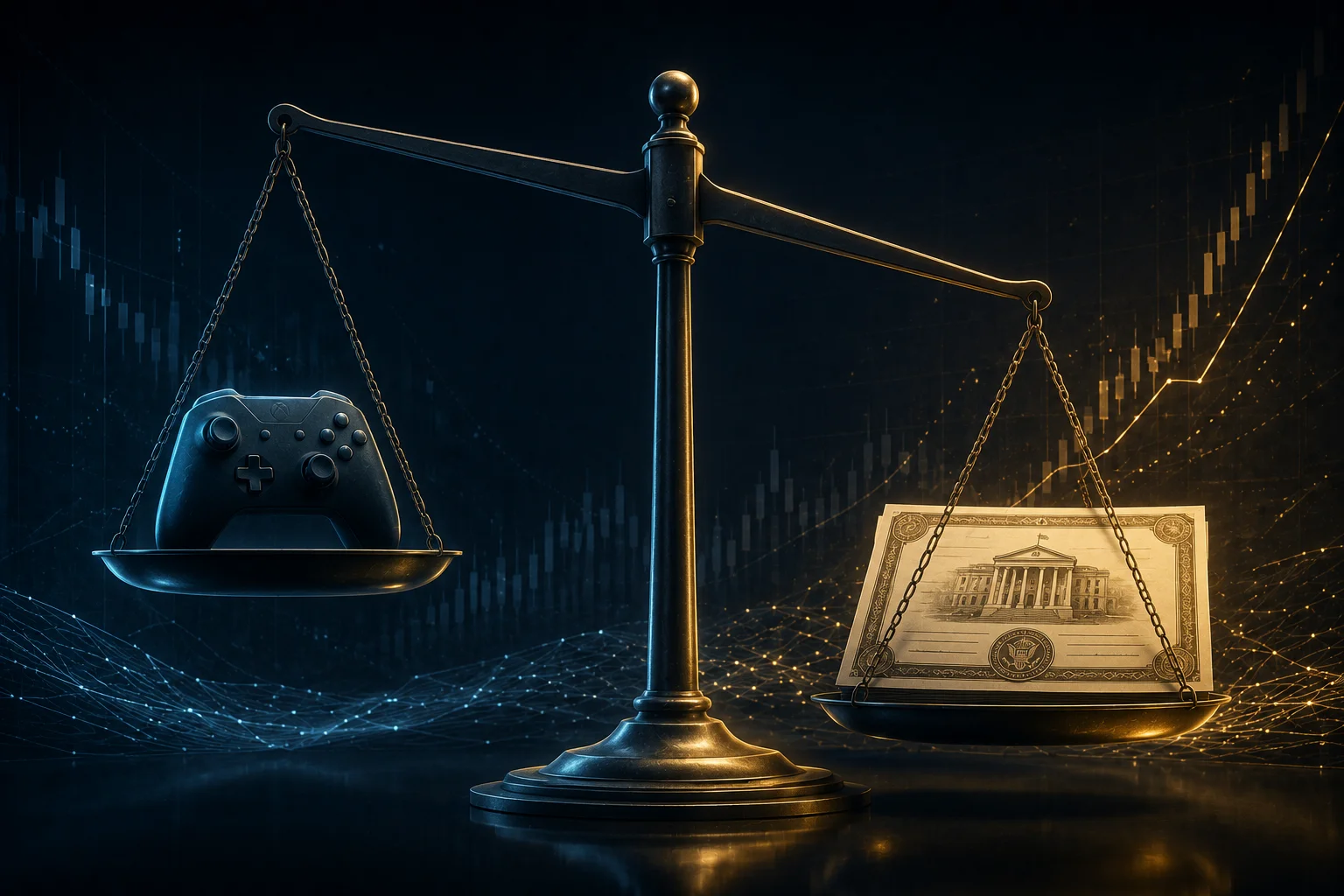
There is a simple, blunt way to evaluate whether that conviction was well-founded. Activision Blizzard’s last full fiscal year before the acquisition closed produced approximately $2 billion in operating income. $2 billion on $68.7 billion of deployed capital is a 2.9 percent yield — call it 3 percent. In October 2023, a six-month US Treasury bill yielded 5.5 percent. The risk-free rate was nearly double what Microsoft was buying.
That comparison is deliberately stark. Acquisitions are not supposed to be evaluated against the current risk-free rate — they are evaluated against the present value of projected future cash flows, which presumably grow. That is the standard argument. This piece examines whether the argument holds, and whether the assumptions embedded in the $68.7 billion price have materialized — or whether Microsoft’s shareholders would, in a narrow but real sense, have been better off if Microsoft had done nothing.
What $68.7 Billion Needed to Earn
Finance has a direct way of answering the question. The weighted average cost of capital — the blended rate at which Microsoft needs to earn returns to justify deploying capital — sits somewhere between 8 and 10 percent for a technology company of Microsoft’s profile. That is the hurdle. An acquisition needs to earn at least that rate on invested capital to create rather than destroy shareholder value.
On the $68.7 billion acquisition price, 8 percent WACC requires approximately $5.5 billion in annual operating income from the acquired business. Activision was generating roughly $2 billion at close. The gap between what Microsoft needed — $5.5 billion — and what it got — $2 billion — is approximately $3.5 billion per year. That is the annual value destruction toll if the acquisition fails to grow into its price. It must compound for years to stay ahead of what shareholders could have earned holding Microsoft stock or, more bluntly, holding bonds.
The T-bill alternative puts a number on the minimum acceptable outcome. $68.7 billion in six-month US Treasury bills in October 2023 would have generated approximately $3.8 billion in annual interest income, risk-free. No employees to manage. No studio closures. No union disputes over AI-displacement classifications. No FTC regulatory proceedings. No $3.8 billion carrying cost — just $3.8 billion incoming. The gaming business, as purchased, earned $1.8 billion less per year than the no-risk alternative. That $1.8 billion annualized gap, compounded over a two-year holding period, is roughly $3.6 billion in cumulative foregone income. Microsoft’s shareholders paid that freight.
Microsoft Borrowed Money at Rates Higher Than the Asset Earned
This is not just a theoretical alternative-rate exercise. To partially fund the acquisition, Microsoft issued bonds in October 2023. The issuance sold approximately $8.5 billion across multiple maturities — a two-year tranche at 5.25 percent, five and seven-year paper at 5.25 to 5.30 percent, ten-year bonds at 5.30 percent, and thirty-year notes at 5.40 percent. These are real borrowing costs, disclosed in public filings. Microsoft was paying 5.25 to 5.40 percent per year to bondholders in exchange for capital it deployed into an asset yielding approximately 3 percent on invested capital.
The spread between borrowing cost and asset yield — approximately 230 to 250 basis points — is not a rounding error. On $8.5 billion of bonds alone, the annual carry deficit is approximately $200 million. Microsoft is a large enough company to absorb that deficit. But it illustrates the fundamental capital structure problem the acquisition created: the asset needed to grow rapidly enough to close a gap that started, from day one, at negative 230 basis points relative to the cost of the debt used to fund it.
Defenders of the acquisition will correctly note that this calculation ignores synergies — the incremental value Microsoft’s platform adds to Activision’s franchises that Activision could not have extracted independently. Synergies are real in principle. The question is whether they have materialized in practice and whether they are large enough to close a $1.8 billion annual gap with a risk-free benchmark, let alone an 8 percent WACC hurdle.
The Thesis That Was Supposed to Justify the Multiple
The acquisition thesis had several components, each of which can be evaluated against what has happened in the two years since close.
First: Game Pass as a subscription flywheel. Microsoft argued that adding Activision’s IP — Call of Duty, World of Warcraft, Overwatch, Candy Crush — to Game Pass would accelerate subscriber growth and justify the subscription model at scale. Game Pass had approximately 25 million subscribers when the deal was announced. It had reached approximately 34 million by close in October 2023. As of the most recent quarterly disclosure, subscribers are approaching 45 million. Subscriber growth has continued. The rate of growth has slowed. Whether adding $68.7 billion of IP was the marginal driver of subscriber adds — versus platform improvements, PC Game Pass expansion, and broader entertainment market trends — is not observable from public data. What is observable: Call of Duty did not become an exclusive. Under regulatory pressure, Microsoft committed to keeping it available on PlayStation for at least ten years. The exclusivity premium that would have justified the strategic price was bargained away before the acquisition closed.
Second: mobile gaming. Activision’s Candy Crush mobile portfolio was cited as a gateway to the mobile gaming market — a market Microsoft had no meaningful presence in. King (the Candy Crush unit) generated approximately $2.7 billion in revenue in FY2022. As a standalone mobile business it is profitable and stable. Whether it is worth the implied strategic premium embedded in a $68.7 billion enterprise-value deal is harder to justify. Mobile gaming is an intensely competitive and margin-compressing business. King has not provided Microsoft a meaningful path into mobile gaming as a platform — it has provided a single profitable franchise in a market where platform leverage does not obviously translate from PC or console.
Third: IP library for Game Pass content depth. This is the strongest component of the thesis, and the least measurable. A library of iconic franchises purchased at any price has perpetual value as long as gaming exists as a cultural medium. The question is whether the value is commensurate with the price paid — and that question will not have a definitive answer for years, perhaps decades.
The Subscription Math and What It Hides
Game Pass is the strategic vehicle that is supposed to transform a 3 percent earnings yield on a $68.7 billion acquisition into something that clears the WACC hurdle. The subscriber economics deserve their own examination — and the Game Pass model has a fundamental tension between subscription value and loyalty extraction that complicates the growth story.
At 45 million subscribers paying an average of approximately $13/month (blending standard and Ultimate tiers, and netting promotional discounts), the run-rate annual revenue from Game Pass subscriptions is approximately $7 billion. Against this, Microsoft incurs substantial content licensing costs to keep Activision IP in the service, game development costs for first-party releases, server infrastructure costs, and the depreciation of the acquisition price itself spread across the asset life. The subscription margin is not disclosed at this granularity in Microsoft’s public filings, which report gaming as a segment that now bundles hardware, content, and subscription revenue together.
The bundling is not accidental. Presenting gaming as a single segment with $21.5 billion in annual revenue (as of FY2024, the first full year with Activision) creates the impression of a business that looks large and growing. The relevant question for the acquisition’s value justification is not segment revenue — it is the return on $68.7 billion of deployed capital embedded within that segment. That number is not disclosed and can only be estimated. The estimate does not flatter the acquisition.
The Share Buyback That Never Happened
There is a cleaner counterfactual than T-bills, and it is one that Microsoft’s own capital allocation history makes relevant. Microsoft is one of the most consistent share repurchasers in the technology sector. Between FY2020 and FY2023, it repurchased approximately $100 billion of its own shares. The program exists because Microsoft’s management believes, in most periods, that MSFT shares represent a better use of capital than alternative deployments.
When Microsoft announced the Activision deal in January 2022, MSFT was trading at approximately $290 per share. $68.7 billion at $290 per share equals approximately 237 million shares. Microsoft had roughly 7.5 billion shares outstanding at the time. Repurchasing 237 million shares would have reduced the share count by approximately 3.2 percent — a permanent, compounding EPS accretion of 3.2 percent with no execution risk, no integration cost, no regulatory review, and no studio closures.
MSFT’s stock appreciated substantially through 2024, reaching approximately $440 per share before recent pressures. At $440, the 237 million unrepurchased shares represent approximately $104 billion in market value — substantially more than the $68.7 billion deployed in the acquisition. A share count 3.2 percent smaller, multiplied against a $3 trillion market cap, is approximately $96 billion in shareholder value that a buyback would have preserved in the form of a larger per-share ownership stake for remaining holders. The comparison is imperfect — buybacks do not compound in quite that linear a way — but the direction is clear.
None of this is to say the Activision acquisition was definitively wrong. It may prove to be the right long-term strategic call. Microsoft’s platform extraction model depends on owning content and IP that creates lock-in across its product portfolio — and gaming IP, particularly Call of Duty, creates behavioral lock-in that Office 365 cannot. But the hurdle cleared by the strategic argument needs to be proportional to the opportunity cost. On that measure, the case remains open.
Why the AI Capex Bet Makes the Gaming Math Harder
The Activision acquisition would be a moderately difficult capital allocation question in isolation. It becomes substantially harder when placed alongside the AI infrastructure capex that Microsoft has committed since late 2023. Microsoft’s $190 billion AI infrastructure investment requires its own return on capital justification — and the gaming division now competes with AI infrastructure for the internal attention and resource allocation that determines whether underperforming assets get addressed or carried.
The two bets create an internal tension. The Activision acquisition needed the AI-enhanced gaming thesis to be true: AI tools would make game development more efficient, AI-generated content would expand the IP library faster and cheaper than traditional development, and AI-assisted game discovery would drive Game Pass subscriber retention. The June 2026 workforce reduction of 2,000 people across Xbox and Activision is explicitly framed in these terms — AI tools reducing the headcount needed to produce competitive game output. That argument is the bridge between the two capital bets: AI efficiency justifies both the gaming workforce reduction and the $190 billion infrastructure investment, because AI makes everything more productive at lower cost.
The problem is that the AI productivity claim has not been demonstrated at this scale in complex creative workflows. The test for game development will take two to three years to produce observable output. Meanwhile, the capex clock is running on $190 billion of infrastructure investment, and Copilot penetration at 3.3 percent enterprise adoption has not yet provided the enterprise revenue return that the infrastructure investment requires. Two unproven bets stacked on top of each other, funded by shareholder capital that could have earned 5.5 percent in T-bills, creates a compounding exposure that is not visible in segment-level revenue reporting.
What Would Actually Justify the Price
The acquisition becomes value-accretive under a specific set of conditions. Game Pass reaches 100 million subscribers — roughly 2.2× current count — at a meaningfully higher average revenue per subscriber than today. The AI efficiency claims prove out in game development, reducing per-title cost enough that the Activision IP library produces materially higher margins than Activision achieved standalone. Call of Duty maintains its franchise dominance over a development cycle produced by a leaner, AI-assisted team. Mobile gaming through King continues its stable cash generation while Microsoft finds a platform model for mobile that builds on the subscriber base it is assembling through console and PC.
None of these conditions are impossible. Some are actively in progress — subscriber growth continues, AI tooling is being deployed. The question is whether they collectively materialize at the speed and scale the acquisition price assumed. At $68.7 billion, the implied subscriber count needed to justify the price through Game Pass alone — with no margin improvement — is approximately 110 million at current pricing. Microsoft is at 45 million. The path requires either subscriber growth of 2.4× current scale, or a combination of subscriber growth and significant margin expansion, achieved against a competitive backdrop that includes Sony PlayStation’s platform and Nintendo’s hardware-software integration model, both of which have continued to invest in their own subscriber-acquisition strategies.
The Opportunity Cost Is Not an Academic Exercise
The T-bill comparison is deliberately simplified, but it is not meaningless. It puts a floor on what Microsoft’s shareholders gave up by making this acquisition at this price in this rate environment. $1.8 billion per year in foregone risk-free income is real money foregone on a real decision. The question it forces is not whether gaming is a bad business — it is whether $68.7 billion was the right price for this business at this moment, and whether the assumptions embedded in that price have proven more or less durable than the rate environment in which the decision was made.
Two years in, the evidence is mixed at best. Subscriber growth has continued below the trajectory needed to clear the WACC hurdle through Game Pass alone. The strategic exclusivity that would have added a platform premium was bargained away. AI productivity gains in game development are real in narrow applications and unproven at the scale that justifies the workforce reduction. The hardware business has declined for three consecutive quarters. The opportunity cost accumulates quarterly.
This is the part of Microsoft’s broader capital allocation story that does not appear in the press releases celebrating Game Pass subscriber milestones or AI-first development announcements. The T-bills would have paid more. The buybacks would have returned value in a provably compounding form. Whether the gaming bet beats those alternatives over a ten-year horizon is genuinely uncertain. But the uncertainty was knowable in January 2022, the price was knowable, and the rate environment was knowable. The decision to deploy $68.7 billion rather than the alternatives available at that moment is a board-level capital allocation judgment that shareholders should be asking about — quietly, or loudly, depending on how the next two years of Game Pass subscriber growth and first-party title quality resolve.
The Capital Allocation Record: What $68.7 Billion Teaches About Conviction Bets
Morgan Housel writes about the distinction between being right about the outcome and being right about the timing and price. The $68.7 billion Activision acquisition may be correct in the long view: gaming is a durable entertainment category, the IP portfolio has lasting value, and subscription gaming economics may eventually outperform transactional models at scale. None of that changes the immediate capital allocation reality. Microsoft paid a price that required a specific financial outcome by a specific time, and that outcome has not materialized on the timeline the price implied. Being right about the 20-year direction does not compound to rescue a short-term price that required 40x earnings to be justified by outcomes that arrived slower than the multiple assumed.
The opportunity cost frame is the one most gaming industry coverage skips, because opportunity cost requires thinking about what was not done rather than what was. The question is not whether the Activision acquisition was a poor acquisition in isolation. The question is what Microsoft could have done with $68.7 billion given what the company now knows about the AI transition timeline and the gaming market trajectory. It is the question that capital allocators should be asking about major acquisitions in real time, with explicit probability distributions across alternative uses of capital, and it is the question the acquisition’s defenders have not answered convincingly.
The parallel to concentrated single-thesis capital allocation is instructive. Saylor’s Bitcoin treasury strategy had internal structural coherence: fixed supply, increasing institutional demand, and a specific mechanism by which accumulation affects price. The problem with concentrated single-thesis bets is not the quality of the thesis at the time of commitment. The problem is that the position sizing does not account for scenarios in which the thesis is correct in direction but wrong in timing, and that price paid at peak narrative intensity rarely leaves room to survive those scenarios long enough to be vindicated. Microsoft buying a gaming asset at the beginning of an AI transition that would redirect consumer attention and corporate capital toward AI products is a version of this dynamic at the corporate balance sheet level.
The borrowing dimension compounds the opportunity cost calculation in a specific way. If Microsoft issued debt at rates higher than the gaming asset’s earnings yield, which the math suggests it did at scale given the acquisition multiple, that is the precise definition of value-destroying capital structure: paying a higher cost for borrowed capital than the acquired asset earns on that capital. The financial logic of doing so requires a growth projection in which the asset’s earnings eventually exceed the borrowing cost. That growth projection has not materialized on the timeline the acquisition pricing implied, and two subsequent rounds of layoffs suggest the growth path is being revised downward rather than upward.
The AI capex comparison is the most uncomfortable element of the opportunity cost calculation. The AI infrastructure buildout that Microsoft is now financing is competing for the same balance sheet that the Activision acquisition consumed. Microsoft’s total capital commitment in 2025-2026 is higher than it would have been without the acquisition, and the gaming revenue required to justify the combined capital structure is correspondingly higher than the gaming business can currently generate. The acquisition has not prevented the AI investment. It has made the AI investment more expensive at the margin by consuming financial flexibility that would otherwise reduce the cost of the AI capital structure.
The missing buyback is the balance sheet telling the story that the earnings press release does not. US corporate buybacks are at record levels in 2026. Microsoft has been absent from the trend at its pre-acquisition pace. A company generating Microsoft’s level of operating cash flow should be buying back stock aggressively, unless that cash flow is being consumed by debt service and capex commitments that reduce the available return. The buyback pace is the most honest signal of how much financial flexibility the capital structure actually has, and it has been compressing since the acquisition closed.
Housel’s version of this lesson focuses on what changes when you hold a concentrated bet across a long horizon. The investors who have compounded wealth most reliably over long periods are not typically the ones who made the single highest-returning bet. They are the ones who avoided the catastrophic drawdown that a single wrong concentrated bet can inflict, because the drawdown removes the financial optionality to participate in the next opportunity. For a corporate balance sheet, the equivalent is a large acquisition that generates below cost-of-capital returns for long enough that management attention, strategic flexibility, and investment capacity are all constrained during a critical competitive transition. Microsoft has the resources to absorb the Activision misallocation. The cost is not existential. The cost is measured in the optionality consumed during the AI transition, in what the company could have done and could now be doing with that capital at the most consequential inflection point in technology history since the internet.
The Copilot trajectory is the one scenario in which the capital allocation record reads differently at a five-year horizon. Enterprise AI adoption penetration at 3.3% currently is the early-adoption phase of what could become a structural shift in enterprise software economics. If Copilot reaches 15-20% penetration across the enterprise base over the next three years, the recurring revenue compounding will generate returns that make the gaming acquisition a smaller fraction of total value creation. In that scenario, the portfolio of AI investment plus gaming acquisition is more defensible than gaming alone, because the AI returns offset the gaming underperformance. The gaming math, stated on its own terms, does not work at the acquisition price. The question is whether the AI trajectory is strong enough and fast enough to make the portfolio work. That is the bet Microsoft is now running.
Charlie Munger’s Opportunity Cost Test: What the Xbox Acquisition Actually Cost
Charlie Munger argued that the most important number in capital allocation is not the return on the investment being evaluated, but the return on the best alternative use of the same capital. By this standard, the $68.7 billion paid for Activision Blizzard requires comparison not to zero or to the cost of capital but to the specific alternatives that Microsoft could have executed with the same capital at the same time. The relevant alternative in 2023-2026 is not hypothetical. Risk-free rates moved to 5%, meaning Microsoft could have earned a guaranteed real return higher than the Xbox gaming business has historically produced. The 3% return this article documents against a 5% risk-free rate is not a failure of gaming strategy — it is a demonstration of the opportunity cost principle that Munger deployed as his primary investment filter.
Munger also identified the danger of what he called “first-conclusion bias” — the tendency to defend an investment thesis once committed rather than continuously re-evaluating it against the current opportunity set. The fiscal trajectory that keeps Treasury yields elevated changes the opportunity cost calculation prospectively, not just retrospectively. If yields remain at or above 4.5% for the next three years — which the deficit math implies is plausible — then every dollar of Microsoft’s capital allocated to gaming content production is competing against a 4.5% risk-free floor. The restructuring of Microsoft’s AI supply chain raises the opportunity cost further, because Azure AI infrastructure investments now have a clearer path to returns than gaming content does.
The Munger discipline would not conclude that the acquisition was necessarily wrong — hindsight is not the standard — but would insist that the current allocation of resources within the acquired entity should be continuously tested against alternatives. Governance instability at OpenAI makes the Azure AI opportunity less certain than the risk-free rate, but it does not change the fundamental logic: capital deployed at 3% return when alternatives yield 5% is being misallocated, and the organisational reason that misallocation persists matters. The developer ecosystem dynamics suggest that Microsoft’s highest-return capital deployment is in the AI infrastructure stack, not the gaming content stack — which makes the Xbox acquisition’s opportunity cost not just a historical observation but an active capital allocation question. The crossroads Microsoft now faces is precisely the moment Munger’s framework was designed for: when the first-conclusion position has underperformed the opportunity cost for long enough that re-evaluation is overdue.