
SpaceX (SPCX) closed at $161 on its first day of trading on June 12 — up 19% from its $135 IPO price. Three sessions later it peaked at $225.64, a 67% gain from the offer price. Then it began falling. By June 17, the date options started trading, the stock had retreated from its high. By the following week it had lost approximately 10% from the peak. Gary Black, managing director of The Future Fund — a long-focused manager with no particular incentive to be bearish — stated publicly that SPCX “acts more like a meme stock than one driven by fundamentals.” Nothing about the company changed across any of those sessions. What changed was the structure of the market around it.
What a 4% Float Actually Means
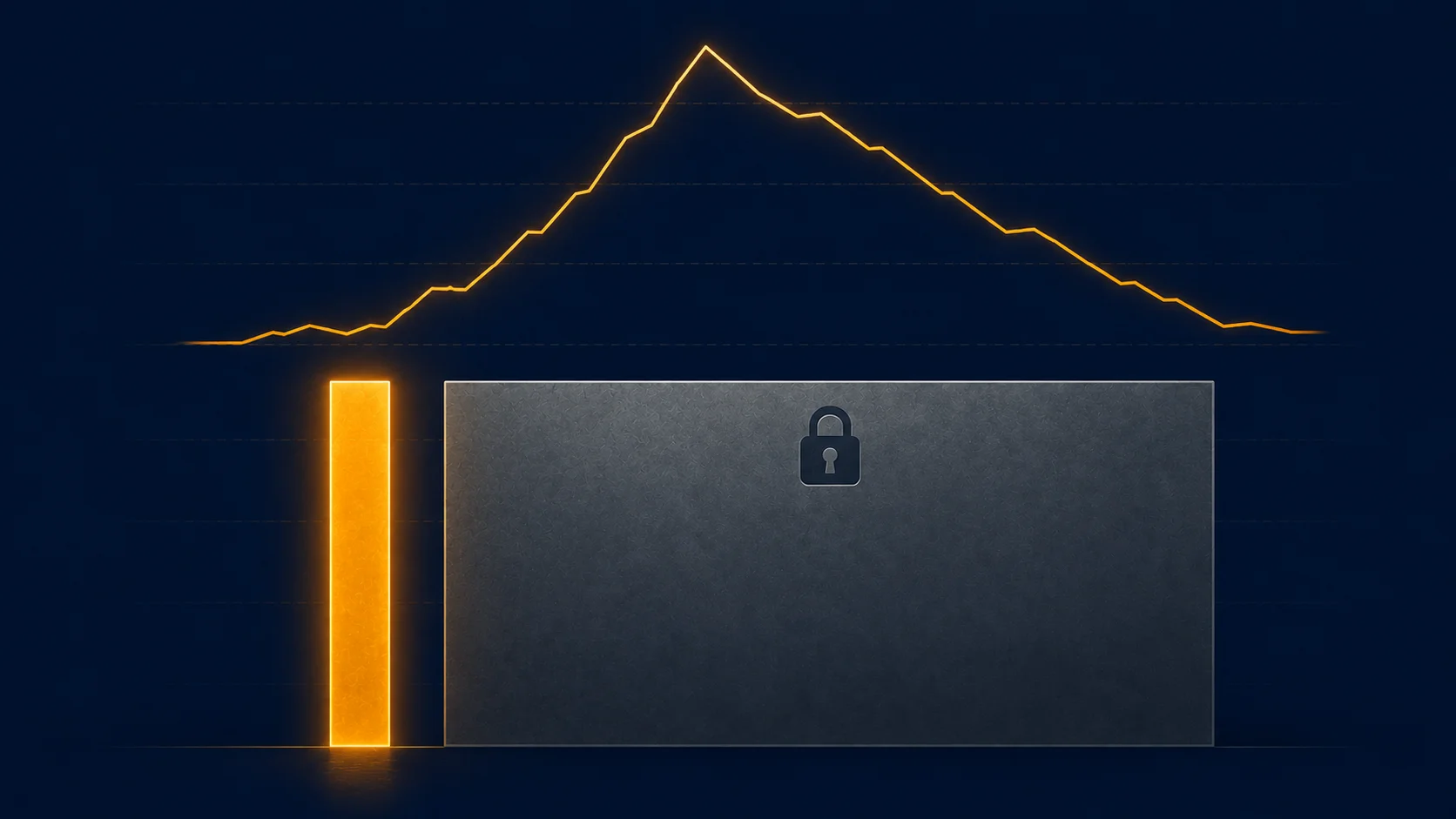
SpaceX sold approximately 4% of its shares in the IPO. The remaining 96% are held by insiders — founders, early investors, employees with vested options — and are subject to lock-up agreements running until December 2026. This structure is not unusual for large IPOs. What is unusual is the combination of a 4% float with a company carrying a $1.77 trillion implied market capitalisation and the largest retail FOMO profile of any listing in recent memory.
When 4% of the shares determine the price for 100% of the company, the price-setting mechanism is not a broad equilibrium between buyers and sellers with diverse information, diverse time horizons, and diverse views on valuation. It is the price at which the 4% clears against the highest-motivated buyers who have been waiting years for SpaceX to list. That is a different thing than a market price in any conventional sense. It is the price at which FOMO capital absorbs the available supply — and available supply was deliberately minimised by the decision to float only 4%.
The structural constraints on the other side of the trade amplified this effect. At IPO, there were no shares available to borrow for short selling — no institutional lender had stock to lend because no stock was in public hands. There were no put options — SPCX options did not begin trading until June 17. Any participant who believed SPCX at $135, $161, or $200 was materially overvalued had no practical mechanism to act on that view. They could not short the stock. They could not buy puts. They could only decline to buy. That is a very different market structure than the one that prices established equities, where bears and bulls compete simultaneously to determine the clearing price.
The 67% run from $135 to $225 happened entirely within this asymmetric market: maximum concentrated demand (years of pent-up retail interest in SpaceX) against minimum available supply (4% float) with zero ability to express a negative view. Under those conditions, $225 is not evidence that the market values SpaceX at approximately $2.9 trillion. It is evidence of what the price looks like when demand has no counterweight.
The June 17 Structural Break
Options began trading on SPCX on June 17. This was the first moment in the stock’s public life when a participant who believed it was overvalued could take a practical position expressing that belief. Put options on SPCX — which had been unavailable — became tradeable. The market structure that had produced the 67% run now had a counterweight.
The timing correlation is precise: SPCX peaked at $225.64 before options trading began and began its retreat on June 17. This is not a coincidence of investor psychology. It is a structural consequence. The market that existed from June 12 to June 16 was not a normal equity market. It was a market in which the bears had been formally excluded. On June 17 they were readmitted. The price adjusted.
The crypto listing mechanics we documented previously operate at a faster timescale but the same structural logic: the pump window is bounded by the period during which bears cannot participate. In a Telegram pump-and-dump, that window is seconds to minutes — the coin is illiquid enough that the price peaks before sellers can coordinate a response. In SPCX, that window was five trading days — the period between listing and the start of options trading. In both cases, the window’s close is the beginning of the reversion.
Gary Black’s Assessment
Gary Black’s statement is worth quoting in full: “I have resisted commenting on SPCX as it acts more like a meme stock than one driven by fundamentals.” He added that the dynamic “may be ending,” and specifically flagged the lockup expiry as the event to watch — advising investors to revisit their SpaceX position after lock-ups begin expiring in August.
The source matters here. Black is not a short-seller publishing a thesis designed to move the price of a position. He is a long-focused fund manager who has owned Tesla through its own controversial valuation periods and who therefore understands the distinction between a high-multiple stock with a defensible growth thesis and a stock whose price is a product of structural market conditions rather than fundamental reassessment. His explicit use of “meme stock” — a term with a specific meaning in market commentary — and his reluctance to comment until the situation became unambiguous reflect a considered judgement, not a reflexive response.
The former Nasdaq CEO Robert Greifeld had already stated, separately, that SPCX was “not trading on fundamentals” and was trading on “aspiration.” Morningstar had published a $780 billion fair value, less than half the listing price. Damodaran had published $1.3 trillion, 28% below listing. The named authority consensus on the valuation gap is unusually large and unusually consistent. When a stock’s first major post-listing commentary consists of a meme stock label from a respected long-only manager, a “not on fundamentals” assessment from the former head of its listing exchange, and fair value estimates from two independent analysts that are 28% to 56% below the listing price, the burden of proof rests on those arguing the listing price is correct.

The Cursor Deal and What It Tells You About Management
SpaceX announced on June 16 — four days after the IPO — that it would acquire Cursor, the AI coding assistant developed by San Francisco startup Anysphere, in a $60 billion all-stock deal. The transaction is expected to close in the third quarter of 2026. What the announcement revealed is not just SpaceX’s AI ambitions. It revealed the pre-IPO structure of the deal.
SpaceX committed to the Cursor acquisition in April 2026 — before the IPO. The terms: $60 billion in SpaceX stock, or a $10 billion break-up fee if SpaceX walked away. This pre-commitment structure means SpaceX management made a $60 billion stock deal at a time when SpaceX was a private company carrying a pre-IPO valuation well below the eventual $1.77 trillion listing price. The stock they were committing to pay with was worth substantially less than it would be worth by IPO day.
The consequence is arithmetically precise: a $60 billion payment in stock requires fewer shares when the stock price is higher. At the $135 IPO price, paying $60 billion requires issuing a specific number of new shares. At the $225 peak, the same $60 billion payment requires roughly 40% fewer shares — meaning less dilution for existing shareholders, including SpaceX founders, employees, and early investors. The meme-stock run that drove SPCX from $135 to $225 was, from SpaceX’s perspective as a corporate acquirer committed to a fixed dollar value stock deal, concretely beneficial. Every dollar of SPCX price appreciation between commitment and payment translated directly into fewer shares issued to Cursor shareholders.
This is not an accusation. It is a description of how equity works. Cursor carries approximately $2.6 billion in annualised B2B revenue and represents a genuine strategic asset in the enterprise AI coding market. SpaceX is acquiring a real business with real revenue. The question is simply what currency they are paying with, and whether the value of that currency at the moment of payment reflects a stable assessment of SpaceX’s worth or a structural market condition that is in the process of correcting.
The historical precedent for this dynamic is unambiguous. The 1999–2001 period saw technology companies systematically use inflated stock as acquisition currency. Cisco Systems completed 72 acquisitions between 1993 and 2000, the majority paid in stock during a period when Cisco’s own price-to-earnings ratio reached levels that no cash flow model could justify. AOL acquired Time Warner in January 2000 for $182 billion, overwhelmingly in stock, at the precise peak of the dot-com valuation bubble — a transaction that subsequently became the textbook case for using overvalued equity to acquire tangible assets. The common structure in each case: management committed to stock-denominated deals when the stock’s value was at its maximum narrative concentration, then closed the deals before the correction fully ran.
SpaceX’s Cursor deal fits this pattern structurally. The commitment was made before the IPO created the narrative concentration. The closing is expected in Q3 2026. The question of whether the $225 SPCX price at time of close represents durable value or a temporary peak will determine whether this acquisition was made at a favourable exchange rate or at the rate that a patient Cursor shareholder will regret.
The Low-Float Structural Parallel in Crypto
The 4% float structure has a precise analogue in crypto market mechanics. The low-float, high-fully-diluted-value token listing is a standard pattern in crypto markets: a project lists a small percentage of its total token supply at a high implied valuation. The majority of supply is held by the team, early investors, and advisors, subject to vesting schedules that create structured release over 12–36 months. The listing price is set by the demand for the small circulating supply against the full implied market capitalisation. As vesting unlocks arrive, supply increases and the price reverts toward a level where the broader supply is cleared.
Crypto markets developed a specific vocabulary for this structure. “Low float, high FDV” (fully diluted valuation) became a warning term among experienced participants — it identifies listings where the circulating supply is so small that the listing price reflects FOMO demand against minimal supply, not the price at which the full supply would clear. The pattern was documented sufficiently often that by 2023, most serious crypto participants treated low-float listings with explicit scepticism regardless of the project’s quality.
SPCX is a 4% float, high implied market cap listing of exactly this type. The analogy is not an attack on SpaceX’s business. It is a description of the market structure. SpaceX is a genuine company with genuine revenue and genuine technological achievements. The low-float crypto tokens that became cautionary tales were often legitimate projects as well. The issue is not the quality of the underlying entity. The issue is what the listing price represents when 96% of the supply has not yet participated in price discovery.

Three Dates That Actually Matter
The IPO date — June 12 — is the date most people associate with SpaceX’s entry into public markets. It is the least informative date for understanding what SPCX will be worth at equilibrium. Three subsequent dates carry more analytical weight.
August 2026: The first partial lockup release. Gary Black explicitly identified August as the date investors should revisit their SPCX position — not June, not the IPO, but the first moment when a meaningful portion of locked-up shareholders can access liquidity. The decision insiders make in August — whether to hold, sell partially, or begin reducing positions — will be the first data point on what people with full information about SpaceX’s operations and prospects believe the stock is worth at prevailing prices.
September 2, 2026: The first post-IPO earnings release. SpaceX will report quarterly results as a public company for the first time. The financials — including the $4.28 billion net loss and negative $9 billion free cash flow that the IPO prospectus disclosed — will become the subject of quarterly analyst scrutiny rather than one-time IPO commentary. Revenue growth rates, Starlink subscriber additions, Starship launch cadence, and the trajectory of R&D spend will all be measured against what the $225 peak price implied. The September earnings are the first genuine fundamental anchor for a stock whose price has so far been set primarily by structural supply constraints and narrative concentration.
December 2026: The principal lockup expiry. When 96% of SpaceX shares become freely tradeable, the price-setting mechanism changes fundamentally. The market will no longer be pricing 4% of the company against concentrated FOMO demand. It will be pricing 100% of the company against the full range of buyers and sellers, including insiders with cost bases near zero, employees with options exercised at pre-IPO valuations, and early investors who have waited years for this moment. December is when the supply side of the SpaceX market will fully participate in price discovery for the first time.
The asymmetry of the December situation is important. An early SpaceX employee or seed-stage investor holding shares with an effective cost basis of effectively zero will find it rational to sell some portion of their position at $100, $150, or $200 — all prices that represent extraordinary returns from their perspective. The seller pool in December does not need a price target above $225 to make selling rational. It needs only the lock to open. The buyer pool in December will need to believe that the current SPCX price reflects a value they are willing to pay. That is a much higher bar than it sounds when Morningstar’s fair value is $780 billion and Damodaran’s is $1.3 trillion and the current implied market cap is approaching $3 trillion.
What Comes After SpaceX
The SPCX listing is one event in a pattern that will recur with every high-anticipation private company that transitions to public markets. The pipeline is well-populated. OpenAI’s private valuation has been reported at approximately $850 billion, set in funding rounds where institutional access was restricted and retail access was unavailable. When OpenAI lists — if it lists — the same structural conditions will be available: years of accumulated narrative, maximum FOMO concentration at listing, a decision on float size that will determine how much structural support or suppression the listing price receives, and a lock-up expiry that will be the real test of durable value.
The lesson that crypto markets taught — at the cost of significant retail losses across thousands of low-float, high-FDV listings — is that the quality of the project and the rationality of the listing price are independent variables that must be assessed separately. SpaceX is an extraordinary company. The SPCX listing price at $225 on a 4% float with no short selling and no put options is a measurement of something other than what SpaceX is worth. Both things can be true simultaneously.
The December lockup will produce data that no analyst model, no DCF, and no narrative assessment can substitute for: the price at which people who built SpaceX and have been waiting years for liquidity choose to sell. If they sell heavily and the price holds, the $225 level had more fundamental support than the structural analysis suggests. If they sell and the price falls significantly, the 67% IPO run will be understood retrospectively as exactly what Gary Black called it: a meme stock run, executed at the speed of an equity market rather than a crypto exchange, but operating by the same underlying mechanics.
The Only Question That Matters
The question of whether SPCX is a buy at any given price is not the question this article addresses. Damodaran’s $1.3 trillion, Morningstar’s $780 billion, and the current implied market cap of approximately $2.9 trillion at the $225 peak describe a wide range of outcomes. Reasonable investors with access to the same prospectus can arrive at very different conclusions about where in that range the stock will eventually find equilibrium.
The question this article does address is narrower: what does the 67% run from $135 to $225 actually measure? The answer is that it measures concentrated FOMO demand against minimal available supply, in a market that structurally excluded the counterweight of bearish participants, during the peak narrative concentration window of SpaceX’s transition from private to public. It is not a measurement of what SpaceX is worth. It is a measurement of what happens when the most anticipated listing in years meets the thinnest float on record in an environment designed to produce price spikes.
December will provide a different measurement. Not a perfect one — no single price is — but one generated under conditions that are considerably closer to a real market. When 96% of the shares can be sold, the sellers who choose to sell are providing information about what the people with the longest, deepest knowledge of the company believe the stock is worth at prevailing prices. That information does not exist yet. It will exist in December.
In the meantime, SpaceX has used the window to commit $60 billion in stock to acquire Cursor, paying with currency that was worth its maximum relative to any defensible fundamental value. Gary Black has called the run what it is. The options market, active for six days, has provided the first mechanism for bearish price discovery. The structural conditions that created the run are being dismantled in sequence — options in June, partial lockup in August, earnings in September, full lockup in December. The 67% is the peak narrative concentration. What follows is the process of finding out whether any of it sticks.
The 4% Float and the Flywheel: What the SPCX Lockup Structure Reveals About SpaceX’s Business Logic
Collins’s flywheel concept is the most useful frame for understanding why SpaceX’s 4% public float is not a quirk of the capital markets situation but a deliberate reflection of the company’s strategic logic. The flywheel is a self-reinforcing cycle of activities that, once established, generates its own momentum: each turn of the wheel makes the next turn easier. Applied to SpaceX’s equity structure, the 4% float preserves the flywheel by keeping the company’s decision-making authority within the organisation’s mission-aligned leadership and away from the quarterly earnings pressure that would force trade-offs between short-term capital return and long-term mission execution.
The flywheel for SpaceX is not a typical technology flywheel. It is a mission-and-capital-cycle flywheel: launch volume drives down cost-per-launch (reusability economics), lower costs attract more commercial and government customers, more customers fund the R&D and manufacturing scale that enables the next-generation hardware, next-generation hardware enables higher launch cadence and Starlink expansion, Starlink cash flows fund the Mars and deep-space architecture. Each element of this cycle requires multi-year capital commitment at a scale that is incompatible with the quarterly reporting rhythms that public market ownership typically imposes. The 4% float is the structural mechanism that prevents public shareholders from disrupting the flywheel’s tempo.
Collins distinguishes between companies that sustain the flywheel discipline — making consistent, coherent choices aligned with their core competence over long periods — and companies that pursue the ‘doom loop’ of lurching between strategies in response to external pressure. The doom loop for SpaceX would be a scenario where public market pressure forced the company to prioritise Starlink profitability over Starship development, or to reduce launch cadence to protect margins in a quarter when Falcon 9 demand is temporarily lower. The 4% float is insurance against this scenario: the shareholders who own 96% of SpaceX outside the public market either believe in the flywheel or have had their access priced to reflect long-term risk. the SpaceX IPO FOMO listing psychology represents one path to the doom loop: if the SpaceX FOMO narrative drives the valuation to levels that create redemption pressure among secondary holders, that pressure eventually reaches the cap table even through a restricted float.
The comparison to OpenAI’s $1 trillion IPO and float management is instructive. OpenAI’s IPO at $1 trillion is a scenario where the public market float will be large enough to create substantial public shareholder pressure from day one. OpenAI has explicitly tied its mission (beneficial AI for humanity) to a for-profit capital structure that will need to satisfy public shareholders’ return expectations. The tension is structural: the mission may require capital allocation choices that reduce near-term profitability in service of long-term safety or capability goals, and public shareholders are not well-positioned to evaluate those trade-offs without accepting significantly more valuation uncertainty than a $1T IPO price implies. SpaceX has, so far, avoided this tension precisely by keeping the public market ownership minimal.
what the end of the easy technology era means for capital structure provides the macro context: the end of the easy-technology era means that future large-technology capital structures will face more scrutiny on the alignment between public equity claims and actual business fundamentals. SpaceX’s flywheel is real — Starlink has genuine revenue, launch economics have genuinely improved, the government customer base is genuinely defensible. The question is whether the flywheel’s value can be sustained across a capital structure that will eventually need to reconcile the private-market valuation with public-market information requirements. tokenisation of private equity as a market access mechanism is relevant here as an emerging alternative: if tokenised private equity instruments allow SpaceX to extend its funding base without expanding the public float, the flywheel can be maintained longer. The attribution illusion in equity float analysis: the SPCX lockup structure creates a measurement problem for investors trying to value the public equity correctly, because the 4% float produces pricing that is partially a function of liquidity scarcity rather than pure fundamental value. The premium paid for SPCX access is not fully attributable to SpaceX’s intrinsic value — it is partly an attribution to the artificial scarcity of the float. Separating these two components requires more analytical discipline than most retail FOMO participants apply.