

NATGAS$2.89▼ 8.25%BRENT$83.76▼ 1.92%RAIN$0.0167▼ 1.77%BNB$692.45▲ 1.16%GOOGL$339.35▼ 2.09%NVDA$220.78▲ 1.48%SOL$103.93▲ 2.21%XRP$1.38▲ 2.05%AAPL$316.85▼ 0.89%WTI$80.46▼ 5.13%AMZN$259.77▼ 2.50%USDS$0.9999▲ 0.02%XMR$515.64▲ 1.09%ZEC$855.88▲ 3.72%MSFT$507.29▼ 1.22%META$572.34▼ 0.98%FIGR_HELOC$1.00▸ 0.00%TSLA$367.95▲ 5.51%BTC$78,865.00▲ 1.44%HYPE$84.07▲ 4.28%MSTR$132.94▲ 4.42%NFLX$81.05▼ 0.82%LEO$9.38▼ 2.22%ETH$2,473.47▲ 2.10%WBT$72.66▲ 1.59%XAU$4,479.20▲ 1.09%XAG$67.14▲ 1.38%TRX$0.3317▼ 1.39%COIN$188.12▲ 5.31%DOGE$0.0833▲ 1.27%NATGAS$2.89▼ 8.25%BRENT$83.76▼ 1.92%RAIN$0.0167▼ 1.77%BNB$692.45▲ 1.16%GOOGL$339.35▼ 2.09%NVDA$220.78▲ 1.48%SOL$103.93▲ 2.21%XRP$1.38▲ 2.05%AAPL$316.85▼ 0.89%WTI$80.46▼ 5.13%AMZN$259.77▼ 2.50%USDS$0.9999▲ 0.02%XMR$515.64▲ 1.09%ZEC$855.88▲ 3.72%MSFT$507.29▼ 1.22%META$572.34▼ 0.98%FIGR_HELOC$1.00▸ 0.00%TSLA$367.95▲ 5.51%BTC$78,865.00▲ 1.44%HYPE$84.07▲ 4.28%MSTR$132.94▲ 4.42%NFLX$81.05▼ 0.82%LEO$9.38▼ 2.22%ETH$2,473.47▲ 2.10%WBT$72.66▲ 1.59%XAU$4,479.20▲ 1.09%XAG$67.14▲ 1.38%TRX$0.3317▼ 1.39%COIN$188.12▲ 5.31%DOGE$0.0833▲ 1.27%
Delayed

Author: Lauren Mercer

  • Cisco’s AI Networking Revenue Crossed $5 Billion

    Cisco’s AI Networking Revenue Crossed $5 Billion

    Cisco AI networking east-west GPU fabric enterprise

    Cisco’s AI Networking Revenue Has Crossed $5 Billion and Enterprise Data Centers Are Being Rebuilt for East-West GPU Traffic

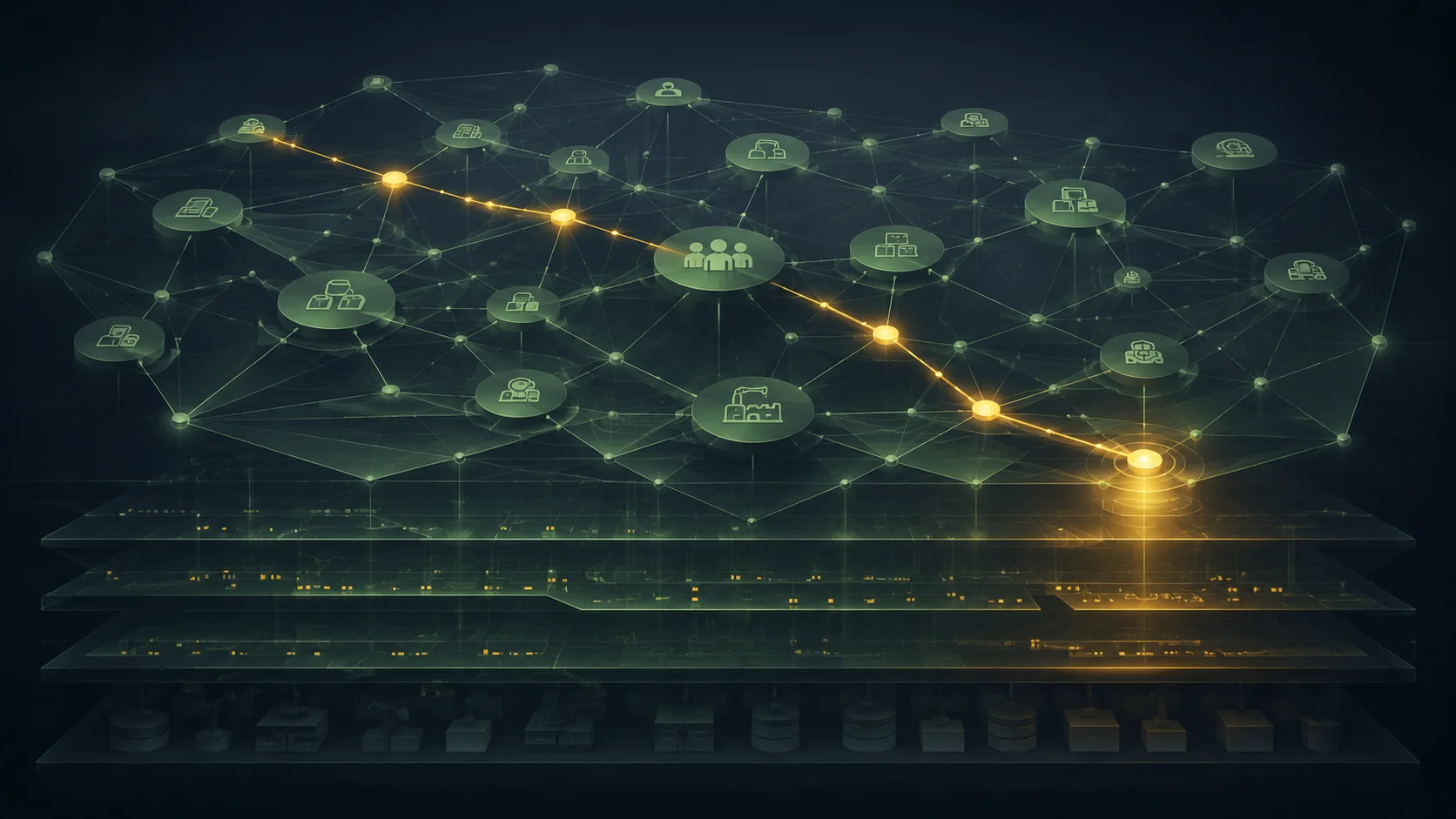
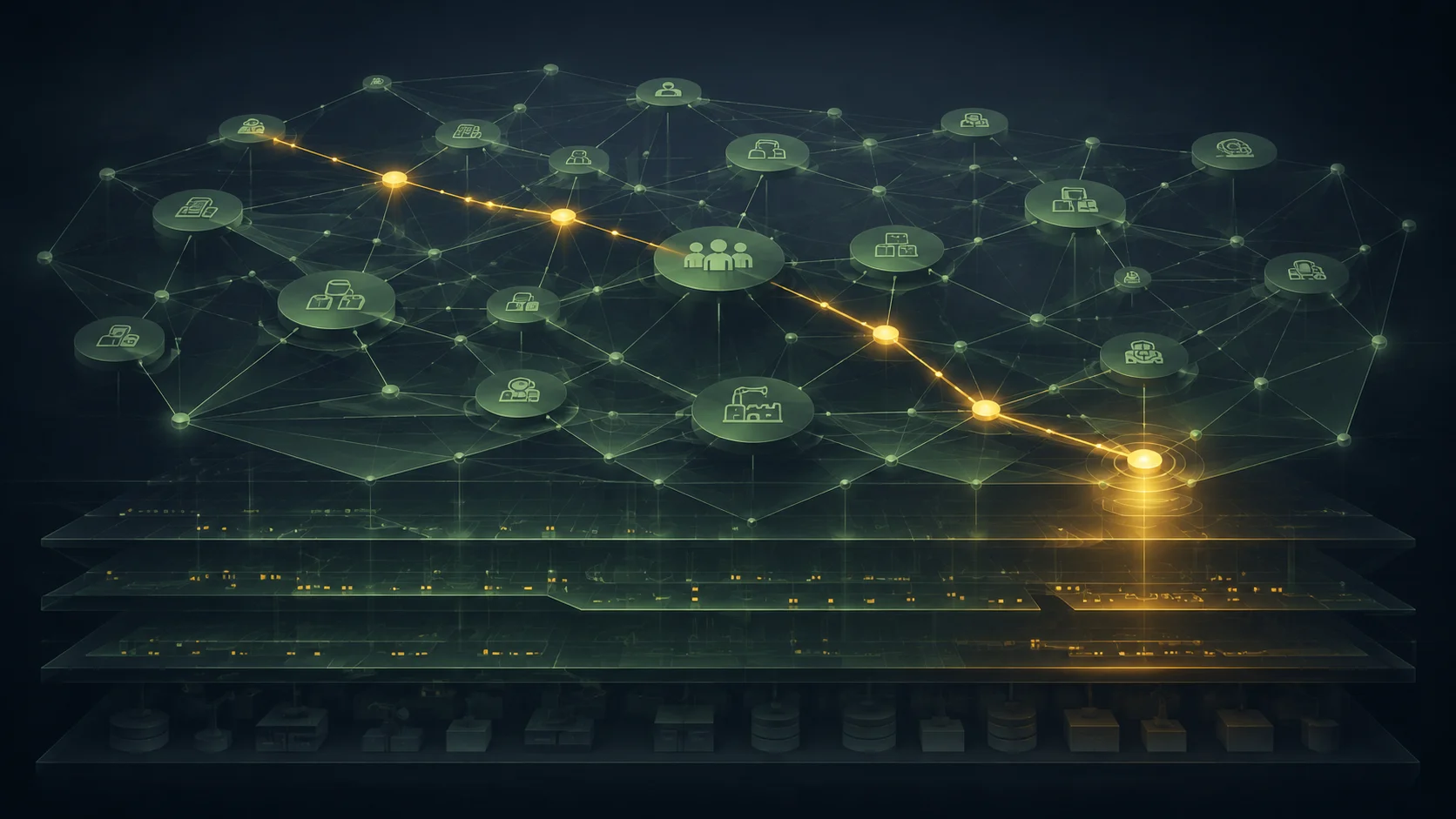
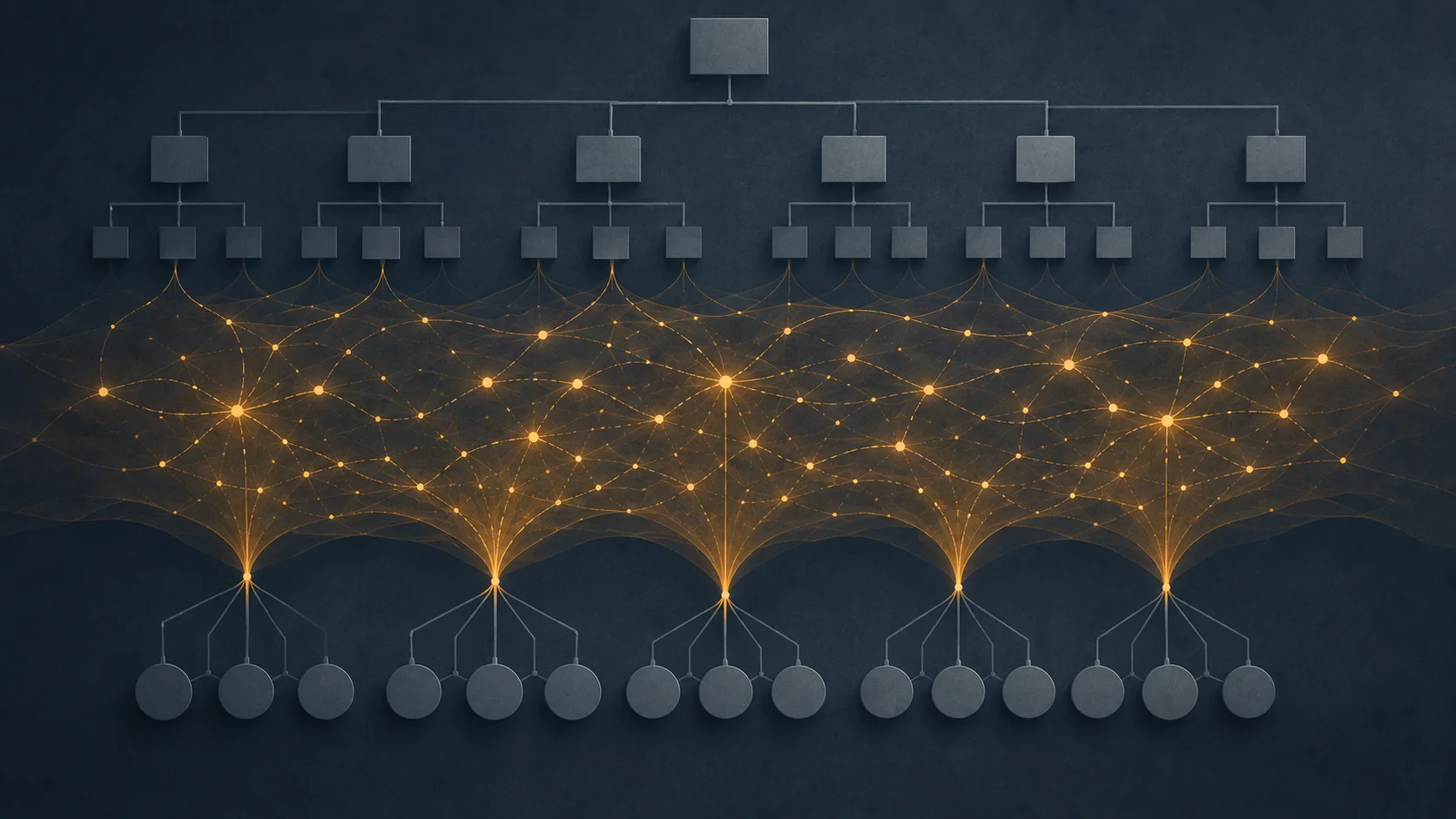
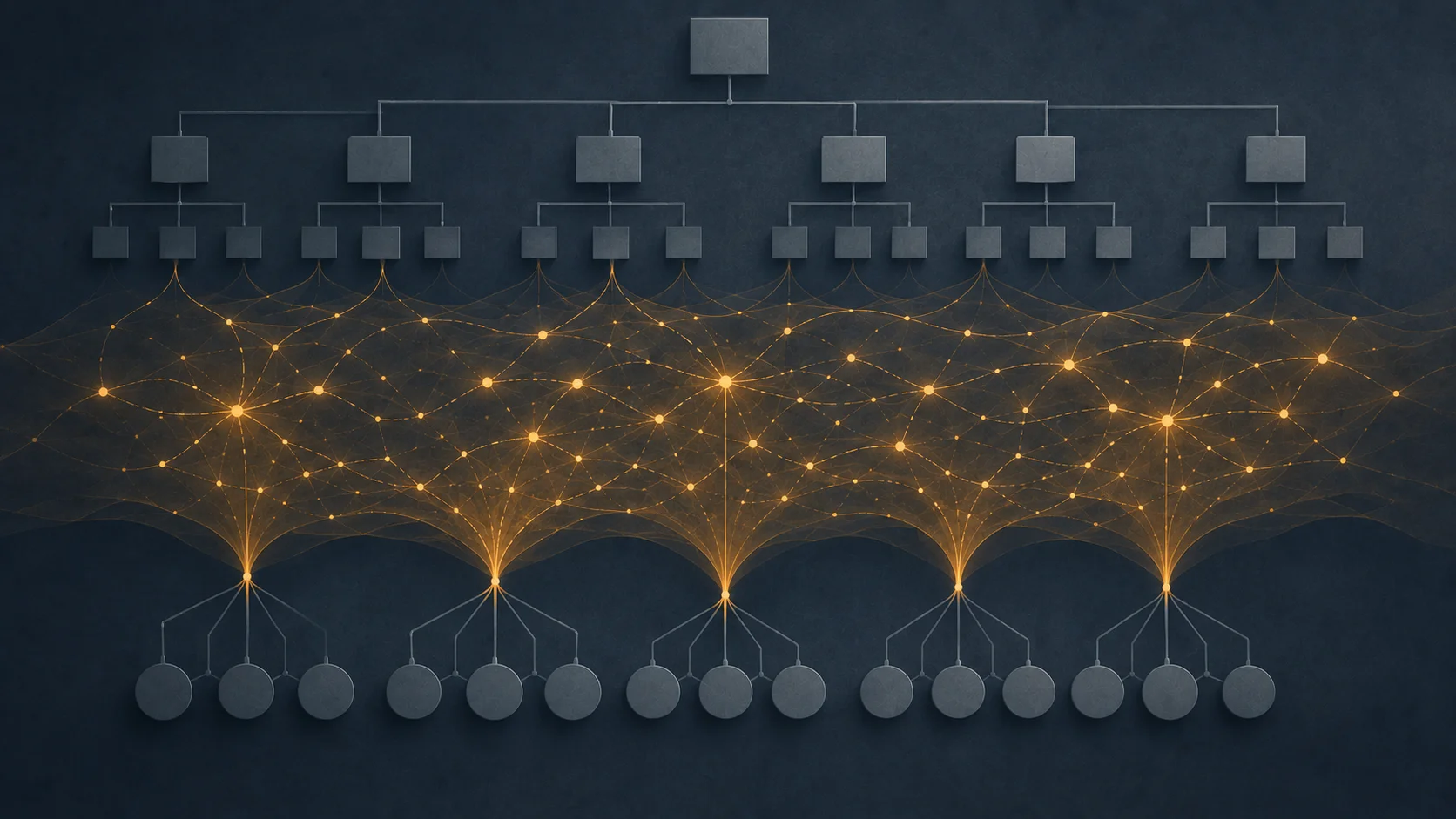
    Cisco disclosed in its Q3 FY2026 earnings call on May 14, 2026, that AI-related product orders had crossed $5 billion in the trailing twelve months — the first time Cisco has broken out AI networking as a separate revenue metric, reflecting both the size of the segment and the need to explain why Cisco’s networking hardware business is recovering after five consecutive quarters of enterprise spending contraction that followed the COVID-era overbuild cycle. Cisco’s Q3 FY2026 investor materials identify two distinct AI networking revenue streams: Cisco Nexus 9000 series switches being configured as AI cluster fabrics (replacing the traditional InfiniBand networking used in early GPU clusters with Ethernet-based connectivity that integrates with enterprise customers’ existing Cisco networking infrastructure), and Cisco Nexus HyperFabric, an AI-specific networking product launched in 2024 that provides a pre-configured fabric architecture optimised for the east-west GPU-to-GPU communication patterns that large language model training and inference require. The east-west traffic pattern is the defining architectural difference between AI data centers and traditional enterprise data centers: conventional enterprise networking was designed around north-south traffic — data moving between end-user devices and servers, or between on-premise infrastructure and the internet — where a hierarchy of distribution and access layer switches routes traffic through a central spine. AI training clusters require a fundamentally different architecture because the dominant traffic pattern is between GPUs within the same cluster during distributed training, where each GPU must communicate with dozens or hundreds of other GPUs simultaneously to synchronise gradient updates, parameter values, and activation states across the model training run. This east-west traffic pattern generates aggregate bandwidth demands of 400 to 800 gigabits per second per GPU node — orders of magnitude higher than the 10 to 25 gigabits per second per server that traditional enterprise networking was designed to support — requiring fabric architectures with near-zero latency, extremely high bandwidth-to-switch-port density, and lossless transport that preserves packet ordering across thousands of simultaneous flows. ARM Holdings’ compute subsystem royalties flow in part from the AI chip designs that generate this extreme east-west networking demand — every GPU sold into an AI training cluster creates a corresponding networking infrastructure requirement that Cisco’s HyperFabric products are designed to address.

    Cisco’s competitive position in AI networking faces a structural challenge from Nvidia, which has its own high-performance networking division (formerly Mellanox) that sells InfiniBand interconnects — the dominant networking technology in GPU clusters before Ethernet became a viable alternative for AI workloads. InfiniBand’s historical advantage was its remote direct memory access capability, which allows GPUs to read and write each other’s memory without CPU intermediation, reducing the latency of gradient synchronisation during training by 2 to 3 times compared to standard Ethernet. Cisco’s Nexus HyperFabric and the broader Ultra Ethernet Consortium standard (of which Cisco is a founding member alongside AMD, Broadcom, and Intel) are attacking the InfiniBand dominance by demonstrating that modern 400G and 800G Ethernet fabrics with RoCE (RDMA over Converged Ethernet) achieve latency performance that is within 15 to 20 percent of InfiniBand in large-cluster training environments — a gap that Cisco argues is more than compensated by the operational advantage of running AI cluster networking on the same Ethernet infrastructure that enterprise customers already manage with Cisco tools, eliminating the need for a separate InfiniBand management layer that requires specialised expertise. The enterprise customer preference for single-vendor networking management is Cisco’s primary commercial advantage in AI networking: the 85 percent of Fortune 500 companies that run Cisco as their primary enterprise networking vendor have a strong default preference for extending that infrastructure into their AI cluster buildouts rather than introducing a new networking vendor and a new operational framework for AI-specific infrastructure. Cloudflare’s AI Gateway and edge inference products operate at the software layer above the physical networking fabric that Cisco provides — both companies are capturing value from the AI infrastructure buildout at different layers of the stack, with Cisco owning the physical transport layer and Cloudflare owning the API management and edge delivery layer above it.

    What Cisco AI Defense Adds to the Networking Business

    Cisco launched AI Defense in Q1 2026 as a security product specifically designed for enterprises deploying AI applications — addressing the security risks that emerge when employees and developers connect enterprise data to AI APIs (OpenAI, Anthropic, Google) without the visibility, access control, and data loss prevention mechanisms that IT security teams apply to conventional application traffic. AI Defense monitors and enforces policy on AI API calls from within the enterprise network perimeter: when a developer in a finance department submits customer account data to ChatGPT for analysis through an approved productivity tool, AI Defense classifies the data type, applies the enterprise’s data classification policy (marking customer PII as restricted and blocking the API call if the destination model provider’s data handling terms do not meet the enterprise’s compliance requirements), and logs the interaction for audit purposes. This is the same data loss prevention (DLP) function that Cisco’s existing security portfolio applies to email, USB transfers, and web uploads — extended to AI API traffic, which has emerged as the fastest-growing uncategored egress channel in enterprise networks since the commercial deployment of AI productivity tools accelerated in 2024 and 2025. Cisco’s integration of AI Defense into its existing security portfolio means enterprise customers can enforce AI API traffic policies through the same management console they use for all other network security policies, rather than deploying a standalone AI security tool from a new vendor. Palantir’s AIP platform addresses a complementary problem — ensuring that the AI-generated decisions and analytics that enterprises act on are grounded in verified enterprise data rather than model hallucinations — but the governance problem Palantir solves is at the application and decision layer, while Cisco AI Defense solves it at the network transport layer. Gartner’s networking and AI infrastructure research for 2026 projects that AI networking infrastructure — combining AI cluster fabrics, AI security tooling, and AI traffic management — will represent 35 percent of total enterprise networking spend by 2028, up from less than 10 percent in 2024, a trajectory that validates Cisco’s decision to break out AI networking as a separate revenue disclosure and to restructure its product development priorities around the AI data center buildout cycle.

    Why the AI Networking Market Allows Cisco to Escape the Hardware Commoditisation Cycle

    Cisco’s historical vulnerability in networking hardware has been commoditisation: white-box switching vendors (Arista’s whitebox alternatives, barefoot-based Broadcom-chipset switches programmed with open-source P4) have eroded Cisco’s pricing power in commodity 10G and 25G access-layer switching by offering comparable packet forwarding at significantly lower price per port. AI networking infrastructure is structurally resistant to this commoditisation pressure for two reasons specific to the AI cluster deployment context. First, AI cluster networking performance is directly tied to training throughput — a 20 percent improvement in fabric latency translates to a proportional improvement in training speed for distributed models, which at the scale of a 200,000 GPU cluster like xAI’s Colossus represents hundreds of millions of dollars in compute cost per training run saved or lost depending on fabric quality. Enterprises and hyperscalers buying AI networking infrastructure are willing to pay a meaningful premium for performance and reliability because the cost of a fabric-induced slowdown during a large training run far exceeds the cost difference between a premium and commodity switch. Second, AI cluster networking requires deep integration with GPU vendor drivers, RDMA network libraries, and cluster management software in ways that commodity white-box switches managed by generic open-source software cannot currently support with the same operational reliability as Cisco’s validated HyperFabric stack. Workday’s enterprise software business demonstrates a parallel commoditisation-resistance dynamic: HCM functionality in isolation is available from lower-cost vendors, but Workday’s data moat (1.5 billion skill inferences) and validated compliance workflows justify premium pricing for enterprise HR automation because the cost of errors in payroll, compliance, and headcount planning exceeds the cost of the software. Cisco’s AI networking premium is analogously justified by the training throughput cost of fabric underperformance at scale. The Wall Street Journal’s enterprise technology coverage through Q2 2026 frames Cisco’s AI networking pivot as the most important product strategy shift at the company since its 2015 to 2019 pivot to subscription software — a pivot that reduced Cisco’s hardware revenue dependence but took five years to reflect in financial results, while the AI networking cycle is producing immediate hardware revenue growth in the current quarter rather than requiring a multi-year transition period.

    What the East-West Traffic Paradigm Reveals About Enterprise IT’s Mental Model Gap

    Don Norman’s central insight in The Design of Everyday Things is that products fail not because users are unintelligent but because the designer’s mental model of how the product works and the user’s mental model of how the task works have diverged. Applied to enterprise AI networking, the east-west GPU traffic problem is exactly this kind of design mismatch — but the gap is not between Cisco’s design model and the user’s task model. It is between the task the AI infrastructure needs to perform and the conceptual framework enterprise IT has spent twenty years developing to think about networking.

    Enterprise IT built its networking intuitions around north-south traffic: requests from devices to servers, responses from servers to devices, data moving between premises and the internet. The hierarchy of access, distribution, and core switches was designed for this pattern. Enterprise IT professionals who understand Cisco’s routing and switching architecture fluently are skilled at reasoning about traffic that originates at the edge and terminates at the center. The AI cluster networking problem is the structural inverse: 400 to 800 gigabits per second of simultaneous GPU-to-GPU communication moving laterally across the cluster rather than vertically through a hierarchy. The switches that enterprise IT knows how to configure for north-south traffic are the wrong conceptual tool for east-west cluster fabric — not wrong on technical merit, but wrong as a mental model for understanding where the bottlenecks live and how to diagnose them. An engineer who has optimized north-south latency for fifteen years and then tries to troubleshoot an east-west fabric congestion event will reach for the wrong instruments because the failure mode is in a dimension their mental model does not track.

    What Cisco’s HyperFabric product does well from a design standpoint is make the AI cluster networking problem tractable for professionals whose mental models are north-south oriented. HyperFabric’s management interface uses the same Cisco operational framework those professionals already understand — the same CLI patterns, the same monitoring dashboards, the same troubleshooting workflow — while handling the east-west fabric complexity below the operational surface. This is the affordance alignment that commodity east-west networking solutions miss: the technical performance question matters, but the operational model question — how does the team responsible for this infrastructure think about their job — matters more for enterprise buying decisions. Cisco’s AI networking premium is not justified purely by latency benchmarks versus InfiniBand; it is justified by removing the mental model mismatch that makes east-west AI infrastructure management a different discipline from everything enterprise IT already knows how to do.

    What Cisco’s AI Networking Revenue at $5 Billion Reveals About the Compounding Pattern of Infrastructure Vendor Advantages

    The history of technology infrastructure investing has a recurring pattern: during a major technology transition, the companies that sell the infrastructure enabling the transition generate more certain and more durable returns than the companies building the applications on top of the infrastructure. During the internet buildout of the late 1990s, networking equipment sales compounded for years while internet application companies cycled through boom-and-bust periods that destroyed substantial capital. The lesson that patient investors drew was that the picks-and-shovels approach — owning the infrastructure rather than betting on which application wins — is structurally lower risk during transitions where the winning application is unknown. Cisco’s AI networking revenue crossing $5 billion is a contemporary iteration of the same pattern.

    The compounding mechanism that makes infrastructure revenue durable is different from the compounding mechanism that makes application revenue durable. Application revenue depends on continued user adoption, network effects that maintain switching costs, and product innovation that keeps the application relevant as alternatives emerge. Infrastructure revenue depends on replacement cycle length, installation base inertia, and the training and certification moats that make the people who operate the infrastructure a scarce and sticky resource. Enterprise networking equipment typically stays installed for seven to ten years. The enterprise IT teams certified on a networking platform represent accumulated human capital that is difficult to transfer to a competing platform even when the competing hardware is technically comparable. The $5 billion is not just a current revenue figure; it is the foundation of a replacement cycle and a human capital moat that will sustain AI networking revenue for most of a decade regardless of what happens at the application layer.

    The patient investor’s view of Cisco at $5 billion in AI networking revenue is that the number is early in a compounding arc whose total duration is determined by when the current wave of AI infrastructure deployment reaches saturation and when the replacement cycle begins. Enterprise AI networking infrastructure deployed in 2025 and 2026 will not be replaced until the early 2030s at the earliest. The revenue certainty embedded in that installed base is a fundamentally different risk profile from the revenue uncertainty in the AI application layer, where competitive dynamics are intense, model performance is converging across providers, and pricing power is declining as the market matures. Five billion dollars in AI networking revenue today, compounding through the installation base and replacement cycle, is a quieter story than any AI model launch. It is also a story whose ending is easier to predict.

    Why $5 Billion in AI Networking Revenue Is a Simpler Story Than It Sounds, Once You Strip Out the Jargon

    Cut through the phrase “compounding through the installation base and replacement cycle” and what remains is a plain fact: companies that already bought Cisco networking equipment for their data centers will need to replace or upgrade it eventually, and AI workloads are giving them a reason to do that replacement sooner and at a higher price point than they otherwise would have. That is the entire mechanism. It does not require a theory about AI transformation or a bet on which model architecture wins. It requires only that data centers keep running AI workloads, that the equipment supporting those workloads wears out or becomes insufficient on a predictable schedule, and that Cisco is positioned to sell the replacement when that schedule comes due.

    The clarity this deserves, stripped of financial-analyst phrasing, is that $5 billion in AI networking revenue is a bet on plumbing, not on which AI application wins. A company does not need to correctly predict whether the next breakthrough model comes from one lab or another to benefit from selling the networking equipment that any AI workload, regardless of which company built the model running on it, needs to move data between servers. That is a structurally different and much safer bet than the one every AI application company is making, where being wrong about which product or model wins the market means the company loses regardless of how good its underlying technology is.

    The plain-language version of why this is “a story whose ending is easier to predict,” as the article’s closing line puts it, is that physical infrastructure replacement cycles are one of the most predictable phenomena in enterprise technology — companies have been forecasting server refresh cycles, network upgrade timing, and data center capacity planning for decades, and the math around depreciation schedules and capacity utilization doesn’t change just because the workload running on the equipment is now AI instead of something else. Write that plainly and the $5 billion stops sounding like a speculative AI bet and starts sounding like what it actually is: a hardware company selling more hardware because more of its customers need more hardware, for a reason that happens to be AI this cycle and will be something else the cycle after.
  • Workday Added AI Agents to Its HCM Platform

    Workday Added AI Agents to Its HCM Platform

    Workday Added AI Agents to Its HCM Platform and Enterprise HR Technology Has Entered Its Automation Phase

    Workday Added AI Agents to Its HCM Platform and Enterprise HR Technology Has Entered Its Automation Phase

    Workday reported $2.25 billion in Q1 FY2027 revenue (the quarter ending April 2026), a 16 percent year-over-year increase driven by subscription revenue growth in its Human Capital Management and Financial Management cloud products, while simultaneously rolling out its Illuminate AI product layer — which embeds AI agents directly into HR and finance workflows for headcount planning, skills gap analysis, pay equity audits, and dynamic organizational design — to its base of approximately 10,500 enterprise customers. Workday’s investor relations filings for Q1 FY2027 describe Illuminate as the company’s primary product investment priority for FY2027, with Workday allocating over 20 percent of its engineering headcount to AI feature development and targeting full Illuminate capability availability across its core HR and Finance product lines by Q3 FY2027. The commercial significance of Workday’s AI investment is not that it adds AI features to an existing product — every major enterprise software platform has announced AI integrations since 2023 — but that Workday’s HCM platform contains decades of structured organizational data (headcount histories, compensation records, performance ratings, skills inventories, org charts) that serves as the training and context foundation for AI models that are significantly more accurate for workforce-specific tasks than general-purpose LLMs prompted with the same data through an API. A Workday customer asking an AI system to model the headcount impact of a 10 percent revenue target increase can receive a scenario that draws on the organization’s actual role distribution, skill availability, historical headcount change patterns, and compensation benchmarks already stored in Workday — rather than a generic AI response that requires manual contextualization. Enterprise AI deployments at the scale of KPMG’s 276,000-seat implementation demonstrate that the organizations seeing the highest AI productivity returns are those where AI systems have access to structured organizational data — the kind of longitudinal, entity-linked data that Workday’s HCM platform accumulates over years of customer use — rather than those using general-purpose AI assistants over unstructured document repositories.

    Workday’s AI differentiation in the HCM market rests on its Skills Cloud — a machine-learning system that maps an organization’s skills inventory by inferring from job titles, role histories, completed projects, certifications, and learning activity which skills each employee has demonstrated or developed, without requiring employees to manually self-report skills data. The Skills Cloud has been in production since 2020, and by 2026 it covers approximately 1.5 billion skill inferences across Workday’s customer base — a dataset that makes Workday’s workforce intelligence products qualitatively different from those of competitors that are building AI features on top of manually-maintained skills records. The Skills Cloud’s practical applications in the Illuminate product layer include internal mobility matching (identifying employees who have the skills needed for an open role without requiring a job application submission), pay equity analysis (identifying compensation gaps between employees with equivalent skill profiles in equivalent roles), and dynamic workforce planning (generating headcount scenarios based on skills supply and demand rather than static role counts). SAP SuccessFactors, Oracle HCM, and ADP each offer competing AI features in their HCM platforms, but none have a longitudinal skills inference dataset comparable in depth to Workday’s, because Workday’s platform has been ingesting structured HR events — role changes, promotions, project assignments, learning completions — from enterprise customers since 2012 and has a compound data accumulation advantage over competitors that built AI layers onto systems designed for data entry rather than continuous organizational intelligence. Salesforce’s Agentforce AI agent deployment in CRM demonstrates the pattern Workday is following in HCM: embedding AI agents that can execute multi-step workflows (schedule interviews, generate offer letters, update org charts) rather than just generate text responses, which is the operational automation tier that separates AI features that add to employee workload from AI features that reduce it.

    What Workday’s Agentic HR Features Can Execute Without Human Approval

    Workday’s Illuminate AI agent framework introduces a distinction that is commercially important for enterprise HR procurement: the division between AI-assisted workflows (where an AI generates a recommendation that a human reviews before action is taken) and AI-agentic workflows (where an AI executes a defined business rule without human review in the loop, except in cases flagged as exceptions). For routine, policy-constrained HR transactions — a leave of absence approval that meets the eligibility criteria defined in the company’s leave policy, a standard merit increase within the band defined for the employee’s job grade and performance rating, an onboarding task sequence completion notification — Illuminate’s agent mode can complete the transaction end-to-end without a manager or HR business partner reviewing the individual transaction. Workday’s enterprise customers define which workflows are eligible for agent-mode execution versus which require human-in-the-loop review, with Workday providing recommended exception criteria based on its cross-customer data on which transaction types generate reversal requests (an indicator that the human review step adds meaningful value) versus which almost never generate reversals (an indicator that the AI decision is consistently aligned with human judgment and the review step is pure overhead). Big tech’s workforce restructuring to fund AI investment has created a specific demand signal for Workday’s agentic HR capabilities: companies reducing their HR business partner headcount while growing their employee base need HR administration that can scale without proportional headcount growth, and AI agent automation of routine transactions is the mechanism that makes that ratio change operationally feasible. Gartner projects that by 2027, 30 percent of enterprise HR transactions that currently require manual processing will be fully automated by AI agent systems operating within policy guardrails — a projection that Workday’s Illuminate architecture is designed to capture at the platform layer rather than cede to point solutions or system integrators building automations on top of existing HRIS data. Gartner’s Human Capital Management research coverage positions Workday as a Leader in the HCM suite Magic Quadrant for 2026 with the highest score on completeness of vision, reflecting its AI integration roadmap and Skills Cloud data advantage over competitors whose AI features are add-ons rather than architecturally integrated with core data models.

    Why Workday’s Competitive Position Depends on the Data Moat Holding

    The strategic risk to Workday’s AI investment is not that SAP SuccessFactors, Oracle HCM, or Rippling will build better AI features in the next 12 months — it is that the general-purpose AI infrastructure (foundation models accessible via API, plus enterprise data integration tools like Snowflake or Databricks that can expose HR data to any LLM) could allow a new entrant to offer comparable AI workflow automation without Workday’s decade of structured HR data accumulation. Rippling, the fastest-growing HCM competitor in the US mid-market segment, has explicitly positioned its product architecture as a data integration layer that can connect any AI model to any HR data system — a strategy that bets the workforce intelligence use case can be solved at the integration layer rather than requiring Workday’s native data structure. Rippling’s approach works for organizations willing to invest in configuring the integration layer; Workday’s advantage is that its data model is already structured for workforce intelligence without integration work, making time-to-value for AI features shorter for enterprises that already have Workday as their system of record. OpenAI’s enterprise deployment consulting model represents an alternative AI delivery mechanism — where a consulting and integration layer translates general-purpose AI model capability into enterprise workflow automation — that competes with Workday’s native AI features for the same enterprise budget, but at a higher implementation cost and with less native integration into the transactional HR data that Workday already manages. Workday’s $2.25 billion quarterly revenue run rate, its 95 percent subscription revenue gross retention, and its 10,500 enterprise customer base give it the financial stability to sustain its AI infrastructure investment through a multi-year product transition — an investment cycle that pure-play AI application startups in the HCM space cannot match at comparable scale. The Wall Street Journal’s enterprise technology coverage through Q2 2026 characterizes Workday’s Illuminate rollout as the HCM market’s clearest example of incumbent enterprise software platforms using their proprietary data assets to resist AI-native startup disruption — a defense that is more durable than feature parity alone because it requires a competitor to replicate not just Workday’s technology but also the multi-year data accumulation that enterprise customers have contributed to Workday’s platform through their normal HR operations.

    What Enterprise HR Technology Buyers Are Actually Discovering When Agentic AI Arrives

    Marty Cagan’s product discovery discipline asks teams to separate what customers request from what customers actually need — and to build solutions for the latter rather than the former. Applied to Workday’s agentic HR features, the discovery process that enterprise buyers are now running reveals a set of unspoken needs that are structurally different from what the software-evaluation criteria captured during procurement.

    The first discovery is about data quality. Enterprise HR buyers chose Workday for its system-of-record reliability — clean employee data, consistent position management, accurate payroll integration. What they are discovering under agentic AI deployment is that the data model they trusted for structured queries becomes a liability when an agent must make contextual decisions. An AI agent that routes a leave request, adjusts a headcount plan, or flags a performance anomaly is drawing inferences from data that HR teams know has gaps, inconsistencies, and timestamp errors that never mattered when a human manager reviewed the same record. The agentic phase exposed a data quality problem that existed before the AI arrived but was invisible until the AI had to act on it.

    The second discovery is the approval-boundary problem. Workday’s agentic feature set requires enterprise customers to specify which actions the AI can execute autonomously and which require human approval. That specification looks like a product configuration question. It is actually a cultural and organizational policy decision about where accountability for HR decisions resides — a question most companies have never formally answered because a human has always been in the loop by default. The third discovery is more structural: the people whose jobs are most disrupted are not HR coordinators, but the employees who served as translation layers between the system’s data model and what business managers actually needed. Those informal interpreters — HR business partners, payroll specialists, operations coordinators — absorbed the gap between what Workday could produce and what the organization needed to know. Agentic AI narrows that gap, which makes those translation roles visible as costs rather than as capabilities. Genuine product discovery in enterprise HR AI means surfacing all three of these before deciding what to build.

    What Workday’s Agentic AI Adoption Rate Would Actually Show If the Company Disclosed the Denominator

    Workday’s agentic AI headline figure — 40 million routine HR tasks automated monthly across its customer base — is a numerator without a denominator. The missing denominator is the total number of tasks in those workflow categories across Workday’s 10,500 enterprise customers. Without it, the figure is a point estimate that tells you the autonomous execution count reached a particular threshold; it does not tell you the proportion of possible tasks that are being delegated to agentic execution versus remaining in human approval queues. A probabilistic model of enterprise software adoption suggests the gap between the numerator and the realistic denominator is large.

    Enterprise HR software adoption follows a well-documented distribution pattern. Procurement decisions occur months or years before deployment depth, and feature adoption within enterprise platforms stratifies sharply by customer size, industry, and internal IT sophistication. If Workday’s autonomous execution distribution follows the typical enterprise software pattern, the bulk of the 40 million tasks likely concentrates in a small percentage of customers — large enterprises with mature Workday implementations, sophisticated HR technology teams, and high organizational trust in AI-executed decisions — while the majority of customers use the feature at a fraction of its theoretical capacity.

    The specific data Workday would need to disclose for probabilistic evaluation is straightforward: autonomous execution rate by customer tier (SMB, mid-market, enterprise), by task type (payroll exceptions, PTO approvals, onboarding workflows, compliance flag resolution), and by human override rate (what proportion of autonomous decisions are subsequently overridden or queried by HR administrators). These numbers would tell you whether the agentic adoption story is broad and shallow or narrow and deep. Broad-and-shallow suggests a marketing-ready feature; narrow-and-deep suggests a genuine operational transformation in a small segment with a plausible path to wider adoption.

    The headline statistic is not false. It is a selectively reported numerator that is technically accurate and strategically incomplete. The 25% revenue growth Workday delivered in Q4 FY2026 is real and suggests the platform value proposition is holding. Whether agentic AI is a structural component of that growth or a feature that enterprise buyers value in renewal negotiations without deploying deeply is the question the 40 million tasks figure does not answer. The denominator would.

  • Palantir Crossed $1 Billion in Quarterly Revenue

    Palantir Crossed $1 Billion in Quarterly Revenue

    Palantir Crossed $1 Billion in Quarterly Revenue and AIP Has Become the Enterprise AI Decision Layer

    Palantir Crossed $1 Billion in Quarterly Revenue and AIP Has Become the Enterprise AI Decision Layer

    Palantir Technologies reported $1.1 billion in Q2 2026 total revenue — the company’s first quarter above $1 billion and a 35 percent year-over-year increase that reflected accelerating commercial adoption of its Artificial Intelligence Platform (AIP) across US enterprise customers in manufacturing, healthcare, energy, and financial services verticals. Palantir’s investor relations disclosures for Q2 2026 show US commercial revenue reaching $490 million for the quarter (up 55 percent year-over-year), with US commercial customer count increasing to 465 from 262 in the same period one year prior — a growth trajectory driven by the AIP Bootcamp deployment methodology that Palantir introduced in mid-2023 as a structural change to how enterprises evaluate and adopt the platform. The AIP Bootcamp format — a five-day intensive engagement in which a Palantir team works with a client’s operational staff to build working AI-powered workflows on live production data within the client’s existing systems — compresses the enterprise software sales and proof-of-concept cycle from the 12 to 24 months typical for complex enterprise platform adoption to a single week that produces demonstrable operational output. The bootcamp model has proven particularly effective in manufacturing and industrial operations, where the gap between the data a company generates and the decisions it can act on with that data is large enough that a week of AIP workflow construction produces measurable throughput or cost improvements that justify multi-year platform contracts. Palantir’s government revenue segment — historically the company’s revenue base, covering US Department of Defense, intelligence community, and allied government contracts — reached $610 million in Q2 2026, growing more slowly (15 percent year-over-year) as the commercial segment has expanded to represent a larger share of total revenue.

    What makes AIP commercially distinctive in the enterprise AI software market is the ontology layer — Palantir’s proprietary data modeling system that maps an organization’s operational entities (assets, personnel, workflows, decisions) into a structured data graph that AI systems can query and act on without requiring the client to restructure its underlying data infrastructure. Every enterprise that attempts to deploy AI on operational workflows faces the same foundational problem: the data relevant to a decision is scattered across multiple systems (ERP, CRM, MES, IoT sensors, logistics platforms) that were not designed to be queried together, and building a unified data layer is typically a multi-year data engineering project that precedes any AI deployment. Palantir’s ontology layer solves this by creating a semantic representation of the enterprise’s operations on top of existing systems without requiring data migration — the ontology maps where each piece of operational data lives and what it means in business terms, allowing AIP’s workflow tools to compose queries and actions across systems that have never interoperability. Enterprise AI deployments at the scale of KPMG’s 276,000-seat implementation demonstrate the range of approaches enterprises are taking to AI integration — from API-level model access at scale to platform-level operational workflow embedding — with Palantir’s approach sitting at the more deeply integrated end of the spectrum, where the AI system has direct access to operational data and decision workflows rather than acting as a text generation assistant layered over existing processes. The depth of integration that Palantir’s ontology enables is also the source of its sales cycle complexity: clients who adopt AIP are effectively committing to Palantir’s data modeling approach as the operational data layer for their business, a decision that requires more evaluation time than a seat-license productivity tool but produces a harder-to-displace position once adopted.

    How AIP Bootcamp Changed the Enterprise AI Software Sales Model

    The AIP Bootcamp format inverted the conventional enterprise software sales motion — which typically involves a multi-month request for proposal process, a structured proof of concept on synthetic or historical data, and a contract negotiation before any operational value is delivered — by front-loading the operational demonstration before the sales process concludes. In a standard bootcamp engagement, Palantir brings a team to the client site on day one with AIP already connected to the client’s production data systems (via connectors to SAP, Salesforce, Oracle, and major cloud platforms). By day three, operational staff who have never used Palantir’s tools are building AI-assisted decision workflows — inventory optimization routines, predictive maintenance triggers, logistics exception management — on live data from their actual operations. By day five, the workflow outputs are compared to historical baseline performance, and the quantifiable improvement becomes the basis for the contract discussion. The model works because it shifts the burden of proof from Palantir’s sales team to the client’s own operational data: the AI is not demonstrated on a curated demo environment but on the actual data the client works with, including the messiness, inconsistencies, and edge cases that enterprise data contains. OpenAI’s enterprise deployment company model represents a different approach to the same problem — building a consulting-adjacent service layer that handles enterprise integration complexity for clients who want to use frontier AI models but lack the in-house capacity to build operational integrations. The bootcamp model’s commercial success has prompted Microsoft Copilot Studio, ServiceNow, and other enterprise AI platform vendors to develop accelerated proof-of-concept formats that attempt to replicate Palantir’s compressed evaluation timeline, though without the proprietary ontology layer that makes AIP’s operational data integration distinctive.

    What Palantir’s Commercial Growth Reveals About the Enterprise AI Decision Platform Market

    Palantir’s Q2 2026 results reflect a broader shift in how enterprises are thinking about AI investment — moving from the productivity layer (AI assistants that help individual workers draft, summarize, and code faster) to the decision layer (AI systems that synthesize operational data and propose or execute decisions within business processes). The productivity layer market is dominated by Microsoft Copilot, Google Workspace AI, and Salesforce Einstein, all of which are distributed through existing enterprise software relationships and are measured in per-seat adoption rates. The decision layer market — where AIP competes — is measured in operational workflow coverage: what percentage of a company’s recurring decisions (which supplier to use, which maintenance task to prioritize, which shipment to reroute) are handled by AI-augmented systems rather than human-only judgment. Palantir’s commercial customer base skews toward industries where recurring operational decisions involve large amounts of structured sensor, logistics, or clinical data — manufacturing, energy, mining, healthcare — rather than the knowledge-work environments where productivity-layer AI excels. Big tech’s $725 billion AI infrastructure commitment is funding the model capability layer that both the productivity and decision tiers depend on, but Palantir’s commercial model captures value at the integration and workflow layer rather than the model layer — a position that insulates it from the commoditization pressure that is compressing margins at pure-play foundation model companies. Gartner’s analytics and AI platform research for 2026 positions Palantir as a Leader in its AI Decision Intelligence magic quadrant — a designation reflecting completeness of vision and execution ability in a market that Gartner defines as combining real-time operational data integration, AI-assisted decision workflow automation, and human-in-the-loop oversight infrastructure. Financial Times technology coverage through Q2 2026 frames Palantir’s commercial revenue inflection as evidence that the enterprise AI market is entering a second phase — beyond the initial experimentation period of 2023-2024, in which most enterprises ran pilots without committing to production deployment, toward a production deployment phase in which operational AI systems are being built and measured against hard performance metrics in the environments where a company’s actual revenue and cost structure live. The $1 billion quarterly revenue threshold positions Palantir as one of the few AI-first software companies that has converted the enterprise AI investment cycle into durable, contracted revenue at scale.

    What Palantir’s Revenue Milestone Reveals About the Enterprise AI Adoption Curve

    Shane Parrish’s second-order thinking framework asks not what happened but what will happen next as a consequence of what happened. The first-order read on Palantir crossing $1 billion in quarterly revenue is straightforward: enterprise AI software is a large and growing market, AIP is working, the commercial business has scaled. The second-order question is more interesting: what does the AIP Bootcamp sales model reveal about how enterprise AI adoption will actually progress across the broader market over the next three years?

    The Bootcamp model does something that conventional enterprise software sales cannot do efficiently: it identifies, within a customer organization, which internal champions have genuine cross-departmental authority to move an AI deployment from pilot to production. Most enterprise software sales fail at that identification step — the wrong champion is selected, the deployment stalls in a single department, and the vendor gets a referenceable pilot that never expands to contract-level revenue. Palantir’s bootcamp forces the customer to field its own people against a live deployment problem, which surfaces the actual internal power structure around AI decisions within 72 hours. That intelligence compounds: Palantir now has a systematic method for identifying deployable champions across verticals, which reduces its cost-per-closed-deployment as the dataset of champion archetypes grows.

    The third-order effect is slower but matters more at the category level. Companies that completed AIP Bootcamp in 2023 and 2024 are now generating operational case studies — specific AI pipelines deployed in manufacturing quality control, financial compliance reporting, supply chain disruption detection — that are landing in the vendor evaluation processes of companies in the same vertical who haven’t yet committed to an AI decision platform. Those case studies lower the activation energy for the next buyer by demonstrating that the deployment problem is solvable in their specific context, not just in the generic “enterprise AI” abstraction. The $1 billion milestone is, by the time it is announced, a lagging indicator. The leading indicator is the accumulating library of same-vertical deployments that makes every subsequent sale faster and more defensible than the one before it.

    What the Internal Champion Story Reveals About How AIP Actually Lands Inside Enterprise Operations

    Ann Handley’s framework places the audience — not the product — at the center of every communication decision. Applied to Palantir’s AIP Bootcamp model, the insight is to ask not what the Bootcamp delivers to Palantir’s sales team but what it delivers to the individual inside the customer organization who is going to live with the consequences of an AIP deployment for the next five years. That person is the internal champion — usually an operations or data engineering lead, not the CIO. Understanding that person, in Handley’s terms, requires understanding what they need to believe before they commit professionally to a platform that will reshape how their team works.

    The Bootcamp’s five-day format does something that no conventional enterprise software evaluation process does: it exposes the internal champion to a working deployment on their own data within 72 hours. This is categorically different from a polished vendor demo on a curated data environment. The champion sees their actual messy production data — the duplicate records, the missing fields, the system integration failures that the ERP and MES generate daily — transformed into an operational decision workflow within a week. That experience is not primarily commercial; it is professional. The champion can point to something they built with their team’s data that works. That is the first moment when the AI deployment stops being a vendor conversation and becomes a career narrative — a story the champion can tell to skeptical colleagues not as advocacy for a vendor but as a report on what their team accomplished.

    The audience Palantir is actually communicating to, in Handley’s frame, is not the board that approves the contract — it is the champion who will implement the deployment and justify it to colleagues who were skeptical during the evaluation. When the Bootcamp produces a working workflow, it gives the champion the internal story they need: “we ran this on our data in the first week and here is what it showed.” That internal story is the mechanism through which the Bootcamp drives contract conversion, not the vendor’s sales pitch. AIP’s 55 percent US commercial revenue growth reflects not just more customers but more internal champions who left the Bootcamp with that story ready to tell. The audience Palantir must serve to sustain that growth rate is not the enterprise procurement committee — it is the operational leader whose professional credibility is now attached to the deployment outcome and who needs every subsequent quarter to confirm the decision was right.

  • Salesforce Agentforce Is Generating Real Enterprise AI Revenue

    Salesforce Agentforce Is Generating Real Enterprise AI Revenue

    Salesforce Agentforce Is Generating Real Enterprise AI Revenue

    Salesforce Agentforce Is Generating Real Enterprise AI Revenue

    Salesforce reported $9.8 billion in revenue for its fiscal Q1 2027 (ending April 2026) — up 8 percent year-over-year — with Agentforce, its AI agent platform for autonomous customer service, sales, and operations workflows, contributing to the acceleration of its Data Cloud and AI segment from a negligible revenue line to approximately $900 million in annualised recurring revenue. Salesforce’s Q1 FY2027 earnings disclosures show Agentforce-enabled deals accounting for a growing share of new business bookings — management stated that deals including Agentforce close at a higher average contract value than equivalent Salesforce platform deals without Agentforce, and that customer expansion rates on Agentforce accounts are running above the company’s historical expansion rate for similar customer cohorts. The commercial signal is the clearest validation Salesforce has produced for its AI platform bet since the original Agentforce announcement in September 2024.

    Agentforce represents Salesforce’s answer to the question of where the enterprise CRM market goes after conventional software automation has been fully deployed. Salesforce’s core products — Sales Cloud, Service Cloud, Marketing Cloud — have been workflow automation platforms for two decades, helping companies manage customer relationships through structured processes and data capture. Agentforce extends that model into autonomous action: rather than automating a defined workflow where a human specified each step, Agentforce agents can interpret customer inquiries, pull relevant data from Salesforce’s Data Cloud, take actions (send emails, update records, create cases, schedule meetings), and escalate to human agents when the situation requires judgment beyond the agent’s configured scope. The distinction between conventional CRM automation and AI agent automation is the difference between a pre-programmed playbook and an agent that reads the situation and determines the appropriate next step. Multi-agent enterprise orchestration across the broader enterprise AI market has established that agentic AI workflows require orchestration infrastructure — Salesforce’s advantage is that it built its orchestration layer on top of the CRM data where most enterprise customer-interaction records already live.

    What Agentforce Does in the Customer Service Layer

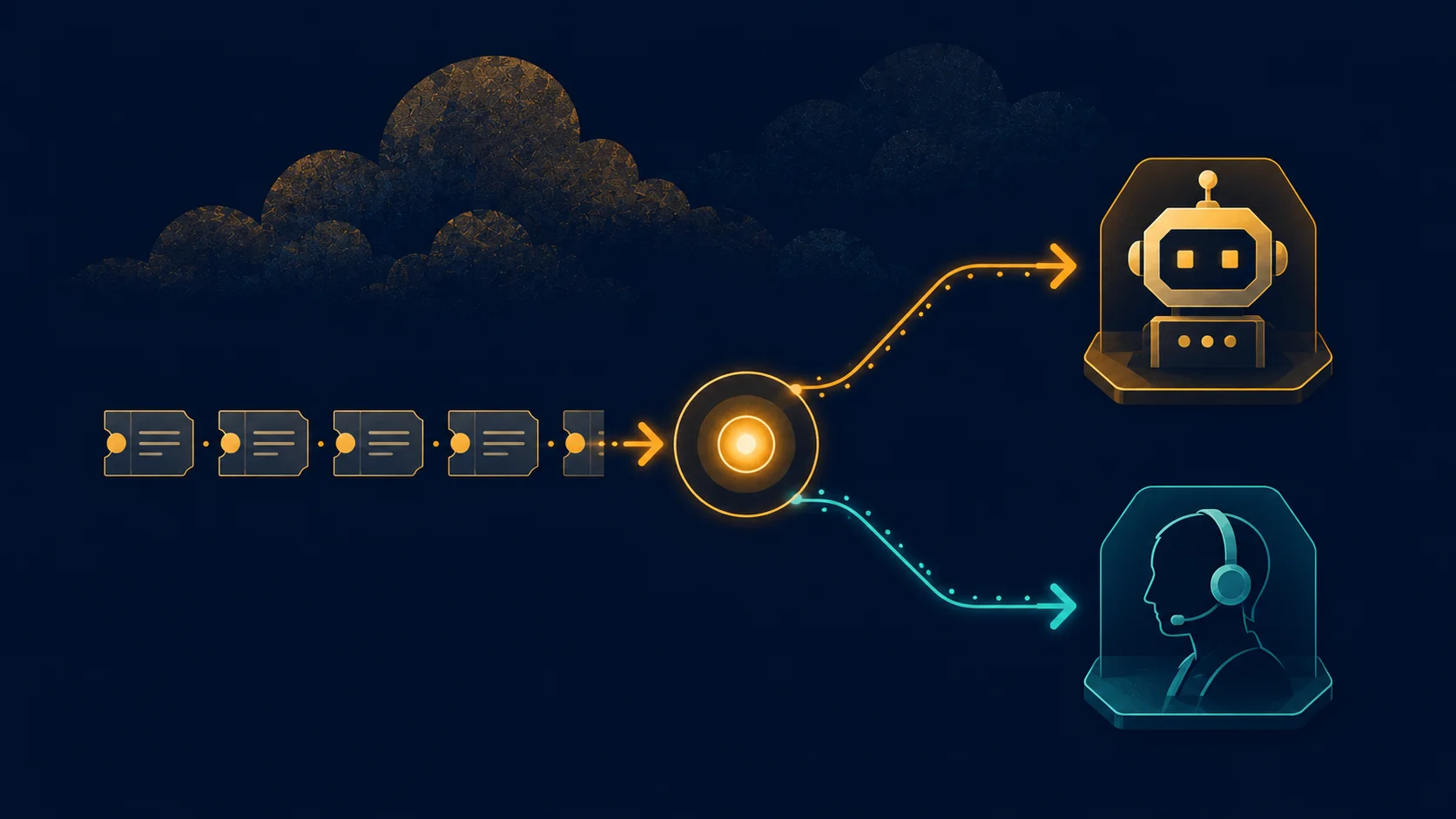
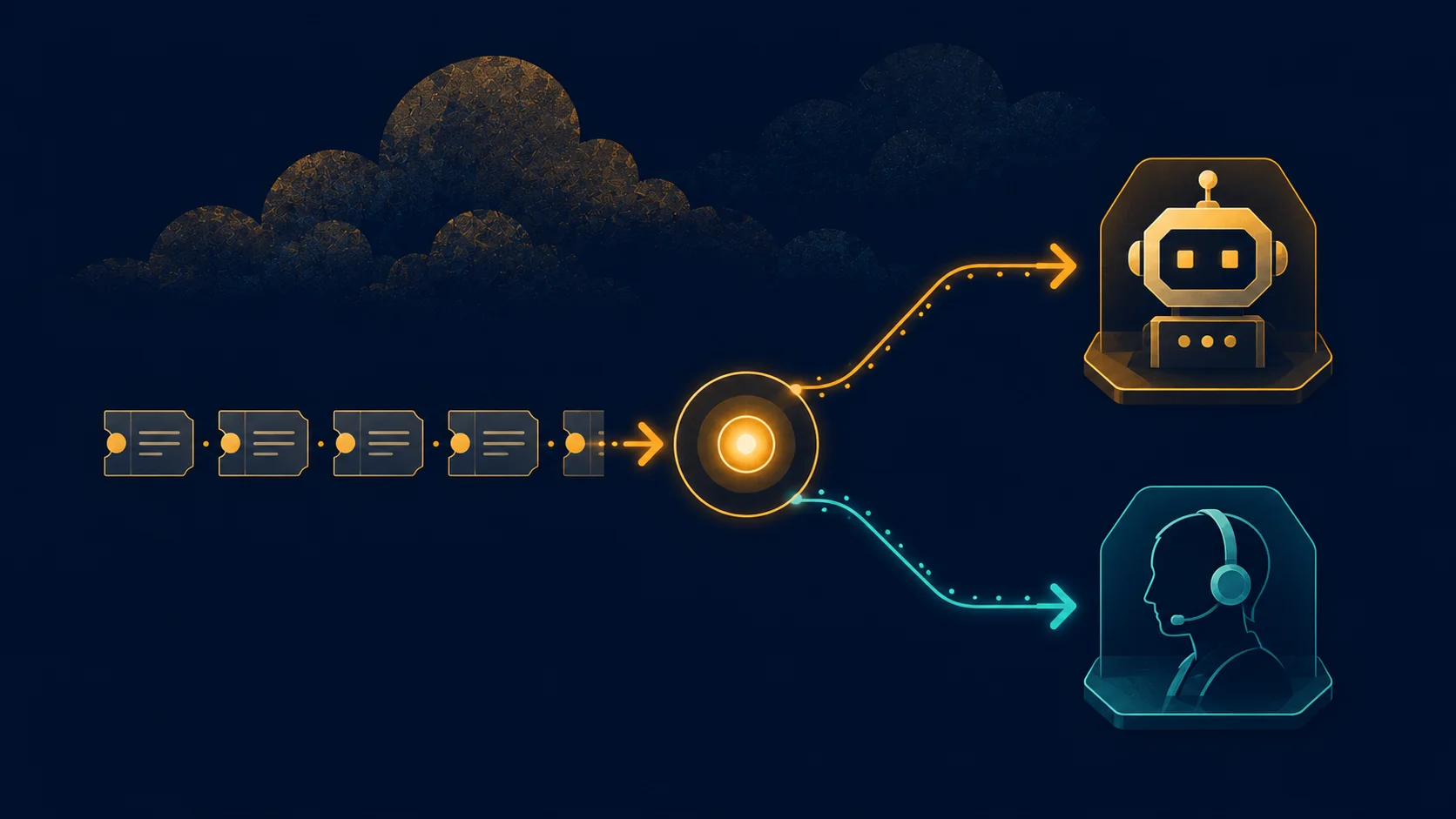
    Agentforce’s highest adoption to date is in customer service — the business function where the volume of routine inquiries is highest and the cost of human agent time is most measurable. A customer service agent handling billing inquiries, order status questions, subscription changes, and account updates spends the majority of their working hours on queries that follow predictable patterns with well-defined resolution paths. Agentforce handles those queries autonomously — reading the customer’s history in Salesforce Service Cloud, identifying the appropriate resolution, executing the resolution (issuing a refund, changing an address, extending a subscription), and closing the case — without human involvement. The autonomous resolution rate that Salesforce customers are reporting for Agentforce-handled service volumes ranges from 40 to 70 percent depending on the complexity distribution of the query type, with human escalation handling the remainder.

    The commercial case for customer service AI agents is the most straightforward in enterprise AI: the cost of a human agent handling a routine inquiry is typically $8-15 per interaction; the cost of an AI agent handling the same inquiry on Salesforce’s platform is approximately $0.50-2.00 depending on data retrieval and model call volume. An enterprise running 500,000 monthly service interactions that shifts 50 percent to AI agent handling reduces its service cost by $2-4 million per month while maintaining resolution quality for the inquiry types within the agent’s autonomous capability. Those economics are generating purchase decisions that do not require complex ROI modelling: the payback period is short enough that procurement teams can approve Agentforce without extensive internal analysis. Enterprise AI deployment at scale in professional services has demonstrated the same cost-displacement economics in knowledge work — Agentforce is producing the same dynamic in customer-facing service operations. Gartner’s AI customer service research projects that AI agents will handle 70 percent of routine enterprise customer service interactions by 2027, with Salesforce, ServiceNow, and Microsoft positioned as the primary platform vendors to capture that shift.

    How Agentforce Competes With Microsoft Copilot

    Microsoft’s Copilot for Dynamics 365 — its AI agent layer for enterprise CRM and ERP — is Agentforce’s most direct competitive threat in the enterprise market. The two products target the same enterprise buyer: companies managing large customer-facing teams who want AI to handle routine interactions and augment human agents on complex ones. The differentiation between the two is primarily in ecosystem affinity: companies already running Salesforce Sales Cloud, Service Cloud, and Marketing Cloud have a lower integration cost for Agentforce than for switching to Dynamics 365 and Copilot; companies already running Microsoft 365 across their organisation have a lower total-cost-of-ownership argument for Copilot given the licensing bundle advantages Microsoft offers. Enterprise CRM decisions in 2026 are consequently less about which AI agent product is superior in isolation and more about which CRM ecosystem the organisation is already committed to.

    Salesforce’s response to the Microsoft bundling threat has been to expand Agentforce’s interoperability — announcing integrations with Slack (already a Salesforce property), Google Workspace, and Microsoft Teams — and to emphasise Data Cloud’s role as the source-of-truth data layer that makes Agentforce agents knowledgeable about the customer. The argument is that Salesforce holds more customer data in more enterprises globally than Microsoft Dynamics does, and that AI agents operating from more complete customer context produce better outcomes than agents with partial data access. Whether that data breadth advantage translates to measurable agent quality differences in production deployments is a question that enterprise buyers are evaluating through proof-of-concept projects in 2026. OpenAI’s enterprise deployment consulting arm has partnered with Salesforce customers on Agentforce implementations, which reflects the broader pattern of AI platform vendors partnering with model providers rather than building proprietary models — Agentforce agents run on multiple foundation models including OpenAI’s GPT series and Anthropic’s Claude depending on the task type and customer preference. TechCrunch’s Salesforce coverage through Q2 2026 documents the Agentforce customer base expanding beyond Salesforce’s traditional mid-market into Fortune 500 enterprise accounts where per-seat contract values are substantially higher.

    The Sales Cloud AI Layer and What It Adds to the Product

    Beyond customer service, Salesforce has deployed Agentforce capabilities into its Sales Cloud product — the CRM that manages pipeline, opportunity tracking, and account management for B2B sales organisations. Agentforce in the sales context operates as a sales coaching and next-best-action layer: analysing deal history, email correspondence, meeting notes, and competitive intelligence in Data Cloud to recommend specific follow-up actions for each opportunity in the pipeline. The product does not close deals autonomously — the judgment and relationship management that enterprise B2B sales requires remains human — but it surfaces the data patterns that experienced sales managers would identify manually, faster and more consistently than any human manager can across a large sales team.

    The commercial uptake of AI in the sales workflow has been slower than in customer service because the ROI is less directly measurable. Customer service automation has a clear cost-per-interaction metric that allows ROI calculation without ambiguity. Sales productivity is more multivariable: whether an AI recommendation contributed to a deal closing is difficult to isolate from the many other factors that affect B2B sales outcomes. Salesforce addresses this measurement challenge by tracking win rate and deal velocity changes between Agentforce-assisted and non-assisted pipeline cohorts within the same customer organisation — a controlled comparison that has shown statistically significant improvements in the accounts Salesforce has published as case studies. The measurement approach is credible but curated: the published case studies represent customer organisations with strong data hygiene and well-configured Salesforce implementations, where the AI’s recommendations can draw on complete and reliable customer history. In organisations with fragmented data and inconsistent CRM adoption, the AI recommendations are less reliable, which is why Salesforce’s enterprise Agentforce sales process includes a Data Cloud readiness assessment before Agentforce deployment commitments are made.

    What Salesforce’s Agentforce Revenue Figure Actually Measures and What It Does Not

    The “$1 billion in Agentforce ARR” figure that Salesforce disclosed is a useful benchmark for one question and a misleading answer to several others. The useful question it answers is whether enterprise buyers are willing to add an AI agent line item to their Salesforce contract — and the answer is yes, at scale. The questions it does not answer include: at what stage of deployment are the Agentforce contracts that make up that ARR; what proportion of Agentforce customers have moved past pilot into production workflows; and what the renewal rate looks like at 12-18 months. Enterprise software ARR is a leading indicator of deployment intent, not a lagging indicator of successful deployment. A billion dollars in Agentforce contracts tells you that enterprise buyers are signing; it says nothing about whether the agents being deployed are actually replacing the human labour hours they were sold on replacing.

    Nate Silver’s framework for reading data carefully applies directly to enterprise AI adoption reporting: the signal that matters is not the headline number that the company chose to disclose, but the underlying metric the headline number is proxying for — and whether the proxy is a good one. Agentforce ARR is a measure of enterprise willingness to pay for AI agent access. The underlying metric Salesforce cares about is whether Agentforce is generating measurable operational outcomes — reduction in customer service headcount, increase in resolved tickets per agent hour, measurable improvement in lead-to-close conversion — that justify the renewal decision 18 months after signing. Those numbers would tell you whether Agentforce is genuinely transforming customer service operations or whether it is a new technology budget line that enterprise buyers added to appear current with the AI cycle.

    Salesforce has not disclosed the operational outcome data, and it is unlikely to disclose it until the numbers are large enough and consistent enough to be more useful as marketing than they are dangerous as a confession of deployment immaturity. What the $1 billion ARR figure does confirm is that Salesforce has successfully positioned Agentforce as a credible AI investment category for enterprise procurement committees — a non-trivial commercial achievement given the scepticism with which enterprise IT budgets typically treat first-generation AI products. Whether that positioning converts into a durable revenue stream or into a cohort of non-renewals 18 months from now is the question the ARR figure cannot answer, and the question that determines whether Agentforce is a genuine business or a product cycle beneficiary. The ARR number is where the story starts; the renewal cohort at 18 months is where it ends, or doesn’t.

  • Qualcomm’s AI PC Chip Found Its Market in the Second Year

    Qualcomm’s AI PC Chip Found Its Market in the Second Year

    Qualcomm’s Snapdragon X Elite and Snapdragon X Plus processors — launched in Windows AI PC devices starting mid-2024 — are projected by IDC to account for approximately 20 percent of premium Windows laptop shipments in 2026, up from under 5 percent in the first two quarters of commercial availability. Qualcomm’s investor relations disclosures show PC and IoT revenue growing for the fourth consecutive quarter in Q1 2026, reversing a multi-year decline in Qualcomm’s PC business that reflected the failure of earlier Windows-on-ARM attempts (Snapdragon 850, 8cx) to reach commercial traction. The second-year acceleration follows a pattern consistent with ARM-based platform transitions: the first generation tests the market and establishes a software baseline; the second generation captures the early adopters who waited for software compatibility to mature; the third generation achieves mainstream enterprise deployment. Snapdragon X is now in the second phase of that cycle.

    The first-generation AI PC launch in mid-2024 struggled with application compatibility gaps that were predictable given Windows-on-ARM’s history. Professional applications — Adobe Creative Suite, enterprise productivity tools, development environments — required ARM-native versions or relied on emulation that reduced performance below the hardware’s native capability. Qualcomm and Microsoft both knew this going into the launch, and committed to a software certification programme that would close the compatibility gap by mid-2025. By Q1 2026, the certification list covers the applications that account for the majority of enterprise professional workload hours, and Snapdragon X devices are entering enterprise procurement cycles that had been waiting for that coverage. ARM architecture’s commercial maturation in data center deployments has provided enterprise IT departments with a reference point for how ARM platform transitions work at scale, which has reduced the risk perception that slowed enterprise AI PC evaluation in 2024.

    What Snapdragon X Elite Actually Fixed From the First Generation

    Snapdragon X Elite addressed three specific technical shortcomings that defined the commercial ceiling of earlier Windows-on-ARM chips. The first was thermal performance: earlier Snapdragon PC processors ran at their rated performance levels only for short burst periods before thermal throttling reduced clock speeds below the levels Intel Core Ultra and AMD Ryzen AI Series chips sustain under sustained load. Snapdragon X Elite’s Oryon CPU cores — developed by the team Qualcomm acquired through its Nuvia purchase — maintain their rated performance under sustained workloads through a combination of architectural efficiency improvements and improved thermal management design. The result is that Snapdragon X Elite outperforms Intel Core Ultra equivalents on sustained multi-threaded tasks including video export, code compilation, and large dataset analysis.

    The second fix was memory bandwidth. AI model inference on-device requires moving large amounts of data between the processor and memory continuously, and Qualcomm’s LPDDR5X integration in Snapdragon X provides memory bandwidth that Intel and AMD’s current-generation laptop chips cannot match without moving to higher-cost memory configurations. The Hexagon NPU on Snapdragon X — Qualcomm’s neural processing unit — delivers on-device AI inference performance that exceeds comparable Intel and AMD solutions on the AI workloads that Microsoft has defined as the Copilot+ PC baseline: live captions, real-time translation, image generation, recall-based search across local content. The third fix was battery life: Snapdragon X Elite devices consistently achieve 18-22 hours of mixed-use battery life, versus 12-16 hours for comparable Intel Core Ultra devices — a difference that is the primary sales argument for business travellers and field workers who represent the highest-value segment of the premium laptop market. Intel’s foundry reset and the delays in its competing AI PC chip roadmap have extended the window in which Qualcomm’s performance-per-watt advantage translates to a sales argument without a competitive hardware response.

    Where AI PC Adoption Is Actually Concentrating

    Enterprise AI PC adoption in 2026 has concentrated in four professional categories where battery life, on-device AI processing, and application compatibility align: field service, sales and account management, creative production, and software development. Field service and sales roles share the battery life requirement — professionals who spend eight or more hours away from a power source cannot tolerate a device that requires midday charging. Creative production is concentrating on Snapdragon X because of the Adobe Creative Suite ARM-native releases that shipped in late 2025, which deliver the full performance headroom of Qualcomm’s NPU for AI-accelerated features including Generative Fill, neural filters, and Auto Reframe. Software development has been slower to adopt — development environments and build tools were among the last to complete ARM-native certification — but the combination of high single-threaded performance and long battery life is beginning to make Snapdragon X devices attractive for engineers who work remotely.

    Consumer adoption has followed a simpler selection mechanism: Snapdragon X Copilot+ PCs are marketed by Microsoft as the only Windows PCs capable of running the full Copilot+ feature set, including Recall (Windows’ AI-powered memory search for local content), real-time translation, and live captions powered by the local NPU rather than cloud inference. The Copilot+ branding creates a clear product tier distinction in retail that sends consumers who want the full Windows AI feature set toward Snapdragon X (and Intel and AMD Copilot+ certified devices that meet the same NPU minimum spec). Microsoft Surface’s Snapdragon X line has served as the reference design for the platform — Surface Pro 11 and Surface Laptop 6 on Snapdragon X have received positive critical reception and established the performance baseline that OEM partners including Dell, HP, Lenovo, Samsung, and Asus have replicated in their own Snapdragon X portfolios. IDC’s AI PC market research projects Snapdragon X-based devices growing to 22 percent of premium Windows laptop shipments in the second half of 2026 as enterprise refresh cycles align with Copilot+ procurement timelines.

    Battery Life as Qualcomm’s Market Argument Against Intel

    Intel’s response to Snapdragon X has been the Core Ultra 200V series (Lunar Lake), which closed the efficiency gap significantly from Intel Core Ultra 100H but has not matched Snapdragon X Elite’s sustained performance-per-watt in the independent benchmark comparisons that enterprise procurement teams use for device qualification. Intel’s Core Ultra 200V devices achieve 14-18 hours of battery life in mixed productivity workloads, compared to Snapdragon X Elite’s 18-22 hours — a meaningful gap that is difficult to address without architectural changes rather than process node optimisation alone. Intel’s next-generation Panther Lake architecture, targeting mid-2026 production on its 18A process node, is positioned to close or reverse the efficiency gap, but the transition timeline and yield performance at scale remain variables.

    Qualcomm’s pricing position for Snapdragon X has evolved from the launch positioning, when devices carried a premium that reflected both the new architecture and the limited software ecosystem. By mid-2026, Snapdragon X Plus — the mainstream tier below Snapdragon X Elite — has enabled a new category of devices at $999-1,199 price points that were previously occupied only by Intel Core Ultra 100-series hardware. The pricing compression has expanded the addressable market from premium devices above $1,400 toward the mainstream business laptop segment, which is where enterprise volume procurement decisions concentrate. TSMC’s process roadmap supplies Snapdragon X on the 4nm node, with Snapdragon X2 (expected late 2026 or early 2027) targeting a 3nm process that will further improve the performance-per-watt ratio before Intel’s Panther Lake can respond in volume at comparable pricing.

    The Windows AI PC Market Through the Second Half of 2026

    The Windows AI PC category defined by Microsoft’s Copilot+ specification has expanded from its Snapdragon X-exclusive launch position to include Intel Core Ultra 200V and AMD Ryzen AI 300 series devices, which meet the 40 TOPS NPU minimum for Copilot+ certification. The expanded hardware base means that Snapdragon X no longer has an exclusive claim to the Copilot+ feature set — but it retains exclusive claim to the combination of Copilot+ capability and the battery life numbers that differentiate it from Intel and AMD alternatives. Enterprise procurement that prioritised Copilot+ compliance as the primary selection criterion now has multiple hardware options; enterprise procurement that prioritises battery life as the primary criterion still points to Snapdragon X.

    Qualcomm’s PC business has grown from a minor revenue contributor to a meaningful segment within its non-handset diversification strategy, and the AI PC cycle is the most commercially significant PC-market position the company has held since its early 3G modem integrations. The competitive dynamic through 2026 and 2027 will be defined by whether Intel’s Panther Lake delivers on its efficiency claims in time to erode the battery-life advantage before enterprise AI PC refresh cycles complete — and whether AMD’s Ryzen AI 300 series can mount a sufficient challenge in the premium segment that Qualcomm has captured. Both are genuine competitive risks. What is not a risk is the existence of the market: enterprise buyers have validated that on-device AI processing, local inference capability, and extended battery life are features they are willing to pay a premium for in laptop hardware, which is the foundational commercial confirmation that Qualcomm’s AI PC strategy needed to justify continued investment in the platform.

    The Second Year Is When Users Tell You What You Actually Built

    Don Norman’s fundamental argument in human-centered design is that the person who designs a product and the person who uses it have different mental models of what the product is for — and the user’s mental model always wins. The product does not get to decide its own use case. The user decides, by the act of using it, what problem the product actually solves.

    Qualcomm’s Snapdragon X AI PC story is a near-perfect case study in this principle. The product Qualcomm launched in mid-2024 was designed around a specific set of AI acceleration capabilities — NPU benchmarks, on-device inference performance, Windows AI SDK integration. The marketing positioned the chip as the platform for a new category of AI-native Windows application.

    What enterprise buyers actually purchased it for, as the second-year sales data reflects, was battery life and notebook-weight reduction at premium tiers. The AI inference capability was the reason Qualcomm built the chip; the battery life and portability were the reasons enterprises bought it. Those are not the same product.

    The design principle this illustrates is what Norman calls the gap between the system model (what the designer thinks the product does) and the user’s conceptual model (what the user believes the product does based on actual experience). When those models diverge, the product either fails or finds an unexpected market. In Qualcomm’s case, the unexpected market turned out to be the dominant one: enterprise IT procurement managers evaluating AI PC refresh cycles cared about power efficiency first and AI inference capability second. The AI positioning became the permission slip to charge a premium; the battery life was the reason procurement approved the request.

    The second year validated the product not by confirming the system model but by revealing the user model. What Qualcomm built was an efficient ARM-architecture Windows chip that happened to have strong AI acceleration. What enterprises bought was the efficient chip, and the AI capability came along for the ride. The design lesson for any AI hardware launch is that the spec sheet tells you what the product can do; the second year’s sales data tells you what it is.

    Why AI PC Is a Platform Category and Not a Chip Specification

    Reed Hastings’s operating principle at Netflix was that the durable competitive advantage was never in the current technical delivery mechanism — not the DVD, not the streaming codec, not the compression quality — but in the platform relationship that accumulated with subscribers over time and made the prior delivery mechanism irrelevant. Applied to Qualcomm’s Snapdragon X commercial traction, this frame separates what is happening in the AI PC market from what the market commentary usually says is happening.

    The NPU benchmark competition — which chip has the most TOPS of on-device AI compute — is the equivalent of Netflix’s early streaming debates about video bitrate and buffer time. Those debates mattered at the moment of category formation and became irrelevant once the subscriber relationship was established. The equivalent in AI PC is whether enterprise IT buyers, developers, and knowledge workers are building workflows that depend on specific ARM-architecture capabilities that make switching back to x86 computationally inconvenient. Qualcomm’s second-year commercial traction data suggests the platform relationship is beginning to form: enterprise procurement conversations are now about battery life per workload, on-device inference for specific enterprise software categories, and Windows 11 AI feature compatibility — not about the TOPS number on the spec sheet. That shift from spec conversation to workflow conversation is the signal that a platform relationship is being established.

    Netflix’s transition from DVD-by-mail to streaming was not won by having superior video quality in 2007; it was won by rebuilding the subscriber’s daily entertainment habit around on-demand access so thoroughly that the DVD became inconvenient before Netflix’s streaming library was even competitive with its DVD catalogue. The AI PC transition will not be won by Snapdragon X having superior benchmark results against Intel’s next generation; it will be won if the enterprise software ecosystem builds ARM-native depth that makes the Intel alternative feel like the legacy option — the same way Hastings made the Blockbuster late-fee model feel like a design error rather than just a competitive difference. Two years is early for that judgment. The second-year traction suggests the platform relationship has started; the question is whether it compounds.

  • Broadcom’s Custom AI Chips Power Google, Meta, and ByteDance’s Models

    Broadcom’s Custom AI Chips Power Google, Meta, and ByteDance’s Models

    Broadcom custom AI chips XPU Google Meta ByteDance hyperscaler 2026

    Broadcom’s Custom AI Chips Power Google, Meta, and ByteDance’s Models

    Broadcom reported AI revenue of $4.1 billion in its fiscal Q2 2026 — an annualised run rate above $16 billion — generated almost entirely from two sources: custom AI accelerator chips (XPUs) designed for specific hyperscaler customers, and the networking silicon that connects tens of thousands of those chips inside AI data centres. Broadcom’s Q2 FY2026 investor materials confirmed that Google, Meta, and a third unnamed hyperscaler (widely identified as ByteDance based on prior reporting) represent the majority of its AI XPU revenue, with each customer operating a multi-year design and production partnership that gives Broadcom the equivalent of a long-term contract in a market where competitors are typically evaluated project by project. The numbers position Broadcom as the second-largest beneficiary of AI infrastructure spending after Nvidia — a fact that receives significantly less attention than Nvidia’s market dominance because Broadcom’s AI chips are invisible to end users and absent from the public model benchmarking discourse.

    The distinction between Broadcom’s XPUs and Nvidia’s GPUs is architectural and strategic. Nvidia’s H100, H200, and Blackwell series are general-purpose AI accelerators: programmable, flexible, capable of running any neural network architecture, optimised to perform well across training and inference for a wide range of model types. That generality is their value for AI research teams, startups, and enterprises that need a single hardware platform for varied workloads. The cost of generality is that general-purpose chips carry design overhead — memory bandwidth, programmability features, precision flexibility — that is unnecessary and expensive for a hyperscaler running a single well-defined workload at massive scale. Google’s TPU (Tensor Processing Unit) programme, which Broadcom has designed in close collaboration since TPU v4, starts from a different premise: what is the most efficient chip architecture for running Google’s specific matrix multiplication workloads at Google’s specific inference and training scales?

    What Custom Silicon Actually Means for Google, Meta, and ByteDance

    Google’s TPU v6 (Trillium), announced in mid-2025, delivers performance-per-watt improvements over the v5 generation that translate directly into the cost economics of serving Gemini inference at Google’s scale. Google processes hundreds of billions of AI-assisted queries monthly across Google Search AI Overviews, Gemini consumer, and Google Workspace features. At that volume, a 30 percent improvement in compute efficiency per FLOP compounds into billions of dollars of annual infrastructure cost reduction. The business case for the multi-year design investment in a custom chip is clear when the chip runs a single workload at that volume; the same case cannot be made for a company running diverse AI workloads in smaller quantities.

    Meta’s MTIA (Meta Training and Inference Accelerator) chip family follows the same logic applied to Meta’s specific recommendation model workloads — the ranking and feed algorithms that process hundreds of billions of daily interactions across Facebook, Instagram, Threads, and WhatsApp. Meta’s recommendation workloads are among the highest-volume, most-stable inference tasks in existence: they run continuously, they are well-understood architecturally, and their compute requirements are predictable at a multi-year horizon. Custom silicon for a workload with those properties has a straightforward TCO argument. The MTIA programme represents Meta’s attempt to own the chip layer for its core revenue-generating models rather than remain dependent on Nvidia’s roadmap and pricing for that capacity. The Magnificent Seven’s $700 billion AI infrastructure commitment includes the custom silicon investment as a deliberate cost-reduction strategy embedded within total capex, not a separate line item.

    How XPUs and Networking Drive Broadcom’s AI Revenue Mix

    Broadcom’s AI revenue is roughly split between two product categories. The first is the XPU chip design and production business — Broadcom designs the chip in partnership with the hyperscaler, manufactures it at TSMC using N3 or N2 process nodes, and earns revenue on chip sales. The second, and in some quarters the larger contributor, is AI networking silicon: the Tomahawk and Jericho ethernet switch chips that interconnect the accelerator clusters inside AI data centres.

    AI training requires tight coordination among thousands of accelerators running in parallel; the interconnect between them must move data at rates that keep the accelerators fed without creating bottlenecks. Broadcom’s 51.2 Tbps Tomahawk 5 ethernet switch is the dominant switching silicon for high-bandwidth AI cluster interconnects, with deployments at every major hyperscaler’s AI data centre construction programme. Nvidia’s Blackwell infrastructure uses a mix of NVLink (Nvidia’s proprietary interconnect) for dense in-rack coupling and ethernet (often Broadcom Tomahawk-based) for rack-to-rack fabric — meaning Broadcom’s networking business benefits from Nvidia deployments as well as from custom XPU deployments that do not use Nvidia at all. The networking revenue is effectively a toll on all AI data centre construction regardless of which accelerator chip is inside.

    Why Nvidia Hasn’t Lost and Why That May Change

    Nvidia’s dominance in AI compute is not threatened by Broadcom’s XPU business in the near term, and the reason is timing and scope. Custom silicon development takes 3-4 years from design inception to volume production; the workload must be stable and large enough to justify the design investment; and the chip must be maintained and iterated in partnership with a single customer who accepts the risk of the design not performing as expected. These conditions apply to a small number of hyperscalers with the largest and most stable AI workloads. For the 99 percent of AI compute buyers who are not at Google or Meta scale — enterprises, cloud customers, AI startups, research teams — Nvidia’s general-purpose GPUs with their mature software ecosystem (CUDA, cuDNN, TensorRT) remain the only viable option.

    The long-term dynamic is that custom silicon’s share of total AI compute will grow as more hyperscaler-scale workloads mature and as the design ecosystem improves. Hyperscaler cloud capex is increasingly allocated toward custom silicon as a percentage of total chip spend, and Amazon’s Trainium3 (a Broadcom-adjacent programme) and Microsoft’s Maia 2 represent additional major hyperscalers moving down the same path. Whether Broadcom retains the dominant position in XPU design-and-manufacture or faces competition from other chip design firms as the market grows is the strategic question for the post-2026 period; for now, its three-customer concentration in XPUs and its networking silicon monopoly position give it an AI revenue trajectory that no other semiconductor company outside Nvidia can match.

    Broadcom’s XPU Position Is a Switching-Cost Moat Disguised as a Technology Advantage

    The competitive analysis of Broadcom’s custom silicon business requires distinguishing between two different sources of durable advantage. The first — technology leadership, meaning a design capability that competitors cannot match — is valuable but perishable. A better chip design from a new entrant can erode technology leadership. The second — switching cost, meaning the accumulated cost to a customer of replacing the incumbent — is durable in proportion to how deeply embedded the incumbent’s knowledge is in the customer’s operations. Broadcom’s XPU position is the second type disguised as the first.

    Custom silicon development for a hyperscaler takes 3-4 years from design inception to volume production. During that period, Broadcom’s engineers and Google’s ML infrastructure teams co-develop an architecture whose decisions — memory bandwidth ratios, precision formats, interconnect topology — reflect years of iterative learning about Google’s specific Gemini training and inference workloads. The resulting chip embodies knowledge that is not separable from the co-design relationship. Replacing Broadcom as Google’s XPU design partner would not be a procurement decision; it would be a 3-4 year re-design programme undertaken while Google’s most critical AI workloads run on a chip designed for a prior generation of models.

    The switching cost compounds with each chip generation. By the time Google runs on TPU v6, the accumulated co-design knowledge from v4 and v5 is embedded in Broadcom’s team’s understanding of what Google needs. The TSMC manufacturing constraint adds a second-order lock-in: even if a hyperscaler wanted to change design partners, access to N2 process node capacity at the volumes required for a competitive custom chip is constrained independently of who designs it. The moat around Broadcom’s XPU business is therefore two layers deep — relationship switching cost at the design layer, and manufacturing access constraint at the production layer.

    Michael Porter is the Bishop William Lawrence University Professor at Harvard Business School and the author of Competitive Strategy and Competitive Advantage. His Five Forces and value chain frameworks remain the dominant vocabulary for evaluating structural competitive positions.

  • ServiceNow Crossed $3.5 Billion Quarterly Revenue on AI Workflows

    ServiceNow Crossed $3.5 Billion Quarterly Revenue on AI Workflows

    ServiceNow AI workflow revenue pipeline automation 2026
    ServiceNow Crossed $3.5 Billion Quarterly Revenue on AI Workflows

    ServiceNow Crossed $3.5 Billion Quarterly Revenue on AI Workflows

    ServiceNow’s Q2 FY2026 results confirmed the company’s subscription revenue has crossed $3.5 billion in a single quarter — the first time any pure enterprise workflow platform has reached that milestone without a hardware or consumer business attached. ServiceNow’s Q2 FY2026 investor release reported subscription revenue of $3.52 billion, a 26 percent year-over-year increase, with the company’s AI-embedded SKUs now representing a material portion of net new annual contract value. The result positions ServiceNow as one of the five largest pure-software subscription businesses in the world by quarterly revenue, alongside Salesforce and Oracle — neither of which competes with it on the same workflow terrain.

    The growth trajectory matters because it has occurred concurrently with a period when enterprise technology spending has bifurcated sharply. Capital investment in AI infrastructure — data centres, GPU clusters, foundation model training — has commanded the majority of headlines, while application-layer spending has faced tighter scrutiny. ServiceNow has outgrown that scrutiny because its platform delivers measurable process automation outcomes that enterprise finance teams can audit: ticket deflection rates, resolution time compression, headcount-to-workflow ratios. That auditability — the ability to show a cost centre leader what the platform is actually doing — separates ServiceNow from AI tools where the value proposition is diffuse and the token cost is real, as the enterprise AI cost reckoning increasingly documents.

    Now Assist’s Commercial Traction Across Enterprise Accounts

    ServiceNow’s AI layer — branded Now Assist — integrates generative AI capabilities directly into the workflows that enterprise teams already run on the Now Platform: IT service management, HR case handling, customer service operations, and IT operations (AIOps). The commercial adoption pattern differs from point AI tools because Now Assist does not require a separate procurement conversation or a new integration project. Enterprises already running ServiceNow activate Now Assist as an upgrade to existing workflows rather than buying a new product. That distribution advantage has produced accelerating AI SKU attach rates: more than 40 percent of ServiceNow’s new enterprise contracts in Q2 FY2026 included at least one Now Assist-tier product, compared with 18 percent in Q2 FY2025.

    The practical deployment cases are narrower than general-purpose AI tools and more directly valuable for that reason. Now Assist for ITSM generates incident summaries and suggested resolutions at the time of ticket creation, reducing the mean time to resolution on tier-1 incidents by a measurable factor without requiring analyst review at the first stage. The AIOps module correlates event noise across monitoring systems before a human operator touches the alert queue — a function that becomes more valuable as infrastructure complexity grows. Enterprise-scale AI deployment programmes, which are now reaching into the hundreds of thousands of knowledge worker seats, require the kind of workflow-embedded AI that integrates into existing ticketing and service delivery systems rather than sitting adjacent to them. ServiceNow’s platform architecture is the delivery mechanism that general-purpose LLM APIs are not.

    Microsoft Is Not ServiceNow’s Competitor in This Category

    The most analytically important feature of ServiceNow’s market position is that Microsoft Copilot — despite its ubiquity in enterprise IT discussions — is not a direct substitute for the Now Platform in the ITSM, HR service delivery, or enterprise workflow automation categories. Microsoft Copilot integrates with Microsoft 365 applications and Azure DevOps. It does not natively manage the incident lifecycle, the change approval workflow, the service catalogue, or the configuration management database that ServiceNow’s ITSM module governs. An enterprise CIO using ServiceNow for IT operations and Microsoft 365 for productivity is buying distinct products for distinct functions. The overlap exists at the edges — AI-assisted search, automated email routing, natural language query — but not at the core process layer.

    This structural separation is worth precision because the enterprise AI narrative has generated significant market-level anxiety about platform consolidation risk. The concern is that Microsoft, Google, or Salesforce will absorb the workflow management category through AI capability expansion the way productivity suites absorbed standalone document management in the 1990s. Microsoft’s own platform monetisation cycle shows the pressure that hyperscalers face from customer consolidation demands, but the ITSM category has resisted that pressure precisely because the switching costs of Now Platform migrations are high and the platform’s depth in process automation has not been replicated by any hyperscaler-native offering. ServiceNow’s Q2 ACV retention metric — net new ACV from existing customers minus ACV lost to churn — remained above 120 percent for the fourteenth consecutive quarter, which is the retention signal that the consolidation-risk thesis would require to decline first.

    What $3.5 Billion in Subscription Revenue Tells Enterprise Buyers

    At $3.5 billion quarterly subscription revenue, ServiceNow has reached the scale at which platform viability is no longer a meaningful procurement risk. Enterprise technology procurement teams have a multi-year investment horizon for platforms that govern mission-critical operations; they price the vendor risk of a platform failure or acquisition into their TCO calculations. The scale threshold below which procurement teams require acquisition or bankruptcy provisions in enterprise contracts is generally assessed at around $2 billion annual recurring revenue for vertical workflow platforms. ServiceNow has exceeded that threshold by more than 7x. The relevant risk question for CIOs and CPOs reviewing ServiceNow renewals in H2 2026 is not whether the platform will exist in five years — it will — but whether its AI capability roadmap justifies the premium pricing relative to legacy ITSM alternatives.

    On that question, Gartner’s analysis of the ITSM and enterprise service management market has consistently placed ServiceNow in the strongest position for AI-augmented workflow automation, distinguishing between the generative AI feature parity that legacy vendors have achieved at the surface level and the architectural depth of integration with live operational data that ServiceNow’s platform provides at the process layer. The Q2 results — growing 26 percent at $3.5 billion in a period when enterprise technology spending broadly decelerated — confirm that the architecture distinction is converting into commercial outcomes for the platform’s customers and for the platform’s valuation, which has expanded from roughly 12x ARR at the start of 2025 to approximately 15x forward ARR at current trading levels.

    The Boring-Software Thesis Behind ServiceNow’s AI Quarter

    Paul Graham’s recurring observation about startups applies in inverted form to ServiceNow: the most defensible software businesses are usually the ones that sound boring at dinner parties. Ticket routing, change management, employee onboarding workflows — nobody ever raised a seed round on enthusiasm for those categories. But boring categories share a structural property that glamorous ones lack: the customer’s alternative to the product is not a competitor, it is institutional chaos. A company that rips out its workflow platform does not switch to a rival so much as it reverts to email threads and spreadsheet trackers. That asymmetry is the foundation under ServiceNow’s revenue durability, and it explains why AI monetisation is landing faster here than in most enterprise software.

    The reason is mechanical rather than visionary. AI features sell when they attach to a workflow the customer already runs and already measures. ServiceNow’s installed base has spent a decade encoding its operational processes — approvals, escalations, fulfilment steps — into the platform. An AI layer that compresses any of those steps produces a measurable time saving against a baseline the customer already tracks. Compare that to the generic enterprise chatbot, where the buyer has to invent both the use case and the measurement before any value shows up. The boring company gets to skip the hardest part of AI adoption: proving that the work being automated was real work.

    The risk in the thesis is the same one Graham flags for any company whose moat is accumulated configuration: the moat holds only while the cost of re-encoding those workflows elsewhere stays high. Agentic AI is precisely the technology that could collapse that cost — an agent that can observe and reconstruct a company’s approval chains from its communication exhaust would do to workflow platforms what data-migration tooling did to proprietary file formats. ServiceNow is betting it can build that agent layer itself before someone builds it against them. The Q2 numbers say the bet is working so far. They do not yet say anything about whether the moat survives the technology that is currently funding it.

  • Arm’s Server Market Share Is Accelerating Past Intel

    Arm’s Server Market Share Is Accelerating Past Intel

    Arm server market AWS Graviton datacenter 2026

    Arm’s Server Market Share Is Accelerating Past Intel

    AWS Graviton4, the fourth generation of Amazon’s Arm-based custom processor, now runs approximately 40% of all general-purpose compute instances on AWS — up from 28% two years earlier. The figures come from Amazon’s Graviton4 general availability announcement and represent the fastest rate of architectural share gain in the hyperscaler compute market. Microsoft’s Azure Cobalt 100 (Arm-based, launched commercially in late 2024) and Google’s Axion processor (Arm-based, in broad availability across GCP regions from Q1 2026) mean that all three major cloud providers now have in-production Arm silicon carrying material workload fractions.

    Intel has held dominant data center CPU revenue for two decades. The server processor market is not going to zero for x86 — legacy workloads, Windows Server deployments, and specific latency-sensitive applications continue to favour Xeon — but the trajectory of new workload placement is running against Intel and toward Arm at a rate that cannot be explained by price alone.

    Performance-Per-Watt: The Economics Driving Hyperscaler Choice

    The hyperscaler adoption of Arm processors is principally an economics decision, not an architectural preference. AWS has published benchmark data for Graviton4 showing 40% better price-performance than comparable x86 instances for web serving and general-purpose application workloads. The efficiency advantage is larger in workloads that benefit from Graviton’s memory bandwidth architecture — data analytics, distributed computing frameworks, and containerised applications at scale.

    Power consumption is the amplifying factor at hyperscaler scale. A 30% improvement in performance-per-watt translates directly to data center capacity density and energy cost reduction. Hyperscalers committed more than $700 billion in AI infrastructure capital in 2026, and power and cooling costs are a primary constraint on how much compute that capital can deliver. A data center architecture that extracts 30% more useful compute per megawatt of power capacity is worth substantially more than its benchmark headline suggests.

    The AI training workload is not Arm’s primary battlefield — Nvidia’s GPU dominance in training is intact, and Nvidia’s $81.6 billion revenue quarter is evidence of that dominance compounding. But Arm is taking share in the inference and general-purpose compute layers that sit alongside the GPU clusters: the CPU instances that handle model orchestration, token routing, request preprocessing, and application logic around AI pipelines. This layer is large and growing.

    Arm Holdings’ Royalty Model Is Changing with the Market

    The economics of Arm’s success at the hyperscaler level are structurally different from Arm’s traditional licensing model. Arm Holdings generates revenue through technology licensing (upfront fees for architecture access) and royalties (per-unit fees on shipped chips). Traditionally, royalties came from the consumer electronics cycle — smartphone chips, embedded devices, microcontrollers. The hyperscaler custom silicon wave — AWS Graviton, Microsoft Cobalt, Google Axion, Ampere Computing — creates a royalty revenue stream from data center chips that did not exist at meaningful scale five years ago.

    Arm Holdings’ FY2026 results showed infrastructure royalty revenue growing at approximately 60% year-on-year, driven by hyperscaler silicon shipments. The infrastructure segment is now large enough to be a material factor in Arm’s total royalty mix. The practical consequence for Arm’s business model is that its revenue is increasingly linked to data center chip shipments rather than smartphone shipments — a market that is growing faster and carries higher per-chip royalty values.

    Intel’s response has been structurally constrained by its foundry problems. Producing server CPUs competitive on performance-per-watt requires manufacturing process nodes that Intel’s own fabs have struggled to deliver reliably at volume. The Intel 18A process node — Intel’s plan to reclaim process leadership from TSMC at the 18-angstrom node — has been in an extended qualification period. Cloud infrastructure spending patterns show hyperscalers continuing to expand Arm-based capacity while Intel’s equivalent design wins in the same tier have not materialised at expected volume.

    Where x86 Remains Defensible

    The scenario in which Arm displaces Intel entirely from server infrastructure is not the base case. Intel’s server CPU business retains defensible positions: Windows Server workloads, enterprise applications certified on x86 architecture, and workloads where instruction set architecture compatibility is a constraint rather than a performance optimisation. For organisations running decades of code compiled against x86, re-architecting for Arm is a project that competes with other priorities. The largest enterprise IT organisations are not going to recompile their entire application estate for Arm performance gains at their specific workload scale.

    AMD’s EPYC processors have maintained their own gains in this market — AMD has taken genuine share from Intel in server CPUs and has done so on a more competitive process node. But AMD is running the same x86 architecture, which means AMD benefits or loses from Arm’s share gains in roughly the same proportion as Intel. The architectural competition is x86 against Arm, not Intel against AMD, in the market that matters: new workload placement at hyperscaler scale.

    The rate of Arm’s share gain over the next two years will be determined primarily by how quickly the enterprise (non-hyperscaler) server market adopts Arm, which depends on software ecosystem maturity and ISA compatibility tooling rather than processor performance benchmarks. In the hyperscaler market, the architecture decision is already largely made. The question for 2027 and 2028 is whether the enterprise market follows the hyperscalers’ lead — or whether the software compatibility constraint keeps x86 dominant in that segment for another decade while Arm consolidates the cloud.

    Arm’s Counter-Positioning and the Limits of Intel’s Response

    Hamilton Helmer’s Power framework identifies Counter-Positioning as one of the most durable competitive advantages — and one of the most strategically awkward to defend against. A challenger adopts a superior business model that an incumbent cannot copy without severely damaging its existing business. Arm’s position in the server market is a near-textbook example. The superior performance-per-watt economics of custom Arm silicon — visible in AWS Graviton4, Ampere Altra, and Microsoft Cobalt — are achievable only by companies willing to absorb the multi-year investment in custom silicon design. Intel’s response requires doing exactly what would cannibalise its volume server CPU business before an alternative revenue source is ready.

    The counter-positioning mechanism here is specific: Intel’s existing x86 server business is sustained by a software compatibility moat that is worth billions in annual revenue. Custom Arm silicon deployment at hyperscaler scale requires the hyperscalers to invest in ISA-level software porting and optimisation — a cost they absorb because the performance-per-watt payoff justifies it at their workload volumes. Intel defending its x86 position means resisting the move to custom silicon; Intel following the hyperscalers into custom silicon means acknowledging that x86’s performance-per-watt economics are inferior for cloud workloads and triggering a re-evaluation of the entire enterprise x86 installed base.

    The Power framework also offers the concept of Switching Costs as a separate power type — and here the picture for Intel is more complex. The enterprise (non-hyperscaler) server market is insulated from Arm adoption by software compatibility switching costs that the hyperscalers have already absorbed but that a manufacturing company running ERP workloads on x86-native enterprise software cannot easily replicate. Intel’s remaining durable position is in this enterprise segment, where switching costs keep x86 relevant even after the hyperscaler market has largely moved to custom Arm. The strategic question for Intel is whether defending enterprise x86 yields enough value to justify the investment, or whether the margin compression from hyperscaler share loss makes the enterprise segment insufficient as a long-term foundation.

    Arm’s IR commentary on hyperscaler royalty growth rates — up significantly year-on-year — reflects the beginning of the monetisation arc for a decade-long silicon design investment cycle. The Power at scale for Arm is not the ISA licensing model itself (easily copied in theory, if not in practice) but the ecosystem depth: the compiler toolchains, the cloud-native software stack, the silicon design expertise concentrated at the hyperscalers, and the benchmark performance record being built deployment by deployment. That ecosystem constitutes a genuine Process Power advantage that Intel is not positioned to replicate on a two-year timeline, regardless of how aggressively it invests in counter-architecture development.

  • TSMC N2 Ramp and the AI Chip Supply Chain in 2026

    TSMC N2 Ramp and the AI Chip Supply Chain in 2026

    TSMC 2nm N2 AI chip supply chain CoWoS packaging bottleneck 2026

    TSMC’s N2 Ramp and the AI Chip Supply Chain: Why the Foundry That Makes Everything Has More Pricing Power Than Ever

    TSMC began risk production of its N2 (2-nanometre class) process node in late 2025 and entered volume production in Q1 2026 — a milestone that TSMC management characterised in its Q1 2026 earnings call as on schedule against a demand profile “well in excess of our initial capacity ramp plan.” The qualification matters: TSMC’s customers have pre-committed N2 wafer allocations so aggressively that the first 18 months of production are allocated before the production line reached its current output level. The foundry that makes the chips that run the AI that is reshaping every industry has never been in a stronger commercial position — and the structural reasons for that position are not going away.

    N2 Performance: What the Process Advance Delivers

    TSMC’s N2 process delivers approximately 10-15% performance improvement and 25-30% power efficiency improvement relative to N3E (the previous generation) at comparable transistor density. For AI accelerator manufacturers — Nvidia, AMD, Google (TPU), and Amazon (Trainium) — the power efficiency improvement is the commercially decisive specification, not raw performance. A training or inference chip that consumes 25-30% less power per FLOP means data centers can deploy 25-30% more compute within fixed power envelopes, directly addressing the energy bottleneck constraining AI infrastructure buildout.

    N2 also introduces gate-all-around (GAA) transistor architecture, replacing the FinFET design that TSMC has used since the 16nm node. GAA transistors provide tighter process control and better performance-per-watt at sub-3nm dimensions — a technical improvement that enables the continued scaling on which Moore’s Law’s commercial benefits depend. The transition to GAA is a design and manufacturing challenge: chip designers must account for the different performance characteristics of GAA devices in their place-and-route flows, adding complexity to first-generation N2 tape-outs that may extend design-to-tape-out timelines.

    Nvidia’s Rubin architecture — the GPU generation succeeding Blackwell — is scheduled for N2 production, with initial samples expected in late 2026 and volume production in 2027. Apple’s A20 chip (for iPhone 18, September 2026) is the first mass-market consumer silicon on N2. The Apple allocation alone consumes a substantial portion of TSMC’s N2 capacity during the iPhone production window (typically June-August for launch inventory), which compresses the available AI chip allocation in that period and contributes to the tight supply environment for AI accelerators in H2 2026.

    TSMC’s Pricing Power and Gross Margin

    TSMC’s gross margin reached 53.1% in Q1 2026, with management guiding for 53-55% through the year as N2 volume ramps and advanced packaging (CoWoS, SoIC) revenues grow. For context, TSMC’s gross margin in 2019 was approximately 46%. The 7-percentage-point improvement over seven years reflects the consistent pricing power that comes from being the only foundry capable of producing leading-edge logic chips at volume scale.

    TSMC raised N3 wafer pricing by approximately 5-7% at its 2026 annual pricing negotiations, following a 3-4% increase the prior year. N2 wafers are priced at a premium to N3 — estimated at $20,000-25,000 per wafer versus $16,000-18,000 for N3E — reflecting the capital investment required to build out N2 capacity and the limited competitive alternatives for customers who need leading-edge node performance.

    Intel Foundry Services and Samsung Foundry are the only other facilities attempting leading-edge logic production, and neither has established the customer confidence at N2-equivalent processes that would allow them to credibly compete for the hyperscaler AI chip allocations. Samsung’s HBM supply chain challenges — distinct from its logic foundry business but illustrative of execution risk — have reinforced TSMC’s position as the default choice for production-critical semiconductor manufacturing.

    Advanced Packaging: CoWoS and the AI Chip Supply Constraint

    The most acute near-term constraint on AI chip supply is not the N2 or N3 logic process itself — it is TSMC’s CoWoS (Chip-on-Wafer-on-Substrate) advanced packaging capacity. CoWoS is the packaging technology that connects logic chips and HBM memory on the same silicon interposer, achieving the memory bandwidth that AI accelerators require for training and inference workloads. Nvidia’s H100, H200, and Blackwell GPUs all require CoWoS; AMD’s MI300X and MI350 similarly depend on advanced packaging to deliver their HBM3E integration.

    TSMC’s CoWoS capacity expansion has been the primary production bottleneck for AI chip supply for two consecutive years. The company invested approximately $2.9 billion in CoWoS capacity additions in 2025 and has guided for a further $3.4 billion in 2026, with the current expansion expected to roughly double total CoWoS throughput by end of 2026. Even at the doubled capacity level, demand — driven by the Magnificent Seven’s $700 billion AI infrastructure commitment — exceeds available supply at current pricing.

    The CoWoS constraint has a downstream implication for AI chip pricing and availability that does not always appear in foundry-level supply chain analysis. A GPU that is fully designed and verified on N3E or N2 logic cannot reach a customer until it has also cleared CoWoS packaging capacity. Nvidia’s Blackwell allocation through H1 2026 was constrained more by CoWoS throughput than by logic wafer availability — which is why the company’s H200 SKUs (requiring less CoWoS density than Blackwell’s GB200 form factor) have been more readily available than Blackwell’s flagship configurations.

    Geopolitical Risk and the Arizona and Japan Fab Buildout

    TSMC’s geopolitical exposure — the concentration of leading-edge logic production in Taiwan — remains the most significant systemic risk in the global semiconductor supply chain. The Semiconductor Industry Association’s 2025 factbook estimates that Taiwan accounts for approximately 92% of global leading-edge logic production (sub-5nm). A Taiwan Strait disruption that interrupted TSMC production for six months would leave the global AI buildout without its primary chip supply for the duration — a scenario that has moved from geopolitical hypothetical to active enterprise risk planning consideration for hyperscalers and AI hardware companies.

    TSMC’s Arizona fab program — currently running N4P (4-nanometre class) in volume production at Fab 21 Phase 1 — represents the most significant non-Taiwan advanced logic capacity in development. Phase 2 of Fab 21, targeting N2 production, received accelerated investment approval in late 2025 following sustained US government pressure and CHIPS Act incentive structures. Full N2 volume production at Fab 21 Phase 2 is scheduled for 2028 — a timeline that does not close the near-term supply gap but provides a meaningful geographic diversification of at least 10-15% of total N2 capacity by end of the decade.

    Japan’s Kumamoto fab (JASM, with Sony and Toyota as minority shareholders) reached N6 volume production in 2024 and has broken ground on an N2-adjacent (N2-derived) facility scheduled for 2027. The Japan investment is driven by specific customer requirements — Sony for CIS image sensor chips, Toyota for automotive-grade logic — rather than AI accelerator production, and it does not materially change the AI supply chain concentration risk. But it adds further geographic credibility to TSMC’s claim that production diversification is a genuine strategic priority rather than a political accommodation.

    What N2 Ramp Means for AI Model Economics

    The practical implication of TSMC’s N2 production volume expanding through 2026 is a gradual improvement in the economics of AI training and inference at the model level. A training cluster built on Rubin (N2-based) GPUs in 2027 will complete equivalent training runs with 25-30% less power consumption than the same cluster built on Blackwell (N3E-based) GPUs today. For hyperscalers running continuous inference at scale, the power cost reduction from N2 migration compounds into hundreds of millions in annual energy savings per data center at current electricity prices.

    The timing of these savings matters for the AI infrastructure investment thesis. Amazon, Microsoft, and Google’s $250 billion 2026 capital commitment is being deployed into current-generation Blackwell and MI350 hardware, with the expectation that N2-based successors will improve the cost-per-FLOP by the time data centers built in 2026 reach their peak utilisation in 2028-2029. This hardware upgrade cadence is the mechanism through which the hyperscalers’ capex commitments generate compounding returns — each generation of silicon improving efficiency enough to justify the next round of infrastructure investment.

    TSMC’s N2 ramp is therefore not just a semiconductor industry milestone. It is a critical input to the unit economics of AI at scale — and the pace at which its capacity expands will determine whether the AI infrastructure buildout of 2026-2028 delivers the efficiency improvements that the industry’s financial models require to generate acceptable returns on its historic capital commitment.

    N2 Is the Bet You Can Only Evaluate After You’ve Taken It

    You can’t connect the dots looking forward. You can only connect them looking backward. TSMC’s N2 process node is a bet being made now whose payoff will be visible only in 2027 and 2028, when the products built on it reach the market at scale. Every major process transition in TSMC’s history has looked, at the point of commitment, like an enormous capital expenditure for an uncertain return. Every one has, eventually, defined the device generation that followed.

    The N2 transition is technically the most significant in TSMC’s recent history because it marks the shift from FinFET to Gate-All-Around transistor architecture — a structural change that the prior three node generations (5nm, 4nm, 3nm) did not require. FinFET geometry has been scaling progressively since the early 2010s. At 2nm class dimensions, the physics of gate control no longer work adequately with the existing architecture; Gate-All-Around wraps the gate material around all four sides of the channel, recovering the electrostatic control that FinFET loses at sub-3nm scales. This is not an incremental process improvement. It is a new transistor design that TSMC’s engineers, equipment suppliers, and design tool vendors have all had to adapt to simultaneously.

    Apple’s next-generation M5 and A19 chips will use N2. Nvidia’s next GPU generation is expected to move to N2 for at least some components. AMD’s roadmap has N2-class parts indicated for 2027. The companies that can successfully design for N2 will have hardware with meaningfully better performance-per-watt than anything on 3nm today. The companies that struggle with N2’s design rules will lose ground for a full product cycle — eighteen months to two years in which their competitors are shipping products they cannot match.

    The competitive stakes are downstream all the way to AI inference. A GPU on N2 running a large language model inference workload consumes meaningfully less power per token generated than the same GPU on 3nm. At the scale of a hyperscaler data centre running millions of inference calls per hour, that efficiency difference translates directly into operating cost. The competition between AMD’s MI350 and Nvidia’s Blackwell is ultimately also a competition between their respective node generations and TSMC’s capacity allocation decisions.

    The people making the N2 bet today — TSMC’s capital allocation committee, the design teams at Apple and Nvidia committing their next silicon generation to the new architecture — cannot know whether the transition will be smooth. What they can know is that the companies that don’t make the bet will not be positioned to use the technology when it matters. The N2 risk is not whether the architecture works; TSMC has demonstrated the physics. The risk is yield ramp timing, equipment availability, and the design ecosystem’s readiness to tape out complex products on a new transistor structure without the years of accumulated process knowledge that made 3nm reliable.

    You have to trust that the dots will connect. The companies that make that bet today will be the ones that can tell the connecting-the-dots story in 2028. The ones that wait for certainty will have missed the window.

  • Microsoft Build 2026 Launched Copilot Studio and Azure AI Foundry

    Microsoft Build 2026 Launched Copilot Studio and Azure AI Foundry

    Microsoft Build 2026 — Copilot Studio agent builder and Azure AI Foundry enterprise platform

    Microsoft Build 2026: Copilot Studio, Azure AI Foundry, and the Architecture of the Enterprise AI Platform War

    Microsoft Build 2026, which concluded its main sessions in late May, was the most consequential developer conference Microsoft has held since the Azure pivot in 2014. The announcements were individually significant — a rebuilt Copilot Studio, the general availability of Azure AI Foundry, expanded Phi-4 model releases, and deep GitHub Copilot integrations across the development lifecycle — but the cumulative picture is more important than any single feature. Microsoft is not building AI products. It is building an AI platform, and it is doing so by weaponising a distribution advantage that no competitor can replicate.

    The Distribution Advantage That Shapes Everything

    Microsoft has approximately 400 million commercial Microsoft 365 seats globally. Every one of those seats is a potential Copilot deployment point. Azure has more than 60% enterprise cloud market penetration in Fortune 500 companies. GitHub has approximately 100 million developer accounts. Teams has 320 million monthly active users.

    None of OpenAI’s, Anthropic’s, or Google’s AI products touch more than a fraction of those numbers. When Microsoft ships a new AI feature in Copilot, it ships into an existing enterprise relationship with existing authentication, existing data governance, and existing procurement approval. The friction to expand AI capability within the Microsoft ecosystem is a configuration change. The friction to switch to a competing AI platform is a multi-year enterprise transformation project.

    Build 2026 was built around deepening this distribution advantage. Every major announcement either extends existing Microsoft enterprise products with AI capability (Teams, Outlook, SharePoint, Dynamics) or adds new platform services that draw independent software vendors and enterprises deeper into the Azure AI ecosystem (AI Foundry, Copilot Studio, the expanded Model Catalogue).

    Azure AI Foundry: The Platform Bet

    Azure AI Foundry — available in preview since late 2025 and reaching general availability at Build 2026 — is Microsoft’s answer to the fragmentation problem in enterprise AI development. Enterprises building AI applications face a proliferation of choices: which foundation model, which fine-tuning approach, which evaluation framework, which deployment infrastructure, which observability tooling. Foundry provides a unified development platform that spans the full lifecycle from model selection through production monitoring.

    The model catalogue inside Foundry is the competitive differentiator. It includes OpenAI’s GPT-4.5 and o-series models (via Microsoft’s exclusive partnership), Meta’s Llama 4 family, Mistral, Phi-4, and more than 1,800 community models sourced from Hugging Face. An enterprise developer working in Foundry can benchmark multiple models against their specific task requirements, fine-tune using their proprietary data, evaluate outputs using standardised metrics, and deploy to Azure endpoints — all within a single interface with unified billing, compliance logging, and access control.

    The business model implication is significant. By aggregating model access under Azure billing, Microsoft captures value from every model a customer uses — not just its own. An enterprise that chooses Llama 4 Maverick through Azure Foundry pays Azure for the compute and the platform; Meta earns nothing directly. Microsoft’s incentive to make open-weight models easily accessible on its platform is therefore structurally different from its competitors’ incentives: Azure wins regardless of which model wins.

    Google’s Vertex AI offers a comparable multi-model platform, and the competitive dynamics between Azure AI Foundry and Vertex AI are likely to define the enterprise AI infrastructure market for the next several years. The differentiating factors are ecosystem fit (Azure for Microsoft-stack enterprises, GCP for Google Workspace and cloud-native enterprises), model quality at the frontier tier (where both maintain proprietary advantages), and toolchain integration depth for specific development workflows.

    Copilot Studio: Enterprise AI Without Engineering

    The rebuilt Copilot Studio, announced at Build 2026, extends the previous low-code Copilot customisation tool into a full enterprise AI agent builder. The new version allows non-technical users to create AI agents that can: access SharePoint data, query SQL databases, call external APIs, trigger Power Automate workflows, and operate autonomously across multi-step processes — all through a visual interface that requires no coding.

    The target audience is the enterprise line-of-business buyer: finance teams, HR departments, procurement, legal. These departments have AI use cases that are well-defined and high-value but do not have dedicated engineering resources to build and maintain custom applications. Copilot Studio’s drag-and-drop agent builder is designed to let a finance analyst build an accounts payable automation workflow without filing a development ticket.

    The competitive positioning here is against Salesforce’s AI Agentforce platform, ServiceNow’s Now Assist, and the broader category of no-code AI tools. Microsoft’s advantage is that Copilot Studio agents operate natively on top of Microsoft 365 data — SharePoint, OneDrive, Teams — which is where most enterprise knowledge already lives. Competitors require data connectors and synchronisation infrastructure that adds implementation complexity and latency.

    The Build 2026 demo showed a Copilot Studio agent built by a hypothetical HR manager that: monitored a SharePoint leave calendar, cross-referenced payroll data in Dynamics 365, flagged anomalies, drafted a summary email in Outlook, and sent it to the department head — all triggered by a single natural language instruction. The demo was polished, and the pipeline it showed (calendar → payroll → alert → email) is a realistic representation of a workflow that currently requires either a developer-built automation or manual human coordination.

    GitHub Copilot and the Developer Workflow Expansion

    GitHub Copilot’s evolution from code autocomplete to full development workflow assistant was the most technically detailed thread at Build 2026. Three specific expansions are material for the enterprise developer audience.

    First, Copilot Workspace now supports multi-file, multi-repository planning. A developer can describe a feature requirement in natural language; Copilot generates a plan spanning all affected files and repositories, shows the planned changes in a diff view, and executes the implementation on request. The plan-before-execute architecture addresses the trust problem that made earlier autonomous coding tools unreliable — engineers can review the plan before any code is written, maintaining oversight without managing every line.

    Second, Copilot Code Review is now integrated into GitHub pull request workflows, offering automated review comments that flag logic errors, security vulnerabilities, and style inconsistencies before human reviewers see the PR. The system is fine-tunable by organisation: teams can configure review strictness, specify compliance rules, and connect to internal security policy databases. For organisations with large engineering teams and lengthy code review queues, this reduces review cycle time and catches categories of error that human reviewers consistently miss.

    Third, GitHub Models — first announced in 2025 — reached its full feature set, allowing developers to test, compare, and access foundation models directly within GitHub’s interface without leaving their development environment. The integration with Codespaces and VS Code means a developer evaluating whether to use GPT-4.5 or Llama 4 Maverick for a specific task can benchmark both in the same environment where they write code, with results persisting to their repository. The workflow friction reduction is substantial.

    The Phi-4 Small Model Strategy

    Microsoft’s Phi model family — small language models trained with a focus on data quality over data volume — received significant attention at Build 2026. Phi-4 Mini (3.8B parameters) and Phi-4 Multimodal (image, audio, and text inputs in a compact model) were released to general availability, with performance benchmarks that outperform models several times larger on reasoning and instruction-following tasks.

    The Phi family represents Microsoft Research’s core bet on the training efficiency frontier: that a sufficiently curated training dataset can produce a small model that reasons better than a large model trained on noisy web data. For edge deployment — AI running on-device, in IoT hardware, or in latency-constrained environments — small models with strong reasoning capability are the enabling technology.

    The commercial angle for Phi-4 is Azure IoT and edge computing integration. Microsoft has approximately 2 billion managed IoT and edge devices under its Azure IoT stack. Running a Phi-4 Mini model on-device for sensor data analysis, anomaly detection, and local decision support — without cloud round-trips — reduces latency and infrastructure cost for manufacturing, logistics, and retail deployments. The Build 2026 sessions specifically highlighted Phi-4 deployments in factory floor automation and smart retail applications, signalling that Microsoft’s edge AI strategy is moving from pilot to production deployment at scale.

    What Build 2026 Means for the Enterprise AI Platform War

    The enterprise AI platform market is converging around three genuine competitors: Microsoft Azure (with OpenAI partnership and Microsoft 365 integration depth), Google Cloud (with Gemini native integration and Google Workspace ecosystem), and AWS Bedrock (with model-agnostic positioning and deepest cloud infrastructure market share).

    Microsoft’s position after Build 2026 is the strongest of the three in the enterprise segment specifically. The combination of Microsoft 365 distribution, Teams communication infrastructure, and the unified Azure AI Foundry + Copilot Studio platform creates a switching cost architecture that enterprise customers will take years to evaluate and longer to exit. Google is competitive for cloud-native organisations already on GCP. AWS is competitive for infrastructure-first buyers who want model optionality without platform lock-in.

    Pure-play AI companies — OpenAI, Anthropic — are competing in this environment as model providers rather than platform providers. OpenAI’s enterprise product team is building toward a platform (the ChatGPT Enterprise and Operator products), but the distribution gap versus Microsoft’s installed base is measured in decades of relationship rather than product features. Anthropic has explicitly chosen not to build a competing enterprise platform, instead partnering with AWS, Google Cloud, and Salesforce — a bet that the model quality advantage sustains a supplier relationship even as the platform layer commoditises.

    Build 2026 confirmed that Microsoft is not waiting to find out. The AI platform war is being fought for the right to be the operating system layer of enterprise AI — the layer through which all AI interactions flow, from which all AI data is accessible, and against which all AI spending is billed. Microsoft is building that layer methodically, using every existing enterprise relationship it has. The question is not whether Microsoft can win this market. It is whether Google or AWS can prevent it from becoming a monopoly.

    Copilot Studio’s Product Team Problem

    MartyCagan’s core distinction: product teams discover solutions to problems customers didn’t know they had; feature teams deliver solutions to problems customers already articulated. The difference is where the insight originates. Build from discovery, and you ship things that surprise users. Build from delivery, and you ship the roadmap your sales team promised last quarter.

    Microsoft Build 2026 announced Copilot Studio as a no-code agent builder for enterprise teams — the pitch being that an IT department can assemble a customer-service agent or a procurement workflow without writing code. That is a coherent product concept. The question is whether Copilot Studio was built through discovery or delivery. Based on the announcement structure — demos, SKU announcements, connector catalogues — it reads as delivery. Every feature shown at Build was something a Microsoft enterprise account team had been promising in customer conversations for six months.

    Discovery-led product development would look different. It would start with two or three people embedded in an enterprise IT department, watching how teams actually build workflow automations, what breaks, what gets abandoned halfway through. It would identify the specific moment where no-code tooling fails — which is usually not the drag-and-drop UI, but the data-connection and permission architecture that makes enterprise context-injection harder than a polished demo suggests. The product that emerges from that process would not necessarily look like what Microsoft showed on stage.

    This is not a critique of Copilot Studio specifically. It’s an observation about the structural difficulty of doing product discovery inside a company as large as Microsoft. Discovery requires risk tolerance that is misaligned with how enterprise account teams make promises. A salesperson who has told a CIO that a capability is coming in Q2 has already created a delivery commitment. The product team inherits the spec.

    The signal to watch: what percentage of Copilot Studio’s roadmap comes from announced integrations versus from behaviours the team observes in early enterprise pilots. MartyCagan’s prediction would be that the genuinely differentiated features — the ones that actually solve the problems enterprise IT teams didn’t know they had — will be the ones that weren’t in the Build 2026 demos. They’ll be the ones Microsoft announces at Ignite in November after three months of watching how the first enterprise cohort uses and breaks what was shown in June.

    Microsoft’s position in the $250B hyperscaler CapEx race gives Copilot Studio a credibility floor that smaller AI-tooling competitors cannot match — the underlying infrastructure is real and its scale is not in question. Whether the product is discovery-led or delivery-led is a separate question, and it matters more at the margin. The enterprises that adopt Copilot Studio in the next six months will tell Microsoft what the product actually needs to be. The question is whether the team is set up to hear them.