The MiCA transition period ended on July 1, 2026, and OKX came through it authorised, with a Maltese licence granted in January 2025. Its record also includes three enforcement actions against OKX companies, in the United States, Malta and the Netherlands. Binance withdrew its Greek application on June 24 and has no listed entity as of ESMA’s register update of November 27. The two outcomes show that the deadline measured whether an entity could win an authorisation and left out whether that entity’s compliance operation works.
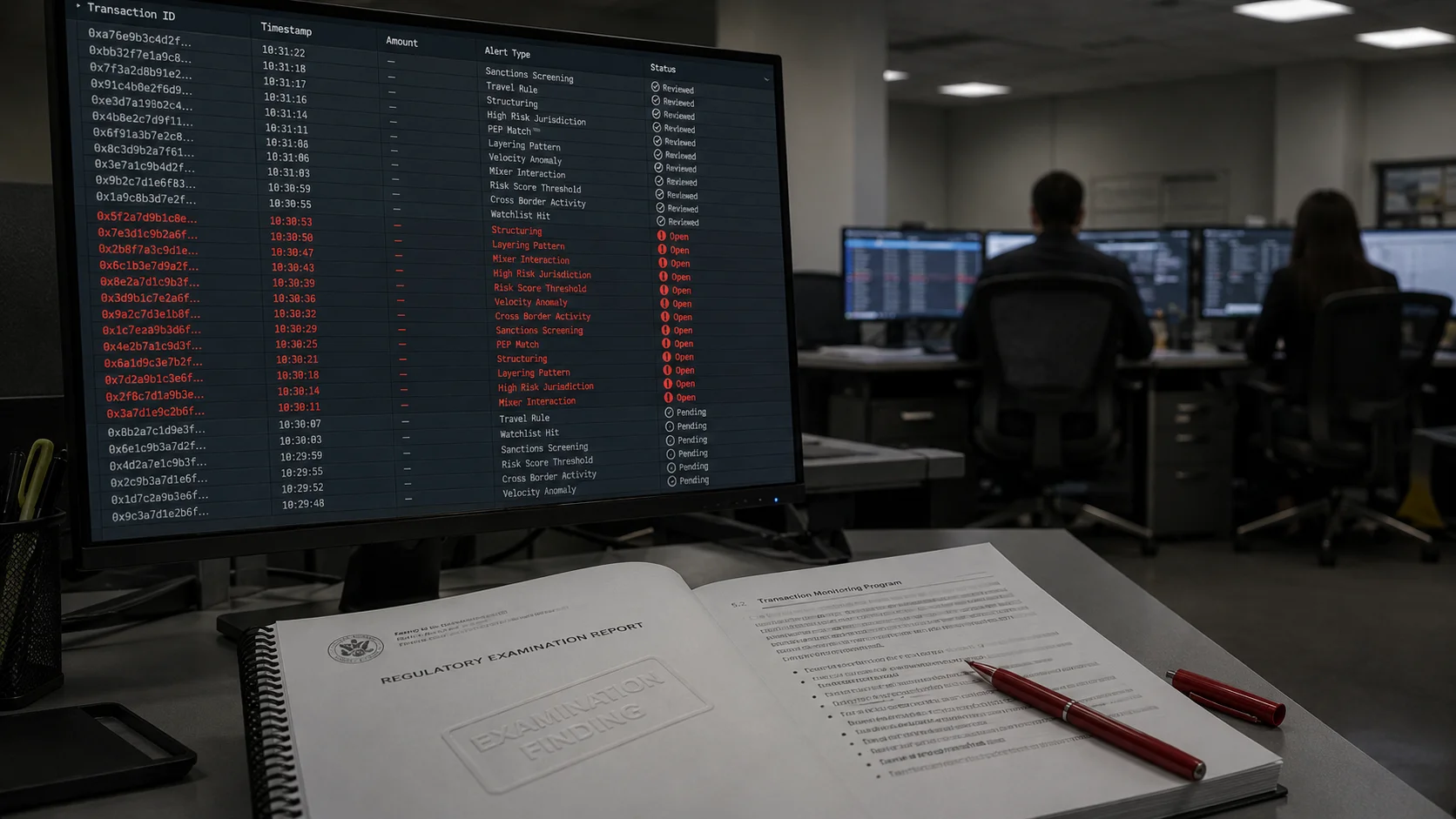
The enforcement record behind those outcomes supports the argument this article made in May: documented compliance and functional compliance differ, and the gap between them is where enforcement cases are built. The OKX actions show the gap in three jurisdictions. The Binance, Paxful, Coinbase Europe and MEXC cases show it at other exchanges.
What Happened at the MiCA Deadline
ESMA said in advance that the deadline would be enforced. Its April 17 statement told the market that any entity serving EU clients without a MiCA licence after July 1 would be in breach of EU law, and that unauthorised providers needed wind-down plans already in operation by that date. In December 2025 it had told national regulators to treat last-minute applications with considerable caution and to hold applicants to the same standard as any other, even if the firm had to wind down while its application was assessed. The May version of this article said ESMA expected regulators to use enforcement discretion for applicants with complete filings. ESMA’s statements do not support that.
On June 23, ESMA listed what an unauthorised provider must do from July 1: stop onboarding EU clients and marketing, limit services to selling, transferring or closing positions, and keep anti-money-laundering controls running through the wind-down, including customer due diligence, transaction monitoring and sanctions screening. Luxembourg’s CSSF repeated the requirements on July 2 and told customers to check that their provider is still allowed to operate.
The register shows a rush to beat the date. ESMA’s interim register, updated on November 27, lists 412 entities. Of those, 170 are Article 60 notifications, 164 are Article 63 authorisations, and 78 are older entries with no legal basis recorded. Firms such as the banks N26 and Trade Republic filed the notifications. Only 151 entities carried an authorisation date by the end of 2025. Another 75 were dated in June 2026 alone, the largest month in the file. A further 114 carry dates between July 2 and November 27, so the licensing queue did not clear when the deadline passed. The dates are those national regulators reported, and ESMA says reports can take time to appear in the register.
Binance did not join that queue in time. It withdrew its Greek application on June 24, a week before the deadline. The Block, citing Reuters and two people with knowledge of the process, reported that Greek officials worried about Binance’s past money-laundering penalties, its structure and what they saw as a risk-taking culture, and that talks with regulators in Ireland and Latvia met resistance. Binance told customers in France, Italy, Poland and Spain that it would take no new registrations and would wind down unlicensed activity, and that their assets would stay accessible, CoinDesk reported. Co-chief executive Richard Teng said Binance expects a licence in the coming months.
ESMA also keeps a register of non-compliant providers, which holds 218 records. Fifty-two carry decision dates after July 1: 27 from the Bank of Lithuania, 23 from Italy’s CONSOB, and one each from the Czech and Estonian regulators. None of the exchanges discussed in this article is among them. The Dutch regulator AFM had already listed MEXC in September 2025 for serving Dutch customers without a licence. On November 6 the U.S. Treasury cut MEXC off from U.S. financial institutions, a step covered below.
The other deadline the May version flagged also passed. July 18 was the one-year mark for GENIUS Act implementing rules, and the OCC, FDIC, NCUA and Treasury packages were all still proposals that day, The Block reported. The OCC finalised its rule on October 21, and both the rule and the Act take effect on January 18, 2027. VaaSBlock’s analysis of the GENIUS Act stablecoin deadline covers what that means for stablecoin operators.
What the OKX Record Shows
The OKX record is three actions by three authorities against two companies. Aux Cayes Fintech Co. Ltd., a Seychelles company that operates OKX, was the defendant in the United States and the respondent in the Netherlands. OKCoin Europe Limited, now called OKX Europe Limited, was the subject of the Maltese penalty and holds the MiCA authorisation.
In the United States, Aux Cayes pleaded guilty on February 24, 2025 to one count of operating an unlicensed money transmitting business and agreed to pay more than $504 million, according to the U.S. Attorney’s Office for the Southern District of New York. The total was $420.3 million in forfeiture and a fine of about $84.4 million. The fine was set after a 25% reduction off the bottom of the recommended range for cooperation and remediation. OKX had barred U.S. persons by policy since 2017, the office said, but it sought them out anyway. From 2018 to at least early 2024, U.S. customers traded more than $1 trillion on the exchange and generated hundreds of millions of dollars in fees and profits. Retail customers could open accounts, move funds and trade without any KYC process until about November 2022, and existing accounts kept that access through at least early 2023. OKX did not adequately use monitoring software until about May 2023. The office said more than $5 billion in suspicious transactions and illicit proceeds passed through the exchange, based on a review of third-party transaction data. It also said that on certain occasions OKX employees advised prospective U.S. customers how to supply false information at sign-up. OKX must keep an outside compliance consultant through February 2027.
In Malta, the Financial Intelligence Analysis Unit (FIAU) imposed a penalty of €1,054,269 and a follow-up directive on OKCoin Europe Limited on April 1, 2025. The breaches dated to an April 2023 on-site examination and the years before it. GLEIF’s record for OKX Europe Limited lists OKCoin Europe Ltd as its previous legal name. OKX itself has described Okcoin Europe as its MiCA-licensed entity.
The FIAU’s published findings are the clearest public account of the gap between a documented programme and a working one. The Maltese entity had an automated monitoring system that generated alerts. For about 80% of the customer files the examiners reviewed, covering transactions of more than $20 million, those alerts were not properly reviewed and were often closed without sufficient justification. Calibration ran backwards: customers with little activity triggered many alerts, while high-value, high-volume customers generated only a few. For about half the files, no customer risk assessment was done when the relationship began. Some customers had deposited thousands of dollars before an assessment was completed, months later in some cases. In one file, deposits of almost $1.2 million in three months were followed by fiat withdrawals above $1.4 million. That activity set off almost 30 alerts and an internal investigator report, yet no suspicious transaction report went to the FIAU. Its committee held that a report was required.
The FIAU also credited what OKX changed afterwards, including separate monitoring systems for fiat and on-chain activity and audit checks on discounted alerts. OKX said the review identified historical gaps that it had addressed through its own remediation.
In the Netherlands, the central bank DNB fined Aux Cayes €2.25 million for offering crypto services without the required registration from July 2023 to August 2024. DNB imposed the fine on May 27, 2025 and published it on September 3. It noted that without registration the company could not report unusual transactions to the Dutch financial intelligence unit. It reduced the amount after OKX moved its Dutch customers to a registered group entity. OKX told Cointelegraph the fine did not concern its MiCA-licensed entity.
OKX did not withdraw from Europe, as the May version of this article said. The Malta Financial Services Authority authorised OKX Europe Limited under MiCA on January 27, 2025. ESMA’s register lists it with 29 other EEA countries where it intends to provide services, among them custody, a trading platform and order execution. All three actions were announced after that licence was granted, and all three concerned conduct from before it. An authorisation clears an entity to operate from that point forward. It leaves the record intact.
The U.S. record also shows the incentive the May version described. A compliance programme that slows growth costs revenue today, and enforcement arrives later. The release puts revenue from U.S. customers in the hundreds of millions of dollars, and the penalty of more than $504 million arrived about seven years after that trading began.
Where Enforcement Finds the Gap
The OKX actions and the other exchange cases of the past three years cluster in four places.
KYC that exists in policy and lapses in practice. OKX let retail customers trade without a KYC process for about five years. Binance admitted failing to run KYC checks on many users, the Treasury said when it announced Binance’s $3.4 billion FinCEN penalty and $968 million OFAC penalty on November 21, 2023. In Malta, risk assessments were missing at onboarding for about half the sampled files. South Korean regulators raised a similar customer-identification issue at Upbit, which VaaSBlock covered in its Upbit analysis.
Monitoring that runs and misses. The FIAU findings describe alerts that fired and were closed without review. The Central Bank of Ireland found a different fault at Coinbase Europe Limited: faults in the configuration of its monitoring system left 30,442,437 transactions, worth more than €176 billion and about 31% of its transactions in the period, without full monitoring. A review that took almost three years then produced 2,708 suspicious transaction reports. The regulator fined Coinbase Europe €21,464,734 on November 6, 2025 after a 30% settlement discount, and the High Court confirmed the sanction on January 12, 2026. In both cases a monitoring system existed, but what it covered or what happened to its alerts differed from what the policy described.
Operating outside the perimeter. OKX’s unregistered Dutch activity, which DNB fined, left it unable to report unusual transactions to the Dutch financial intelligence unit from July 2023 to August 2024. FinCEN assessed a $3.5 million penalty against Paxful on December 9, 2025, after Paxful admitted that it failed to register as a money services business, to maintain an effective AML programme and to file suspicious activity reports. FinCEN said Paxful facilitated more than $500 million in suspicious activity and enabled transactions with countries including Iran, North Korea and Venezuela. On November 6, 2026, the Treasury said FinCEN had ordered U.S. financial institutions to stop processing transfers involving MEXC Global. The Treasury added that the order cited at least $16 billion in funds tied to sanctions evasion, cybercrime and other illicit activity between May 2021 and May 2026.
Suspicious-report culture. The Maltese customer file above shows the pattern: internal investigators flagged the customer, and the internal report was closed without a filing. Binance never filed a suspicious activity report despite more than 100,000 unreported suspicious transactions, the Treasury said in 2023. The filing count itself is the evidence.
GDPR showed a similar distance between a rule on paper and its application, which VaaSBlock examined in its analysis of GDPR’s limits.
What a MiCA Authorisation Tells You
ESMA’s April 17 statement says MiCA protections apply only to the specific authorised legal entity, which excludes other companies in the same group and non-EU entities. It also says that providers may operate under one brand across several companies. The OKX record shows the practical stakes. Aux Cayes Fintech pleaded guilty in New York and was fined in the Netherlands. It is a different company from the one in ESMA’s register, OKX Europe Limited. A customer’s contract names one of them. ESMA tells customers to confirm which entity actually provides their service.
The cost of sitting on the wrong side of the register is specific. On June 23, ESMA said clients of unauthorised providers do not benefit from MiCA safeguards, including protections for client assets, and told them to move assets to an authorised provider or a self-hosted wallet. Binance told EU customers their assets would remain accessible, but it stopped taking new registrations and began winding down unlicensed activity. A business that depends on an exchange for API access, custody or liquidity carries the same exposure at the level of the entity that serves it.
Authorisation also ties the entity to continuing duties. ESMA’s June statement treats AML controls as a condition that survives even a wind-down: customer due diligence, transaction monitoring, sanctions screening, suspicious transaction reporting and the traceability rules for crypto-asset transfers all stay in force. Operating substance sits behind a licence, and VaaSBlock’s analysis of MiCA and the RMA framework treats it as the gap an authorisation leaves open.
Questions That Test Whether Compliance Works
The FIAU found its gaps by sampling customer files, a test any counterparty can approximate with the right questions. Which legal entity will hold the account and the assets, and is it in ESMA’s register for the services and countries needed? What share of customer files had a risk assessment completed before the first deposit? How many monitoring alerts were closed without escalation last year, who reviewed the closures, and what share got a second review? What share of customers have been through enhanced due diligence rather than a simplified check, and does any account tier skip the full process? How was the monitoring system last tested for coverage, and how do its detections compare with what external blockchain analytics flag? Does the exchange publish suspicious-report volumes, and how do they compare with peers of similar size and risk? An exchange that tracks these measures can answer with numbers.
Certifications help only where they test the thing in question. ISO 27001 certifies an information security management system, and anti-money-laundering controls fall outside it, so ask what each attestation covered. VaaSBlock’s comparison of RMA and ISO 27001 sets out what that standard does and does not address.
FAQ
When did MiCA enforcement begin for unlicensed providers? The transition period ended across the EU on July 1, 2026, and ESMA expected unauthorised providers to have implemented wind-down plans by then: no new clients, no marketing, and only services that let clients exit. ESMA did not signal discretion for pending applications; its December 2025 statement told regulators to treat last-minute applications with considerable caution. The register of non-compliant providers lists 52 decisions dated after July 1, none against the exchanges named in this article.
How large was the OKX fine? There was no single fine. Aux Cayes Fintech, which operates OKX, agreed to pay more than $504 million in the U.S. plea: $420.3 million in forfeiture and a fine of about $84.4 million. Malta’s FIAU imposed €1,054,269 on OKCoin Europe Limited, now OKX Europe Limited, and DNB fined Aux Cayes €2.25 million in the Netherlands.
Did OKX leave the EU under MiCA? No. The Malta Financial Services Authority authorised OKX Europe Limited on January 27, 2025, and ESMA’s register lists it with 29 other EEA countries where it intends to provide services.
What is the most common pattern in exchange compliance failures? A written programme that the operation does not follow. The cases above show KYC skipped for some customers, monitoring alerts closed without review or never generated, and suspicious reports not filed despite red flags. The failures sit in how the programme runs, so they show up in sampled files and alert queues before they show up in policy documents.
What should I ask an exchange about its compliance? Which legal entity serves you and whether it is in ESMA’s register, the share of customer files with a risk assessment before the first deposit, how many alerts were closed without escalation and who reviewed them, the share of customers through enhanced due diligence, and how the monitoring system was last tested for coverage.
What is the counterparty risk of using an unauthorised exchange? Clients of an unauthorised provider do not get MiCA safeguards, including protections for client assets, ESMA said on June 23. It told them to move assets to an authorised provider or a self-hosted wallet. Binance told EU customers their assets would stay accessible while it wound down unlicensed activity.
Updated November 27, 2026. This article first ran in May as a preview of the MiCA cutoff and the GENIUS Act deadline, and now reports what followed. Corrections: OKX did not withdraw from the EU and holds a MiCA authorisation, the 2025 U.S. case was a guilty plea to unlicensed money transmitting by a different OKX company, ESMA’s statements did not signal enforcement discretion, the GENIUS Act takes effect on January 18, 2027, and a Kroll illicit-flow estimate and a Grant Thornton quotation that could not be verified were removed.
Sources
- ESMA: Statement on the end of transitional periods under MiCA, April 17, 2026
- ESMA: Public statement on the end of the MiCA transitional period, June 23, 2026
- ESMA: Statement on MiCA transitional measures, December 4, 2025
- ESMA: Markets in Crypto-Assets Regulation page and Interim MiCA Register, last update November 27, 2026
- ESMA: Interim MiCA Register, crypto-asset service providers file, read November 27, 2026
- ESMA: Interim MiCA Register, non-compliant entities file, read November 27, 2026
- CSSF: MiCA transition period for virtual asset service providers ended on 1 July 2026, July 2, 2026
- The Block: Binance co-CEO remains committed to securing an EU license after withdrawing Greece bid, June 24, 2026
- CoinDesk: Binance tells EU users it will no longer provide services after failing to secure MiCA license, June 26, 2026
- U.S. Attorney’s Office, Southern District of New York: OKX pleads guilty to violating U.S. anti-money laundering laws and agrees to pay penalties totaling more than $500 million, February 24, 2025
- FIAU Malta: Administrative measure publication notice, OKCoin Europe Limited, April 3, 2025
- De Nederlandsche Bank: Fine for Aux Cayes Fintech Co. Ltd, September 3, 2025
- GLEIF: LEI record for OKX Europe Limited (previous legal name OKCoin Europe Ltd)
- Cointelegraph: OKX and Crypto.com secure MiCA licenses, January 27, 2025
- Cointelegraph: OKX fined $2.6 million in the Netherlands for operating without a license, September 3, 2025
- OKX: EU compliance update, April 2025
- Central Bank of Ireland: Enforcement action against Coinbase Europe Limited, November 6, 2025
- U.S. Treasury: Largest settlements in history with Binance, November 21, 2023
- FinCEN: FinCEN assesses $3.5 million penalty against Paxful, December 9, 2025
- U.S. Treasury: Operation Economic Outcast severs MEXC Global’s access to the U.S. financial system, November 6, 2026
- The Block: US regulators miss GENIUS Act’s one-year deadline for final stablecoin rules, July 18, 2026
- OCC: News Release 2026-92, final rule to implement the GENIUS Act, October 21, 2026
- GovInfo: Public Law 119-27, GENIUS Act, section 20 (effective date)