
TL;DR
In a year where much of Web3 has struggled to deliver amid weak crypto sentiment and macro pressure, WeFi Bank — a self-described “deobank” — has emerged as an unexpected outlier. Its reported token performance and growing visibility stand in contrast to an industry dominated by stalled roadmaps and broken narratives. That makes WeFi interesting, but not automatically credible. This article looks at the project behind the price: what WeFi says it is building, what can be verified today, where the risks sit, and what would need to be true for this to hold up under stress.
WeFi Bank: The Under-the-Radar “Deobank” Bucking Web3’s Tough 2025 — So Far
In a year where many Web3 narratives have failed the delivery test, WeFi has been framed as a counter-trend outlier.
How to read this: This deep dive aims to separate verifiable facts from marketing claims, and to keep scepticism front and centre.
Disclosure: This is editorial analysis based on publicly available reporting, project documentation, code/audit materials where available, and third-party market data. A consolidated list of references appears in Sources & Notes at the end.
Written by: VaaSBlock Research
January 2026 Update
This article was originally published on December 21, 2025. This January 2026 update adds a time-stamped market snapshot and incorporates new publicly available information and project documentation that emerged after publication. As always, we distinguish between what can be verified and what remains reported or claimed.
- Market snapshot refreshed: Price, market cap, supply and volume figures are now time-stamped (see below).
- Incentives layer noted: WeFi now describes an “Energy” (NRG) program that may alter the value proposition for some users (details covered later in the article).
- Emissions context clarified: WeFi’s mining / emission schedule and halving mechanics are treated as a key risk and volatility driver into 2026.
- Compliance language tightened: We continue to separate “registration” from “banking licence” and treat broad licensing claims as jurisdiction-by-jurisdiction assertions that require verification.
Market Snapshot (As of January 25, 2026)
Market data changes quickly. The figures below are intended as a reference point for this update, based on major market-data trackers at the time of writing.
- Price: ~$2.94
- Market cap: ~$229M
- Circulating supply: ~78.2M WFI (max supply: 1.0B)
- 24h volume: ~$3.7M
- Primary tracker: CoinMarketCap (WFI)
- Cross-check: CoinGecko (WFI)
Note: Some sites list similarly named tickers (e.g., “WEFI”). This article refers to WFI as shown on the trackers above.

In a turbulent 2025, where Bitcoin has struggled at points even as major equity indices hit record highs and inflation remains a persistent pressure in many economies—the Web3 sector has once again been crowded with overhyped sales stories: projects heavy on promises but light on delivery. WeFi Bank (marketed as a decentralised on-chain bank or “Deobank”) has emerged as a counter-trend outlier in that environment. Recent coverage and market-data trackers report sharp appreciation in its WFI token over the year, while the company and several outlets also claim rapid adoption across dozens of countries.
As broader crypto sentiment has remained uneven and regulatory uncertainty continues to shape the market, WFI has reportedly moved from the low-cents/low-dollars range earlier in the year to the mid-$2 range by late December 2025, with market capitalisation estimates around ~$200m depending on venue and methodology. These figures are market-data estimates, not “fundamentals.”
This performance contrasts with an industry that often rewards story-telling more than operational excellence—an issue we’ve previously framed as “amateur hour” in Web3 operations. WeFi may be an exception—for now—but scepticism is still the correct posture: is this sustainable value creation, or simply another narrative that has not yet met the stress-tests that typically break crypto “winners”?
This deep dive covers WeFi’s positioning, team, code signals, token trajectory through 2025’s key moments, and the risk factors that matter into 2026. Where information cannot be independently verified, we label it as “reported” and avoid treating it as fact. If you’re here specifically for a faster orientation on claims, risks, and positioning, our WeFi banking analysis is a dedicated starting point.
The Deobank Revolution: What is WeFi and Its Core Innovation?
What does “Deobank” mean?
“Deobank” is not a regulated category and has no standard definition. In practice, it is usually used to describe a hybrid product that borrows the interface and convenience of a neobank (cards, payments, fiat on/off‑ramps) while routing some functions through crypto rails (wallet-based custody, token incentives, on-chain settlement, and smart contracts). Where risk sits depends on the custody model, counterparties, and jurisdictional structure — not on the label.
Quick comparison: This table is intentionally simplified. Real-world implementations vary by provider and by country.
| Model | Typical user experience | Where risk often concentrates |
|---|---|---|
| Neobank | App-first banking interface, fiat accounts, cards, payments | Banking partner structure, account protections vary by jurisdiction, operational risk |
| “Deobank” | Neobank-like UX plus stablecoins, self-custody elements, token incentives | Custody design, smart-contract risk, incentives sustainability, regulatory ambiguity |
| DeFi app | Wallet-native, on-chain protocols, composable yield and lending | Smart-contract exploits, governance/control risk, oracle/bridge dependencies |
WeFi positions itself as the “world’s first Deobank,” reimagining banking by migrating traditional services onto blockchain rails while emphasising regulatory compliance. Launched in early 2025 after a closed beta in late 2024 (as described in project materials and several third-party profiles), WeFi says it operates on “WeChain,” described in coverage as a Cosmos-based stack with cross-chain ambitions. Where this matters for users is not the branding, but whether the chain and its dependencies withstand real-world adversarial conditions.
Users access a unified interface for fiat and crypto management: deposits convert seamlessly to stablecoins, enabling global payments, yield earning (the company and some coverage cite figures “up to” ~18% on stablecoins, though terms, duration, and sustainability can vary), ATM withdrawals via payment cards (card acceptance is typically mediated through card programme partners and networks, so “merchant count” claims are best treated as marketing shorthand), and automated services like lending, borrowing, and bill payments—all settled in WFI for genuine utility.
Important caveat on yields: High advertised returns are not a neutral feature in crypto—they are a risk signal. Rates can change without notice, may depend on promotional periods, may involve counterparty and smart-contract risk, and in the worst cases can resemble the early-stage dynamics of yield-driven failures. Sadly, there are countless examples of consumers losing funds chasing yield in prior cycles. Treat any “up to” number as non-guaranteed and manage your exposure accordingly.
Energy (NRG): a secondary incentives layer
Since publication, WeFi has described an “Energy” (NRG) program — a loyalty-style incentives layer that, according to project materials, can be used to increase certain reward rates and reduce some platform fees for active users. What matters is the mechanism: if rewards are boosted by incentives rather than organic revenue, the sustainability of those benefits becomes a core diligence question.
Practical lens: Treat “Energy” as an incentive design choice. It may improve retention and perceived value for some users, but it also increases the importance of (1) clearly documented terms, (2) emission and subsidy dynamics, and (3) what happens when promotional structures change.
This model aims to reduce familiar friction points — fiat on/off-ramps, payments usability, and cross-border transfers — while keeping a crypto-native incentive layer. Some coverage claims adoption has been strongest in parts of the Global South, where stablecoins and crypto rails are used for remittances and inflation hedging. Treat geographic adoption narratives as “reported” unless backed by primary data.
WeFi describes a distributed custody and social‑recovery approach intended to reduce the risk of permanent loss from key mismanagement, while avoiding a fully custodial model. Details matter here (who holds recovery shares, under what conditions recovery is possible, and what a user’s recourse looks like in a dispute), so readers should treat high-level custody language as “claimed” unless it is backed by a published design spec, audit scope notes, or a clearly documented custody partner arrangement. In the project’s own words, the positioning is aspirational: “We’re not just building a bank; we’re building a movement.”
How to evaluate any “Deobank” claim set
Awards and “record” narratives can be useful cultural signals, but they are not substitutes for due diligence. A more reliable approach is to treat the product as a set of claims that can be stress-tested against documentation, registry entries, and live availability.
- Separate registration from licensing: an MSB/PSP registration may be legally required for certain activities, but it is not the same as a prudential banking licence.
- Verify availability by country: card programs, limits, fees, and KYC requirements often vary materially by jurisdiction.
- Read the yield terms like a lawyer: confirm duration, caps, eligibility rules, and what is subsidised versus revenue-backed.
- Audit scope matters: check what was actually audited (contracts vs infrastructure), the date, and whether critical dependencies (bridges, custody, key management) were included.
- Model dilution: compare current market cap to FDV, and treat emission schedules as ongoing sell pressure unless there is clear demand absorption.
- Track operational execution: uptime, support responsiveness, disputes/chargebacks (if applicable), and whether the product remains consistent through market stress.
This is not a claim that any particular criticism is correct — only that crypto-banking hybrids tend to fail at the edges: unclear legal structure, weak consumer recourse, unsustainable incentives, or fragile technical dependencies.
The Team: Veterans or Questionable Ties?
WeFi’s leadership blends fintech and blockchain expertise, suggesting intent for lasting infrastructure over quick schemes. Sakharov, ex-founder of crypto exchange Exflow, brings compliant infrastructure experience from emerging markets. Chairman Reeve Collins, Tether (USDT) co-founder, a history that attracts scrutiny in some narratives given Tether-era controversies; where claims go beyond public records, they should be treated as unverified and are not relied upon here. Chief Product Officer Roman Rossov, formerly at Wise (TransferWise), excels in cross-border payments.
Recent additions include ex-Visa executive Michael Batuev as Global Head of Payments, which some observers interpret as a credibility signal with 18+ years of fintech experience including leadership roles in mobile payments and self-custody card solutions at Tangem. In the project’s own communications (and in syndicated coverage), the appointment is framed as part of an institutional expansion narrative: “The payments industry is now at a turning point. Legacy systems are struggling to keep up with the fluid, borderless nature of digital finance. WeFi’s model combines the trust of banking with the freedom of Web3”.
COO Alice Tärk and others like Adrian Liddiard (ex-BlueWater Communications, sold to Presidio) and John Schmidt (ex-Castle Pines Capital, sold to Wells Fargo) round out a team with successful exits. However, bios are sparse in places, and Collins’s ties invite scrutiny—echoing how stellar teams in past projects didn’t prevent collapse when market conditions changed.
Professional analyst John Lee from PiggyCell adds perspective: “The best projects solve everyday problems,” fitting WeFi’s practical bent toward addressing real financial infrastructure gaps.
Code and Technical Architecture: Transparency Meets Security?
WeFi’s GitHub shows active development, with repositories like the WFI Token Distribution Contract on Binance Smart Chain (Solidity 0.8.20, Foundry framework) featuring mining rewards with halvings (8 → 4 → 2 → 1 WFI per block), linear vesting for referrals/staking over two years, and security via OpenZeppelin’s ReentrancyGuard, Ownable controls, ECDSA signatures, and pausability.
Audits by SolidProof, Cyberscope, Peckshield, and Quillhash identified minor issues but no critical flaws, with routine code reviews noted. However, “audited” does not mean “safe,” and audit scope can be narrow or time-bounded. Not all code and operational systems are fully open, and some discussions reference marketing-style technical claims (for example, “quantum-grade” language) that are difficult to independently validate and should not be treated as evidence of security. In a year with over $3 billion in DeFi hacks, this partial transparency warrants caution.
More broadly, crypto security incidents remain common at both the protocol and user-wallet level; this context matters when evaluating any app that blends payments, yield, and on-chain mechanics.
Some project materials and coverage describe a distributed custody architecture with social-recovery mechanics designed to reduce single points of failure. As with any custody claim set, the key diligence question is scope and verification: which components are audited, which are operational (not on-chain), and which dependencies (custody partners, key-share storage, recovery workflows) are actually in place for users in a given jurisdiction.
Token Performance: Key 2025 Moments and Market Dynamics
WFI’s reported rise through 2025 can be described in distinct phases that help explain how the narrative formed — but the exact figures should be treated as time-bound market-data estimates rather than “fundamentals.” For a current reference point, see the Market Snapshot (As of January 25, 2026) above. Earlier milestones and quarter-by-quarter moves below are retained for context, not as a guarantee that the same dynamics persist.
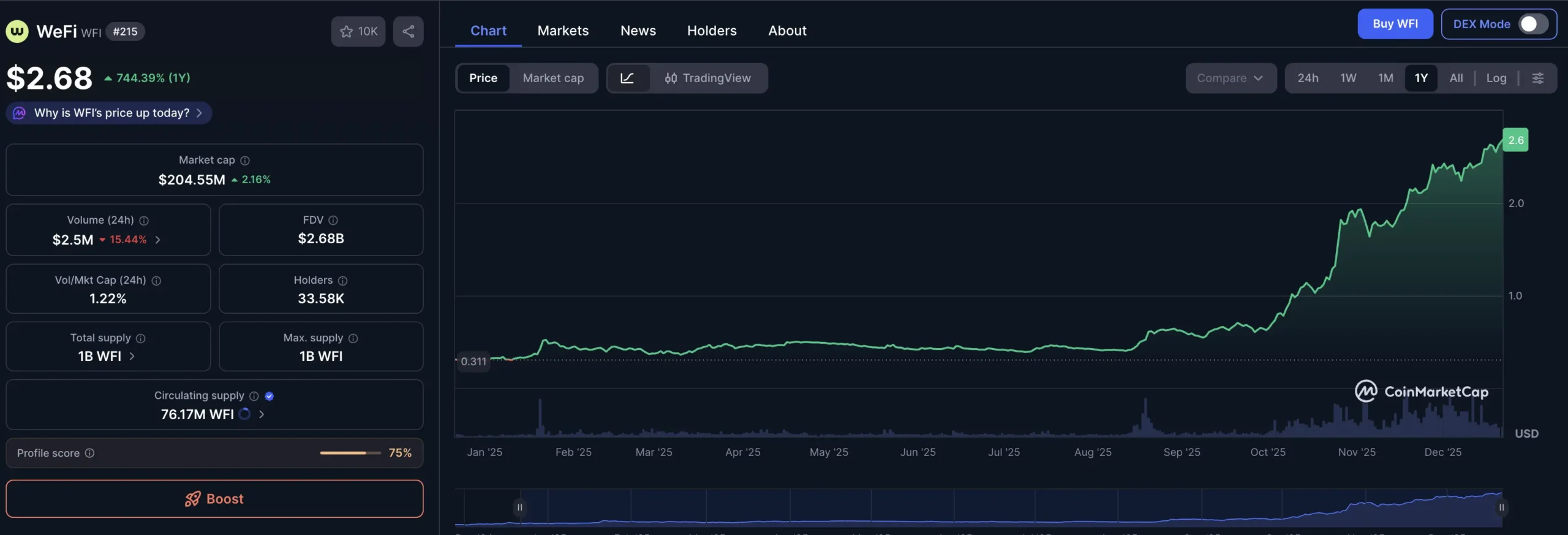
Q1 Launch (January-March): +200% to $0.50 amid Deobank rollout, as BTC dipped 15% during broader market uncertainty.
Mid-Year Rally (April-June): +400% to $1.50 on Asian licensing announcements, bucking BTC’s stagnation during regulatory headwinds.
Q3 Adoption (July-September): +30% to ~$2.00, with coverage increasingly emphasising emerging-market corridors and payments narratives. Sector-wide TVL and “macro DeFi” context should be treated as background rather than a direct explanation for WFI’s move.
Q4 Peak (October-December): The move to ~$2.68 coincided with award coverage and institutional-expansion narratives, with +90% reported in November alone as traditional finance executives joined the project.
Some market coverage has framed WFI’s move as an anomaly versus Bitcoin’s choppier periods; however, attributing price action to “utility rather than speculation” is inherently uncertain in crypto markets.
However, the disconnect between current market capitalization and fully diluted valuation signals significant dilution risks as more tokens enter circulation through mining rewards and staking distributions.
2026 Roadmap and Milestones (reported / documented)
Roadmaps in crypto change frequently. The table below separates what appears live today from items that are announced or reported in project materials and coverage. Timeframes are indicative and should be treated as non-binding unless backed by jurisdiction-specific disclosures or released product terms.
| Milestone | Indicative window | Status | Why it matters |
|---|---|---|---|
| Energy (NRG) incentives layer | 2025–2026 (ongoing) | Reported / documented in project materials | Changes effective rewards/fees; sustainability becomes a key diligence question. |
| Emissions schedule and halving mechanics | 2026 (notably early September, as reported) | Documented (mechanics) / Reported (timing) | Reduces new issuance rate; may act as a volatility catalyst without guaranteeing price outcomes. |
| Payments expansion narrative | 2026 (ongoing) | Reported in project comms and syndicated coverage | Execution quality (availability, fees, limits, KYC) matters more than headline “global” claims. |
| Jurisdiction-by-jurisdiction compliance build-out | 2026 (ongoing) | Reported / partially verifiable via registries | Regulation strength and consumer recourse differ widely; “registered” is not “licensed as a bank.” |
Regulatory Strategy and Global Expansion
WeFi and several third-party profiles describe a “multi-jurisdictional” approach to compliance—often listing registrations or authorisations such as Canadian MSB registration with FINTRAC, and additional permissions in other regions. The key point: these terms are frequently used loosely in crypto marketing. For example, FINTRAC MSB registration is a legal requirement for certain activities in Canada, but registration does not imply endorsement, a prudential “banking” licence, or top-tier consumer protections. Readers should treat any broad “licensed everywhere” framing as a claim that needs jurisdiction-by-jurisdiction verification.
The company is pursuing Singapore, UAE, and US expansions while using AI-driven KYC and zero-knowledge proofs for privacy-preserving compliance. This “regulatory-first” approach creates significant operational costs but positions the platform advantageously as global cryptocurrency regulations evolve.
Macro context: Major policy and financial-stability institutions have repeatedly warned that “crypto-banking” or crypto-to-payments hybrids can create risks through opacity, leverage, maturity mismatches, and growing interconnectedness with traditional finance. For a high-quality overview, see the European Central Bank’s Financial Stability Review (including its crypto-focused analysis) and the Basel Committee’s prudential framework for banks’ cryptoasset exposures.
However, third-party safety assessors have raised concerns about the strength of oversight. For example, BrokerChooser argues that WeFi is not regulated by a top-tier regulator and recommends avoidance on that basis. Even if one disputes BrokerChooser’s framing (it reviews “brokers” and may not map perfectly onto a deobank model), the underlying point is still relevant: the quality of regulation matters, and not all registrations provide meaningful consumer recourse.
That caution has since been confirmed by a primary regulator. On May 15, 2026, BaFin — Germany’s federal financial supervisory authority — updated its public consumer warning on WeFi to state that the company holds no authorisation to offer banking, financial, or cryptoasset services in Germany, and that no application for a German banking licence has been submitted, with BaFin calling the prospects for one “extremely doubtful.” Unlike the third-party assessments cited above, this is a primary regulator finding, not a secondary opinion, and it applies specifically to Germany, a market where WeFi has held promotional events (see Sources & Notes).
Why Bucking the Trend? Competitive Analysis and Market Positioning
WeFi’s competitive edge lies in addressing real market failures that traditional finance and pure DeFi have failed to solve. The platform targets the 1.4 billion unbanked globally while serving cross-border workers, freelancers, and businesses needing multi-currency functionality.
As professional analyst Valerio Attilio Rossi noted: “Who creates value, receives value”—a principle that appears to drive WeFi’s focus on practical utility over speculative features. The platform’s payment-card narrative is framed around Visa-network acceptance in many locations, but real-world utility depends on the specific card programme, issuer terms, regional availability, fees, limits, and KYC requirements.
Competitors like Coinbase, Binance, Revolut, and N26 offer pieces of WeFi’s functionality but none provide the same integrated DeFi-traditional fusion. Traditional banks struggle with crypto integration due to legacy infrastructure, while crypto exchanges typically lack comprehensive banking services and regulatory compliance across multiple jurisdictions.
Yet this positioning also creates vulnerabilities. Traditional financial institutions with deeper resources could replicate WeFi’s model, while regulatory changes could impact the platform’s multi-jurisdictional approach. The project’s success has attracted attention, but sustainable competitive advantages require continuous innovation and investment.
Risks, Challenges, and 2026 Outlook
Despite impressive achievements, WeFi faces significant challenges that could derail its momentum. The most immediate concern involves sustainability of advertised yields: 18% returns on stablecoin deposits appear optimistic amid traditional finance’s low-yield environment.
Technical risks include smart contract vulnerabilities where industry reporting has consistently documented multi‑billion‑dollar losses from DeFi exploits and scams in recent years. While WeFi’s audits show no critical flaws, the partial transparency around some “quantum-grade” claims raises questions about unverified technological assertions.
Regulatory risks loom large as the platform’s multi-jurisdictional approach creates exposure to evolving rules across numerous markets. A single regulatory action in a key jurisdiction could impact global operations, while compliance costs continue rising as the platform expands.
Token economics present another challenge: gradual release of the 1 billion maximum supply creates inherent selling pressure that must be offset by continuous user growth and utility expansion. The disconnect between current market cap and fully diluted valuation suggests significant dilution risk as more tokens enter circulation.
The WFI halving: what changes mechanically
WeFi’s published token mechanics describe an emissions model that reduces mining rewards over time via scheduled halvings (often framed as 8 → 4 → 2 → 1). If implemented as described, a halving does one thing with certainty: it reduces the rate of new token issuance. What it does not guarantee is a higher price — markets can react in multiple directions depending on liquidity, demand, and the level of sell pressure from rewards recipients.
Why it matters: For readers evaluating WFI, the halving is best treated as a potential volatility catalyst and a stress-test for whether demand and utility are sufficient to absorb ongoing emissions and unlock-related selling.
Rather than leaning on point forecasts — which age quickly and often embed hidden assumptions — a more useful way to think about 2026 is scenario-based. In a stronger outcome, demand (users, payments volume, and genuine utility) absorbs ongoing emissions and offsets dilution. In a weaker outcome, incentives fade, sell pressure dominates, or regulatory friction reduces distribution. The practical diligence focus is whether usage and revenue drivers (if any) remain resilient when market conditions tighten.
The cautionary tale of Kadena’s rapid rise and fall serves as reminder that even projects with strong technical foundations and experienced teams can falter when market conditions change or promised utility fails to materialize at scale.
Conclusion: Exception or Harbinger?
WeFi is a useful test case for whether crypto-banking hybrids can mature beyond speculation into something closer to financial infrastructure. The platform’s reported token appreciation and growing visibility have been framed in coverage as “utility-led,” but that interpretation remains hard to prove in crypto markets. The more practical question is whether the product holds up through stress: changing market conditions, tighter regulation, and the inevitable unwind of promotional incentives.
The project is positioned around practical use-cases — cross-border payments, inflation hedging, and access — that traditional finance often serves imperfectly in many corridors. Its “regulatory-first” framing and experienced hires may help, but they are not guarantees. The appointment of executives like Michael Batuev is better read as an institutional-expansion signal than as evidence that key product claims (availability, compliance posture, or economics) are already proven.
However, significant risks remain. Unverified technological claims, sustainability questions around high yields, regulatory exposure across multiple jurisdictions, and the inherent challenges of scaling complex financial infrastructure create substantial uncertainty. The platform’s short track record provides limited evidence of long-term viability, while competitive pressures from better-funded institutions could erode current advantages.
For the broader crypto sector, WeFi is best treated as an early case study rather than a template. It suggests one possible path for teams trying to combine payments, compliance narratives, and crypto-native incentives — but the hard part is operational: maintaining availability across jurisdictions, keeping terms clear, and proving that demand exists without subsidy-heavy mechanics.
Whether WeFi represents the exception that proves the rule about crypto’s tendency toward hype over substance, or a harbinger of a more mature phase of cryptocurrency development, depends on its next phase: scaling globally while maintaining compliance, generating sustainable revenues, and preserving token value. That is the test that will determine whether it joins the ranks of genuine financial innovation or becomes another cautionary tale.
FAQ: WeFi Bank, “Deobanks,” and WFI
Is WeFi Bank a regulated bank? WeFi and several third-party profiles describe various registrations or authorisations in multiple jurisdictions. However, these should not be assumed to be equivalent to a prudential banking licence or regulatory endorsement. Consumer protections and recourse vary significantly by country and by the specific legal entity providing the service.
Are WeFi’s advertised yields guaranteed? No. Any “up to” yield figures referenced in company materials or coverage are non-guaranteed and can change without notice. Returns may depend on promotional periods, incentives, counterparties, and smart-contract or custody risks. Treat yields as a risk signal and size exposure accordingly.
What does “Deobank” mean in practice? “Deobank” is not a standard regulatory category. In practice, it typically refers to a hybrid model that combines crypto rails (wallets, token incentives, on-chain components) with traditional finance interfaces (cards, payments, fiat on/off-ramps). The exact design — and where risk sits — depends on custody, counterparties, and jurisdictional structure.
What is WeFi “Energy” (NRG) and how does it affect users? WeFi describes “Energy” (NRG) as a loyalty-style incentives layer that can be used to boost certain reward rates and reduce some platform fees for active users. The key diligence point is the mechanism and the terms: if benefits are driven by incentives or subsidies rather than organic revenue, sustainability and eligibility rules become central to evaluating the offering.
What is the WFI halving and what does it change? WeFi’s published token mechanics describe scheduled halvings that reduce the rate of new token issuance over time (often framed as 8 → 4 → 2 → 1). Mechanically, a halving reduces emissions. It does not guarantee a higher price, and it can act as a volatility catalyst depending on liquidity, demand, and sell pressure from rewards recipients.
Does WFI token performance prove long-term value? Not by itself. Token price action can reflect liquidity conditions, market narratives, incentives, and speculation as much as utility. A more durable evaluation looks at dilution dynamics, usage and revenue drivers (if any), governance and control, audit scope, and whether key claims remain true under stress.
Sources & Notes
All figures and claims in this editorial should be read alongside their original references.
Source hygiene note: The Energy (NRG) and ITO/mining links below are project-affiliated and are used primarily to describe claimed mechanics (not to verify outcomes). Where possible, we rely on independent registries, code/audit portals, and major market-data trackers for verification.
- CoinMarketCap — WeFi (WFI) price, market cap, circulating supply, and chart
- Yahoo Finance — Market coverage and price-move reporting (search: WeFi / WFI)
- Yahoo Finance — “What is WeFi Crypto? …”: syndicated overview that explicitly mentions the reported early September 2026 halving and a reduction in mining rewards to 4 WFI per second (secondary source)
- DeepWiki — Mining rewards pool & halving schedule summary derived from the public wefico/wefi-contracts repository (code-derived secondary reference)
- CoinGecko — Market data cross-check (search: WFI / WeFi)
- WeFi — “Power up with Energy”: project explanation of the Energy (NRG) incentives layer (project-affiliated)
- WeFi Deobank — ITO / mining page: emissions and halving mechanics as described in project materials (project-affiliated)
- BrokerChooser — Safety overview / regulation discussion (WeFi)
- The Block (press release) — Ex‑Visa payments leader Michael Batuev joins WeFi
- FinanceFeeds — Interview with Maksym Sakharov
- Gulf Business — “The deobank revolution” (profile/coverage)
- IQ.wiki — WeFi project profile (community-edited)
- The Cryptonomist — “Most Innovative Web3 Project” coverage
- Bitget News — Award coverage (promotional/syndicated)
- WeFiTec — Team page (project-affiliated)
- GitHub — wefico/wefi-contracts repository
- SolidProof — Smart contract audit provider (WeFi audit referenced in coverage)
- Cyberscope — Smart contract audit provider
- PeckShield — Blockchain security & audit firm
- QuillAudits / QuillHash — Smart contract audit firm
- Finextra — Traditional banking vs crypto banks (context)
- BaFin (Germany) — Consumer warning: wefi(.)co holds no authorisation to offer banking, financial, or cryptoasset services in Germany (published Feb 3, 2026; updated May 15, 2026)
- European Central Bank — Financial Stability Review (May 2025): crypto market developments and financial-stability risks
- Basel Committee (BIS) — Prudential treatment of banks’ cryptoasset exposures (Basel Framework)
- Cryptohopper — WFI overview (market-data aggregator)
- Chainalysis — Crypto crime & DeFi exploit reporting (context for hack statistics)
- TRM Labs — Illicit finance & crypto risk research
Evidence standard and sourcing note
This article intentionally separates (1) primary/official materials (regulators, registries, code repositories, audit portals), (2) reputable secondary reporting, and (3) lower-credibility or promotional sources. Where only category (2) or (3) sources were available for a claim — or where the only available source was project-affiliated documentation (for example: incentive mechanics, emission schedules, user counts, “up to” yields, broad licensing language, or awards) — the wording is framed as “reported” or “the company claims,” and the claim is not treated as verified. Readers should assume that terms, yields, programme availability, and regulatory posture can change quickly in crypto-banking products and should always check current terms and jurisdiction-specific disclosures before relying on any statement.
This article is not investment advice.
The Behavioural-Finance Question Behind A “Great 2025”
Any project that had a great year produces a specific cognitive trap for the people evaluating whether the next year will also be great. The trap is the assumption that the qualities that produced the good year are the qualities that will produce the next one. Sometimes that assumption holds. More often it does not, and the reason it does not is not that the project changed but that the conditions that rewarded the project’s qualities changed underneath it.
The honest behavioural reading of WeFi’s 2025 is that the project did genuinely good work in a year that was unusually receptive to the specific category of work it was doing. The token mechanics rewarded the projects that had clean tokenomics in a year when clean tokenomics were a differentiator. The bank-licensing angle rewarded projects that were positioning for institutional bridges in a year when institutional bridges were the narrative. None of this is a criticism of WeFi. It is a description of how a project and a market can align unusually well for a window of time, and how the alignment can move without the project moving.
The forward-looking question is not whether WeFi will continue to do good work. The honest assumption is that it probably will. The forward-looking question is whether the conditions in 2026 will reward the same qualities that 2025 did, and the behavioural-finance answer is that they will not — not because anything is wrong with the qualities, but because markets rotate which qualities they reward on a cycle that is faster than most projects can re-position against. The broader tech-cycle reset is the same dynamic at a larger scale: the conditions that rewarded a generation of companies are not the conditions of the next generation, and the gap between the two is where most of the underperformance comes from.
The Capital Allocation Standard Applied to the Deobank Model
William Thorndike’s study of exceptional operators in The Outsiders identified a consistent pattern: the executives who generated the best long-run returns were not the ones who built the best products. They were the ones who made better capital allocation decisions than their peers—specifically, who were willing to shrink the business or decline acquisitions when the alternatives did not clear a rational hurdle rate. Applied to the deobank model, this standard produces a clarifying question: what is the capital allocation logic that makes a hybrid DeFi-banking structure rational rather than merely novel?
The honest capital allocation answer has to address the numerator and the denominator separately. The numerator is the return on deployed capital: yield on lending, fee income on transactions, the value accrual from the WFI token to the extent that it reflects genuine network utility rather than speculative premium. The denominator is the cost of capital—in DeFi this is not the risk-free rate but the alternative return available in on-chain credit markets. DeFi lending and institutional credit benchmarks establish the denominator precisely: if Aave and Morpho are clearing institutional credit at given rates, the deobank proposition has to clear those rates or offer a structural advantage that compensates for the yield difference.
The structural advantages a deobank can offer over pure DeFi protocols are limited but real: regulatory clarity in jurisdictions where protocol interfaces are legally ambiguous, fiat on-ramp and off-ramp efficiency, and the account relationship that enables cross-selling treasury management products requiring identity and compliance history. The $23.6B RWA component-by-component decomposition identifies the market this advantage serves best: institutions that want yield optimization with compliance infrastructure, not retail users seeking permissionless access to the same yields.
Thorndike’s outsiders were notably unwilling to spend capital on acquisitions that did not clear their hurdle. The deobank capital allocation question is whether the cost of building a licensed banking operation—regulatory capital, compliance overhead, relationship banking infrastructure—earns a sufficient premium over the alternative of a pure DeFi interface with an off-ramp integration. Deep due diligence methodology applied to this question requires modeling the regulatory moat: if compliance cost creates a durable barrier preventing protocol-only alternatives from serving the target customer, it is a real advantage. If it only creates a delay that protocols eventually arbitrage, the capital is deployed in a moat that disappears.
The verifiable credibility infrastructure that distinguishes professional from amateur operators maps onto Thorndike’s concept of the internal score: how the organization measures its own performance, whether those metrics are honest, and whether capital allocation decisions are actually driven by them or by narrative momentum. Deobanks that allocate capital based on return on regulatory overhead rather than on token narrative are the ones that will survive the compression phase.
The Transparency Score is the closest operational equivalent to Thorndike’s internal score for the DeFi-adjacent space: a measurable, falsifiable claim about process quality that creates accountability without requiring the market to take the claim on trust. The strong 2025 performance has to be readable in these terms—not as a narrative about momentum but as a capital allocation record that shows what was deployed, at what cost of capital, and what return it generated—before it becomes evidence of a durable model rather than a favorable cycle.