
There is a number that has done more to move utility stocks, nuclear restart decisions, and natural-gas turbine order books over the past two years than any single piece of data in the energy sector. It is the share of US electricity that data centers will consume by 2030. You have seen it. It is usually a single confident figure — somewhere between 8 and 12 percent — and it is usually presented as settled fact, the demand-side certainty against which every supply-side decision is being justified. The problem is that it is not one number. It is at least four different numbers, produced by four different institutions using four different definitions of what counts, and the gap between them is wide enough to drive a gas plant through. The further problem — the one that almost no equity research note acknowledges in its headline — is that the input feeding the most aggressive of these forecasts is a measure that the people who run the grid have been saying, on the record, materially overstates real demand.
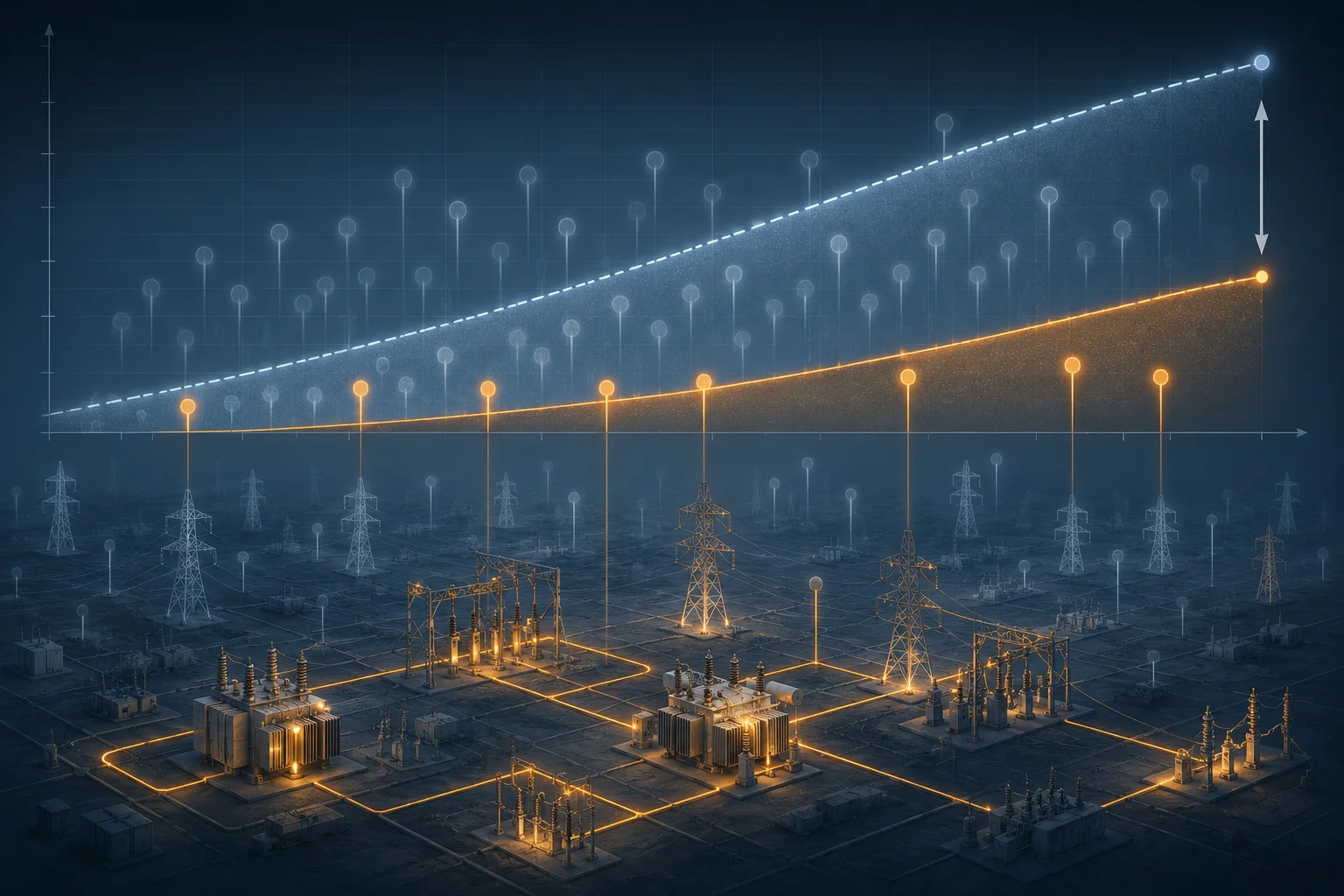
This matters because an enormous amount of capital is being committed against the high end of the range as though it were the base case. The utilities, the data-center REITs, the turbine makers, and the nuclear operators are all making multi-decade decisions on the assumption that the demand is not only real but conservative. If the demand is real, those decisions are correct and the stocks are cheap. If a meaningful fraction of the demand is phantom — counted twice, or never built, or built at half the requested capacity — then a cohort of investments that has been priced for a structural demand shock is instead priced for a forecast that will quietly be revised down without anyone ringing a bell. The purpose of this piece is to give you the tools to tell which world you are in, because the published forecasts will not.
The number everyone cites is four different numbers
Start with the source-skepticism the headline figure deserves. The widely circulated “data centers will reach roughly X percent of US electricity by 2030” claim does not originate from a single authoritative study. It is a flattening — by the financial press and by sell-side research — of several distinct projections that measure different things.
The Electric Power Research Institute, an industry-funded research body whose members are the utilities themselves, has published a scenario range rather than a point estimate, with a low case and a high case that differ by roughly a factor of two. The International Energy Agency models global data-center electricity using a methodology that folds in cryptocurrency mining and conventional cloud computing alongside AI training and inference, which produces a very different denominator than a US-only, AI-specific cut. Goldman Sachs and Morgan Stanley have each published their own data-center power notes built on their own assumptions about chip shipments, utilization rates, and power usage effectiveness. Bloomberg New Energy Finance has its own model again. Each of these is a serious piece of work. None of them is the others. And the practice of citing “the forecast” — definite article, singular — papers over the fact that the spread between the conservative and aggressive scenarios is larger than the entire current data-center load.
The single most important assumption hiding inside that spread is utilization. A forecast that takes the nameplate capacity of announced and queued data centers and assumes they run near full power, near continuously, produces a frightening number. A forecast that assumes the same facilities ramp slowly, run at the 40-to-60 percent average utilization that has historically characterized even well-run cloud infrastructure, and never simultaneously hit peak, produces a number perhaps half as large. Both can be defended. Only one gets quoted in the headline. When a claim circulates identically across a dozen outlets, the uniformity is not corroboration — it is a sign that everyone is citing each other rather than the underlying model. The flattening of a two-fold scenario range into a single scary percentage is the first place the forecast detaches from the measurement.
What an interconnection queue actually measures
The aggressive forecasts get their raw demand signal from interconnection queues — the formal requests that data-center developers file with utilities and grid operators to connect new load to the system. On its face this looks like the cleanest possible demand data: these are not analyst guesses, they are developers putting their names on applications for specific megawatt amounts at specific locations. The queues have swollen to historic size. Across the major US grid operators, the volume of load-interconnection requests now runs into the hundreds of gigawatts, and in some individual utility territories the requested data-center load exceeds the utility’s entire existing peak demand. Taken at face value, this is the demand shock made concrete.
It should not be taken at face value, and the reason is documented in the one body of data that the forecasts systematically ignore: the historical conversion rate of queue requests into operating facilities. The Lawrence Berkeley National Laboratory has tracked US interconnection queues for years, primarily for generation rather than load, and its finding is consistent and damning for anyone treating a queue as a demand census. The large majority of projects that enter an interconnection queue never get built. Historically, only a minority — well under a third, and in some analyses closer to one in seven — of the capacity that enters a queue reaches commercial operation. The rest withdraws: the economics change, the financing falls through, the siting fails, or the project was never as firm as the application implied. A queue is not a measure of demand. It is a measure of optionality. And optionality, by its nature, is mostly abandoned.
This is not a subtle statistical footnote. It is the difference between a forecast that says US data-center load triples and one that says it grows by an entirely manageable amount that the grid absorbs with planned investment. If you feed gross queue megawatts into your model and apply a near-100 percent realization rate, you get the apocalypse. If you apply the realization rate the queue data has actually exhibited for two decades, you get a serious but ordinary infrastructure build. The aggressive forecasts implicitly assume that this time the realization rate is different — that AI data-center queue requests are firmer than the generation requests that preceded them. That assumption may even be partly right. But it is an assumption, and it is doing nearly all the work, and it is almost never stated.
The phantom data center the utilities describe out loud
Here is the part that moves this from a methodological quibble to a genuine warning. The executives who run the affected utilities have been telling investors, regulators, and grid operators — in earnings calls, in regulatory filings, and in testimony — that the queue numbers are inflated by a specific and identifiable mechanism: the same data-center project is being counted in multiple places at once.
A developer planning a large facility does not file a single interconnection request and wait. The developer files requests with several utilities across several states for what is functionally the same project, then negotiates, and ultimately builds in one location while the other applications sit in their respective queues as live megawatts until they are withdrawn — if they are ever formally withdrawn at all. Senior people at American Electric Power and Dominion Energy, among others, have described this dynamic publicly, with Dominion’s leadership going so far as to detail the screening it now applies to distinguish serious requests from speculative ones. In Texas, the operator of the ERCOT grid has flagged the same problem in starker terms, warning that the headline large-load interconnection figures include a large component of requests that the operator does not consider firm, and moving toward rules that require financial commitment before a request is treated as real. Georgia Power, which sits in the path of one of the densest data-center build-outs in the country, has had to repeatedly revise and defend its load forecasts precisely because the gap between requested and probable load is so wide.
The Federal Energy Regulatory Commission has taken the problem seriously enough to open proceedings on how large loads — data centers chief among them — should interconnect, co-locate with generation, and be screened, an implicit acknowledgement that the existing process produces a demand signal that cannot be trusted as a planning input without adjustment. When the regulator responsible for the wholesale power system begins rewriting the rules because the demand numbers are unreliable, the appropriate response to a forecast built on those same numbers is not to quote it with more decimal places. It is to ask how much of it is double-counted.
None of this means the demand is fake. It means the queue is a gross figure that contains an unknown but non-trivial quantity of duplication, and that the burden of proof is on the forecaster to net it out — a step the headline numbers conspicuously skip.
Why developers are paid to over-request
The duplication is not fraud and it is not irrational. It is the predictable result of an incentive structure that rewards over-requesting and barely penalizes it. Understanding the incentive is the key to estimating how much phantom load is in the system, because the size of the distortion is a function of how asymmetric the payoff is.
For a hyperscaler or a large colocation developer, securing a firm, early interconnection position is one of the scarcest and most valuable things in the entire build. Power, not chips and not capital, has become the binding constraint on AI infrastructure timelines; a shovel-ready site with a guaranteed grid connection in 2027 is worth more than the same site with a connection in 2031. Given that, the rational move is to file early, file wide, and file for more capacity than you are sure you need, in multiple jurisdictions, and then let the options expire as your real plan crystallizes. The cost of an extra application is small. The cost of being caught without a power connection when your competitor has one is potentially the entire project. When the downside of under-requesting is catastrophic and the downside of over-requesting is a modest application fee and some study costs, you over-request. Every sophisticated developer faces the same arithmetic, which is why the queues inflate in a correlated way across the whole sector.
This is also why the phantom load is concentrated at the front of the queue and in the most contested, most power-constrained territories — exactly the places the forecasts point to as the epicenter of the demand shock. The duplication is densest precisely where the headline numbers are scariest, which means the naive forecaster is most wrong where it matters most. The optionality logic that also shows up in equipment order books — where developers reserve transformer and switchgear slots they may not use — is the same behavior expressed in a different queue.
The steel-man: the demand is real and the skeptics are fighting the last war
A skeptic who stops here has only done half the work, because there is a serious case on the other side, and it is held by people who understand the grid far better than most of the forecast’s critics do. The strongest version of the bull argument runs as follows, and it deserves to be stated at full strength rather than waved away.
First, the queue-realization critique is drawn primarily from the history of generation interconnection — wind and solar projects, often filed by thinly capitalized speculative developers chasing tax credits, for whom a queue position was a lottery ticket. AI data-center load requests are a categorically different animal. The serious ones are filed by Microsoft, Amazon, Google, Meta, and Oracle — companies with the balance sheets to actually build, the capital already committed, and a strategic imperative that does not evaporate when a tax credit lapses. Applying the 14-percent realization rate of a speculative solar queue to a request backed by a trillion-dollar company that has already told its own shareholders it is spending the money is a category error. The realization rate for balance-sheet-committed hyperscaler load should be far higher than the historical generation-queue average, and the skeptic who applies the old rate is fighting the last war.
Second, the firm demand is not a forecast. It is already showing up in the physical system. The PJM Interconnection — the grid operator for the mid-Atlantic and the single densest data-center corridor on the continent — ran a capacity auction whose clearing prices rose by an order of magnitude, a market outcome that is not produced by phantom load. Phantom megawatts do not bid up the price of real capacity; only firm, modeled, must-serve demand does that. And the signed deals are concrete and large: Microsoft’s twenty-year agreement to restart the undamaged unit at Three Mile Island through Constellation, Amazon’s purchase of a data-center campus directly adjacent to the Susquehanna nuclear plant from Talen, Meta’s solicitation for gigawatts of nuclear capacity. These are not interconnection requests that might be withdrawn. They are executed contracts with counterparties putting capital at risk. When the most credible buyers in the world sign two-decade offtake agreements for entire nuclear units, the demand behind those specific megawatts is as firm as demand gets.
Third — and this is the bull case’s strongest single point — even if you accept every word of the phantom-load critique and discount the gross queue by half, the residual is still historic. US electricity demand was essentially flat for two decades. A demand increase that is half of the aggressive forecast is still the largest sustained load growth the American grid has seen since the post-war electrification of suburbia, and it still requires the generation, transmission, and equipment build that the bullish stocks are priced for. The skeptic can be completely right about the duplication and completely wrong about the investment conclusion, because the firm core that survives the discounting is itself enough to validate the thesis. Being right about the phantom gigawatts does not make you money if you let it talk you out of the real ones.
This is a strong argument. It is, on the specific question of whether the firm core is large and real, correct. The error the bulls make is a different one, and it is subtler than the error the naive forecasters make.
The bull case proves less than it claims
Each of the three steel-man points is true and each proves less than the people deploying it believe. Take them in turn.
The balance-sheet argument establishes that hyperscaler-backed requests have a higher realization rate than speculative solar. It does not establish that they have a 100-percent realization rate, or that the requested capacity equals the built capacity. A trillion-dollar balance sheet makes a project more likely to happen; it does not make a developer file for the exact amount it will ultimately draw, and the optionality incentive cuts hardest precisely for the best-capitalized developers, who can afford to reserve the most positions. Microsoft will build. The question the forecast needs answered is not whether Microsoft builds but whether Microsoft builds the sum of every megawatt it has requested across every utility — and the answer is plainly no, because some of those requests are the same campus counted in three states. A high realization rate on the firm projects is fully compatible with a large phantom component in the gross queue. Both things are true at once, and the bull only addresses the first.
The PJM capacity-price argument proves that firm demand exists and is straining the system. It does not size that demand at the level of the gross queue; it sizes it at the level the auction modeled, which is the operator’s screened, must-serve estimate — already net of the speculative component. The bull cites the capacity price as evidence that the queue is real, when in fact the capacity price is evidence of what survives after the operator strips the queue down to firm load. It is a measurement of the firm core, not the gross figure. Using it to validate the gross forecast inverts what it actually shows.
The signed nuclear deals are the same move at smaller scale. Three Mile Island, Susquehanna, and the Meta solicitation are firm — and they are also a known, finite, countable list. You can enumerate the executed gigawatts. That is exactly the point: the firm demand is the demand you can name, contract by contract. The phantom demand is the residual between that nameable list and the headline forecast. The bull points to the nameable list as proof of the forecast, when the nameable list is precisely the thing that lets you bound how much of the forecast is not yet nameable — and therefore not yet firm.
So the bull is right that the firm core is large and right that the trade can work on the firm core alone. The bull is wrong to treat the firm core as confirmation of the gross forecast, when it is in fact the measuring stick that exposes the gap. The two camps are not really disagreeing about the same quantity. The forecasters are quoting the gross queue. The bulls are pointing at the firm core. The phantom load is the difference between them, and it is large enough that the stocks priced off the gross figure and the stocks priced off the firm core are not the same investment.
How to tell firm gigawatts from phantom ones
If the published forecasts will not net out the duplication for you, you have to do it yourself, and the good news is that the firm signals are observable if you stop reading the headline number and start reading the primary documents. Five signals separate real load from queue noise, in rough order of reliability.
Signed, long-dated power purchase agreements with named counterparties. This is the gold standard, because it is a contract with capital at risk and a public filing trail. The Microsoft–Constellation and Amazon–Talen deals are firm in a way no interconnection request will ever be. Count the executed PPAs; that sum is your demand floor. Everything above it is probability-weighted, not certain.
Physical equipment orders with delivery slots. A developer that has placed a firm order for the large power transformers, medium-voltage switchgear, and cooling plant a facility needs — equipment now running multi-year lead times — has converted optionality into commitment, because that equipment is expensive, non-cancellable, and purpose-specific. The order books at the electrical-equipment makers are a better real-demand proxy than any queue, because nobody orders a gigawatt of switchgear as a free option.
Substation and transmission construction permits. Steel in the ground is the least fakeable signal there is. When a utility files to build a specific substation to serve a specific large load, the regulatory filing names the customer, the megawatts, and the in-service date. That is firm load with a date attached. Aggregate the construction permits in a territory and you have a demand figure the queue cannot inflate.
Utility rate-base and large-load tariff filings. When a utility goes to its regulator to recover the cost of serving data centers, it must justify the load it is planning around, and increasingly it must do so under new large-load tariffs designed to make the customer pay for the capacity it reserves — which itself screens out the speculative requests, because a developer will not sign a minimum-take tariff for a campus it does not intend to build. The tariff filings are where the phantom load goes to die, because they attach a cost to over-requesting.
Hyperscaler capital-expenditure guidance, read for direction not level. The quarterly capex commitments from the five large buyers are the demand engine, but they are useful as a trend signal rather than a precise quantity, and the next earnings cycle is where any moderation would first appear. A maintained or raised capex line is consistent with the firm core growing; a quiet trim is the first place the gross forecast starts converging down toward the firm core, and it will show up in guidance language months before it shows up in a revised forecast headline.
Read those five signals and you can construct a firm-demand estimate from the bottom up, contract by contract and permit by permit, that owes nothing to the gross queue. It will be smaller than the headline forecast. It will also, as the bulls correctly insist, still be large. The point of the exercise is not to conclude that the demand is fake. It is to know which number you are underwriting, because the gap between the gross forecast and the firm core is exactly the margin of safety you do or do not have.
What this means for the trade
The investment consequence is not “sell the AI-power complex.” It is more precise than that, and more useful. The firm core of data-center demand is real, contracted, and large enough to support the structural thesis behind the utilities, the equipment makers, and the nuclear operators. An investor underwriting those names against the firm, bottom-up, contract-level demand is on solid ground, and the same is true one layer up the stack in the compute supply chain, where the binding constraints are physical and the buyers are committed.
The risk sits in the specific names and specific valuations that have been priced off the gross queue rather than the firm core — the speculative data-center developers whose entire value rests on queue positions they may never build, the merchant generators whose forward curves assume the aggressive load case, the equipment distributors extrapolating today’s lead times into permanent pricing power. Those are priced for a demand number that is partly phantom, and they are the ones that re-rate when the gross forecast quietly converges toward the firm core without an announcement. The convergence will not arrive as a crash. It will arrive as a series of withdrawn interconnection requests that no one reports, capacity-auction prints that come in softer than the bulls expected, and forecast revisions buried in the footnotes of next year’s EPRI scenario update.
The single most valuable thing an investor in this complex can do is to stop treating the headline forecast as the demand number and start maintaining a private firm-demand estimate built from PPAs, equipment orders, and construction permits — and to watch the spread between that estimate and the published forecast. When the spread is wide and the market is paying for the published forecast, the phantom gigawatts are doing the pricing, and the margin of safety is thinner than it looks. When the spread narrows because the firm core is catching up to the forecast, the demand has become as real as the bulls always said it was, and the risk inverts.
The forecasts will keep quoting one confident number. The grid operators have already told you it is too high. The contracts will tell you, one by one, how much of it is true. The discipline is to count the contracts and ignore the headline — because in a build-out this large, the difference between underwriting the firm core and underwriting the gross queue is not a rounding error. It is the entire risk.
What the Phantom Gigawatt Problem Actually Means for the Trade
Scott Galloway draws a consistent distinction between the story and the spreadsheet. The story is what gets the multiple. The spreadsheet is what determines the return. In the AI infrastructure trade, the story is the interconnection queue: hundreds of gigawatts of announced data center projects, a decade of demand visibility, and a capex commitment from the hyperscalers that looks structural. The spreadsheet is what actually gets built, energized, and generating revenue. The gap between those two numbers is not a rounding error. It is the entire investment risk.
The demand side is real but not linear. Enterprise AI adoption at the 3.3% Copilot penetration level is not the driver of gigawatt-scale datacenter demand. Hyperscaler frontier model training is the driver. But frontier training compute requirements are growing at a pace that is difficult to forecast because the architecture transitions change the compute requirements per capability unit in ways that no analyst model can capture in advance. The demand is real. The demand curve is not linear, and the interconnection queue does not reflect the curve. It reflects peak optimism at the time of application.
The supply side has a structural feature that most equity research misses: the Chinese AI buildout through DeepSeek, Qwen, and ByteDance represents genuine incremental compute demand that does not flow through Western interconnection queues in the same way. Chinese AI datacenter expansion creates demand for cooling, power management, and rack infrastructure on a timeline partially decoupled from the Western capacity projections. Analysts who model AI infrastructure demand from US hyperscaler guidance alone are systematically underestimating total global demand while potentially overestimating the share that flows to specific Western suppliers.
The equipment supplier position is worth separating from the infrastructure developer position. Vertiv, Eaton, and Schneider earn revenue when equipment is delivered and installed, not when capacity is announced. The order book reflects capacity requests, not firm commitments. In previous infrastructure buildout cycles the order book cancellation rates in the 30-40% range were common when financing conditions shifted or demand projections were revised. The AI cycle has not yet been tested by a significant demand revision. The phantom gigawatt analysis suggests that when that test arrives, the order book will prove to have been a less reliable leading indicator than the current multiple implies.
Corporate capital return programs are the proxy signal worth tracking. US corporate buybacks are at record levels in 2026, but the hyperscalers most exposed to AI capex are showing a pattern of declining buyback pace alongside rising capex commitments. When a company reduces capital return at the same time it increases capital expenditure, it is signaling that the capex is consuming cash flow that would otherwise be returned. Distinguishing between confidence in future returns and constraint on current cash is the most important analytical question in the AI infrastructure trade right now.
Construction delays, permitting backlogs, and grid interconnection queues are baseline infrastructure risks, not tail risks. They are priced as tail risks in the current multiple. The investor who bought the AI infrastructure story in 2023 at single-digit equipment-company multiples owned both the story and the spreadsheet. The investor entering in mid-2026 at 30-40x forward earnings owns primarily the story. Those are different assets with different risk profiles, and knowing which one you own matters more than being right about the demand trajectory.
Narrative vs Numbers: What Damodaran’s Valuation Framework Reveals About AI Power Demand Forecasts
Aswath Damodaran draws a precise distinction between narrative and numbers in valuation: a narrative is a story about what a company or market will become; a number is a constraint that the narrative must satisfy. The problem with AI power demand forecasts is that they are almost entirely narrative — constructed by parties with strong incentive to produce large numbers — with the numbers serving as decoration rather than constraint. A hyperscaler announcing a $100 billion capex programme is a narrative about AI’s future importance. The demand forecast that justifies that capex is the number that the narrative requires. Agentic AI compute demand is the next layer of the same narrative stack: if agents need 1,000% more compute than generative AI, then the power demand forecasts must also multiply. But the narrative precedes the demand evidence, not the other way around.
The phantom gigawatts phenomenon described in this article is what happens when narrative-derived demand forecasts enter infrastructure planning cycles that have multi-year lead times and limited reversibility. Utilities, REITs, and grid operators make capacity commitments based on announced hyperscaler demand, which is itself based on AI adoption curves that have not yet materialised. The platform dynamics driving AI infrastructure decisions create a recursive incentive structure: each major player must announce large AI capacity commitments to signal strategic seriousness to investors, which adds to the demand forecasts that justify other players’ commitments. The actual workload that will consume that power is being determined in parallel, not in advance. The end of the easy tech era is precisely this dynamic playing out at infrastructure scale — capital committed at growth-phase multiples for demand that may arrive at a slower pace.
Damodaran’s discipline would ask: what is the base case demand, what is the bear case, and is the infrastructure commitment reversible if the bear case arrives? The answer in AI power infrastructure is that it is largely not reversible on the timescales relevant to the demand uncertainty. Tokenised real-world asset infrastructure is facing an analogous question — how much of the announced institutional demand is a narrative position versus a live deployment decision? The same valuation discipline applies: if the narrative requires demand that has not been observed and a mechanism that has not been validated, the number derived from the narrative should carry wide uncertainty intervals rather than point estimates. AI agents as active network participants represent a genuine demand vector, but the timeline from Jensen Huang’s stated compute requirements to actual agent-driven workloads clearing on real power grids involves a series of adoption steps that forecasters are currently assuming away.