

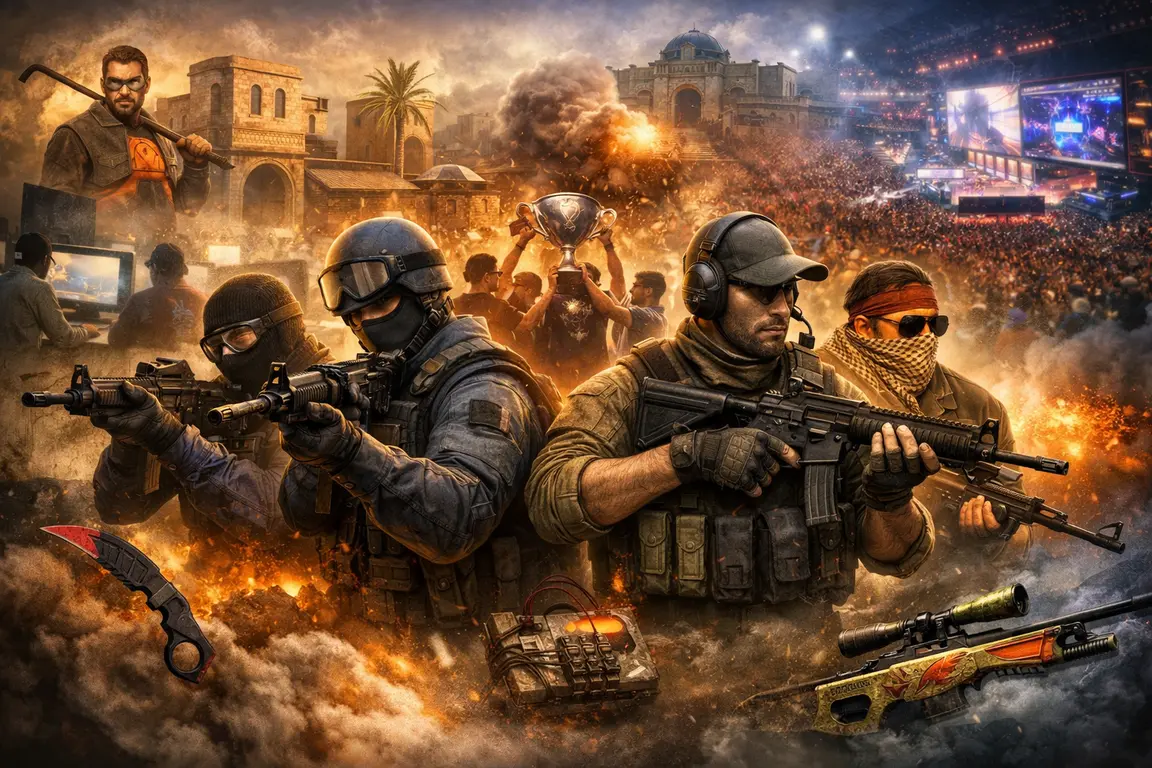
From a fan-made Half-Life mod to one of the most influential esports titles ever created, Counter-Strike’s history is the story of tactical shooters growing up.
Jump to:
- The Birth of Counter-Strike
- Counter-Strike 1.6 and competitive gaming
- Counter-Strike: Source
- CS:GO and the modern era
- Counter-Strike 2
- Counter-Strike’s influence
Only a few video game franchises have left a mark on competitive gaming quite like Counter-Strike. What started in 1999 as a fan-made mod for Half-Life slowly grew into one of the most iconic multiplayer shooters ever made. Over the years, Counter-Strike has not only shaped the way tactical shooters are designed but also played a major role in building the esports scene we know today, all while gathering one of the most passionate gaming communities in the world.
From the days of crowded LAN cafés and small community servers to massive arenas filled with fans watching international tournaments, Counter-Strike has continued to evolve with new technology without losing what made it special in the first place. At its core, Counter-Strike has always been about precision, teamwork, and the constant tension of round-based matches where every move matters.
The Birth of Counter-Strike (1999–2000)
The origins of Counter-Strike can be traced back to 1999, when the game appeared not as a commercial product but as a modification made by the Half-Life community. At the time, modding communities were rapidly growing, allowing talented hobbyists to expand existing games with entirely new experiences. Among these modders were Minh Le and Jess Cliffe. Their project aimed to create a more tactical and realistic multiplayer shooter, contrasting with the fast-paced arena-style shooters that dominated the late 1990s.
The first public beta of Counter-Strike was released in June 1999. Built on Half-Life’s GoldSrc engine, the mod introduced players to a new type of gameplay centered around two opposing teams: Terrorists and Counter-Terrorists. Rather than focusing solely on eliminations, rounds revolved around specific objectives, such as planting or defusing a bomb or rescuing hostages. This objective-based format fundamentally changed the rhythm of multiplayer shooters, emphasizing teamwork, communication, and strategy over pure reflexes.
Several key innovations quickly distinguished Counter-Strike from other shooters of the time. One of the most influential was its round-based structure. Players had only one life per round, meaning mistakes carried real consequences. This mechanic encouraged more careful and coordinated play, as reckless actions could cost a team the entire round. Another defining feature was the in-game economy system. Players earned money based on their performance in previous rounds, which they could use to purchase weapons, armor, and equipment. This system added an additional layer of strategic depth, forcing teams to manage resources and decide when to save or invest in better equipment.
The early success of the mod was also closely tied to its memorable maps, many of which became iconic within the gaming community. One of the most recognizable is de_dust, a desert-themed bomb defusal map that quickly became a favorite among players. Its simple yet balanced layout made it accessible to newcomers while still offering strategic complexity for experienced players. Even decades later, in Counter-Strike 2, variations of Dust remain part of the competitive map pool. According to Leetify’s report, Dust2 is still one of the most played maps in Premier mode, demonstrating the enduring strength of its design.
Another notable early map was de_aztec. With its ancient temple structures set among water channels and jungle surroundings, Aztec stood out for its unique visual style and the memorable gameplay situations it created. While the map is no longer part of the competitive pool in modern titles like Counter-Strike 2, its influence can still be seen today. Maps such as Ancient, for example, draw clear inspiration from Aztec’s visual themes and architectural design. This connection shows how newer versions of Counter-Strike continue to reflect the ideas and aesthetics that helped define the game in its early years.
As Counter-Strike continued to evolve through regular beta updates, its popularity grew at an incredible pace. The mod quickly spread across online servers and soon became a common sight in LAN cafés around the world. In the late 1990s and early 2000s, internet cafés served as major social hubs for multiplayer gaming, especially in Europe and Asia. Players would gather with friends to compete against each other on local networks, creating the perfect environment for Counter-Strike’s tactical gameplay to shine. Through word of mouth, online forums, and countless community-run servers, the mod gained traction faster than anyone expected.
By the end of 1999, Counter-Strike had already become one of the most popular mods in the Half-Life community. Its rapid growth caught the attention of Valve, the company behind Half-Life. Seeing the project’s potential, Valve acquired the rights to Counter-Strike in 2000 and brought its creators on board to continue developing the game. Later that same year, Counter-Strike was released as a standalone title, officially transitioning from a community mod into a fully supported game. This moment marked a turning point, laying the groundwork for what would become one of the most influential and long-lasting franchises in competitive gaming history.
Counter-Strike 1.6 and the Rise of Competitive Gaming (2000–2012)
Following its successful transition from a community mod to an officially supported title in 2000, Counter-Strike quickly began to establish itself as a cornerstone of competitive multiplayer gaming. Over the next few years, the game received multiple updates and refinements, gradually evolving into a more polished competitive experience. This evolution culminated in the release of Counter-Strike 1.6 in 2003, which was distributed through Steam, Valve’s new digital distribution platform. The release marked a major step for the franchise, not only consolidating the game’s mechanics but also standardizing the experience for millions of players worldwide.
During the early 2000s, Counter-Strike 1.6 rapidly became the dominant competitive first-person shooter. Its combination of precise gunplay, tactical teamwork, and strategic depth made it uniquely suited for organized competition. Unlike many other shooters of the era, victory in Counter-Strike required a careful balance of mechanical skill, map knowledge, communication, and economic management. As a result, the game quickly became a favorite for competitive players and tournament organizers alike.
The growth of organized esports during this period was closely intertwined with the success of Counter-Strike. Major international tournaments began to emerge, giving players the opportunity to compete on a global stage. Events such as World Cyber Games (WCG), Intel Extreme Masters (IEM), and the Cyberathlete Professional League (CPL) became key milestones in the early esports calendar. These competitions attracted teams from around the world and offered prize pools that, while modest by modern standards, represented a significant step toward professionalizing competitive gaming.
These early competitions are extensively documented in historical tournament databases such as Liquipedia’s Counter-Strike event archive, which records many of the landmark tournaments from the early 2000s.
Alongside these tournaments, legendary teams began to emerge and shape the early identity of Counter-Strike esports. Organizations such as Ninjas in Pyjamas, SK Gaming, and Fnatic built dominant rosters that defined the competitive scene throughout the 2000s. Players from these teams became some of the first true stars of esports, inspiring a generation of aspiring competitors who dreamed of reaching the same level of success.
Much of this competitive culture was built around LAN tournaments. Early Counter-Strike competitions required teams to travel to physical events where they played side by side on local networks. These LAN tournaments created a unique atmosphere: crowded venues, roaring audiences, and intense matches where every round could decide the outcome of a tournament. The environment also helped foster a strong sense of community, as players, fans, and organizers gathered in the same space to celebrate the growing esports scene.
For many aspiring professionals, the path to these tournaments began in local internet cafés. Across Europe, Asia, and parts of North America, these cafés became training grounds where teams would practice together for hours every day. Players often gathered after school or work to scrim against other teams, develop strategies, and improve their communication. Many professional players still look back on this period as a crucial stage in their development.
Several well-known Counter-Strike players have spoken about how important this environment was during their early careers. Members of the legendary Swedish lineup of Ninjas in Pyjamas — Christopher “GeT_RiGhT” Alesund, Patrik “f0rest” Lindberg, and Adam “friberg” Friberg — have all described spending countless hours playing and practicing in LAN cafés and small gaming centers before competing in international tournaments. In particular, Patrik “f0rest” Lindberg recalled the long hours spent playing in internet cafés during his early years, highlighting how important these spaces were to the growth of competitive Counter-Strike (HLTV – Hall of Fame: f0rest).
Through these experiences, Counter-Strike 1.6 helped establish many of the competitive structures that continue to define esports today. Concepts such as structured team roles, coordinated utility usage, tactical executes, and economic management became fundamental elements of high-level play. Many of these mechanics remain central to modern Counter-Strike titles, demonstrating how the foundations built during the 1.6 era continue to influence competitive gameplay.
By the early 2010s, Counter-Strike had already spent more than a decade at the forefront of competitive gaming. During that time, it not only helped shape the emerging esports industry but also defined what a competitive first-person shooter could be. The standards established by Counter-Strike 1.6 would go on to influence countless other games and lay the groundwork for the next chapter of the franchise.
Counter-Strike: Source – A Divisive Evolution (2004–2012)
In 2004, Valve released Counter-Strike: Source, a new installment in the franchise built on the more advanced Source engine. The game represented a technological leap compared to its predecessor, introducing improved graphics, more detailed environments, and a physics system that allowed objects in the world to react dynamically. Visually and technically, Source was designed to modernize Counter-Strike and bring it in line with the capabilities of newer hardware.
However, despite these improvements, the transition was not universally welcomed by the competitive community. Many players felt that the core gameplay experience had changed in subtle but important ways. Movement mechanics felt different, altering how players navigated maps and executed strategies. Weapon recoil and shooting behavior were also perceived as less predictable compared to Counter-Strike 1.6, which had already become the standard for competitive play.
As a result, the Counter-Strike community became divided. A large portion of professional players and established teams chose to remain with Counter-Strike 1.6, which continued to dominate major tournaments and the competitive esports scene. At the same time, Counter-Strike: Source developed its own community, including competitive leagues and events dedicated specifically to the game. For several years, the franchise effectively operated with two parallel ecosystems: the long-standing 1.6 competitive scene and the newer Source community.
Despite criticism from some competitive players, Counter-Strike: Source remained extremely popular among casual players. Its updated visuals, smoother interface, and accessibility attracted a large player base and kept the Counter-Strike franchise relevant during a period of rapid change in the gaming industry. Although it never fully replaced 1.6 in the professional scene, Source played an important role in sustaining the community and bridging the gap between the early years of Counter-Strike and the modern era that would eventually emerge with later titles.
Counter-Strike: Global Offensive and the Modern Era (2012–2023)
In 2012, Valve released Counter-Strike: Global Offensive (CS:GO), marking the next major evolution of the franchise. Initially developed in collaboration with Hidden Path Entertainment, the game aimed to modernize Counter-Strike while preserving the tactical gameplay that had defined the series for over a decade.
At launch, however, the reception from the community was mixed. Many veteran players felt that the graphics looked simplified compared to expectations at the time, while others were skeptical about changes to weapon mechanics and movement. Additionally, the esports scene around CS:GO was relatively small in its early years, and many competitive players were still transitioning from earlier titles such as Counter-Strike 1.6. For a period, it was unclear whether CS:GO would be able to reach the same level of competitive success as its predecessors.
Over time, however, the game evolved dramatically through continuous updates and community feedback. What initially seemed like a modest continuation of the franchise eventually grew into the most successful and widely played version of Counter-Strike in history. By the mid-2010s, CS:GO had established itself as one of the most important titles in modern esports.
One of the most transformative additions to the game came in August 2013 with the release of the Arms Deal Update, which introduced weapon skins (Valve – The Arms Deal Update). Through in-game cases and keys, players could unlock cosmetic finishes for their weapons, ranging from simple designs to extremely rare and valuable items. While these skins had no impact on gameplay, they quickly became highly sought-after collectibles within the community. The update also connected these items to the Steam Marketplace, allowing players to buy, sell, and trade skins with one another.
This system created an entirely new virtual economy within the game. Rare skins began to command significant prices, with some items selling for hundreds or even thousands of dollars. Over time, the CS:GO skin market grew into a multi-billion-dollar ecosystem involving collectors, traders, content creators, and entire platforms built around virtual item exchanges. Beyond simple customization, skins became a cultural phenomenon within the gaming community, influencing everything from YouTube content and Twitch streams to third-party trading websites and marketplaces.
The impact of this economy extended far beyond the game itself. For many players, skins became a gateway into trading and digital asset ownership, introducing concepts similar to financial markets such as supply, demand, rarity, and speculation. Entire communities emerged around analyzing skin values and market trends. Platforms and services were built to help players earn, trade, or acquire skins through various activities.
For example, services such as GatherSkins demonstrate how the skin ecosystem expanded into broader digital economies. Platforms like this allow users to complete tasks or participate in promotional activities in exchange for in-game skins, illustrating how Counter-Strike items evolved from simple cosmetic rewards into a widely recognized form of digital value within gaming communities.
While the skin economy significantly boosted player engagement, CS:GO also reached new heights in competitive esports. Valve introduced official championship events known as Majors, which quickly became the most prestigious tournaments in Counter-Strike. These events brought together the best teams in the world and featured prize pools that continued to grow year after year.
One of the most historically important early events was DreamHack Winter 2013, the first official CS:GO Major, which marked the beginning of a new era for competitive Counter-Strike. Nearly a decade later, tournaments such as PGL Major Stockholm 2021 attracted massive global audiences and prize pools reaching millions of dollars. Packed arenas, professional production, and millions of online viewers turned these tournaments into major international esports spectacles. Viewership analytics from Esports Charts’ Counter-Strike tournament statistics show that several Counter-Strike Majors have reached peak audiences exceeding two million concurrent viewers.
Alongside the growth of these events came the rise of legendary players who helped define the CS:GO era. Among the most celebrated are Oleksandr “s1mple” Kostyliev, widely considered one of the most mechanically skilled players in Counter-Strike history; Mathieu “ZywOo” Herbaut, known for his incredible consistency and impact in high-level competition; and Christopher “GeT_RiGhT” Alesund, whose influence spanned both the 1.6 and CS:GO eras.
At the same time, the rise of streaming platforms such as Twitch played a crucial role in expanding Counter-Strike’s global reach. Professional matches, major tournaments, and individual player streams attracted millions of viewers, turning competitive Counter-Strike into a major spectator esport. Professional organizations expanded their operations, investing in coaching staff, analysts, training facilities, and full-time rosters.
By the end of the CS:GO era, Counter-Strike had evolved far beyond its origins as a simple mod. It had become a global competitive ecosystem combining professional esports, content creation, digital economies, and one of the most dedicated communities in gaming. The success of CS:GO not only revitalized the franchise but also secured Counter-Strike’s position as one of the defining titles in the history of competitive gaming.
Counter-Strike 2 – The Next Generation (2023–Present)
In 2023, Valve released Counter-Strike 2, marking the most significant technological update to the franchise in over a decade. Rather than creating an entirely new title separate from its predecessor, Valve positioned Counter-Strike 2 as the direct successor to Counter-Strike: Global Offensive, effectively replacing it while preserving the core identity of the series. The release represented a major step forward for the franchise, combining modern technology with the gameplay principles that have defined Counter-Strike for more than twenty years.
One of the most notable upgrades in Counter-Strike 2 is its transition to the Source 2 engine. This new engine allowed Valve to significantly improve lighting, textures, and environmental detail while maintaining the visual clarity that is essential for competitive gameplay. Maps such as Dust2, Mirage, and Inferno were rebuilt with updated lighting systems and improved materials, making them feel both familiar and refreshed. Details about the new engine, sub-tick system, and gameplay changes were outlined in Valve’s official announcement: Counter-Strike 2 – Official Valve Information.
Another major innovation introduced in Counter-Strike 2 is the implementation of sub-tick servers. In previous versions of the game, servers operated using fixed tick rates, which determined how frequently the server updated player actions. Counter-Strike 2 replaces this system with a new architecture where actions such as shooting, jumping, or throwing grenades are registered precisely when they occur. According to Valve, this system allows gameplay interactions to feel more accurate and responsive, particularly in high-level competitive environments where timing can determine the outcome of a round.
Perhaps the most visually striking change in Counter-Strike 2 is the redesign of smoke grenades. In earlier versions of the game, smoke grenades behaved as static visual effects. In Counter-Strike 2, however, smokes are fully dynamic and volumetric. They interact with the environment and respond to player actions — gunfire and explosions can temporarily clear parts of the smoke, while grenades can push and distort it. This change adds a new layer of tactical depth, as players can now manipulate smokes in ways that were not previously possible.
Another important aspect of the transition to Counter-Strike 2 was the preservation of the game’s extensive skin economy. All weapon skins, stickers, and cosmetic items from Counter-Strike: Global Offensive were carried over directly into the new game. Thanks to the improvements of the Source 2 engine, many of these skins also received subtle visual upgrades, with enhanced lighting and material rendering making certain finishes appear more detailed and vibrant than before. This continuity ensured that players retained their existing inventories while also benefiting from the visual improvements of the new engine.
Beyond these specific features, Counter-Strike 2 represents Valve’s broader effort to modernize the franchise while preserving its traditional mechanics, like precise gunplay, round-based gameplay, tactical teamwork, and the in-game economy. By maintaining these core mechanics, Valve ensured that veteran players could transition to the new version without losing the competitive foundations that made the series successful.
At the same time, the new technology provides a foundation for the future of Counter-Strike esports. Improved performance, updated visuals, and new gameplay systems help ensure that the game remains relevant in an increasingly crowded competitive-gaming market. Major tournaments and professional leagues quickly adopted Counter-Strike 2 following its release, continuing the long tradition of high-level competition that has defined the franchise.
Like many large game launches, Counter-Strike 2 was not without controversy. Some players expressed concerns about missing features that had been present in Counter-Strike: Global Offensive, while others debated changes to gameplay mechanics and map pools. However, Valve has historically supported Counter-Strike through long-term updates and community feedback, and many players view Counter-Strike 2 as a foundation that will continue to evolve over time.
Ultimately, Counter-Strike 2 represents the beginning of a new era for the franchise. By combining modern technology with the timeless competitive formula that made the series legendary, Valve aims to ensure that Counter-Strike remains one of the most important and enduring games in the world of esports for years to come.
Counter-Strike’s Influence on the Gaming Community
Over more than two decades, Counter-Strike has become far more than just a successful video game franchise. It has played a central role in shaping the culture of competitive gaming, influencing the design of modern multiplayer shooters, and helping establish esports as a global entertainment industry.
One of the most important contributions of Counter-Strike is the popularization of objective-based tactical shooters. Before Counter-Strike, many multiplayer shooters focused primarily on deathmatch gameplay. Counter-Strike introduced a different approach, where teams had clear objectives and success depended heavily on strategy, coordination, and communication. This model later influenced numerous games across the industry, including titles like Rainbow Six Siege and Valorant, which adopted similar tactical gameplay principles.
Another major influence lies in the professionalization of esports. Counter-Strike helped define the structure of competitive gaming: organized teams, international tournaments, professional players, and dedicated fanbases. Many of the systems now common in esports — team contracts, sponsorships, broadcast production, analysts, and large-scale arenas — emerged during the rise of competitive Counter-Strike. Today, esports events regularly fill stadiums and attract millions of online viewers, a level of visibility that would have been difficult to imagine during the early LAN tournament days.
Counter-Strike also played a key role in shaping online gaming communities. Community servers, custom maps, and modding tools allowed players to actively participate in expanding the game’s community-made content. Modes created entirely by players, such as surfing, zombie escape, and deathrun, became iconic parts of the Counter-Strike experience. This culture of community-driven content demonstrated the value of player creativity and influenced how many modern games support user-generated content.
The franchise has also had a significant impact on digital economies in gaming. With the introduction of weapon skins in CS:GO, players began trading cosmetic items in large virtual marketplaces. Over time, this system evolved into one of the most recognizable digital economies in gaming, involving collectors, traders, and marketplaces around the world. The success of this model influenced how other games approached cosmetic items, marketplaces, and player-driven trading systems.
Because of these combined influences, Counter-Strike is widely regarded as one of the most important games ever created in the multiplayer shooter genre.
What Counter-Strike Preserved That Other Franchises Did Not
JohnMcPhee’s method is to find the specific fact that contains the general truth. For Counter-Strike, that fact might be this one: the core weapon balance — the relationship between the AK-47 and the M4A4, between the AWP and the pistol round — has remained structurally intact across twenty-five years and three major engine transitions. Other franchises have used engine updates to redesign their economies from the ground up, producing games that are technically superior but competitively unrecognisable to their own veteran communities. Valve made the opposite choice. The skill ceiling changed. The graphics changed. The surface feel changed. The underlying competitive grammar did not.
This is an unusual editorial decision for a commercial product. Preserving the competitive grammar means accepting that the ceiling on how different the game can feel is lower than it would be if the team were optimising for novelty. It also means that the twenty-year veteran and the new player share a common reference point — a genuine meritocracy of mechanical skill that does not reset with each patch cycle. CS2’s launch produced the predictable controversy: visual changes that felt wrong to players whose muscle memory had been calibrated for a decade. But the strategic layer — the bomb sites, the economy, the communication requirements — stayed. The franchise’s longevity is not spite of that conservatism. It is because of it. The games that lasted are the ones that knew what they were.
What the Counter-Strike Longevity Model Reveals About How Digital Products Die
Michael Lewis builds his best stories around a simple structural observation: the outcome that everyone can see is not the interesting part of the story. The interesting part is the process, the incentive structure, and the specific sequence of decisions that made the visible outcome inevitable long before anyone outside the room could see it coming. Counter-Strike’s 25-year survival as the dominant competitive first-person shooter is one of the most visible outcomes in gaming. The interesting story is the specific decisions — and, more importantly, the specific refusals to make certain decisions — that made survival possible when nearly every other franchise from the same generation is gone or unrecognizable.
Lewis’s method of finding the person in the room who understood what was happening before everyone else identifies Minh “Gooseman” Le and Jess Cliffe not as the relevant protagonists of the Counter-Strike longevity story — they created the game but left Valve’s stewardship relatively early. The relevant protagonist is Valve’s institutional decision-making structure, which chose, consistently and against significant short-term financial incentive, not to monetize the competitive core of Counter-Strike in ways that would compromise the underlying competitive integrity. The specific refusal to implement pay-to-win mechanics, the specific decision to make the competitive mode free rather than gating it behind a purchase barrier, the specific choice to release the Source engine in ways that allowed community modding to persist — each of these was a decision against short-term revenue maximization that the Lewis framework identifies as the load-bearing decisions of the franchise’s survival.
The structural story behind the longevity model is what Lewis would call the second-order narrative: what does Counter-Strike’s survival reveal about the process by which digital products die? The pattern is consistent enough to constitute a model. Products die not from a single catastrophic decision but from a sequence of small extraction decisions, each individually defensible, that collectively cross the threshold at which the user who sustained the product stops sustaining it. The game publisher who adds a paid XP boost does not observe a meaningful churn event — the player stays. The publisher who adds a paid cosmetic advantage observes mild frustration but not exit. The publisher who bundles a seasonal pass with features that were previously free observes something that begins to look like a churn signal. And the publisher who monetizes ranked matchmaking itself observes the exit of the players whose continued participation made the ranked environment worth playing in for everyone else. NFT gaming economies are the most recent full cycle of this extraction sequence: the games that monetized the competitive environment through tokenized assets observed exactly the Counter-Strike negative model, at accelerated speed.
Lewis’s structural analysis of information asymmetry applies to Counter-Strike’s position in the gaming market in a way that most franchise analyses miss: Valve has information about the Counter-Strike competitive ecosystem that no competitor can replicate without the ecosystem itself. The professional scene data, the amateur competitive ladder data, the specific cheat detection patterns, the map balance signals from millions of ranked games — this is proprietary information that compounds with time and use, and that creates a structural advantage for Valve that a new entrant with a technically superior engine cannot overcome with marketing alone. Friction accumulation is the mechanism that makes this information advantage compounding rather than static: the new competitive shooter faces the friction of convincing experienced players to abandon the ecosystem that has already calibrated to their skill level, while Counter-Strike retains those players because the friction of switching exceeds the perceived benefit of the new platform. Microsoft’s developer platform extraction history is the most recent comparable case in the digital product space: the developer tools ecosystem that Valve chose not to extract from has a health that Microsoft’s equivalent ecosystem is beginning to lose precisely because the extraction decisions that Valve refused have been made systematically in the Microsoft developer context. Crypto gaming’s press release ecosystem — the promotional machinery that announces new gaming titles as competitive CS alternatives — is the clearest evidence that the Counter-Strike longevity model is not understood by the people trying to replicate it: the announcement is not the product, the sustained competitive ecosystem is the product, and no press release cycle creates the ecosystem that twenty-five years of not-extracting creates.
The Scene Nobody Filmed
Neil Strauss’s method as a narrative journalist is to find the specific, undocumented scene that the official history skips — the moment before the moment everyone remembers, where the actual decision got made by people who had no idea it would matter. Counter-Strike’s history is unusually well-documented by gaming-press standards, but the genuinely interesting scene is still the one no press outlet covered in real time: a small mod team choosing, mid-development, which mechanic to cut and which to keep, with no way of knowing which choice was about to define a genre for two and a half decades.
That is the scene worth reconstructing whenever a franchise’s official narrative starts sounding too clean — the retrospective story where every early decision reads as visionary is almost never the story the people living through it would have told. The mod team that built the first version of Counter-Strike was solving an immediate, unglamorous problem, not architecting a future esport, and the gap between those two framings is where the real history actually lives.