


TL;DR: In this episode, Raph Rocher chats with Francis Bea, founder of Eleven International, about how a boutique cross-border PR agency can stay credible while working across both Web2 and Web3. Francis shares Eleven’s background (consumer tech, B2B tech, and crypto clients) and explains why Web3 reputation challenges require traditional communications discipline, not pay-to-play crypto PR. Their playbook: find angles journalists already care about: security, regulation, market trends.. and reframe announcements inside those larger narratives to earn tier-one and mainstream coverage. They also discuss a shrinking media landscape, making ongoing thought leadership essential between launches so journalists don’t forget a brand. Finally, Francis breaks down how PR fundamentals stay the same across industries, but execution must adapt heavily by region, with Western markets demanding far stronger news hooks. The conversation closes on Eleven’s results-driven positioning: high responsiveness, measurable outcomes, and a model built for demanding cross-border clients.
Context
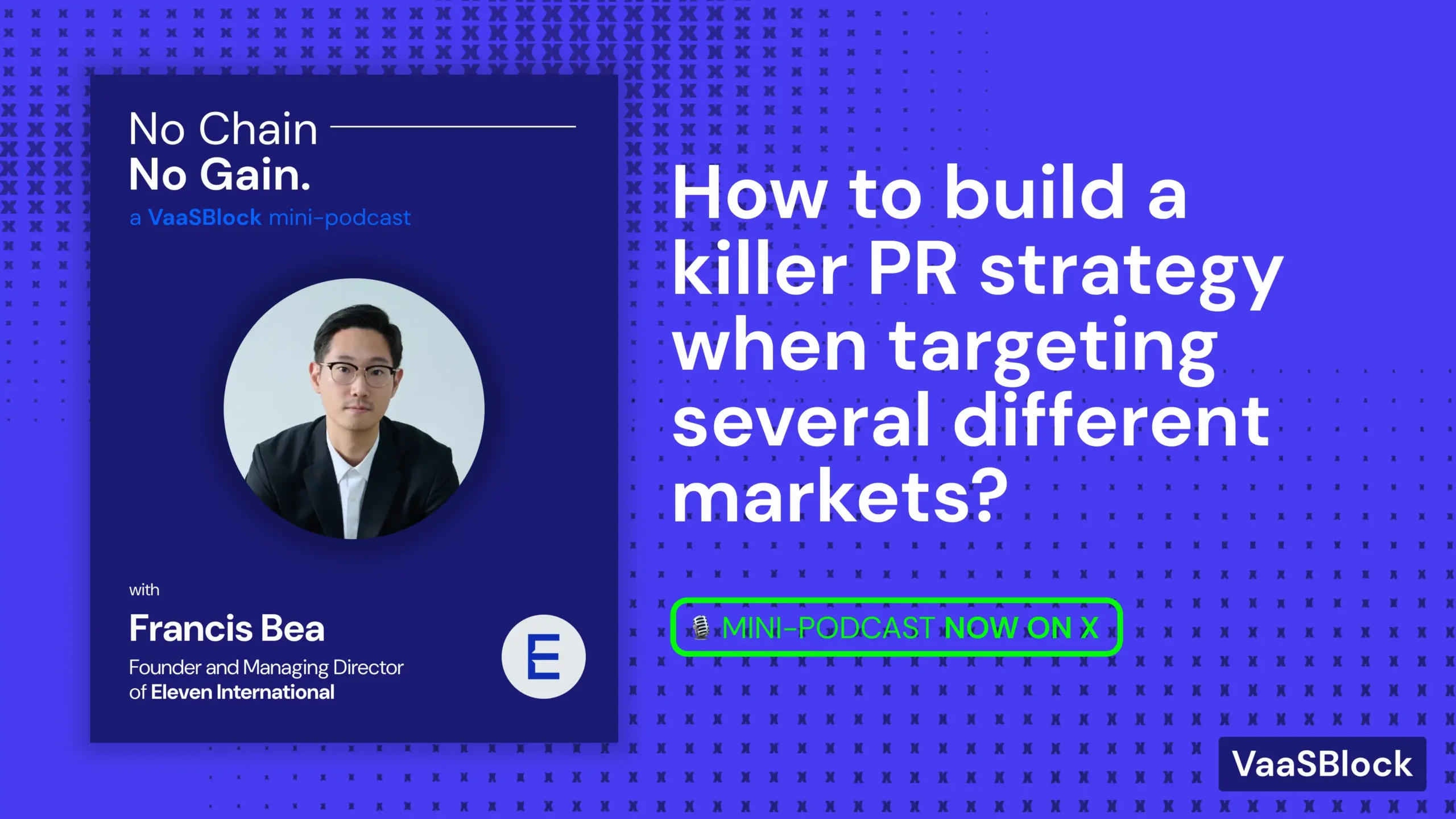
NCNG host Raphael Rocher talks with Francis Bea, founder of Eleven International, about running a cross-border PR agency spanning Web2 and Web3. Francis shares his path from journalism to marketing and creating Eleven seven years ago. The boutique team (under 25 people) has supported brands like Xiaomi and Xreal, launched Brilliant Labs’ Frame AI glasses, and advised crypto firms including Kobo Wallet, imToken, Babel Finance, and Conflux.
Credibility is the centerpiece: Web2 clients benefit from built-in trust, while Web3 brands still fight a “wild-west” image. Eleven’s answer is traditional media strategy over pay-to-play crypto wires, finding angles journalists already cover (security, regulation, market trends) and reframing token or product news inside those narratives. This helps Web3 clients reach both tier-one crypto press and mainstream outlets.
They also discuss media contraction, the need for ongoing thought leadership between launches, and how PR fundamentals stay constant while tactics must adapt to local market norms.
Conversation Transcript
Introduction & Background
R. Rocher (Host): There we go. To start things off, can you start by introducing yourself in two or three sentences, telling me what you do and a few elements of your background.
F. Bea (Eleven International): My name is Francis, and I come from a general marketing and branding background. That started with my experience in journalism back in the day. That segued into me starting this agency called Eleven International, which has been around for about seven years already, which is quite a long time, I guess.
For an agency like ours, we’re still at that boutique stage: we’re a little bit less than 25 people. But we do work with reputable clients, some of which have a global reputation. Names people might be familiar with would be Xiaomi and Xreal AR glasses. We’ve worked with a slew of smartphone brands and quite a few startup companies.
For example, earlier this year we launched AI glasses called Frame from Brilliant Labs. And at the same time, we also work with crypto firms. We were the folks that launched some of the more well-recognized crypto companies like Kobo Wallet and imToken. At one point we helped launch and scale Babel Finance — of course they were eventually liquidated, though we did help them through that process from a communication standpoint.
We also launched companies like Conflux, et cetera. For us, we straddle the best of both worlds in the sense that we’re fundamentally a traditional communications agency. Most clients know us for our expertise in the US and UK markets, but recently we’ve expanded to regions like Korea, Southeast Asia, and a bit of Europe and Japan. So we’re looking to diversify.
The vast majority of our clients are in tech, but we’ve also been working with other types of clients. For example, a supplement brand from India that’s looking to build their reputation in the US. So overall, we’re a traditional cross-border communications agency helping brands jump from one country to another.
What makes us unique is that we’re quite results-driven, even as a communications agency. There aren’t that many firms that can make that claim. We provide a certain level of guarantees in terms of results or expectations — especially because a lot of our early clients were Asian brands, and their expectations aren’t always the same as Western brands. That model has worked for us, and we apply it now with clients in the US and Canada as well.
Keeping Credibility in Web2 & Web3
R. Rocher (Host): OK, thanks. You mentioned you have different types of clients, including blockchain and Web3 companies. How do you manage to keep credibility on both sides, with Web2 corporations and with Web3, knowing that Web3 doesn’t have the best reputation globally? How do you manage that balance without giving up on your identity as a company?
F. Bea (Eleven International): For Web2 companies it’s a little less difficult because there’s an implicit trust, especially with hardware companies or SaaS brands. But with Web3 or crypto, due to the history and reputation of a kind of wild-west ecosystem, the reputation has suffered.
Of course, since institutional investors like banks and family offices became involved, things stabilized and the reputation has improved. But from outside looking in, there’s still that unfortunate negative reputation.
So our goal with Web3 clients is to apply traditional communications methods. A lot of Web3 companies get pitched by random crypto agencies or newswire agencies that claim to be a full solution. But publishing on newswire or Chainwire doesn’t build trust or credibility with journalists — it’s pay-to-play. Journalists recognize it as sponsored or wire-republished, and it doesn’t create real long-term benefit.
Short term, I understand there’s value — like token launches where few journalists want to touch it. But for us, we help clients identify key messages that communicate real value journalists will cover, often tied to current events or market trends.
If a company is just announcing a token, few journalists will cover it unless it’s something huge like Coinbase. Unknown startups face a high probability of no coverage because journalists don’t want to accidentally promote scams — and unfortunately that’s still valid today with pump-and-dump schemes, meme coins, etc.
So we apply traditional strategy: sometimes we push the client outside the box toward topics journalists will embrace — regulatory angles, security issues, things like that — and then bring in what the client wants to discuss within that frame.
For example, when we launched a Web3 gaming company while Axie Infinity had big issues, we tied the token launch into the broader story of building a sustainable in-game economy. That let us “reframe” the token as part of solving a known industry problem.
That approach opens doors not only with tier-one crypto publications like Cointelegraph, CoinDesk, Decrypt, but also mainstream ones like TechCrunch, Forbes, sometimes Bloomberg. The point is building legitimate credibility with journalists so the brand is recognized as legitimate too.
How PR for Web3 Will Evolve
R. Rocher (Host): Okay. Very clear. Still on the same topic, how do you see this evolve? There are only a limited number of serious PR actors in Web3 and tech. Do you think that number is going to go up — more entities and publications — or do you think traditional ones will include Web3 and blockchain more? How do you see it evolving?
F. Bea (Eleven International): I think the media industry overall has been declining, whether Web3 or Web2. Publications have been slashing journalists, and it impacts how much coverage they can manage.
We’ve seen an increase and decrease in willingness to cover crypto, but crypto is here to stay, so there will likely continue to be one or two journalists covering it — even if it’s only part of their beat.
What’s harder is brands interjecting themselves into coverage. Journalists focus mostly on stories around security, regulation, and price volatility — maybe a fourth or fifth trend sometimes — but those are the core topics. Product launches and feature updates matter less to them.
So it becomes more imperative for crypto companies to find ways to interject into those mainstream conversations to increase the odds of coverage.
Also, crypto companies don’t always have news monthly. But journalists prefer to maintain relationships, otherwise they forget the company. If you announce something in month one and come back in month six, the journalist may not pick it up because you’ve fallen off their radar.
So in between, we do thought leadership: placing quotes, offering commentary on BTC price moves, background insights — even if it doesn’t directly promote the brand. That keeps the relationship warm and helps the journalist with credible sources.
By doing that, later they’re more willing to cover your announcements. It also positions the client as a thought leader if they keep appearing in places like Barron’s or the Wall Street Journal. People see consistent coverage and assume legitimacy.
So those are tactics we use — especially as the media environment gets tougher for brands to get coverage.
Operating Across Cultures, Markets & Verticals
R. Rocher (Host): Very insightful. My last question is about your ways of working across different cultures, legislations, work ethics, and industries. As a PR and marketing agency covering many countries and spaces, how do you make it work at Eleven International when the same team has to handle very different projects?
F. Bea (Eleven International): Fundamentally, when you do PR traditionally, the way we do, the strategy is transferable across verticals. We barely touch tier-two or tier-three crypto publications; tier one is usually a million plus monthly visits, and below that is tier two/three.
The fundamentals apply anywhere: strategic thinking, tying client messages into current conversations and themes journalists care about. That works for consumer tech, crypto, sometimes even lifestyle.
Where it really changes is by market. PR in Korea versus Japan versus the US is starkly different. There are varying levels of difficulty. In Korea or China, there’s less emphasis on needing a killer selling point to launch a product. But in the US, UK, or EU, you need a very strong selling point or they won’t pay attention — even if you have relationships.
So for cross-vertical PR, you need a strong grasp of fundamentals and relationships with journalists. Agencies have an advantage here because we represent multiple clients, so we have repeated reasons to go to journalists and build deeper relationships than a smaller agency might.
Those are the two key things. Regions are a different beast, but fundamentals plus relationships carry across industries.
Positioning & Client Expectations
R. Rocher (Host): Perfect. Is there something else you want to add about what you represent and where you want to be positioned as a company?
F. Bea (Eleven International): Not really. Just what I said earlier. As the economy has been changing, there’s more focus on sales even in communications. Clients increasingly want guarantees or minimum expectations, which most agencies in the US and UK aren’t used to.
That’s where we stand out. To date, we’ve never been in a situation where we didn’t meet client expectations, and I’ve been doing this for seven years. So we have a model that works.
It does mean we’re more aggressive and more responsive. Sometimes clients want a response within five minutes — and that’s normal for us. We’re adaptable and flexible with clients, and results-wise we’re on par with, or exceeding, what clients expect from Western agencies.
R. Rocher (Host): Okay, cool. Thank you very much for joining us on NCNG and have a great day.
F. Bea (Eleven International): Thank you for having me.
About Eleven International
Eleven International is an award-winning, boutique cross-border communications and public relations agency founded in 2017. It specializes in helping technology brands build reputation and market presence internationally, with core practices spanning Consumer Tech, B2B Tech, and Crypto/Web3.
With deep roots in Asia-Pacific and strong execution in the U.S. and U.K., Eleven supports companies looking to enter new markets or scale globally, and has expanded its reach to regions including Europe, Japan, Korea, Southeast Asia, India, and China. The agency blends traditional PR fundamentals (strategy, storytelling, and media relations) with modern growth-oriented support such as go-to-market consulting, copywriting, influencer marketing, social and digital campaigns, and branding… all tailored to different cultural contexts.
Eleven International is recognized for being results-driven and for delivering measurable outcomes for its clients, particularly for innovative tech brands navigating cross-border positioning. It has earned multiple industry accolades, including regional consultancy awards, reflecting its growth and impact in tech communications.
Committed to transparency and operational excellence in Web3 communications, Eleven International is also RMA™ certified by VaaSBlock, signaling strong governance and trust standards for partners and clients.