

AAPL$316.85▼ 0.89%NVDA$220.78▲ 1.48%META$572.34▼ 0.98%WTI$80.46▼ 5.13%COIN$188.12▲ 5.31%NFLX$81.05▼ 0.82%AMZN$259.77▼ 2.50%XAU$4,479.20▲ 1.09%DOGE$0.0833▲ 1.27%FIGR_HELOC$1.00▸ 0.00%TRX$0.3317▼ 1.39%HYPE$84.07▲ 4.28%BRENT$83.76▼ 1.92%GOOGL$339.35▼ 2.09%USDS$0.9999▲ 0.02%TSLA$367.95▲ 5.51%MSFT$507.29▼ 1.22%ETH$2,473.47▲ 2.10%MSTR$132.94▲ 4.42%BNB$692.45▲ 1.16%XMR$515.64▲ 1.09%SOL$103.93▲ 2.21%BTC$78,865.00▲ 1.44%NATGAS$2.89▼ 8.25%XRP$1.38▲ 2.05%ZEC$855.88▲ 3.72%LEO$9.38▼ 2.22%RAIN$0.0167▼ 1.77%XAG$67.14▲ 1.38%WBT$72.66▲ 1.59%AAPL$316.85▼ 0.89%NVDA$220.78▲ 1.48%META$572.34▼ 0.98%WTI$80.46▼ 5.13%COIN$188.12▲ 5.31%NFLX$81.05▼ 0.82%AMZN$259.77▼ 2.50%XAU$4,479.20▲ 1.09%DOGE$0.0833▲ 1.27%FIGR_HELOC$1.00▸ 0.00%TRX$0.3317▼ 1.39%HYPE$84.07▲ 4.28%BRENT$83.76▼ 1.92%GOOGL$339.35▼ 2.09%USDS$0.9999▲ 0.02%TSLA$367.95▲ 5.51%MSFT$507.29▼ 1.22%ETH$2,473.47▲ 2.10%MSTR$132.94▲ 4.42%BNB$692.45▲ 1.16%XMR$515.64▲ 1.09%SOL$103.93▲ 2.21%BTC$78,865.00▲ 1.44%NATGAS$2.89▼ 8.25%XRP$1.38▲ 2.05%ZEC$855.88▲ 3.72%LEO$9.38▼ 2.22%RAIN$0.0167▼ 1.77%XAG$67.14▲ 1.38%WBT$72.66▲ 1.59%
Delayed

Author: Owen Baxter

  • Cloudflare’s AI Gateway Has Processed 100 Billion Inference Requests

    Cloudflare’s AI Gateway Has Processed 100 Billion Inference Requests

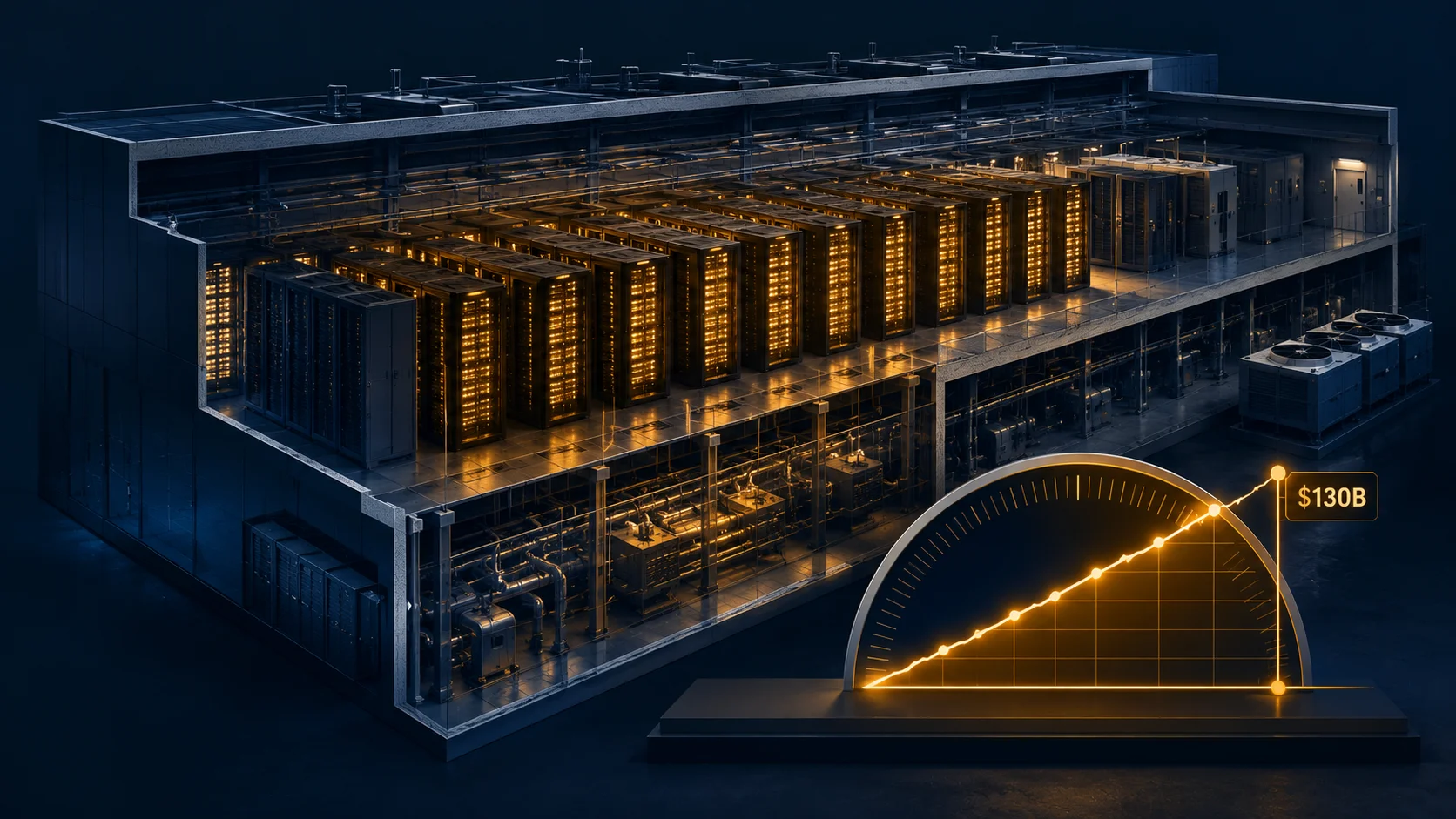
    Cloudflare AI gateway edge inference requests illustration

    Cloudflare’s AI Gateway Has Processed 100 Billion Inference Requests and Edge Delivery Has Become the Default AI Infrastructure Layer

    Cloudflare reported Q1 2026 revenue of $580 million — up 27 percent year-over-year from $456 million in Q1 2025 — with its AI product portfolio (AI Gateway, Workers AI, Vectorize, and NeuralSwitch) collectively crossing $500 million in annualised run-rate revenue and AI Gateway processing more than 100 billion inference API requests in the quarter, a figure that positions Cloudflare not as a foundation model provider competing with OpenAI or Anthropic but as the delivery and management layer through which enterprise applications route their AI API calls before those calls reach the model provider. Cloudflare’s Q1 2026 investor materials describe AI Gateway’s commercial function precisely: it sits between an enterprise application and the AI model providers that application calls (OpenAI, Anthropic, Google Vertex AI, Meta Llama API, Cohere), providing a unified management layer for caching, rate limiting, cost analytics, fallback routing, and compliance logging across all AI provider relationships from a single configuration interface. An enterprise running five different AI models across its product suite — a coding assistant on GitHub Copilot’s model, a customer service bot on Claude 3.5, a document summariser on GPT-4o, an image generator on Gemini, and a search augmentation layer on Llama 4 — previously had to manage API keys, usage monitoring, cost allocation, and failure handling for each provider independently, with no unified view of total AI spending or provider reliability across the stack. Cloudflare AI Gateway eliminates that management complexity by treating AI provider APIs the same way its core CDN product treats origin server connections: as a class of upstream resources to be routed, cached, monitored, and load-balanced from a single control plane. The caching feature specifically — which stores AI API responses for semantically similar queries and serves the cached response to subsequent requests without calling the model provider — produces the most immediate commercial ROI: AI Gateway customers see an average 30 to 40 percent reduction in AI API costs in the first 90 days of deployment as repeated queries to the same model provider (a documentation chatbot being asked common questions, an internal knowledge assistant handling routine lookups) are served from cache rather than generating new inference calls. ARM Holdings’ royalty revenue from AI chips demonstrates how infrastructure-layer companies capture value from the AI compute stack without needing to develop the applications that run on it — Cloudflare’s AI Gateway occupies a comparable infrastructure position one layer above the compute, capturing value from the routing and management of AI API calls that every enterprise application generates regardless of which model or cloud provider the application ultimately uses.

    Workers AI, Cloudflare’s serverless inference product, addresses a different part of the enterprise AI infrastructure problem: latency and data sovereignty for inference workloads that cannot tolerate the 100 to 200 millisecond round-trip times that centralized cloud AI endpoints produce for users located far from the AWS us-east-1, GCP us-central1, or Azure East US regions where the majority of commercial AI model endpoints are hosted. Cloudflare runs Workers AI on its global network of 330-plus data centers in more than 120 countries, meaning that a user in São Paulo, Lagos, or Singapore making an AI inference request through a Workers AI deployment receives a response from a node that is typically within 20 milliseconds of their physical location rather than from a US East Coast endpoint at 150 to 250 milliseconds. The latency advantage matters most for AI applications where the interaction is synchronous and user-facing — a real-time translation feature, a customer-facing chatbot with a visible typing indicator, an AI image filter applied to a video stream — because human perception of response delay degrades interaction quality noticeably above 100 milliseconds in conversational contexts. Workers AI currently supports inference for open-weight models including Llama 4 Scout, Mistral 7B, Gemma 2, and Whisper (audio transcription), with Cloudflare running the model weights on its own GPU infrastructure distributed across the global network. Workers AI is not positioned to replace centralised cloud AI for training workloads (which require GPU clusters with high-bandwidth interconnects that Cloudflare’s distributed single-node architecture does not support) but specifically targets inference workloads where geographic distribution, latency, and data residency are constraints that centralised cloud endpoints cannot satisfy. Palantir’s AIP analytics platform operates at the application layer above cloud AI infrastructure, deploying ontology-driven decision intelligence for enterprises that have already solved their AI infrastructure procurement — Cloudflare Workers AI sits at the infrastructure layer below, providing the edge inference capacity that applications like AIP call when they need low-latency inference outside the US regions where centralised cloud AI is optimised.

    What Cloudflare NeuralSwitch Does for Enterprise AI Cost Management

    Cloudflare launched NeuralSwitch in June 2026 as an extension of AI Gateway that applies automated routing logic to AI API calls based on real-time model availability, cost, and task complexity — selecting the lowest-cost capable model for each inference request from a configured pool of providers rather than routing all requests to a single model regardless of whether that model’s capability level is necessary for the task. The commercial rationale is straightforward: an enterprise application that routes all AI inference requests to GPT-4o at $15 per million output tokens is overpaying for simple classification, extraction, and structured generation tasks that Llama 4 Scout at zero marginal cost (via Workers AI) or Claude Haiku at $1.25 per million output tokens handles with equivalent output quality. NeuralSwitch’s routing logic evaluates each incoming prompt against a task complexity classifier (itself a small, fast inference model running at the edge) and selects the appropriate model tier from the enterprise’s configured provider pool: a multi-step reasoning task routes to GPT-4o or Claude 3.5 Sonnet; a document summarisation request routes to a mid-tier model; a simple keyword extraction or classification request routes to a fast, inexpensive model running on Workers AI at the edge. Early NeuralSwitch deployments are reporting 50 to 65 percent reductions in total AI API spend compared to single-provider configurations, by matching task complexity to model capability rather than using frontier-class models for tasks where 95 percent of the value is available from a model that costs 10 percent as much. Workday’s Illuminate AI layer applies similar task routing logic within the HCM context — agentic workflows that require policy-constrained human-level judgment route to different model configurations than the routine data extraction and summarisation tasks that Illuminate handles without human review. Gartner’s edge computing research for 2026 projects that by 2028, 40 percent of enterprise AI inference workloads will run at the edge rather than through centralised cloud endpoints, driven by latency requirements, data sovereignty obligations under the EU AI Act and equivalent regional regulations, and cost optimisation through geographic proximity to end users. The Wall Street Journal’s enterprise technology coverage through Q2 2026 frames Cloudflare’s AI infrastructure business as the clearest example of a network-layer company converting its existing infrastructure advantage (330-plus global PoPs, 20 percent of internet traffic) into AI delivery value — a conversion that required no new physical infrastructure buildout but rather a software and services layer deployed on existing hardware that was already positioned at the edge of the global internet.

    Why Cloudflare’s Network Position Makes AI Gateway Defensible Against Hyperscaler Competition

    The strategic risk for Cloudflare’s AI Gateway and Workers AI business is that AWS, Azure, and Google Cloud each have financial and technical resources to build identical management and edge inference products within their existing cloud platforms, and that enterprise customers already running AI workloads on a single hyperscaler could be retained by that hyperscaler’s native AI management tools rather than routing through a third-party like Cloudflare. The defence against this risk is Cloudflare’s multi-cloud positioning: enterprises that use AI models from multiple providers — which, as of Q1 2026, is the majority of large enterprise AI deployments according to Cloudflare’s customer data — have a structural reason to prefer a neutral management layer like AI Gateway over any single hyperscaler’s native AI management tools, because a neutral layer does not create pricing dependency on a single provider and does not expose query data to a hyperscaler that is simultaneously a competitor in the foundation model market. An enterprise using both Azure OpenAI Service and Anthropic’s Claude (a common combination where GPT-4o handles general tasks and Claude handles compliance-sensitive document review) has an alignment problem with Microsoft’s native AI management tools: Microsoft Azure’s observability and cost tools are well-instrumented for Azure OpenAI Service calls but do not treat Anthropic API calls with the same native fidelity. Cloudflare AI Gateway is provider-neutral by design and commercial interest, because its business model depends on managing calls to all AI providers rather than favouring any single one. GitHub Copilot’s enterprise growth has been driven in part by Microsoft’s ability to bundle AI coding assistance with its existing developer toolchain — a distribution advantage that works in Microsoft’s favour for single-provider enterprise AI deployments but that creates a friction point for multi-provider enterprise AI architectures where Cloudflare’s neutrality is a commercial advantage rather than a disadvantage. Cloudflare’s Vectorize vector database product — which stores embedding vectors for retrieval-augmented generation applications at the edge, adjacent to the Workers AI inference endpoints that generate them — further deepens the AI infrastructure relationship by making Cloudflare the storage layer for the context data that AI inference calls retrieve, creating a data gravity effect that is structurally similar to how Amazon S3’s dominance in object storage has reinforced AWS compute adoption by keeping data and compute co-located within the same provider’s network.

    What Cloudflare’s 100 Billion Inference Request Milestone Reveals About Where Startups Build AI Infrastructure

    One hundred billion inference requests is a number produced by cumulative developer decisions. Every startup that chose Cloudflare Workers AI over a direct API call to a hyperscaler added to that total. The decision pattern is not primarily about cost, though Cloudflare’s pricing is competitive. It is about the combination of low lock-in risk and zero operational overhead. A startup that routes inference through Cloudflare’s AI Gateway has not committed to a specific model provider, a specific cloud vendor, or a specific inference architecture. That optionality has real value when the underlying model landscape is changing at the pace it changed between 2024 and 2026.

    NeuralSwitch is interesting precisely because it makes a previously manual decision automatic. Multi-model routing — using the cheapest adequate model for each request type — is something sophisticated teams were doing in configuration files. NeuralSwitch makes it a platform default. The economics of AI product building have made this decision valuable: a startup spending $40,000 per month on inference with an 8x cost spread between frontier and small models has genuine P&L incentive to get routing right. The startups that will benefit most from NeuralSwitch are those running heterogeneous workloads where prompt complexity varies enough to justify the routing overhead.

    The hyperscaler comparison matters but is asymmetric. AWS, Azure, and Google Cloud offer inference as part of a larger platform value proposition. Cloudflare offers inference as infrastructure for builders who want to stay independent of that platform consolidation. The 100 billion milestone is evidence that a meaningful segment of the developer market has made the independence bet. Whether that bet compounds into enterprise adoption or remains developer-tier depends on whether Cloudflare can bring enterprise-grade compliance, audit logging, and SLA guarantees to match the hyperscalers’ enterprise motion. That is the product gap the enterprise version of Cloudflare AI Gateway still has to close.

    What Cloudflare’s 100 Billion Inference Requests Reveal About the Pricing Structure Behind AI Infrastructure Independence

    The 100 billion milestone has been covered as a developer adoption story. The more important number Cloudflare has not published is the average revenue per inference request. Cloudflare Workers AI pricing uses a neuron-based compute abstraction rather than a flat per-request or per-token rate, which means 100 billion inference requests translates to a revenue figure that varies enormously by model size and request complexity. The hyperscalers publish exact per-token pricing. Cloudflare’s neuron abstraction makes apples-to-apples comparison deliberately difficult, which is a pricing strategy as much as a product decision.

    The investigative question is who is actually capturing the margin on these 100 billion inferences. Cloudflare’s gross margin on Workers AI is structurally different from its CDN and security products, where bandwidth costs have been compressed through network scale over many years. GPU compute has no equivalent commodity dynamic: Nvidia’s H100 and H200 utilization pricing has not fallen the way bandwidth costs fell, and demand from hyperscalers, AI labs, and cloud providers is outpacing supply. Cloudflare is routing inference requests through GPU capacity it does not own, positioning on routing efficiency and developer ergonomics rather than on controlling the underlying compute. That margin structure looks more like a marketplace premium than an infrastructure moat. The developer who values Cloudflare’s multi-model routing and independence from a single provider is paying for orchestration, not for compute at cost.

    The enterprise version of this story is also a pricing and commercial model story. Enterprise buyers pay premiums for accountability infrastructure: compliance attestations, audit logs, SLA guarantees, and the enterprise agreement mechanism that makes infrastructure purchases predictable within annual budget cycles. The hyperscalers have spent decades perfecting the enterprise agreement model, including committed spend tiers, negotiated credits, and dedicated technical account management that makes switching costs prohibitive even when a competitor’s unit pricing is lower. Cloudflare closing the enterprise gap requires not just audit logging and SLA product features but a commercial motion that competes with the enterprise agreement mechanism itself. The 100 billion inference requests establishes credibility in the developer tier. The commercial model that converts developer credibility into enterprise revenue at enterprise margins has not yet been publicly demonstrated, and that gap is the one that determines whether the independence bet compounds into durable enterprise revenue.

    What Cloudflare’s 100 Billion AI Inference Requests Reveal About the Underground Developer Psychology Driving the Independence-First AI Infrastructure Movement

    The 100 billion inference request milestone carries a specific meaning in developer culture that is not visible in the headline number. Cloudflare’s AI Gateway has reached scale because of a decision — made by hundreds of thousands of individual developers, independently — to route their AI inference through a layer that abstracts across model providers and retains user control over provider selection. That decision is not primarily a technical one. It reflects a value orientation: the developers who built into Cloudflare’s AI Gateway did so specifically because they distrust the lock-in structures that major model providers would prefer they accept. The 100 billion requests are a measure of how many inference calls were made by people who cared enough about AI infrastructure independence to make the architectural choice to care about it.

    Developer culture has a social structure that looks chaotic from the outside but is highly legible from inside. Within that structure, infrastructure independence is a status signal. Choosing to depend on a model provider’s API directly — without an abstraction layer — is a statement about what you believe your options are. Choosing to route through an abstraction layer that lets you swap providers is a statement about what you believe your options should be. The first choice is made by developers who trust the dominant model provider not to change its pricing, its terms, its availability, or its capability parity in ways that hurt them. The second choice is made by developers who have read enough technical history to know that trust in platform providers is structurally fragile. The 100 billion requests are a tally of how many developers have thought through that question and arrived at the independence-first answer.

    The gap between developer credibility and enterprise revenue at enterprise margins is ultimately a psychology gap, not a commercial gap. Enterprise procurement does not operate through the same value system as the developer underground. Enterprise buyers are not optimizing for infrastructure independence; they are optimizing for risk reduction, vendor accountability, and the ability to explain their technology choices to a risk committee. Cloudflare’s path from 100 billion inference requests to durable enterprise margins requires translating the independence-first developer argument into the risk-reduction enterprise argument — and those are not the same argument. The developers who built into Cloudflare’s AI Gateway did so because independence mattered to them. The enterprise buyers who will generate enterprise-margin revenue will adopt Cloudflare because vendor accountability and compliance auditability matter to them. That translation is the commercial work the milestone has not yet done.
  • Arm’s AI Chip Royalty Revenue Became Its Primary Growth Driver

    Arm’s AI Chip Royalty Revenue Became Its Primary Growth Driver

    Arm Holdings Royalty Revenue From AI Chips Has Become the Primary Growth Driver and Compute Subsystem Licensing Is Expanding the Model

    Arm Holdings Royalty Revenue From AI Chips Has Become the Primary Growth Driver and Compute Subsystem Licensing Is Expanding the Model

    Arm Holdings reported royalty revenue of $1.1 billion in fiscal Q4 2026 (the quarter ended March 2026), a 46 percent year-over-year increase that reflected the accelerating shipment of AI chips — including Nvidia’s Blackwell B200 GPU family, Apple’s M4 processor series, Qualcomm’s Snapdragon X Elite, and Amazon’s Graviton 4 data center processor — that use ARM-designed processor cores and pay Arm a per-chip royalty each time a chip ships at commercial volume. Arm Holdings’ investor relations filings for FY2026 show total annual revenue reaching $4.7 billion (up 47 percent from FY2025’s $3.2 billion), with royalty revenue growing faster than licensing revenue for the second consecutive year — a mix shift that is commercially significant because royalties scale with semiconductor unit shipments and average selling prices without requiring Arm to add customers or renegotiate contracts. The royalty acceleration reflects two compounding factors: the transition from ARM v8 architecture to ARM v9 architecture (which carries a higher royalty rate per chip than v8) is now approximately 70 percent complete across major chip designs, and the average selling price of ARM-based chips is increasing as AI processing requirements push chip designers toward higher compute, higher memory bandwidth designs that carry larger royalty obligations. Arm does not disclose per-chip royalty rates publicly, but management has indicated that the blended royalty rate improvement from v8 to v9 is in the mid-single-digit percentage range as a fraction of chip ASP — a modest per-chip improvement that compounds into material revenue growth at the billions of chips that ARM-architecture designs ship annually. Qualcomm’s Snapdragon X commercial traction in AI PCs exemplifies the royalty revenue dynamic: each Snapdragon X Elite shipped generates an ARM v9 royalty payment at a higher rate than the Snapdragon 8 Gen series it replaces for comparable market segments, so Qualcomm’s AI PC market share growth directly expands Arm’s royalty revenue without requiring any change to the licensing arrangement between the two companies.

    Arm’s Compute Sub-System (CSS) licensing program represents the structural innovation in Arm’s business model that has the most significant long-term implications for the company’s revenue per customer relationship. Traditional ARM licensing involves a chip designer licensing the ARM instruction set architecture (ISA) or a specific CPU IP core design, then integrating that core with other IP (GPU, memory controller, interconnect) to build a complete chip. Arm’s CSS program packages pre-integrated compute cluster designs — a CPU IP core, memory subsystem, interconnect, and coherency fabric that are already validated to work together — that chip designers can license as a complete module and integrate into a larger SoC without performing the architectural integration work themselves. CSS licensing carries a materially higher annual license fee than individual IP licensing, because the value delivered is not just the CPU IP but the engineering work of making a validated, production-ready compute cluster. Major semiconductor companies that have adopted CSS include MediaTek (for its Dimensity AI chiplets), Marvell Technology (for its data center interconnect and infrastructure processors), and several smartphone chip vendors that use CSS to accelerate their design cycles. The CSS model is Arm’s response to the competitive pressure from RISC-V — an open-source instruction set architecture that chip designers can use without royalty payments. RISC-V adoption has grown from negligible to approximately 3 to 4 percent of addressable embedded and microcontroller chip designs by 2026, but has not yet penetrated the high-performance computing segments (smartphones, data center CPUs, AI accelerators) where Arm earns the majority of its royalty revenue. TSMC’s 2nm N2 process node expansion is relevant to Arm’s royalty trajectory because TSMC N2 is being used for ARM v9-based designs from Apple (M5), Qualcomm (Snapdragon X successor), and MediaTek — each additional N2 tapeout at TSMC typically represents an ARM v9-based design that will generate royalties at the higher v9 rate.

    How Arm’s Data Center Revenue Has Grown Beyond AWS Graviton

    Arm’s data center CPU revenue was initially concentrated in Amazon Web Services, which began deploying its custom Graviton ARM-based server processors in 2018 and has expanded Graviton to power approximately 40 percent of AWS EC2 compute capacity by 2026. The data center story has broadened since 2023-2024 in ways that are materially increasing Arm’s data center royalty exposure: Microsoft Azure has deployed Arm-based Cobalt 100 processors in its cloud infrastructure, Google has deployed custom ARM-based Axion processors for internal and customer workloads, and Ampere Computing (an ARM-based server CPU startup backed by Oracle) has captured meaningful share in hyperscale-adjacent deployments. The Nvidia GH200 and GB200 superchips — the configurations that hyperscalers are buying at scale for AI training and inference — integrate Nvidia’s Grace CPU (ARM Neoverse V2 core design) with an H200 or B200 GPU on a high-bandwidth NVLink interconnect, making every AI accelerator sale at the datacenter hyperscaler level simultaneously an ARM v9 royalty event. Arm management has not disclosed the Grace royalty rate specifically, but the Neoverse V2 license agreement was disclosed as a multi-hundred-million-dollar arrangement at the time of the Nvidia-Arm acquisition attempt (2020-2022), and the per-chip royalty on each GH200/GB200 sold represents a significantly higher absolute royalty than a standard server CPU because the overall chip selling price is dramatically higher. The $700+ billion in cloud capex commitments from Amazon, Microsoft, and Google for AI infrastructure translates directly into a sustained multi-year demand signal for ARM-based data center processors — both hyperscaler-custom (Graviton, Cobalt, Axion) and standard Arm Neoverse-based server CPUs from Ampere and other vendors — that Arm’s management has explicitly cited as a visibility improvement in royalty revenue forecasting. The earlier trajectory of ARM’s data center penetration through AWS Graviton established the initial data center royalty stream that Arm’s FY2026 results now show has expanded to multiple hyperscaler-custom designs and Nvidia’s AI accelerator superchip configurations.

    What Arm’s Stock Performance and Valuation Reflect About the Royalty Model’s Growth Ceiling

    Arm Holdings stock (NASDAQ: ARM) traded near $200 per share by mid-2026, approximately four times its $51 IPO price from September 2023, giving the company a market capitalization of approximately $170 billion on roughly $4.7 billion in FY2026 revenue — a revenue multiple of approximately 36 times that reflects investor expectations of sustained high-rate royalty revenue growth as AI chip designs proliferate and ARM v9 adoption nears completion. The valuation premium relative to standard semiconductor companies (which trade at 5 to 8 times revenue) reflects Arm’s royalty model characteristic: revenue grows with each new ARM-based chip that ships globally without requiring Arm to add manufacturing capacity, hire proportional headcount, or incur proportional cost of goods sold. Arm’s operating margin profile — approximately 45 percent in FY2026 — is structurally above semiconductor manufacturers’ margins because royalties are essentially pure margin above the fixed costs of maintaining the ISA and supporting licensees’ design implementations. The growth ceiling question is the central investor debate: how much higher can royalty revenue grow if ARM already powers approximately 99 percent of smartphones, approximately 40 to 60 percent of data center CPUs by unit count, and a growing share of AI accelerators? Arm’s answer is that royalty revenue per ARM chip shipped has not yet peaked, because the shift from v8 to v9 architecture and the shift from general-purpose CPUs to AI-specific compute designs (higher ASP, higher royalty absolute value) will continue to expand revenue per unit even as total unit growth moderates from peak smartphone growth rates. IDC’s semiconductor market research for 2026 projects AI-accelerated chip demand to sustain ARM royalty revenue growth above 20 percent annually through 2027, with the primary risk factor being an acceleration of RISC-V adoption in edge AI and IoT applications that could reduce Arm’s royalty exposure in embedded markets while leaving the high-value data center and mobile segments intact. Financial Times technology coverage through Q2 2026 characterizes Arm as the most structurally advantaged company in the AI infrastructure supply chain because its revenue scales with AI chip deployment volume across every chip vendor rather than being concentrated in a single product line, hardware generation, or customer relationship — a diversification that Nvidia, TSMC, and ASML each lack in their respective portions of the AI chip supply chain.

    What Discipline in the Licensing Model Produced When Everyone Else Was Building Chips

    Jocko Willink’s framework is that discipline is the mechanism by which long-term advantage compounds — not inspiration, not market timing, not the right product at the right moment, but the sustained execution of a correct strategic choice under pressure to deviate from it. ARM Holdings’ royalty revenue growth in fiscal Q4 2026 is what 30 years of licensing discipline looks like when the market it embedded itself in becomes the most valuable infrastructure category in technology.

    The discipline ARM maintained was the decision not to manufacture chips. This sounds like a simple business model choice. It required sustained resistance to a pressure that every generation of semiconductor expansion intensified: the argument that vertically integrating — owning the foundry, controlling the packaging, capturing the margin at the chip level rather than the architecture level — would produce better financial outcomes. Intel made that vertical integration bet and spent the 2010s defending a manufacturing lead that eventually became a liability when TSMC’s process technology outpaced its own. Qualcomm’s history is partly a story of the difficulties of designing chips when ARM’s architectural alternatives created commoditization pressure at the SoC level. NVIDIA built its own architectural alternatives in parallel with using ARM in mobile. In each case, the alternative to ARM’s pure licensing model created strategic complications that ARM avoided by maintaining the discipline not to compete with its own customers.

    The 46% royalty revenue growth in the quarter reflects that discipline compounding across NVIDIA’s Blackwell GPUs, Apple’s M4, Qualcomm’s Snapdragon X Elite, and Amazon’s Graviton 4 simultaneously — four of the most significant chip programs in the market, all generating royalties for the same licensor. ARM did not build any of those chips. It built the architecture that made each of them possible, took its royalty, and allowed the chip designers to compete with each other for the market share that ARM collects regardless of who wins. The compute subsystem licensing expansion — the article’s additional revenue layer — is the same discipline applied to a new design scope: as chip architects integrate more subsystems at the IP level, ARM’s addressable royalty surface expands without ARM manufacturing anything. Discipline produced this. Thirty years of it.

  • Oracle Cloud Infrastructure Is Taking AI Revenue From AWS and Azure

    Oracle Cloud Infrastructure Is Taking AI Revenue From AWS and Azure

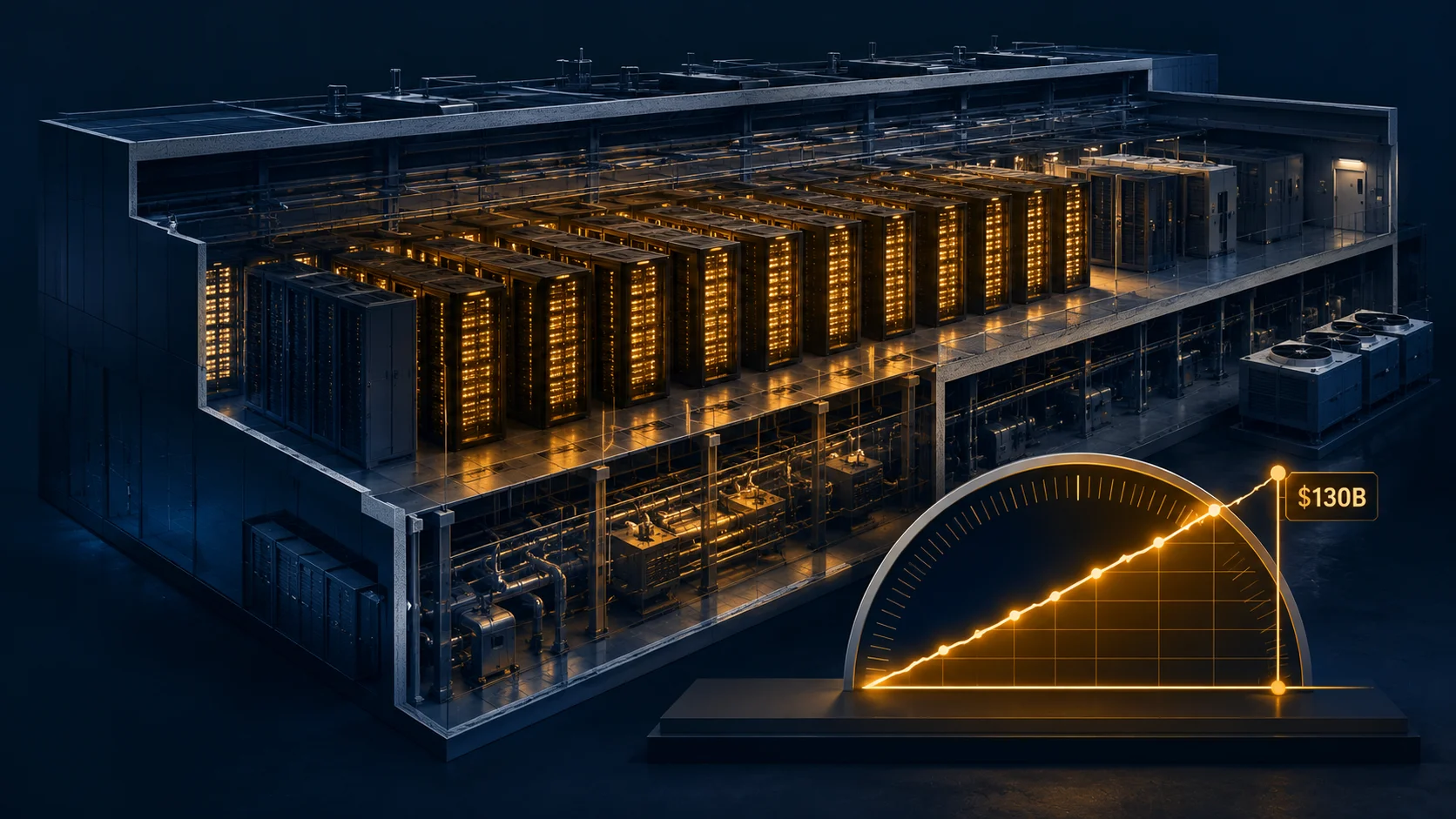
    Oracle Cloud AI infrastructure revenue growth illustration

    Oracle Cloud Infrastructure Is Taking AI Revenue From AWS, Azure, and Google

    Oracle reported $14.3 billion in total revenue for fiscal Q4 2026 (ending May 31, 2026) — up 15 percent year over year — with cloud infrastructure revenue growing 53 percent annually to reach a $25 billion annualized run-rate and remaining performance obligations (contracted-but-not-yet-recognized future revenue) crossing $130 billion for the first time in the company’s history. Oracle’s investor relations disclosures show AI GPU cluster demand filling Oracle Cloud Infrastructure capacity faster than Oracle can build it — with management confirming on the Q4 earnings call that every GPU cluster Oracle has provisioned in 2026 has been sold before it came online, and that the constraint on Oracle’s cloud revenue growth is now data center construction pace and power provisioning capacity, not customer demand. A $130 billion backlog growing faster than a $25 billion annualized revenue run-rate is the most direct available measure that Oracle Cloud Infrastructure has shifted from a secondary cloud option to a primary AI compute destination for enterprises that cannot secure equivalent GPU cluster availability from AWS, Azure, or Google Cloud on comparable timelines.

    Oracle’s position in the cloud market as recently as 2023 was that of a credible but tertiary player in a market structured around three incumbents. Gartner’s cloud infrastructure market share tracking shows AWS commanding roughly 30 percent of global cloud infrastructure revenue, Microsoft Azure at approximately 22 percent, and Google Cloud at 11 percent, with Oracle OCI below 5 percent and characterized primarily by customers running Oracle databases who found OCI the lowest-friction option for adjacent workloads. What changed between 2023 and 2026 was not primarily Oracle’s product quality — OCI had been technically competitive for years — but the arrival of a demand category, AI GPU compute, where the three incumbents were simultaneously supply-constrained and where Oracle had made early infrastructure commitments that gave it provisioned capacity at exactly the moment enterprise demand for that capacity reached its highest point. Oracle’s NVIDIA H100 GPU cluster buildout, accelerated through 2023-2024 ahead of broader AI demand confirmation, positioned the company to fill the availability gap that AWS and Azure left open during their own GPU capacity expansion programs. The capital commitments that Amazon, Microsoft, and Google made to AI infrastructure in 2026 have expanded the total market significantly, but they have not eliminated the gap Oracle exploited — enterprise customers who secured OCI GPU clusters in Q4 2023 and Q1 2024 are now under multi-year committed-spend contracts, and their contracted revenue is in Oracle’s $130 billion backlog.

    What the $130 Billion Backlog Actually Signals

    Remaining performance obligations represent contracted future revenue the customer has committed to purchase but Oracle has not yet recognized. A $130 billion RPO is not a guarantee of $130 billion in next-year revenue — Oracle will recognize roughly $25-30 billion of it in FY2027 — but it is a guarantee of customer commitment. Multi-year cloud contracts are directional infrastructure decisions: enterprises signing 3- to 5-year OCI committed-spend agreements have selected Oracle as a primary vendor, not a backup. The switching cost of migrating AI workloads off OCI — re-architecting pipelines, migrating data, retraining operations teams, renegotiating NVIDIA licensing and support terms — is high enough that contract renewal is the default behavior unless Oracle gives a customer a specific reason to leave. A $130 billion backlog growing by $20-25 billion per quarter is, structurally, a measurement of how many enterprise AI workload decisions have been made in Oracle’s favor and how durable those decisions are through the medium term.

    The Oracle-Microsoft infrastructure interconnect partnership, active since 2024 and expanded to additional regions through 2025-2026, is the clearest market-structure signal in the AI infrastructure race. Under the partnership, enterprises can deploy workloads that span OCI and Azure through a unified management interface, with compute charges billed through whichever provider’s infrastructure runs the workload. The arrangement is commercially unusual because it acknowledges explicitly that Microsoft Azure alone cannot satisfy the AI GPU cluster demand of its enterprise customer base — and that routing overflow demand to Oracle is preferable to losing those customers to AWS or Google. For Oracle, the partnership provides Azure’s distribution reach and enterprise customer relationships at no direct sales cost. Microsoft’s AI revenue gap relative to its capex commitment reflects the same supply constraint Oracle has benefited from — Azure has been spending aggressively on AI infrastructure and still cannot satisfy all the GPU cluster demand from its installed enterprise base. The interconnect partnership resolves that tension while it persists, and Oracle’s contracted backlog captures the revenue from that resolution window regardless of what the hyperscaler capacity picture looks like when the contracts expire.

    How Oracle Won AI Compute Without Playing the Hyperscaler Game

    Oracle’s competitive advantages in 2026 are specific rather than broad. In AI GPU compute availability — particularly for NVIDIA H100 and H200 clusters where AWS and Azure had allocation queues measured in quarters during peak demand — OCI’s wait times have been materially shorter at comparable demand peaks, and OCI’s per-GPU pricing has been consistently at or below the hyperscaler rate cards for equivalent instance types. In Oracle database workloads, OCI is the natural home because running Oracle databases on AWS or Azure introduces licensing and support complications that OCI avoids by design. In dedicated single-tenant AI infrastructure for regulated industries — healthcare organizations with HIPAA requirements, financial institutions with data sovereignty constraints, federal contractors with FedRAMP obligations — OCI’s willingness to provision isolated customer-dedicated GPU clusters at pricing that matches the hyperscaler equivalents has differentiated Oracle in enterprise competitive evaluations where multi-tenant compute is disqualifying. Where OCI trails materially: managed services breadth (AWS has approximately 220 distinct managed services, OCI roughly 150), developer tooling ecosystem, geographic data center coverage outside North America and Western Europe, and the startup-to-enterprise pipeline that AWS and Azure have built through startup credit programs over fifteen years. The $700 billion AI infrastructure commitment from the Magnificent Seven in 2026 will eventually close the GPU availability gap that gave Oracle its market entry window — the question is whether Oracle can use the contracted backlog period to embed OCI more deeply in enterprise database and application estates before the availability advantage normalizes.

    Why Enterprise AI Buyers Are Signing Multi-Year OCI Contracts

    Enterprise infrastructure decisions in 2026 are being made under conditions that favor Oracle’s specific strengths: GPU cluster availability is the highest-priority variable for AI workload infrastructure selection, pricing transparency matters more than ecosystem breadth for workloads where the compute requirement is defined before the infrastructure is selected, and multi-year committed-spend economics reward the vendor that can guarantee delivery timeline over the vendor with the largest service catalogue. Reuters technology coverage through Q2 2026 characterizes Oracle’s cloud position as a specialist that has successfully exploited the AI compute bottleneck without becoming a full-stack hyperscaler competitor — a viable long-term position if AI infrastructure spending remains concentrated at the top of the enterprise budget stack. The strategic risk Oracle faces is the 2027 timeline: Gartner projects that hyperscaler GPU capacity reaches parity with enterprise demand by late 2027, at which point Oracle’s availability advantage normalizes and pricing becomes the primary competitive variable. Oracle’s answer to that risk is the depth-of-integration strategy — embedding OCI into enterprise database operations, analytics workflows, and application estates through APEX, Autonomous Database, and Oracle Analytics Cloud integrations that run materially better on OCI than on competing infrastructure. Whether that depth-of-integration moat is sufficient to retain backlog customers when their multi-year contracts expire is the key question Oracle’s FY2029 revenue will answer. For FY2027 and FY2028, the contracted backlog makes the answer clear: the AI compute window has already been converted into durable forward revenue regardless of what the competitive infrastructure market does in the interim.

    How Oracle Wins AI Infrastructure Without Competing in the Model Layer

    Aggregation theory — the framework Ben Thompson has applied most consistently to understanding platform power — distinguishes between platforms that control access to users and platforms that control access to supply. Google aggregates user attention and uses that control to set the terms of the advertising market. Netflix aggregates content rights and uses that control to negotiate with studios. Oracle’s position in enterprise AI is neither of those things. Oracle controls access to GPU compute at a price point and contract structure that enterprises buying multi-year AI infrastructure commitments find more predictable than the hyperscaler alternatives — and it has no competing AI model product that creates the channel conflict that makes AWS, Azure, and Google Cloud structurally uncomfortable for enterprises that want neutral infrastructure.

    The $130 billion contract backlog that OCI has accumulated is not primarily a signal about Oracle’s model capabilities. It is a signal about enterprise procurement decisions made by companies that need GPU capacity and are specifically avoiding concentrating that dependency in the same vendor from whom they buy their foundational AI services. A pharmaceutical company using Microsoft’s Copilot and Azure OpenAI for internal productivity tooling has a rational reason to prefer Oracle or another provider for its GPU training infrastructure: it does not want Microsoft to have both the client-facing AI model relationship and the underlying compute contract. The structural separation between model vendor and infrastructure vendor has commercial value to the enterprise even when the infrastructure vendor’s technology is not meaningfully differentiated from the hyperscaler equivalent.

    Oracle’s $130 billion backlog reflects this procurement logic at scale. The enterprises signing 3-5 year OCI contracts are not doing so because OCI’s performance benchmarks consistently outperform AWS or Azure. They are doing so because Oracle occupies the “neutral compute” position in the AI infrastructure market — a position that AWS, Azure, and Google Cloud structurally cannot occupy because each of them is also selling the frontier AI models that enterprise AI buyers are using as their primary application layer. Oracle’s competitive moat in enterprise AI is not technical leadership. It is the absence of a model business — which looks like a weakness from a product innovation standpoint and functions as a trust advantage in the enterprise procurement conversations that are producing the $130 billion backlog.

    What the Enterprise Procurement Chain Behind Oracle’s $130 Billion AI Backlog Actually Looks Like

    A $130 billion contract backlog is a number that needs to be followed through the organizations that signed those contracts. Enterprise AI infrastructure commitments of this size do not emerge from a CTO’s preference for a particular vendor’s GPU throughput metrics. They emerge from procurement processes that involve budget committees, vendor risk assessments, legal review of multi-year commitment structures, board-level capital allocation approvals, and finance team analysis of vendor diversification mandates. The people who matter in a $130 billion GPU compute commitment decision are not the ones quoted in Oracle’s investor presentations. They are the procurement officers, the CFOs, and the board risk committees who authorized the capital.

    Oracle’s neutral compute positioning resonates in enterprise procurement because the procurement officers have a specific mandate concern: dependency concentration risk when their infrastructure vendor also competes with their AI model vendor. AWS, Azure, and Google Cloud are all pursuing enterprise AI application revenues that compete with enterprise-built and third-party AI applications. An enterprise that signs a five-year GPU compute commitment with AWS is signing with an entity that may be competing with its own AI application layer in eighteen months. The procurement chain recognizes that risk because recognizing it is the procurement chain’s job. Oracle’s $130 billion backlog reflects, in significant part, that risk committee consensus — not just Oracle’s technical superiority.

    What an investigative inquiry would want to know is the composition of that backlog. How much is driven by genuine compute-cost efficiency versus vendor diversification mandates? How much is concentration from a small number of very large customers versus broad enterprise distribution? What are the exit clauses, and what do they reveal about how committed these customers actually are? A $130 billion number with three customers and flexible exits means something structurally different from a $130 billion number with forty customers on strict multi-year terms. Oracle has not disclosed the backlog composition at that level of detail. The vendor narrative is that demand is strong and structural. The follow-the-money question is who signed, why, and what they have the right to do if the rationale changes.

  • Palo Alto Networks Pushed Platform Consolidation and It Worked

    Palo Alto Networks Pushed Platform Consolidation and It Worked

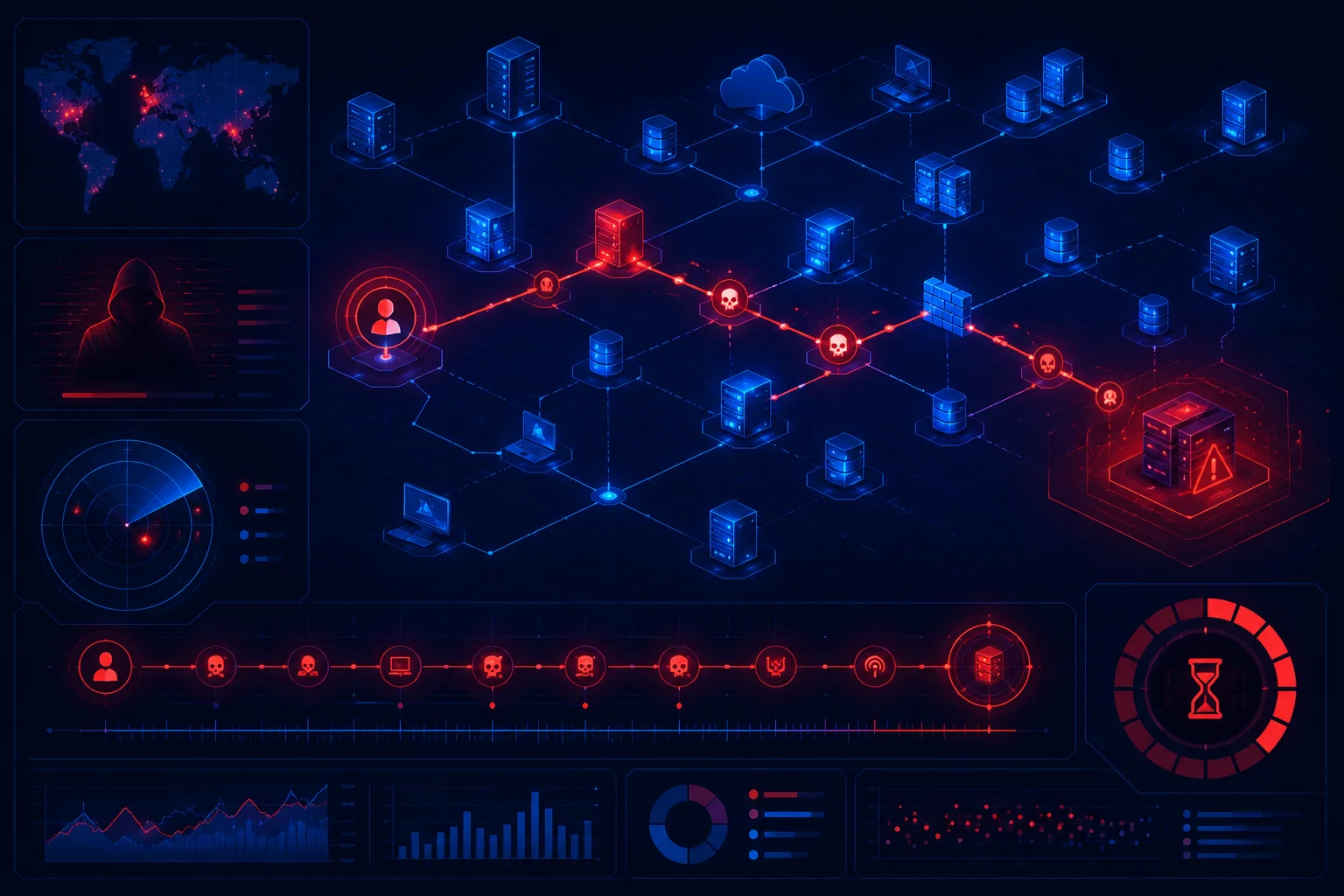
    Palo Alto Networks platform consolidation cybersecurity 2026

    Palo Alto Networks Pushed Platform Consolidation and It Worked

    Palo Alto Networks reported $2.3 billion in revenue for its fiscal Q3 2026 — up 15 percent year-over-year — with its platformisation strategy producing the specific commercial outcome its management team had staked the company’s growth narrative on: customers consolidating multiple point-solution security vendors onto Palo Alto’s integrated platform were generating significantly higher annualised recurring revenue per account than customers running individual products. Palo Alto Networks’ investor disclosures show that accounts with three or more platform modules — combining its SASE (Secure Access Service Edge), Cloud Security, and Security Operations products — churn at substantially lower rates than single-module customers and expand faster over a two-to-three-year relationship. The platformisation bet, which Palo Alto announced aggressively in early 2024 and which initially spooked investors when it offered free product trials to accelerate consolidation, appears to be generating the land-and-expand economics that justify the short-term revenue deferral it required.

    The cybersecurity market’s structural shift toward platform consolidation is one of the defining buyer-behaviour changes of 2025-2026. Enterprise security buyers who spent the 2018-2023 period assembling best-of-breed point solutions — individual vendors for endpoint detection, cloud workload protection, network security, identity management, email security, and security operations — are now evaluating the total cost of running 20-35 separate vendor relationships against the operational overhead and integration complexity that stack creates. AI-driven cyber attack sophistication has accelerated this evaluation: a security stack that requires manual correlation of alerts across 15 different vendor consoles cannot respond to AI-accelerated attacks that move from initial access to lateral movement in minutes rather than hours. The case for consolidation is now being driven by operational necessity rather than cost alone.

    What Platformisation Actually Means in Practice

    Palo Alto’s platformisation strategy is built around three product families that can be sold individually or as a unified platform. The first is Prisma SASE — a cloud-delivered network security product that combines secure web gateway, cloud access security broker, zero-trust network access, and SD-WAN into a single cloud service that replaces the fragmented collection of network security appliances many enterprises operate. The second is Prisma Cloud — a cloud security posture management and cloud workload protection platform that monitors cloud infrastructure across AWS, Azure, and GCP for misconfigurations, vulnerabilities, and runtime threats. The third is Cortex XSIAM — an AI-driven security operations platform that replaces traditional SIEM (Security Information and Event Management) systems with a model that ingests security telemetry at much larger scale and applies machine learning to reduce alert volume and prioritise genuine threats.

    The commercial logic is that an enterprise running all three families through Palo Alto is spending more per year than it would on any individual product, but is replacing a larger number of point-solution vendor contracts that together cost more than the consolidated platform price. Enterprise security procurement teams have validated this math in enough RFP processes that platformisation consolidation is now a standard consideration in annual security budget cycles rather than a novel concept requiring extensive internal advocacy. Regulatory AI risk frameworks in financial services and healthcare have also created demand for unified audit trails and evidence of comprehensive security posture — requirements that fragmented point-solution stacks struggle to satisfy without significant manual integration effort, and that consolidated platforms address natively.

    How Palo Alto Is Separating From CrowdStrike in the Platform Narrative

    Palo Alto and CrowdStrike are the two companies most associated with the cybersecurity platform consolidation narrative, but they have attacked it from different starting positions. CrowdStrike’s Falcon platform originated in endpoint detection and response — it built outward from the endpoint into identity security, cloud workload protection, and threat intelligence. Palo Alto originated in network security — its next-generation firewall business established its enterprise relationships, from which it expanded into cloud security and security operations. The two platform stories therefore land differently with different security buyer personas: CrowdStrike’s narrative resonates most strongly with security operations teams focused on endpoint and identity visibility; Palo Alto’s resonates most with network and infrastructure security teams managing cloud and hybrid environments.

    The distinction matters for understanding which accounts each company is likely to consolidate versus which it will share. A financial services enterprise that already runs CrowdStrike across 50,000 endpoints and trusts its Falcon platform for endpoint detection is unlikely to replace it with Palo Alto’s endpoint product; but that same enterprise may adopt Palo Alto Prisma SASE for its network security layer and Cortex XSIAM for security operations, creating a multi-platform outcome rather than a single-vendor outcome. The security market’s actual trajectory in 2025-2026 is less about one platform winning across all layers and more about two or three platforms each winning across specific layers — with the integration work between platforms becoming the residual complexity that both companies sell professional services to manage. Gartner’s cybersecurity market research characterises this as a “platform of platforms” outcome rather than a single-vendor winner-takes-all scenario — the consolidation is real, but the number of remaining platforms stabilises at two to four rather than collapsing to one. AI agent orchestration in enterprise workflows has added a security dimension that Palo Alto is addressing through Cortex XSIAM’s AI-driven detection — a layer where the platform’s ability to correlate telemetry across network, cloud, and endpoint gives it an advantage that point-solution vendors cannot replicate without the same breadth of data.

    The Free-Trial Strategy and Why It Deferred Revenue to Build ARR

    Palo Alto’s controversial decision in early 2024 to offer its Cortex XSIAM platform to existing customers at no charge for a defined trial period — a move it called “platformisation acceleration” — was widely misread as a sign of pricing weakness or competitive desperation. The actual strategic logic was a customer acquisition model borrowed from enterprise SaaS: offering a premium product at zero cost for a defined period to existing customers converts a theoretical sales conversation into a live deployment, at which point the switching cost of removing the product from production creates a negotiating position for paid conversion that the vendor did not have before deployment.

    The XSIAM trial strategy required Palo Alto to defer approximately $400-600 million in revenue that would have been recognised sooner under a traditional paid deployment model. That deferral produced the guidance shortfall that rattled investors in early 2024. What it also produced, by fiscal Q3 2026, is a cohort of enterprise accounts that have run Cortex XSIAM in production for 12-18 months, have built security workflows around it, have trained their security operations teams on it, and have generated 18 months of historical telemetry that makes the platform more valuable with each passing month. Converting those accounts to paid contracts at renewal has proceeded at a higher rate than Palo Alto’s own internal targets, confirming that the trial-to-paid conversion model works in enterprise security when the product generates genuine operational dependency during the trial period. S&P Global’s cybersecurity market analysis through Q1 2026 shows Palo Alto gaining enterprise account share in security operations at the expense of traditional SIEM vendors including IBM QRadar and Splunk — the segment where the XSIAM free trial was concentrated.

    The Risk That Remains in the Consolidated Platform Bet

    Platform consolidation strategies carry a specific failure mode: a security incident caused by a platform failure affects every layer simultaneously rather than being contained within one product’s scope. The CrowdStrike July 2024 outage — in which a faulty content update to the Falcon sensor caused millions of Windows systems to crash globally — illustrated the systemic risk that single-platform concentration introduces. Enterprises that had consolidated their endpoint security entirely onto Falcon had no fallback; enterprises that maintained some platform diversity could route around the affected product. The incident did not slow enterprise platform consolidation meaningfully in 2025, but it permanently altered the risk conversation: enterprise security buyers now routinely ask consolidated platform vendors how their products fail safe and what redundancy exists at the product layer.

    Palo Alto has addressed this directly in its enterprise sales conversations, emphasising the modular architecture of its platform products — each family (SASE, Cloud, XSIAM) can be operated independently rather than requiring the entire platform to function for any individual component to operate. The modularity argument is real but partial: a security operations team that has built its workflows around Cortex XSIAM’s unified telemetry stream cannot simply substitute another product in the event of a Palo Alto service disruption without disrupting those workflows. The dependency that makes consolidated platforms commercially sticky is the same dependency that creates operational risk under failure scenarios. Managing that risk is now a central component of enterprise security architecture conversations — and it is a conversation that Palo Alto’s sales and solutions engineering teams are better equipped to have in 2026 than they were in 2024, when the CrowdStrike incident first made platform concentration risk a board-level security topic.

    Why Distributed Security Responsibility Equals No Security Accountability

    In security, complexity is the enemy of ownership. When an enterprise operates 25 distinct security vendor relationships — endpoint detection from one vendor, cloud workload protection from a second, identity security from a third, network traffic analysis from a fourth — every potential failure point has a different contractual owner. The SIEM vendor sees the alert. The endpoint vendor controls the remediation tool. The cloud security vendor manages the posture gap. The identity vendor holds the authentication log. When a breach happens, and it will, each vendor can point to the boundary of their product’s scope. No single team inside the enterprise owns the sequence of events connecting initial access to lateral movement to data exfiltration. That is not a technology problem. It is a leadership problem wearing a technology mask.

    Jocko Willink’s principle of extreme ownership is simple: the person responsible for an outcome owns everything that contributes to it, including the failures of the systems they depend on. Applying that principle to enterprise security means the CISO who owns the security outcome owns the entire stack — not the individual contractual boundaries between vendors. A security architecture that distributes responsibility across 25 vendors distributes accountability in a way that makes clean ownership structurally impossible. When the breach investigation report arrives, the narrative almost always reveals that the signals were present across multiple vendor dashboards simultaneously and that no single team had both the visibility and the authority to connect them fast enough to intervene. The distributed architecture was not a cost-optimisation failure. It was an accountability failure that the architecture made inevitable.

    Palo Alto’s platformisation thesis addresses this directly, and the commercial traction it has produced in the two years since the company staked its growth narrative on it confirms that CISOs are recognising the ownership problem. A CISO running Palo Alto’s three integrated product families — Prisma SASE for network security, Prisma Cloud for cloud workload protection, Cortex XSIAM for security operations — owns a single integrated telemetry layer with one escalation path, one quarterly business review, and one contract to hold accountable when the system misses something. That accountability structure does not exist in a 25-vendor stack, because no individual vendor accepts responsibility for the aggregate outcome. The enterprises consolidating onto Palo Alto are not only buying operational efficiency or lower total vendor cost. They are buying back the ability to own their security posture without apology — and for a CISO who answers to a board after a breach, that clarity of ownership is worth more than any individual product’s feature checklist.

    What the Enterprise Buyer Experiences When Security Platform Consolidation Actually Happens

    Julie Zhuo’s product-empathy framework starts from the lived experience of the person using the product, not the intended experience described in the vendor’s case study. Applied to Palo Alto’s platform consolidation story, this means asking not whether the architecture is structurally superior to a 25-vendor stack — it clearly is — but what the enterprise security buyer actually experiences during the consolidation process.

    The first experience is a parallel-run period that the consolidation narrative rarely describes honestly. Enterprise security teams do not decommission legacy tools when the new platform is installed. They run both systems simultaneously, often for 12 to 18 months, because no security operations leader will accept a detection gap during the transition period. The parallel run doubles operational complexity before it reduces it — security analysts must monitor outputs from both environments, triage alerts from two detection systems, and maintain expertise in tools they know they are eventually deprecating. The efficiency gain that the consolidated platform promises is real but deferred. The immediate experience of consolidation is more work, not less.

    The second experience is internal political friction. The teams that owned the legacy tools — endpoint security, network monitoring, cloud posture management — built their expertise, their vendor relationships, and often their career identities around those specific tools. Consolidation on Palo Alto does not just change the software; it changes the organizational structure of who owns security decisions and whose expertise is now the centre of gravity in the security operations team. That friction is not a product failure — it is the normal human response to a major organisational change. The third experience is the operational-readiness lag: the platform can be technically installed and reporting events from day one, but the security operations team is not yet trained to use the new detection logic, the new response playbooks, or the new investigation workflows effectively. The free-trial strategy accelerated the procurement decision. It did not accelerate the operational readiness. The honest product-empathy reading of platform consolidation is: the architecture is better, the path to realising that better architecture takes longer and costs more in disruption than the consolidation narrative acknowledges, and the enterprise buyer who understands that going in is better positioned than the one who expected the efficiency gains to arrive in quarter one.

  • AMD’s AI Chip Revenue Is Growing but Still Far Behind Nvidia

    AMD’s AI Chip Revenue Is Growing but Still Far Behind Nvidia

    AMD’s data center GPU segment generated $3.7 billion in Q1 2026 revenue, driven by continued deployment of MI300X accelerators at Microsoft Azure, Oracle Cloud, and Meta’s AI inference infrastructure — a result that confirms AMD has secured a durable second-tier position in the AI accelerator market while illustrating the scale of the gap it still needs to close against Nvidia. AMD’s Q1 2026 earnings showed data center GPU revenue growing 80 percent year-over-year, the fourth consecutive quarter of strong growth in the segment, but Nvidia’s data center revenue in the same period exceeded $39 billion — a ratio that makes AMD’s position look like a distinct competitor rather than a credible challenger at the top of the market.

    The distinction matters for how the AI accelerator market is characterised. AMD is not a niche alternative to Nvidia; it has secured real commitments from three of the world’s largest AI infrastructure buyers and is embedded in production inference workloads at scale. But AMD is also not competing with Nvidia for the same purchase decisions at the same customers. The MI300X’s commercial success has concentrated in inference — running trained models against new inputs — rather than training, where Nvidia’s H100 and H200 Blackwell GPUs dominate the large-scale cluster deployments that drive the largest purchase orders. The inference-vs-training split in AMD’s deployment base is not a weakness; it reflects a deliberate market positioning decision that has allowed AMD to grow revenue without winning head-to-head against Nvidia on the workload type where Nvidia’s CUDA software ecosystem advantage is strongest. Nvidia’s Q1 FY27 $81 billion revenue quarter illustrates the scale of the training-cluster market that AMD is not yet competing for at full scale.

    Where MI300X Deployments Actually Landed

    The three largest confirmed MI300X deployments in 2025-2026 share a common characteristic: they are at hyperscalers with the in-house engineering capacity to work around CUDA’s absence by investing in ROCm software optimisation at scale. Microsoft Azure launched MI300X-based virtual machine instances in mid-2025, targeting inference workloads where customers are running open-source models — Llama, Mistral, Falcon — rather than models that have been specifically optimised for Nvidia GPU memory architecture. Oracle Cloud Infrastructure became AMD’s largest enterprise cloud deployment partner for MI300X, positioning the accelerators as an alternative to Nvidia for customers facing GPU availability constraints during periods of high demand. Meta has disclosed using MI300X for portions of its internal AI inference infrastructure, primarily for serving recommendation models and content ranking systems where throughput at a given cost per query is the primary performance metric — a deployment confirmed in Meta’s Q1 2026 earnings disclosures as part of the company’s broader AI infrastructure diversification away from single-vendor GPU dependency.

    Each of these deployments reflects a specific economic argument for MI300X rather than an assertion that it outperforms Nvidia across all workloads. At Microsoft Azure, MI300X instances offer a lower cost per token for inference on specific open-source models because AMD has invested in ROCm optimisation for those model architectures. At Oracle, the argument is availability — MI300X hardware is accessible on timescales where H100 allocation queues extend months. At Meta, the argument is cost-per-query at inference scale, where the volume of recommendation requests is high enough that even modest per-query cost advantages justify the engineering investment in non-CUDA infrastructure. Broadcom’s custom XPU deployments at Google and Meta reflect the same pressure: hyperscalers are actively building alternatives to Nvidia procurement dependency, and AMD is one of those alternatives alongside custom silicon programmes. SemiAnalysis’s AI chip deployment tracking through Q1 2026 shows MI300X’s share of inference-workload GPU hours at the three largest cloud providers consistently growing quarter-over-quarter.

    AMD’s Revenue Gap From Nvidia in AI Accelerators

    The revenue ratio between Nvidia and AMD in AI accelerators has not narrowed meaningfully even as AMD’s absolute revenue has grown. Nvidia’s Blackwell-generation accelerators have captured the large-scale training cluster market at a higher price point than the prior H100 generation, which has expanded Nvidia’s total AI revenue faster than AMD’s 80 percent year-over-year growth can close the gap. The gap between $3.7 billion and $39 billion in a single quarter is not a trajectory problem — AMD’s growth rate is real — but a market-share problem: Nvidia is growing at comparable rates off a much larger base, and the training-cluster market that drives Nvidia’s highest revenue per accelerator is the segment AMD has not entered at comparable scale.

    The software ecosystem gap explains the structural difficulty. CUDA, Nvidia’s parallel computing platform and programming model, has been the default development environment for AI research and production engineering since 2007. The models that enterprise AI teams have trained, the inference optimisations they have developed, and the deployment pipelines they have built are all CUDA-native. Migrating a production AI workload from CUDA to AMD’s ROCm is an engineering project that most organisations have not prioritised when Nvidia hardware is available, because the cost of the migration exceeds the cost savings on the hardware at typical deployment scales. The customers who have migrated to MI300X are either hyperscalers with the engineering capacity to absorb migration costs, or new deployments where a team is building a pipeline from scratch and can choose ROCm from the outset. AMD’s MI350 roadmap targets the training market more directly than MI300X did, with architectural improvements aimed at reducing the performance gap that makes CUDA migration less economically compelling.

    What the MI325X Changes for 2026

    AMD launched the MI325X as an incremental upgrade to the MI300X in late 2025, with increased HBM3E memory capacity and bandwidth improvements that address the specific constraint — memory ceiling — that limits MI300X on the largest inference batch sizes. The MI325X does not close the training-cluster performance gap against Nvidia’s Blackwell series, which is designed around a very different memory architecture and interconnect scheme for multi-GPU training jobs. What MI325X does is extend AMD’s competitiveness in inference for larger models and larger batch sizes, which is the workload category where AMD’s commercial traction has been strongest.

    The MI350X, announced for late 2026 production, is the generation where AMD has stated ambitions to compete more directly with Nvidia for training cluster deployments. MI350X is expected to use AMD’s CDNA4 architecture with a substantially larger compute die and improved interconnect for multi-GPU configurations. Whether it succeeds in winning training cluster commitments at hyperscalers depends as much on ROCm software maturity and CUDA-compatibility layer development as on hardware specifications — the hardware gap is closing faster than the software gap, and the software gap is where AMD’s commercial ceiling currently sits. TSMC’s N2 process ramp supplies both AMD and Nvidia with leading-edge silicon, which means AMD’s hardware performance trajectory is constrained by design and architecture rather than by process technology access — the same N2 node is available to both.

    Custom Silicon as the Third Option for Hyperscalers

    The framing of the AI accelerator market as an Nvidia-vs-AMD competition understates a third trajectory that is growing in parallel: hyperscaler custom silicon. Google’s TPU, Meta’s MTIA, Amazon’s Trainium and Inferentia, and Microsoft’s Maia all represent investments in accelerators that bypass both Nvidia and AMD for specific workloads where the hyperscaler’s software team can optimise a custom design more effectively than a general-purpose GPU architecture. The custom silicon programmes do not eliminate Nvidia or AMD from the hyperscaler market — they complement them by handling the workloads that are most cost-sensitive and most amenable to specialised optimisation, while Nvidia and AMD handle the workloads where flexibility and general-purpose performance are more valuable than unit economics at fixed workload types.

    For AMD, the growth of custom silicon programmes at hyperscalers is a different kind of competitive pressure than Nvidia’s dominance. Nvidia’s lead is a software ecosystem problem; custom silicon programmes are a customer insourcing problem. Customers that invest in their own accelerator designs are reducing their dependency on both Nvidia and AMD simultaneously, which limits the total addressable market for merchant silicon in the long run even as AI infrastructure spend grows. AMD’s strategic response has been to pursue customers who do not have the scale to justify custom silicon investment — enterprise AI buyers, mid-tier cloud providers, research institutions — where the cost of building a proprietary accelerator is prohibitive and the choice is between Nvidia and AMD rather than between external vendors and internal design. The revenue growth demonstrates that segment is commercially viable; the trajectory will depend on whether AMD’s software investment in ROCm can make the migration argument compelling at enterprise scale beyond the hyperscalers who have already committed.

    The Software Stack Is the Real Product

    Steve Jobs told Stanford graduates in 2005 that you cannot connect the dots looking forward — you can only connect them looking backward. In AMD’s case, the dots connect to a pattern the semiconductor industry has traced before: a company with excellent hardware and a structural disadvantage in the developer ecosystem that makes the hardware less commercially accessible than its specifications suggest it should be.

    The MI300X’s benchmark performance is not in question. At specific inference tasks — particularly the memory-bandwidth-intensive workloads where HBM3E capacity gives AMD an architectural edge — the chip competes effectively. The question that the revenue gap reveals is not whether the chip is good. The question is why the chip’s customers are mostly the three or four hyperscalers who have the engineering teams to bear the switching cost.

    The answer is ROCm. Nvidia’s CUDA ecosystem is not primarily a collection of compute primitives — it is fifteen years of accumulated developer tooling, library support, debugging environments, profiling tools, and documented workflows that lower the cost of integrating Nvidia hardware into any AI system. ROCm is technically functional; the gap is in the depth of the ecosystem surrounding it. An enterprise AI team evaluating AMD MI300X is not evaluating the chip — they are evaluating whether their engineers’ existing skills, the frameworks their models run on, and the libraries they depend on will work without modification. For most enterprise teams below the hyperscaler tier, the answer is still uncertain enough to make Nvidia the lower-risk choice regardless of the hardware economics.

    This is the pattern Jobs understood about Apple’s Macintosh era against Microsoft’s platform dominance: the product that wins is not always the product with the best specs. It is the product that costs the least to use given everything the developer already knows and has built. AMD is building better chips. The real product it needs to build is the one that reduces the gap between what an Nvidia-trained engineer knows and what an AMD-deployed system requires. ROCm investment is heading in that direction; the revenue data measures how far it still has to go.

    What the AMD and NVIDIA Enterprise AI Chip Deals Actually Show About Who Controls the Market

    Bob Woodward’s investigative method is to follow the specific decision chain rather than the headline metric. The headline metric in the AI accelerator market is revenue gap: NVIDIA’s quarterly GPU revenue is several multiples of AMD’s. That number is accurate. The investigation that matters for understanding who controls the market is not the quarterly delta but the structure of the procurement decisions that produced it — specifically, which buyers chose AMD, under what constraints, and what that reveals about where NVIDIA’s market control is strongest and where it is not.

    NVIDIA’s enterprise AI hardware position is not primarily a silicon advantage. MI300X and AMD’s Instinct line benchmark comparably to NVIDIA hardware in several inference workloads — the performance gap in training is real and significant, but inference-optimized deployments are a large and growing share of enterprise AI compute. NVIDIA’s advantage is an enterprise sales architecture built through fifteen years of CUDA developer tooling, direct-to-customer sales relationships at hyperscalers and AI research labs, and a software ecosystem (cuDNN, cuBLAS, NCCL) so deeply embedded in the ML developer workflow that migrating off it requires retraining teams, rewriting libraries, and accepting a productivity hit during transition. The investigation of AMD’s 2026 wins shows a consistent pattern: AMD is closing deals in workloads where CUDA’s network effect is weakest — inference-only clusters at hyperscalers, Meta’s custom-model inference pools, Microsoft Azure’s inference-optimized VM families where GPU vendor mixing is acceptable. Those aren’t AMD defeating NVIDIA in the AI chip market; they are AMD finding specific market pockets where the switching cost of CUDA is lower than the cost of NVIDIA’s pricing premium.

    Following the specific procurement decisions leads to a different picture than the aggregate revenue gap implies. AMD’s 2026 commercial AI revenue is concentrated in a small number of large hyperscaler contracts for specific inference workloads, not distributed across the enterprise customer base the way NVIDIA’s training-oriented deployments are. The concentration makes AMD’s position more fragile than the revenue growth rate suggests — a single hyperscaler decision to consolidate on NVIDIA or a custom silicon alternative would produce a large discrete revenue drop rather than a gradual share erosion. The investigation of what AMD actually controls in 2026 shows a real but narrow market position, in specific workload categories, at specific customers. That is more precise than “second place in AI chips” and more useful for understanding how the market actually works.

  • Snowflake and Databricks Are Converging on the Same AI Data Platform

    Snowflake and Databricks Are Converging on the Same AI Data Platform

    Snowflake Databricks AI data platform convergence 2026

    Snowflake and Databricks Are Converging on the Same AI Data Platform

    Snowflake’s Q1 FY2027 product revenue reached $996 million — its first brush with the $1 billion quarterly mark — growing 26 percent year-over-year under CEO Sridhar Ramaswamy, who has spent the 18 months since taking over repositioning the company’s roadmap around AI workloads. In the same period, Databricks crossed $3.5 billion in annualised revenue, growing above 50 percent year-over-year, and is preparing for an IPO that analysts are pricing in the $80-100 billion range. Snowflake’s Q1 FY2027 investor materials and Databricks’ most recent funding disclosures confirm that the two largest independent data platforms are now competing for the same enterprise budget category — AI-ready data infrastructure — despite having been built for different purposes from opposite ends of the same problem. The convergence is creating a consolidation moment in enterprise data architecture that CIOs and chief data officers are being forced to navigate without a clear answer about which platform wins.

    Snowflake was built as a cloud-native SQL data warehouse: governed, performant, accessible to business analysts through standard SQL interfaces, priced on compute and storage consumption. Its architecture separated storage from compute in a way that made it radically more flexible than on-premise data warehouses and drove one of the most successful enterprise software IPOs in history in 2020. Databricks was built as a unified analytics platform on top of Apache Spark, designed by the academic team that created Spark and optimised for data engineering and machine learning workloads that required Python notebooks, distributed compute, and direct access to raw data lakes rather than warehouses. The two platforms attracted different buyers — Snowflake’s SQL-first approach won with analytics and BI teams; Databricks’ code-first approach won with data science and ML engineering teams — and for several years co-existed without direct competition in most enterprise accounts.

    Snowflake and Databricks Started at Opposite Ends of the Same Stack

    The architectural gap that kept the two platforms non-competing has closed from both sides. Snowflake added Snowpark — a framework enabling Python, Java, and Scala workloads to run directly in Snowflake — and acquired Neeva (an AI search company) to accelerate its AI feature roadmap. Snowflake Cortex, the company’s AI/ML layer, provides large language model inference, text-to-SQL capabilities, and document AI directly within the Snowflake environment, enabling analysts who have never written Python to run LLM-powered queries against their governed data. Databricks, moving in the opposite direction, added Databricks SQL — a high-performance SQL warehouse that competes directly with Snowflake’s core competency — and has aggressively marketed the Lakehouse architecture as a unified replacement for the Snowflake-plus-Databricks two-platform approach that many enterprises currently operate.

    The strategic logic of both movements is the same: the AI era has elevated the importance of the data layer, and the platform that wins the AI data layer wins a multi-decade renewal of enterprise software spend. Cloud infrastructure capex is growing at rates that reflect AI workload growth, and both Snowflake and Databricks are positioned to capture the application layer above that infrastructure if they can deliver the governed, accessible, AI-augmented data platform that enterprises actually need. The problem for enterprise buyers is that both platforms are credibly claiming to be that platform, and neither has yet demonstrated that its historically weaker side — Snowflake’s ML credentials, Databricks’ governance and BI credentials — has fully caught up to the other’s core strength.

    What Cortex and Mosaic AI Actually Deliver

    Snowflake Cortex and Databricks Mosaic AI are the respective AI product layers that each company is betting on to differentiate in the AI era. Cortex provides LLM functions accessible via SQL: COMPLETE (text generation), EXTRACT_ANSWER (question answering over documents), SENTIMENT, SUMMARIZE, and TRANSLATE. These are high-level, low-friction functions that allow a data analyst to run AI against their Snowflake data without writing Python or managing model infrastructure. The value proposition is accessibility — the analyst who has been using SQL for a decade can now apply AI to their data without crossing a technical threshold they have not previously had to cross.

    Mosaic AI on Databricks targets a different user: the ML engineer or data scientist who wants to fine-tune foundation models on proprietary data, run large-scale model training on distributed Databricks clusters, and deploy models into production with MLflow tracking. The Databricks approach assumes a higher technical floor and delivers deeper capability at that floor — model customisation, vector search, AI agent tooling, and the Unity Catalog governance layer that bridges ML model management with data governance. The practical division is that Cortex is winning with centralised analytics teams who need AI features without ML expertise, while Mosaic AI is winning with data science organisations that are building bespoke AI products. Enterprise AI cost management is a concern on both platforms: Cortex’s per-call LLM pricing and Mosaic AI’s GPU compute charges add cost layers that data platform budgets did not previously carry.

    Microsoft Fabric as the Third Competitor

    The Snowflake-Databricks duopoly framing obscures a significant third force: Microsoft Fabric, announced in 2023 and generally available since late 2023, which attempts to unify the data engineering, analytics, and AI layers within Microsoft’s existing enterprise ecosystem. Fabric integrates OneLake storage, Synapse Analytics, Power BI, Azure ML, and Real-Time Intelligence into a single governance and management surface. For enterprises already paying for Microsoft Azure and Microsoft 365, Fabric’s pricing is bundled in ways that make standalone Snowflake or Databricks economics harder to justify to a CFO — not because Fabric has matched either platform’s depth, but because the incremental cost of Fabric for an existing Microsoft customer is often near zero relative to the existing enterprise agreement. Microsoft’s positioning is laid out on the Fabric product page.

    Snowflake and Databricks are both aware of the Microsoft bundling risk and have positioned their independence — and their multi-cloud neutrality, running natively on AWS, Azure, and Google Cloud — as the differentiator that Fabric cannot replicate. A company standardised on Fabric is a company standardised on Azure; a company on Snowflake or Databricks can shift cloud providers without losing their data platform investment. The precedent from enterprise workflow platforms is instructive: platform independence has consistently commanded a premium when the alternative is lock-in to a single hyperscaler’s ecosystem, and the enterprise data category — where data gravity is even higher than workflow gravity — may prove more resistant to hyperscaler consolidation than adjacent categories. Whether that premium is sufficient to sustain two independent unicorns plus an IPO candidate in a category that Microsoft is bundling aggressively is the question that will resolve in the next platform purchasing cycle.

    Why Enterprises Are Running Both and Whether That Can Last

    The most common enterprise data architecture in 2026 is a combination of Snowflake for governed SQL analytics and Databricks for ML and data engineering, with data shared between them via open formats (Delta Lake, Iceberg, Parquet) that both platforms support. This two-platform approach is expensive — licencing both platforms for a large enterprise adds several million dollars annually to data infrastructure costs — and creates operational complexity around data synchronisation, access governance, and skills development. Databricks’ messaging has explicitly targeted this two-platform reality as the argument for consolidating onto a single Lakehouse; Snowflake’s messaging has equally explicitly targeted it as the argument for staying with Snowflake and using Cortex rather than maintaining a separate ML platform. This is exactly the kind of platform-monetisation overlap hedge funds were exiting tech to avoid.

    The two-platform situation will not last indefinitely: at some point in the next two to three years, the enterprise organisations that currently run both will face a renewal cycle in which one platform’s AI capabilities have become strong enough to justify consolidation, and the switching-cost analysis will tip toward whichever platform has closed the capability gap more convincingly. Which direction that consolidation goes — Lakehouse unifying data engineering and analytics, or cloud data warehouse expanding into ML — will determine which of the two companies captures the majority of the enterprise AI data infrastructure category that both are competing to own.

    When Two Competitors Converge on the Same Architecture, the Category Wins

    Shane Parrish at Farnam Street builds on Charlie Munger’s observation that the best mental models force you to look at a situation from a different level of abstraction than the one that feels most natural. The natural way to read the Snowflake-Databricks convergence story is as a competitive battle — two well-funded companies fighting for the same enterprise data contracts. The second-order read is more useful: when two strong competitors converge on an identical architecture, the category they are both converging toward tends to beat the alternatives they are both abandoning.

    Through 2022, the enterprise data infrastructure market had two genuine camps: cloud data warehouses optimised for structured SQL analytics, of which Snowflake was the commercial leader, and data lakehouse platforms optimised for ML pipelines and unstructured data engineering, of which Databricks was the commercial leader. Enterprises had a real architectural choice. The SQL shop and the Python shop pointed at different platforms and the platforms were genuinely different.

    What the 2026 convergence eliminates is that real choice. Databricks’ SQL Analytics has closed the performance gap with Snowflake’s data warehouse sufficiently that a new enterprise buyer evaluating both platforms faces two products that can do most of what the other one does. Snowflake’s ML and Spark integration has similarly closed the gap with Databricks’ native data engineering environment. The buyer now chooses based on pricing, existing contracts, support relationships, and which sales team showed up better — not based on fundamental architectural fit.

    The mental model that applies here is what Parrish calls “avoiding the obvious wrong choice” — the observation that eliminating clearly bad options is more valuable than optimising among equivalent good ones. For enterprise AI data infrastructure buyers in 2026, the obvious wrong choices (proprietary on-premise databases, first-generation Hadoop stacks, single-workload solutions) have been eliminated by the convergence. Snowflake and Databricks have each become defensible enough that either is a reasonable choice. The category — unified cloud AI data platform — has already won. Which company captures the larger share of that category over the next three years is a second-order question, and it will be decided by sales execution and switching costs rather than architectural differentiation.

  • AI-Generated Attacks Are Reshaping Cybersecurity Spending in 2026

    AI-Generated Attacks Are Reshaping Cybersecurity Spending in 2026

    AI-Generated Attacks Are Reshaping Cybersecurity Spending in 2026

    CrowdStrike’s 2026 Global Threat Report recorded a median adversary “breakout time” — the elapsed time between initial access to a network and lateral movement to other systems — of 2 minutes and 48 seconds, down from 7 minutes in 2024. The CrowdStrike 2026 Global Threat Report attributes the compression primarily to AI-assisted attack automation: intrusion tools that identify exploitable network paths, generate privilege escalation commands, and exfiltrate target data with minimal human attacker intervention between steps. The breakout-time figure is the most directly operational of the report’s metrics — defenders have, in theory, a window to detect and contain an intrusion before lateral movement; at under 3 minutes, that window requires automated detection to be practically useful.

    The budget response from enterprise security teams is measurable in the earnings reports of the two dominant pure-play cybersecurity platforms. Palo Alto Networks reported $2.3 billion in quarterly revenue in its most recent fiscal quarter, with “next-generation security” (its AI-integrated product suite) growing at 37% year-on-year. CrowdStrike’s Falcon platform added 800 net new customers in its most recent quarter despite an already-large installed base. Both companies are attributing the demand acceleration to AI-augmented threat sophistication raising the minimum viable security posture for enterprises that previously considered themselves below the targeting threshold for sophisticated intrusions.

    Sub-Three-Minute Breakout Times Are Forcing a Defence Redesign

    The practical implication of sub-3-minute breakout time is not that human security analysts are useless — it is that human-speed detection is structurally insufficient for the initial containment decision. Security operations centres built around human review of alerts, with analysts triaging and escalating, operate on timelines that were adequate when breakout time was measured in hours. At sub-3-minute breakout, the containment decision must be automated: a detection event triggers isolation of the affected endpoint before an analyst reviews it, with human review of the isolation decision happening after the fact.

    This constraint is reshaping the security architecture buying pattern more than any specific threat. Identity and access management (IAM) — which controls what any authenticated session can access — is receiving the largest incremental budget because it can constrain lateral movement even when initial access succeeds. If an attacker compromises a user credential, IAM controls limit what that credential can reach. The speed of the intrusion is less consequential when the available lateral paths are constrained.

    Anthropic’s Project Glasswing zero-day research, which identified 10,000 software vulnerabilities using Claude’s Mythos Preview, is a direct example of how AI is accelerating the vulnerability discovery side of the security landscape. The same capability that enables defensive research enables offensive discovery; the 1% patch rate that Anthropic observed in their responsible disclosure programme is a measure of how far patch velocity lags behind vulnerability identification velocity — a gap that AI-assisted scanning is widening.

    Where Security Budgets Are Flowing

    The allocation shift in enterprise security budgets in 2026 has two dominant destinations: identity security and AI-integrated detection tooling. Identity security — Microsoft Entra ID, Okta, CyberArk — is growing because the attack vector for most AI-assisted intrusions is credential compromise rather than technical exploitation. Phishing emails generated by LLMs at scale, with personalisation that previously required individual attacker research, are producing credential compromise rates that exceed prior-year baselines even at organisations with mature security training programmes.

    AI-integrated detection — CrowdStrike Falcon’s AI correlation layer, Palo Alto’s Cortex XSIAM, Darktrace’s autonomous response — is growing because the volume of security telemetry generated by modern enterprise environments exceeds human analyst review capacity. A mid-size enterprise generates millions of log events per day; the security operations centre cannot review them without automated triage. AI-driven triage — classifying events by severity, correlating related events into incidents, and suppressing noise — is becoming a prerequisite for staffed security operations at any scale, not a premium capability.

    Cloudflare’s record revenue alongside workforce reduction demonstrates the same pattern in network security infrastructure: AI is enabling more traffic analysis, more bot detection, and more DDoS mitigation with fewer human operators per unit of protected traffic. The Cloudflare case study is widely cited in enterprise security discussions because it shows that the productivity gain from AI-integrated security tooling can be substantial even when the overall threat volume is rising.

    The Small Business and Mid-Market Exposure Gap

    The cybersecurity budget acceleration is concentrated in large enterprises. The CISA AI Cybersecurity Collaboration Playbook, published in early 2026, explicitly acknowledges that smaller organisations face the same AI-augmented threat landscape as large enterprises but lack the budget and staffing to deploy equivalent defensive tooling. The playbook’s recommendations for smaller organisations centre on identity hygiene (multi-factor authentication, privileged access management) and managed detection and response (MDR) services that outsource the AI-integrated security operations function to a third-party provider.

    The MDR market — where a vendor operates the security operations function as a service — is growing faster than the enterprise security product market, partly for this reason. Small and mid-size businesses that cannot build an AI-integrated security operations function internally are outsourcing it to MDR vendors who amortise the tooling investment across a larger client base. CrowdStrike’s Falcon Complete (managed detection and response), Microsoft’s Defender for Business, and SentinelOne’s Vigilance are all reporting mid-market growth that exceeds their enterprise segment growth rates.

    Big tech’s workforce reductions to fund AI infrastructure have reduced the headcount of security teams at companies simultaneously increasing their AI exposure surface. This tension — fewer security engineers at organisations deploying more AI-integrated infrastructure — is one of the structural dynamics that MDR vendors are capitalising on. The security staffing market has not kept pace with the security posture requirements created by AI infrastructure deployment, and the gap is being closed by managed services rather than internal hiring.

    The Security Industry Measures the Threats Its Products Address

    Glenn Greenwald’s core investigative question — who benefits from the narrative, and who provided the data that constructs it — applies with particular force to cybersecurity threat reporting. The 2 minutes 58 seconds breakout time figure, cited as the justification for a fundamental re-architecture of enterprise security spending, comes from CrowdStrike’s own threat intelligence report. CrowdStrike sells the AI-powered detection tools that the sub-3-minute breakout time makes necessary. The circularity here is not evidence of bad faith — the data may be accurate — but it is evidence that the reader should know who is making the measurement before accepting what the measurement implies about spending requirements.

    This is not unique to CrowdStrike. The major cybersecurity vendors — Palo Alto Networks, SentinelOne, Microsoft Defender — all publish annual threat intelligence reports that document the threat landscape their own tools are designed to address. The reports are methodologically rigorous and the data is generally reliable. The question is not accuracy but completeness: what is not measured, and what conclusions does the unmeasured data prevent? Breakout time tells you about lateral movement velocity once a network is breached. It does not tell you about initial breach vector distribution, which determines whether endpoint detection speed is actually the bottleneck in a typical enterprise compromise. If 70% of breaches begin with phishing-enabled credential theft, then sub-3-minute breakout detection is solving the second problem, not the first.

    The small and mid-market exposure gap is real. The concentration of AI-augmented security tools in large enterprise deployments creates an asymmetric vulnerability that is not well served by the current security vendor market structure — the tools that address AI-generated attack volume are priced and architected for organisations with dedicated security operations teams. This is a structural market failure that managed security service providers are filling more effectively than direct vendor channels. The question that the next security budget cycle should be asking is not “which AI detection tool performs best on the benchmark” but “which threat vector is actually responsible for the most breaches in our organisation’s category, and is our current spend addressing that vector or a more visible but less prevalent one?”

  • Intel 18A Foundry Reset Targets TSMC’s Advanced Node Lead

    Intel 18A Foundry Reset Targets TSMC’s Advanced Node Lead

    Intel 18A foundry reset competing with TSMC N2 2026

    Intel’s 18A Process Node: Whether the Company’s Foundry Reset Can Actually Threaten TSMC

    Intel began risk production of its 18A process node in Q1 2026 — a milestone Intel’s leadership called “the most significant technical achievement in the company’s modern history.” 18A is Intel’s gate-all-around (GAA) transistor implementation, competing directly against TSMC’s N2 node on density and power efficiency. If 18A delivers on its specifications, Intel Foundry Services has a credible leading-edge logic product for the first time in a decade. If it does not, the foundry strategy Intel has staked approximately $45 billion in capital on over the past four years will face terminal questions from its investors and its customers.

    The technical data published so far suggests Intel’s claims are partially supported and partially aspirational — which, at this stage of the risk production cycle, is better than the foundry strategy’s history since 2021 warrants.

    18A Technical Specifications Against TSMC N2

    Intel’s published 18A specifications claim approximately 10% performance improvement and 30% power reduction versus Intel 3 (its previous generation), at a transistor density comparable to TSMC N3E. Against TSMC’s N2 — which Intel is directly positioning 18A to compete with — the published claim is performance parity at comparable power, with Intel arguing a cost advantage from its RibbonFET (GAA) implementation and its integrated backside power delivery (PowerVia).

    Independent foundry analysis from SemiAnalysis — the most technically rigorous public semiconductor analysis available — assessed 18A as capable of competing with TSMC N3E but not yet definitively at N2 parity. The integrated backside power delivery is genuinely novel and delivers meaningful power efficiency improvement; the RibbonFET implementation is technically comparable to TSMC’s GAA but is a first-generation production implementation that will require yield learning before it matches TSMC’s production maturity.

    Yield is the operative variable. TSMC’s N2 has been in risk production since late 2025 with customer tape-outs; Intel’s 18A is in risk production now, approximately six months behind. At risk production, both nodes are operating below commercial yield — the percentage of functional chips per wafer that makes production economically viable. TSMC’s typical ramp from risk to commercial yield takes 12-18 months. Intel’s recent history (delays and yield problems on Intel 4 and Intel 3) makes the same timeline optimistic, but Intel’s manufacturing organisation has been substantially restructured under Pat Gelsinger and his successor, and the current 18A execution has proceeded more closely to schedule than its predecessors.

    The IFS Customer Pipeline

    Intel Foundry Services’ commercial viability depends on attracting customers who will commit multi-year wafer agreements at volumes that utilise Intel’s fab capacity. The current 18A customer pipeline includes Microsoft (confirmed via public disclosure), a US Department of Defense programme, and several undisclosed customers that Intel has characterised as “hyperscale and defence.”

    Microsoft’s 18A commitment is the most commercially significant disclosed agreement. Microsoft has announced plans to use Intel 18A for undisclosed chip designs — likely custom AI accelerators for Azure rather than x86 consumer products — with wafer production scheduled to begin as 18A ramps to commercial yield in 2027. The Microsoft commitment represents a validation from a hyperscaler that has the engineering resources to evaluate foundry alternatives rigorously and the financial credibility to make the commitment meaningful.

    The Apple relationship, which Intel and Apple have discussed publicly, remains uncertain. Intel’s Apple chip talks have centred on whether Apple would use Intel Foundry for future A-series or M-series silicon production alongside TSMC, providing geographic diversification for Apple’s most critical chip production. Apple has not committed publicly, and the timeline for any Apple IFS production would be 2028 at earliest given Apple’s multi-year chip design lead times. But a disclosed Apple commitment would be transformative for IFS’s commercial credibility in a way that even the Microsoft deal is not — Apple’s chip volumes are the single largest leading-edge logic customer in the world.

    Intel’s Financial Position Under the Foundry Bet

    Intel’s capital investment in its manufacturing turnaround has been the largest in US semiconductor history: approximately $20 billion in 2024 capital expenditure, $18 billion planned for 2025, and $14 billion in 2026 as the fab buildout matures and operating costs stabilise. The CHIPS Act provided approximately $8.5 billion in direct funding and approximately $11 billion in loan guarantees, reducing the net capital burden — but Intel is still running at negative free cash flow as the foundry investment scales ahead of revenue.

    Intel’s Q1 2026 financial results showed IFS revenue of approximately $4.7 billion — up 8% year-over-year but still substantially below the $20 billion annual IFS revenue target that management has set for 2030. The gap between current IFS revenue and the target requires signing major external customers (currently, IFS revenue is dominated by Intel’s own product designs). At current external customer win rates, the 2030 target requires signing 3-4 major hyperscaler or fabless chip customer relationships within the next 18 months — a timeline that aligns with 18A reaching commercial yield and customer tape-out volumes.

    What the Terafab Discussion Signals

    The announced discussions about a potential Terafab programme — a large-scale US semiconductor manufacturing joint venture involving Intel, US government funding, and potentially industry partners including Elon Musk’s xAI — adds a geopolitical dimension to Intel’s foundry trajectory. The programme, which has not moved beyond discussion and MOU stages, would potentially provide additional capital for fab expansion at a scale that Intel could not fund independently.

    The Terafab concept is driven by the same national security logic as the CHIPS Act: the US government wants leading-edge logic production capacity on American soil that is not dependent on TSMC’s Taiwan concentration. Intel is the only American company with the engineering capability to attempt this. Whether Terafab actually forms and at what terms are unknowns, but the discussion itself signals that Intel’s political capital with the US government remains intact — a non-trivial asset in the current semiconductor policy environment.

    The Honest Assessment

    Intel’s 18A represents the company’s most credible foundry technology since 2016. The GAA implementation is technically sound, the backside power delivery is genuinely innovative, and the execution to date has been closer to schedule than any of Intel’s prior leading-edge node programs since Cannon Lake. These are real improvements.

    Against this is the context: TSMC’s N2 had its first 18 months of capacity pre-sold before production started, its CoWoS advanced packaging capacity is being doubled, and its gross margins are at 53%. TSMC’s existing customer relationships, production maturity, and supply chain ecosystem represent a structural moat that Intel cannot close through process node parity alone — it requires convincing customers to adopt Intel’s foundry infrastructure, which means qualification cycles, co-investment in packaging development, and management bandwidth commitments that customers will not make without a compelling risk-adjusted case.

    The 2027-2028 window — when 18A reaches commercial yield, the first external customer chips begin production, and the Microsoft tape-out results become evaluable — will provide the definitive answer to whether Intel’s foundry reset produces a real competitor to TSMC or a perpetually-promising-but-second-tier alternative. The bet Intel’s investors have made is on the former. The semiconductor industry’s history of the past decade suggests caution about that bet. The 18A execution to date suggests the caution should be moderate, not absolute.

    Intel’s Foundry Pivot and the Innovator’s Dilemma It Has to Solve

    ClaytonChristensen’s innovator’s dilemma: companies that lead a market are systematically unable to invest in disruptions that would cannibalise their existing business. The disruption comes from below, from entrants who target the least demanding customers with a simpler or cheaper alternative, and moves up-market until the incumbent has lost the position it needed to defend. Applied to Intel, the analysis is more specific — Intel was not disrupted from below; it was overtaken by TSMC, which moved faster on a sustaining dimension (process node advancement) that Intel’s IDM model was structurally slower to execute.

    The 18A foundry pivot is Intel’s attempt to solve a different version of the dilemma: not a disruptive challenger below it, but a structural manufacturing disadvantage that allowed TSMC and Samsung to leapfrog it on the performance curves that matter most to its largest customers. Intel Foundry Services is the answer to the question: can Intel become a credible contract manufacturer for external customers while simultaneously manufacturing its own chips? The dilemma is that these two roles have partially conflicting requirements. An IDM optimises its process for its own chip designs. A pure-play foundry optimises its process to serve many customers’ designs. Intel is attempting both simultaneously, with the same capital base and the same engineering workforce.

    The 18A node — Intel’s most advanced, which the company claims is competitive with TSMC’s N2 in certain performance-per-watt metrics — is being evaluated by potential customers who must decide whether to commit design work before the node’s yield and reliability track record is established. This is the standard foundry evaluation challenge, compounded for Intel by a customer trust problem: will Intel Foundry prioritise an external customer’s production slot over Intel’s own chip production when capacity is constrained? TSMC has no such conflict — it manufactures for competitors without manufacturing for itself. That structural clarity is part of why TSMC commands the customer trust it does.

    Christensen would frame Intel’s task as a sustaining technology challenge with an organisational execution problem layered on top. Intel needs to catch up on process performance while simultaneously building the internal separation and customer-facing trust that a credible foundry business requires. Both tasks compete for the same engineering talent, the same capital budget, and the same management attention. Organisations that try to do two structurally conflicting things at once tend to do both of them poorly.

    The hyperscaler CapEx commitments Intel Foundry is targeting — Amazon, Google, and Microsoft exploring domestic chip production under CHIPS Act incentives — are the prize. Those commitments will not materialise unless hyperscaler procurement teams believe that 18A’s yield ramp is on schedule and Intel Foundry’s customer model is genuinely independent of Intel’s internal priorities. That belief cannot be stated by Intel; it has to be demonstrated across successive production quarters.

    Christensen would note that the dilemma Intel faces has been solved before — IBM’s Global Services separation, HP’s Agilent spin-off, Motorola’s solutions vs. mobility split. The structural solution in each case was creating genuine organisational separation, not just a new P&L label. Whether Intel Foundry has the separation it needs — in incentives, in culture, in customer-conflict resolution — is the management question the 18A yield data alone cannot answer.

  • Google I/O 2026: Gemini 2.0 Ultra and the Search Cannibalisation Bet

    Google I/O 2026: Gemini 2.0 Ultra and the Search Cannibalisation Bet

    Google I/O 2026 — Gemini 2.0 Ultra and the search cannibalisation bet on AI Overviews

    Google I/O 2026: Gemini 2.0 Ultra, Android 16, and the Search Reinvention That Puts Google’s Core Business at Risk

    Google I/O 2026, held in mid-May at the Shoreline Amphitheatre, was simultaneously Google’s most impressive technical showcase in years and the clearest public statement yet of the company’s central tension: how to deploy the AI capabilities that could make Google Search obsolete without making Google Search obsolete.

    The announcements — Gemini 2.0 Ultra, AI Overviews’ expansion, Android 16’s deep Gemini integration, Project Astra’s progress toward persistent multimodal AI, and the continued evolution of NotebookLM — were technically impressive across the board. But the strategic subtext beneath each announcement was the same: Google is trying to turn the threat of AI-disrupted search into a durable advantage before someone else does it to them.

    Gemini 2.0 Ultra: The Benchmark Leader That Matters Less Than It Should

    Gemini 2.0 Ultra debuted at I/O 2026 — building on the agentic shift previewed earlier in the I/O keynote — with benchmark scores that establish it as the leading publicly-available foundation model on several major evaluations. On the MMLU Pro reasoning benchmark, Gemini 2.0 Ultra scores 91.4 — above GPT-4.5’s 89.7 and Claude 3.7 Opus’s 90.1. On coding benchmarks including HumanEval and LiveCodeBench, Gemini 2.0 Ultra similarly leads the pack — and the Flash tier compression that has played out earlier in 2026 means the price-performance advantage extends down the model stack. On multimodal benchmarks, it holds a more commanding lead: Google’s investment in video and audio understanding, built on top of its YouTube training data advantage, produces measurable capability improvements on video comprehension tasks that text-focused models cannot match.

    The benchmark victory is genuine. The commercial implication is more complicated.

    Enterprise buyers increasingly understand that benchmark scores predict model capability on well-defined tasks but do not fully predict real-world deployment reliability, instruction-following consistency, or safety behaviour. The enterprise sales cycle for foundation model access runs through procurement teams that prioritise vendor stability, compliance documentation, and integration support over benchmark rankings. In this environment, being the benchmark leader is a marketing advantage, not a decisive commercial one.

    Google’s distribution through Google Cloud’s Vertex AI platform is its more durable competitive advantage. Gemini 2.0 Ultra access through Vertex AI means enterprise buyers already on GCP — Google’s estimated 30% share of enterprise cloud deployments — can add Gemini access to their existing vendor relationship without new procurement processes. For Google, the benchmark win matters primarily as permission to be in the evaluation shortlist; the distribution advantage is what converts evaluations to contracts.

    AI Overviews and the Search Revenue Question

    The most consequential and most carefully managed announcement at I/O 2026 was the expansion of AI Overviews — Google’s AI-generated search summaries that appear above organic results. AI Overviews now trigger for approximately 40% of Google Search queries in the US, up from 25% at launch and the 10% in the experimental phase. The expansion includes more categories: shopping queries, local business queries, and multi-step research queries now routinely receive AI Overview summaries.

    The commercial tension is explicit: when an AI Overview answers a user’s question directly in the search results page, that user has less reason to click through to a website. Fewer click-throughs mean fewer opportunities for Google’s cost-per-click advertising to generate revenue. AI Overviews that are monetised with ads embedded in the summary itself produce lower CPMs than traditional search ads (because the user is reading rather than actively seeking to transact). The revenue-per-query economics of AI-augmented search are structurally lower than the revenue-per-query economics of traditional search.

    Google’s response to this tension has been to move fast and shape the market before anyone else can. If AI search summaries are inevitable — which Google’s own data suggests, given user satisfaction scores for AI Overview results — then it is better for Google to cannibalise its own click-through revenue than to allow a competitor to capture the AI search market and cannibalise Google’s entire revenue base.

    The bet is that AI-augmented search, despite lower per-query revenue, increases total query volume and total user time in the Google ecosystem sufficiently to offset the per-query revenue decline. Early data from Google’s advertising team supports this: average queries per user per day increased approximately 18% in markets where AI Overviews have been fully deployed for more than six months. If per-query revenue falls 20% but queries grow 18%, the net revenue impact is manageable — and if query growth continues to compound while per-query revenue stabilises, the long-term economics improve.

    Android 16: Gemini Everywhere

    Android 16, previewed at I/O 2026 for release to Pixel devices in Q3 2026, ships with Gemini as the system-level AI — replacing Google Assistant throughout the operating system. The integration is materially deeper than previous Gemini rollouts: Gemini has access to all on-screen content, the device’s notification history, calendar, contacts, Gmail, and Google Photos, enabling the contextual awareness that Apple Intelligence’s Siri has been attempting to achieve.

    The Android 16 Gemini integration is significant for two reasons beyond user experience. First, the scale: approximately 3 billion active Android devices will eventually run Gemini-integrated Android, giving Google a training signal and product feedback loop that no competitor can match. Second, the data advantage compounds over time — Gemini learning from billions of Android interactions (with appropriate privacy controls) builds a behavioural model of how people actually use AI-augmented mobile operating systems that will improve Gemini’s on-device performance in ways that are structurally difficult to replicate.

    The competitive comparison to Apple Intelligence is inevitable and instructive. Apple’s on-device AI runs 3-7B parameter models; Google’s Pixel-native Gemini Nano (the on-device component) has been expanded to larger model sizes with the A19-class Tensor chip in Pixel 10. The on-device vs cloud-dependent architecture debate continues, but Android 16’s approach — a hybrid that runs common tasks on-device and escalates complex tasks to cloud Gemini — is more pragmatic than Apple’s privacy-first on-device purist position.

    Project Astra: The Persistent Multimodal Assistant

    Project Astra, Google DeepMind’s research project for a persistent, multimodal AI assistant, showed its most advanced capabilities at I/O 2026. The demonstration showed an AI that maintains persistent memory across conversations (remembering context from sessions days earlier), understands video in real time through a phone camera, and can navigate complex multi-step tasks by combining visual understanding, web access, and long-form reasoning.

    Astra is not a shipping product — the full vision remains a research demonstration. But the components are real and progressively being deployed: Gemini Live (real-time voice conversation), camera-based contextual awareness in the Gemini app, and memory features that persist across conversation sessions. The I/O 2026 demonstration showed these components operating more fluidly than in any previous public demo, suggesting the gap between research vision and shipping product has narrowed.

    The strategic importance of Project Astra is not its current state but what it signals about Google’s capability roadmap. If Astra’s full vision ships — a persistent AI that knows your history, understands your environment in real time, and can act autonomously on your behalf — it represents a shift from search as query-and-response to search as continuous ambient intelligence. Google’s position at the centre of that paradigm is more defensible than its position in a world of competing AI chatbots, because the data infrastructure required to make Astra work at scale is something only Google (with its combination of search history, Maps data, YouTube engagement history, and Android device penetration) can credibly build.

    NotebookLM and the Knowledge Work Tool

    NotebookLM — Google’s AI-powered research and note-taking tool — received substantial updates at I/O 2026 that move it from a consumer productivity tool toward enterprise knowledge management. The enterprise tier, introduced in GA at I/O, allows organisations to deploy NotebookLM on top of internal document repositories, enabling employees to query institutional knowledge the same way they would query a curated research corpus.

    NotebookLM’s audio overview feature — which generates a conversational podcast-style summary of a document or research topic — has been particularly successful with enterprise learners who absorb information better through audio than text. The feature is technically trivial (text-to-speech over a structured summary) but commercially clever: it creates a usage pattern that is highly sticky and differentiates NotebookLM from generic AI summarisation tools.

    The enterprise NotebookLM play is a direct challenge to Microsoft’s Copilot positioning in knowledge management. Both products do similar things — surface relevant organisational knowledge in response to natural language queries. Google’s advantage is the quality of its foundation model for information synthesis; Microsoft’s advantage is integration depth within the Microsoft 365 data graph. The competition will be decided in enterprise IT evaluation cycles over the next 12-18 months, with data sovereignty configuration and existing vendor relationships the primary decision criteria.

    What I/O 2026 Reveals About Google’s Strategic Position

    Google enters mid-2026 in a stronger AI position than the conventional narrative — which spent 2023-2024 focused on OpenAI’s lead and Google’s alleged fumbling — suggested. Gemini 2.0 Ultra’s benchmark leadership, Android 16’s deep integration, and the measured expansion of AI Overviews reflect a company that has caught up technically and is executing a coherent commercial strategy.

    The existential risk that preoccupied Google’s leadership from early 2023 — that AI search alternatives would erode the advertising revenue base before Google could adapt — has not materialised at scale. Perplexity, you.com, and other AI search alternatives have not taken measurable market share from Google Search. The 40% AI Overviews penetration is Google’s own cannibalisation of its click-through revenue, but it is happening on Google’s terms, at Google’s pace, with Google’s advertising infrastructure capturing most of the value.

    The medium-term risk is not displacement but margin compression. A world where AI Overviews handle 70-80% of queries with embedded, lower-CPM ads is a structurally less profitable search business than the pre-AI baseline. Google’s response — growing query volume through better user experience and expanding beyond search into Assistant, Cloud, Workspace, and device AI — is the right playbook. Whether the revenue diversification happens fast enough to offset the core search margin compression is the question that Google’s financial results over the next three years will answer.

    I/O 2026 showed a company that knows what game it is playing. Whether it wins that game is a different question.

    The Second-Order Case for Cannibalising Search

    ShaneParrish’s framework: first-order thinking sees the obvious outcome. Second-order thinking asks what happens after that.

    The first-order reading of Google’s AI Overviews strategy is that it eats its own search ad business. AI Overviews answer questions without making users click through to publisher sites. Fewer click-throughs means lower ad impression volume on publisher sites, which means lower Google ad revenue over time. The evidence for this reading is in the traffic data: multiple studies published in the twelve months after AI Overviews launched showed click-through rates on informational queries declining by 15 to 35 percent on search results pages where an AI Overview appeared.

    The second-order reading is different. Google’s ad revenue doesn’t come primarily from informational queries. It comes from transactional and commercial queries. The user who asks Google “what is inflation” is not the user Google monetises at premium CPM. The user who asks “best credit card for travel points” or “buy MacBook Air M4” is. AI Overviews are concentrated in the informational query space because that’s where LLMs perform most reliably. Commercial-intent queries remain click-heavy because the user is making a purchase decision, and a summary paragraph doesn’t substitute for price comparison.

    The deeper second-order question is what happens if Google doesn’t build AI Overviews. If Google concedes the informational query layer to ChatGPT’s Browse mode or Perplexity, it concedes the attention entry point for users who start their online sessions with a question. Those users don’t stay on Google for the follow-up commercial query — they stay where they are. AI Overviews are Google’s effort to ensure that the answer to every question, even questions that don’t generate ad revenue today, is something Google shows the user. That positions Google for the monetisation of those queries when the format evolves.

    The Gemini 2.0 Ultra benchmark performance claim from I/O 2026 matters less than it appears and more than the stock price movement suggests. It matters less because benchmark leadership in AI has a half-life measured in months. It matters more because enterprise AI procurement decisions are being made right now, and procurement teams use benchmark data as a decision shortcut. A company that can demonstrate its model leads on the benchmarks that procurement teams are using has a meaningful short-term conversion advantage over a company whose model is comparable but harder to evaluate — and Google is competing for enterprise AI infrastructure spend at a moment when that spend is being locked in for multi-year horizons.

    ShaneParrish would frame the central question this way: not whether AI Overviews hurt today’s ad revenue, but what Google’s competitive position looks like in 2028 if it had chosen not to build them. That counterfactual answer is worse than any traffic decline the Overviews have produced so far. The cost of inaction in platform competition is rarely visible until it’s irreversible. That’s the lesson from every search disruption cycle that preceded this one.

  • Apple WWDC 2026: What Apple Intelligence 2.0 Has to Prove

    Apple WWDC 2026: What Apple Intelligence 2.0 Has to Prove

    Apple WWDC 2026 — Apple Intelligence 2.0 and iOS 20 on-device AI keynote announcement

    Apple WWDC 2026: What Apple Intelligence 2.0 and iOS 20 Need to Prove About the On-Device AI Bet

    Apple’s Worldwide Developers Conference opens June 9 in Cupertino with unusually high stakes. Apple Intelligence — the company’s on-device AI framework launched with iOS 18 in September 2024 and substantially expanded with iOS 18.1 through 18.3 — has had 20 months of real-world deployment. The market now has data to evaluate whether Apple’s structural bet on on-device AI processing is a genuine technical differentiator or a privacy narrative wrapped around hardware limitations.

    The signals ahead of WWDC 2026 suggest Apple is ready to escalate its claims. The question is whether the product catches up to the pitch.

    The On-Device Bet: What Apple Wagered

    Apple’s strategic position on AI diverged sharply from competitors at the iOS 18 launch. Where OpenAI, Google, and Microsoft built cloud-first AI products that sent user data to remote servers for processing, Apple made the architectural choice to run the majority of Apple Intelligence tasks on the device itself — on the Neural Engine chips embedded in the A-series and M-series silicon.

    The strategic logic had two components. First, a genuine privacy argument: processing data on-device means it never leaves the phone, which addresses a real and growing consumer concern about AI services accessing personal context. Second, a hardware differentiation argument: if AI capability is tied to the Neural Engine in Apple silicon, then upgrading to Apple Intelligence features requires upgrading your iPhone — a powerful upgrade cycle driver that cloud AI cannot replicate.

    The execution caveat was that on-device processing imposes real capability constraints. The 3B-7B parameter models that fit comfortably on device are substantially less capable than the frontier models OpenAI, Anthropic, and Google run in their data centres. Apple’s workaround was Private Cloud Compute — a system where complex tasks that require larger models are sent to Apple-operated servers that process the request without logging it, using a cryptographic attestation system designed to prevent Apple’s own employees from accessing the data.

    This architecture is genuinely novel. Apple hired a team of cryptographers and security engineers to design the Private Cloud Compute system, and independent audits have confirmed the technical claims. But whether consumers value the privacy architecture enough to choose it over more capable cloud competitors is an empirical question that 20 months of deployment data now helps answer.

    What Apple Intelligence 1.x Delivered (and Didn’t)

    The iOS 18 and 18.x versions of Apple Intelligence deployed a focused set of capabilities: text summarisation in Mail and Messages, priority notification ranking, image generation via Image Playground and Genmoji, an upgraded Siri with contextual awareness of on-screen content, and ChatGPT integration (via opt-in handoff) for queries requiring frontier model capability.

    Consumer reception was mixed in ways that split neatly along demographics and use cases. Power users who work extensively in Apple’s productivity apps found the Mail summarisation and Priority Notifications genuinely useful — the reduction in notification-driven interruption scored highly in user research. The image generation features attracted enthusiastic use among younger demographics but received criticism for inconsistent quality and a tendency toward generic outputs.

    The upgraded Siri disappointed. Despite two years of buildup and marketing positioning that implied Siri had been fundamentally rebuilt, real-world Siri remained inferior to Google Assistant, Gemini, and ChatGPT on factual queries, follow-up conversation, and complex multi-step requests. The on-screen context awareness was novel but the underlying reasoning quality remained bounded by the model size that fits on-device.

    Apple’s response — acknowledged indirectly through product updates and development timelines that slipped from original announcements — was to sequence the rebuild over multiple releases rather than deliver a comprehensive Siri overhaul at once. WWDC 2026 is expected to be the moment where the rebuilt Siri architecture becomes visible to developers.

    What WWDC 2026 Is Expected to Announce

    Apple has maintained strict pre-announcement secrecy, but supplier chain signals, developer forum activity, and analyst research point to several anticipated announcements.

    Apple Intelligence 2.0 — the framework brand for iOS 20’s AI capabilities — is expected to substantially expand the on-device model capability through architectural improvements in the A19 and M5 chip Neural Engines. The key claim expected is not raw benchmark improvement but a specific capability threshold: on-device models capable of handling conversation chains of the complexity currently requiring Private Cloud Compute handoff. If Apple can demonstrate that common agentic tasks run fully on-device with no cloud dependency, the privacy differentiation argument becomes significantly more concrete.

    Siri with App Intents — the rebuilt Siri integration that allows third-party apps to expose structured actions to Siri — is expected to reach its full launch state. The developer framework was announced at WWDC 2024 but the first-party Siri capabilities required to make it compelling were not yet ready. WWDC 2026 should deliver the reasoning layer that allows Siri to understand complex cross-app tasks: “book me a table at the restaurant my friend messaged about and add it to my calendar” as a single coherent operation rather than a chain of explicit instructions.

    iPhone mirroring and continuity intelligence — extending Apple Intelligence to share context seamlessly between iPhone, iPad, and Mac in a way that maintains on-device processing without duplicating data — is expected as an iOS 20 capability. The technical challenge is significant: maintaining private context across devices without cloud synchronisation requires either local device-to-device transfer protocols or a fundamentally new approach to distributed context management.

    Developer APIs for on-device model access — allowing third-party developers to build applications that run directly against Apple’s on-device models — would be a significant ecosystem expansion. Currently, third-party AI applications use cloud APIs. Apple opening local model inference to developers would accelerate the development of privacy-preserving AI applications that function without internet connectivity, a feature set particularly valuable for enterprise and regulated-industry developers.

    The Competitive Pressure Apple Is Responding To

    Apple enters WWDC 2026 having lost ground in the AI narrative. The Google I/O 2026 conference in May demonstrated Gemini 2.0 capabilities that outperformed Apple Intelligence on most published benchmarks. Microsoft’s Copilot integration across Windows 11 and the Microsoft 365 ecosystem has created a credible enterprise AI story that Apple’s business-user base is watching. OpenAI’s expanded ChatGPT Plus features — including the memory system that builds persistent user context across conversations — represent a user experience that iCloud Keychain-integrated Apple Intelligence does not yet match.

    The competitive disadvantage is real but also somewhat overstated by the benchmark-focused coverage. Apple’s addressable market is different from the addressable market that Google, Microsoft, and OpenAI are optimising for. The 1.2 billion active iPhone users include a very large population that has never used ChatGPT, does not have a Microsoft 365 subscription, and experiences AI entirely through the interface Apple ships. For that population, the relevant comparison is not “Apple Intelligence vs. Gemini 2.0” but “Apple Intelligence vs. no AI at all two years ago.”

    The market share argument for Apple is therefore less about winning head-to-head AI benchmarks and more about converting the passive installed base into active AI feature users. Any improvement in Siri capability that meaningfully increases daily active use among the iPhone installed base is worth more in commercial terms than a benchmark win against a competitor with 5% of Apple’s user base.

    The Hardware Dependency Loop

    Apple Intelligence full feature set requires iPhone 15 Pro or later, or the base iPhone 16 and beyond. This hardware floor is explicit in Apple’s feature matrices and represents a deliberate strategic choice: tying AI capability to current-generation silicon creates upgrade pressure without requiring a separate subscription.

    The upgrade cycle impact was visible in the iPhone 16 launch data. iPhone 16 sales in the four quarters post-launch were approximately 3% higher than the comparable iPhone 15 window, a modest but measurable acceleration attributed in analyst models to AI feature pull. The upgrade cycle hypothesis assumes the effect compounds as Apple Intelligence 2.0 features are restricted to even newer silicon — specifically capabilities requiring the A19’s Neural Engine improvements — putting further distance between current-generation iPhones and the AI feature set.

    For Apple’s financial model, this matters. iPhone revenue represents approximately 48% of total company revenue. A structural improvement to the upgrade cycle — even a modest acceleration from 3.7-year average replacement cycles to 3.4 years — is meaningful at 1.2 billion active devices. The AI hardware tie-in is not just a product strategy; it is a revenue cycle management tool.

    What Success Looks Like at WWDC 2026

    Apple’s WWDC presentations are designed to move developer behaviour rather than consumer sentiment directly — the consumer marketing campaign follows in September at the iPhone 18 launch event. But the developer audience at WWDC functions as a proxy for whether the technical claims are credible.

    Success at WWDC 2026 for Apple Intelligence looks like: a rebuilt Siri architecture that impresses developers with its cross-app reasoning capability, a Neural Engine performance specification that credibly supports the on-device inference claims, a developer API framework that makes building AI-native apps on Apple platforms structurally attractive, and a Private Cloud Compute expansion that extends the capability ceiling without compromising the privacy architecture.

    What would fall short: incremental improvements to existing Apple Intelligence features without the Siri rebuild, a developer API that restricts access in ways that frustrate third-party AI builders, or a marketing narrative that outpaces actual capability in ways that generate the same disappointment response that iOS 18 Siri did.

    The stakes are higher than a typical WWDC. Apple’s premium hardware business is defensible only as long as its software differentiation justifies the price. The era when iOS itself was the differentiation is over — Android has caught up on nearly every observable metric. The bet Apple has placed is that on-device AI, done with Apple’s quality bar and privacy architecture, becomes the next decade’s iOS. WWDC 2026 is the moment where that bet either becomes visible as a genuine platform or reveals itself as a marketing story in search of a product.

    On-Device as Sustaining, Not Disruptive

    Clayton Christensen’s disruption theory makes a distinction that Apple’s WWDC framing consistently elides. Sustaining innovations improve existing products for existing customers along the dimensions those customers already value. Disruptive innovations offer lower performance on existing metrics but unlock new customer segments or use cases that the incumbent cannot serve. Apple’s on-device AI argument — that Neural Engine processing is faster, more private, and more integrated than cloud inference — is a sustaining argument. It improves iPhone for the customer who already chose iPhone and values privacy and integration.

    The structural risk for a sustaining innovator is that it becomes vulnerable to an attacker improving from below. Cloud-native AI services — ChatGPT, Gemini, Claude — offer their best capabilities to any device with a browser. They are not upgrade-cycle gated. They are not dependent on Neural Engine access. The user running ChatGPT on a four-year-old iPhone gets the same GPT-4o capabilities as the user on an iPhone 17 Pro. Apple’s on-device advantage disappears precisely where the cloud alternative is good enough for the task, and “good enough” is a bar that cloud AI is lowering with every model generation.

    Christensen’s framework predicts how this resolves: the sustaining innovator wins the high end — the buyers who most value privacy, deep hardware integration, and offline capability — and loses the commoditising middle to cloud services that improve fast enough on the dimensions that casual AI users actually care about. For Apple, that middle is the user who wants a writing assistant and a search enhancement and does not particularly care whether the computation happens on Neural Engine silicon or in a data center in Iowa.

    What WWDC 2026 needs to demonstrate is capability that cloud alternatives cannot replicate: things Siri or Apple Intelligence can do specifically because of persistent on-device memory, real-time sensor access, or deep OS integration — not just privacy parity. Apple already made the Gemini integration at WWDC its hedge against the capability gap. iOS 20’s job is to narrow that gap from the other direction.

    Christensen’s disruption theory ultimately rewards the innovators who find use cases where the incumbent’s architecture is genuinely limiting, not just slower. On-device AI’s legitimate claim to disruption is not in general task performance — it is in the specific class of tasks where permanent cloud access cannot be assumed, where user data must not leave the device, and where latency is measured in frames rather than seconds. If WWDC 2026 demonstrates that class clearly, the on-device bet survives as a durable position. If it demonstrates only that on-device is fast and private, the cloud will catch up on speed and offer comparable privacy marketing.