
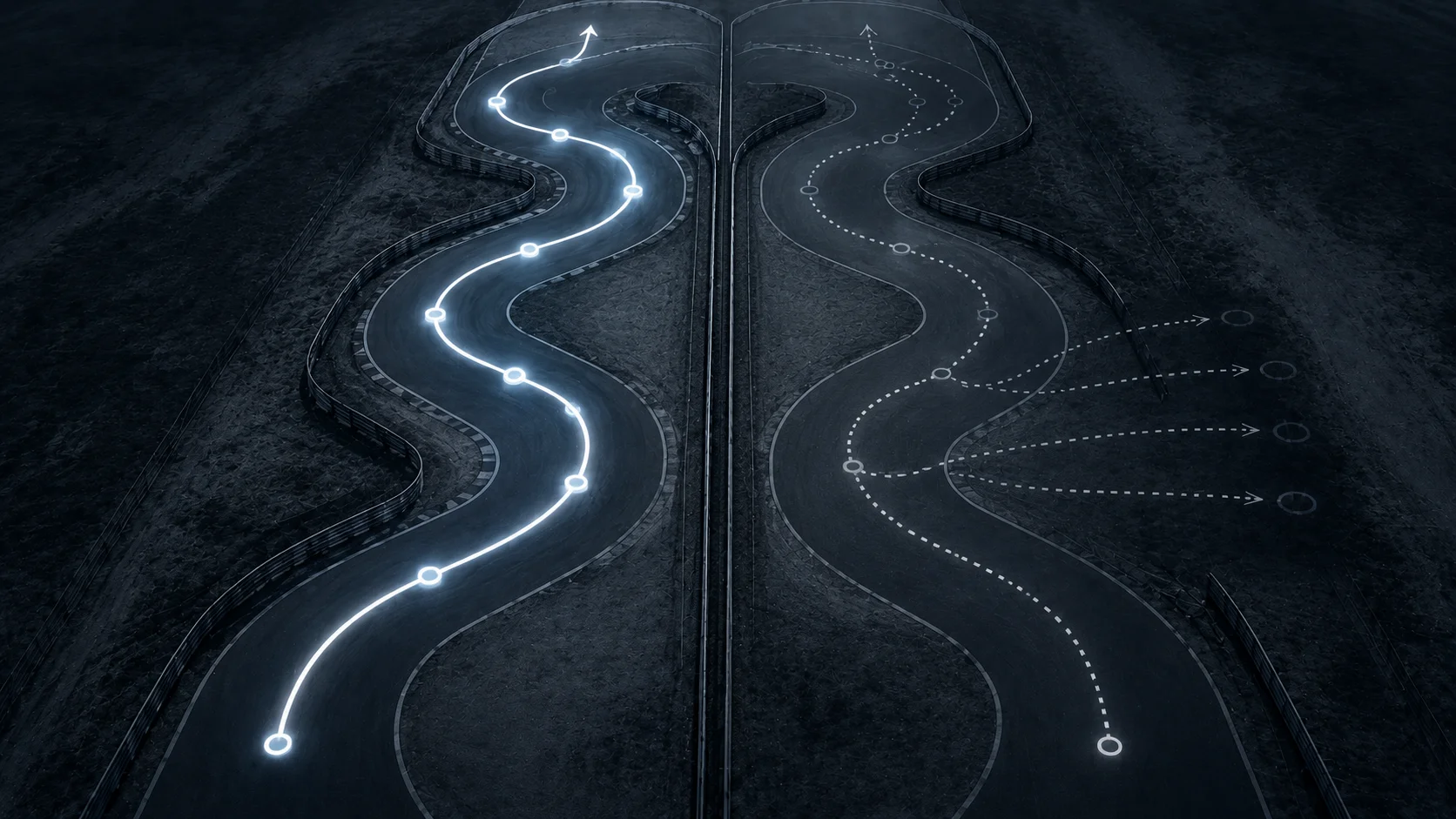
The autonomous vehicle commercialisation race in 2026 has two visible leaders pursuing fundamentally different strategies. Waymo, Alphabet’s autonomous driving subsidiary, is operating revenue-generating robotaxi service in Phoenix, San Francisco, Los Angeles, and Austin, with active expansion plans for additional metropolitan areas. Tesla has announced Cybercab production timelines and continues to develop its Full Self-Driving software toward an unsupervised consumer release, with Elon Musk repeatedly projecting near-term autonomous capability that has not materialised on the original timelines.
Treating these two companies as direct competitors misses the more important point: they are pursuing different products through different technical and commercial approaches, and the question of which approach succeeds is genuinely open and will be answered over years rather than quarters. Understanding what each company is actually building — and what evidence we have about how the approaches are performing in practice — is more useful than the binary win-or-lose framing that dominates most coverage of autonomous vehicles.
What Waymo Is Actually Doing
Waymo operates a managed robotaxi service in defined operational design domains: specific geographic areas, specific weather conditions, and specific times of day where the system has demonstrated safe operation. The vehicles use a sensor suite that includes lidar, radar, and cameras combined with high-definition mapping of the operational areas. The technology stack is more expensive per vehicle than vision-only systems but provides redundancy and resilience that simpler architectures lack.
By 2026, Waymo’s commercial service has scaled to hundreds of thousands of paid trips per week across its operational cities. The data point that matters more than total trip count is the safety record: Waymo has consistently reported substantially fewer collisions per million miles than human drivers in its operational areas, and the trend has improved over time as the system has accumulated additional driving experience. The safety case for Waymo’s deployed service is at this point empirically defensible rather than aspirational.
The commercial economics of the Waymo service are still in development. The capital cost of each Waymo vehicle is substantial — the sensor stack and computer infrastructure add significant cost above a stock automotive platform — and the unit economics of a managed service in defined geographies depend on utilisation, fare pricing, and the slow amortisation of mapping and engineering investments. Whether the Waymo business model produces sustainable returns at scale is a question that the 2026 deployment data does not yet definitively answer, though the trajectory of improving utilisation and expanding geographies is consistent with the path to commercial viability.
What Tesla Is Actually Doing
Tesla’s autonomous vehicle approach is fundamentally different: a vision-only sensor architecture that aims to achieve general autonomous capability across all geographies and conditions through neural network learning from the fleet of human-driven Teslas. The product Tesla is building is not a managed robotaxi service in defined areas but a consumer autonomous capability that would in principle allow any Tesla to operate without human supervision anywhere a human driver could operate. The Cybercab — a purpose-built two-passenger vehicle without steering wheels or pedals — would extend this capability into a dedicated robotaxi platform.
The vision-only approach is a much harder technical problem than geofenced operation because the system must handle the full distribution of driving scenarios rather than the subset that exists within a mapped operational area. Cameras provide rich perception information but require the AI system to do significantly more interpretation than a lidar-equipped system that directly measures distances. Tesla’s bet is that scaling neural network training on enormous datasets from the fleet can produce a system that solves the perception and decision problem at the generality required for unrestricted autonomous operation.
Tesla’s progress is genuinely mixed: Full Self-Driving capability has improved substantially over multiple software versions, that the system handles many driving scenarios well, and that it continues to fail in edge cases that prevent unsupervised deployment from being safe. The gap between the demonstrated capability and the level required for unsupervised commercial operation has been Tesla’s persistent challenge, and the timeline for closing that gap has been extended repeatedly over the past several years.
The Sensor Stack Debate and Why It Matters
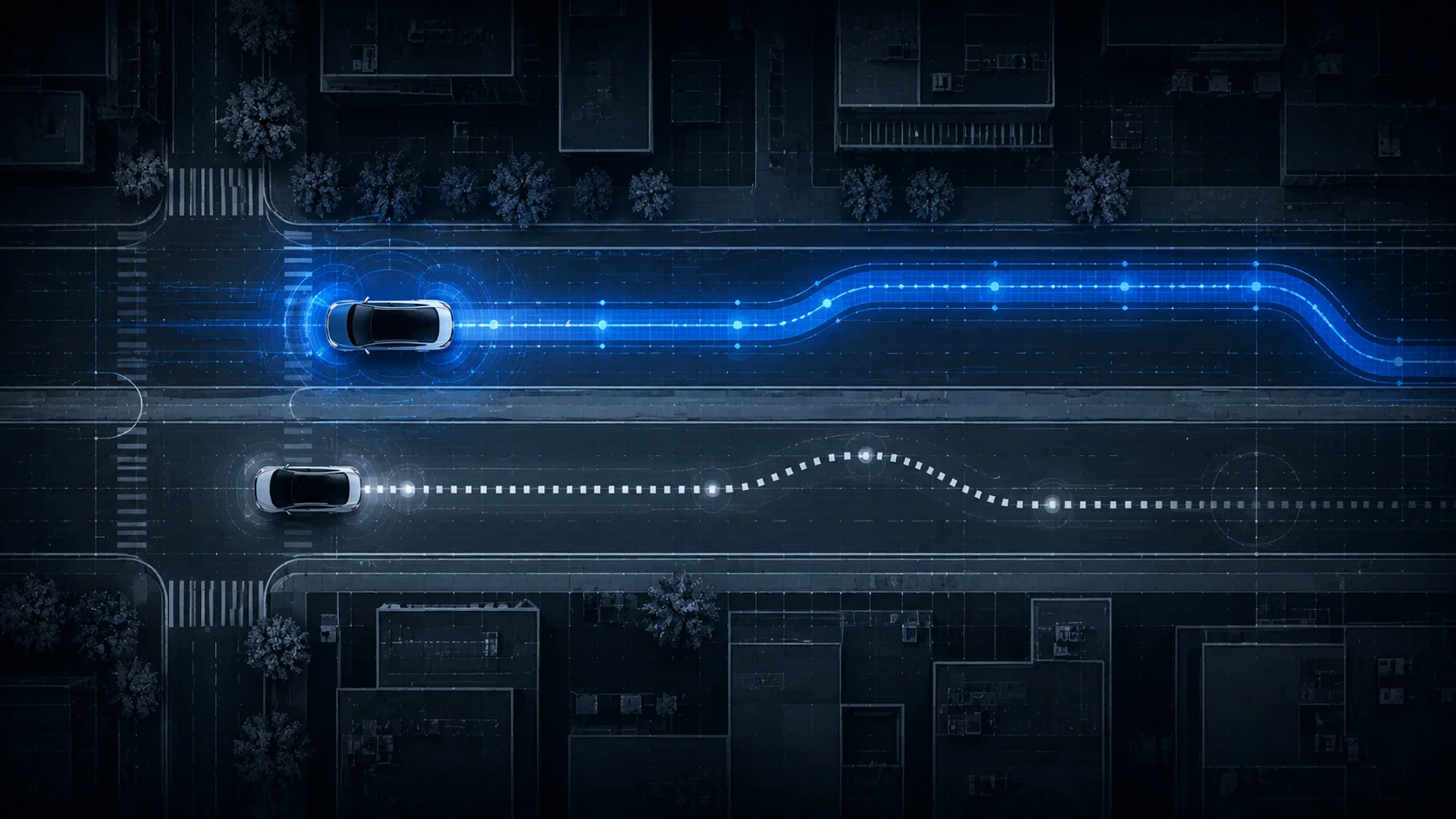
The technical debate between lidar-equipped sensor stacks and vision-only architectures has continued through 2025 and into 2026 without converging on a consensus answer. Waymo’s view — that lidar provides redundancy and direct distance measurement that improves safety and reliability — is supported by the empirical safety record of its deployed vehicles. Tesla’s view — that vision-only systems can be made sufficiently capable through neural network scaling and that the cost reduction enables much wider deployment — has not yet been proven at the level of unsupervised commercial operation.
The relevant industry data point is that essentially every other autonomous vehicle developer — Cruise (before its post-incident retrenchment), Mobileye, Aurora, Zoox, Pony.ai, and the Chinese AV companies — has converged on multi-sensor architectures that include lidar. Tesla remains the most prominent advocate for vision-only AV, and its position is technically defensible but represents a minority view within the AV development community. The lidar cost reduction over the past five years — from tens of thousands of dollars per unit to under a thousand for solid-state sensors — has also weakened the cost argument that originally justified vision-only architectures.
The broader AI infrastructure development matters here because autonomous vehicle systems require enormous on-vehicle compute for real-time perception and decision making, plus enormous off-vehicle compute for training. Tesla’s HW4 platform and the Dojo training supercomputer represent the company’s investment in this compute layer. Waymo’s compute investments are smaller in absolute terms but more targeted at the specific problem of operating safely within defined domains.
The Regulatory Environment in 2026
Autonomous vehicle regulation in the US has remained primarily state-led rather than federally coordinated, with significant variation across jurisdictions. California’s regulatory framework, administered by the DMV and Public Utilities Commission, has been formative for the industry. Arizona has been more permissive. Texas has been mixed. The federal regulatory framework administered by NHTSA has provided high-level safety standards but has not preempted state-level regulation of commercial AV operations.
The Cruise incident in San Francisco in late 2023 — when a pedestrian was struck and dragged by a Cruise vehicle — created the most significant regulatory reckoning the industry has faced. Cruise’s subsequent loss of California operating permits, its 2024 retrenchment to a reduced footprint, and its 2025 sale to a strategic buyer demonstrated that state regulators retain the authority and willingness to remove operating permits from AV operators who fail to maintain safety performance. The incident also catalysed broader scrutiny of incident reporting, transparency, and the relationship between AV operators and the cities where they operate.
Waymo’s regulatory positioning in 2026 reflects the lessons of this episode: extensive engagement with city officials, transparent incident reporting, and gradual geographic expansion that allows regulators and the public to develop confidence in the service before scaling. Tesla’s regulatory positioning is structurally different because its consumer Full Self-Driving product operates under the existing driver-assistance regulatory regime; any move to unsupervised operation would require either a different regulatory framework or a different deployment model than Tesla currently uses.
The Competitive Reality in 2026
The clearest fact about autonomous vehicle commercialisation in 2026 is that one company — Waymo — is operating revenue-generating robotaxi service at scale in multiple cities with empirically defensible safety performance, and that the gap to other operators is meaningful. The general lesson from competitive technology markets — that capability matters more than narrative — applies here: Waymo’s deployment scale and safety record are the most relevant evidence about autonomous vehicle viability today, and Tesla’s continued promises do not displace that evidence.
This does not mean Tesla’s approach is wrong. The general autonomy problem that Tesla is trying to solve is genuinely harder than the geofenced problem Waymo has solved, and the commercial opportunity if Tesla’s vision-only approach succeeds is correspondingly larger. The Cybercab production economics — a purpose-built robotaxi with significantly lower cost than retrofitted SUVs — would also be a competitive advantage if the autonomous capability ships at the level Tesla projects. But the operative word is “if,” and the track record of Tesla’s autonomous vehicle timing projections suggests that “if” should be heavily discounted.
For investors evaluating these companies and their autonomous vehicle exposures: Waymo’s value to Alphabet is substantial but currently represents a small fraction of Alphabet’s overall valuation. Tesla’s stock price reflects significant expectations about its autonomous vehicle outcome that the evidence to date does not support. The realistic position is that autonomous vehicles will be a meaningful commercial reality over the coming decade, that Waymo is currently leading in deployment, that Tesla retains optionality on its vision-only approach if it can solve the capability problem, and that the rest of the field includes credible players (Mobileye, Aurora, the Chinese AV companies) whose ultimate outcomes are also uncertain. Treating any of these as a settled investment thesis is inconsistent with the actual state of the technology and the market.
The Civilisational Stakes: What 3.5 Million Drivers Are Not Being Told
Historians looking back on the industrial transitions of the past two centuries will note a recurring pattern: the people whose labour was displaced by a new technology were almost never the primary audience for the announcements of that technology’s arrival. The factory workers displaced by automated looms did not read the investor briefings about textile efficiency. The telegraph operators made redundant by telephone exchanges did not attend the shareholder calls about communication cost reductions. The structural labour displacement event was documented extensively — in quarterly earnings, in industry forecasts, in academic papers — but the documentation was addressed to the beneficiaries of the transition, not to its casualties.
Autonomous vehicles are the clearest pending instance of this pattern in the contemporary economy. There are approximately 3.5 million truck drivers in the United States and roughly 1.5 million taxi, rideshare, and delivery drivers — a total of five million people whose primary income depends on being the human in control of a vehicle. The commercialisation timeline for fully autonomous long-haul trucking is longer than optimists projected in 2018, but the Waymo data points in 2026 — hundreds of thousands of paid trips per week, operational expansion to multiple metropolitan areas, a safety record that is meaningfully better than the human average for equivalent urban driving — represent the clearest evidence yet that the technology is not theoretical. It is operational. The question is not whether autonomous vehicles will displace human drivers at scale, but over what timeline and in which segments first.
The political economy of this transition is conspicuously absent from most coverage of the autonomous vehicle sector. The truck driver is among the most common occupations for workers without four-year college degrees in the United States, with median compensation that places drivers in the middle of the income distribution — a relatively comfortable economic position that historically has been accessible to people without advanced educational credentials. The displacement of this cohort would not simply eliminate jobs; it would eliminate the economic pathway that has provided stable middle-class income to a specific demographic without requiring credentials that many members of that demographic do not have and will not be able to acquire quickly enough to transition to adjacent roles.
The uncomfortable truth about the Waymo-versus-Tesla framing — the sensor stack debate, the geofenced versus general autonomy approaches, the commercialisation timelines — is that these are questions about the speed and sequencing of the displacement, not about whether the displacement will occur. The policy frameworks that would be required to manage this transition at civilisational scale — retraining programmes with adequate funding and duration, income bridge mechanisms, genuine regional economic development in the areas most concentrated with affected workers — do not yet exist. The humanoid robotics commercialisation timeline adds a further layer to the same structural question: the labour displacement from autonomous vehicles is the near-term instance of a broader pattern of automation-driven restructuring that will require institutional responses that the current policy conversation has not yet seriously begun to build.
The Company That Counted Versus the Company That Promised
There is a number in the Waymo data that does not get the attention it deserves, and it is not the trip count. It is the collision rate — fewer crashes per million miles than a human driver, measured, audited, and improving each quarter. That is an actuarial fact, the kind of thing an insurance underwriter would build a business on. Here is the strange part: the market barely pays for it. Waymo, the company quietly assembling the single most valuable dataset in the history of driving, is a rounding error inside Alphabet’s valuation. Tesla, the company that has been promising the same capability since 2016 and has not yet shipped it, carries a valuation that assumes the promise is already most of the way to being kept.
This is one of the oldest stories in markets, told in a new setting. One party is counting; the other is narrating. The counter accumulates evidence that is boring precisely because it is real — miles driven, incidents logged, permits earned city by city. The narrator sells a future that is thrilling precisely because it has not yet had to survive contact with a regulator or an intersection. The reveal, when it comes, will not be a breakthrough. It will be the slow recognition that the unglamorous discipline of accumulating verified miles was the whole game, and that patience was the scarce asset all along. The displacement this sets in motion will not stop at drivers, either; the same automation logic is already reshaping white-collar payrolls, one restructuring announcement at a time.