TL;DR
AI is exposing the gap between marketers who generate visible activity and marketers who generate genuine commercial movement. Average execution is becoming cheaper, faster, and easier to automate, while elite judgment is becoming more valuable. This article explains why apathy marketing is being exposed, why alpha marketers are pulling away from the field, and why the profession is moving toward the rise of the million-dollar marketer.
Key Takeaways
- AI is exposing the difference between visible marketing activity and genuine commercial impact.
- Apathy marketers optimize for motion, while alpha marketers optimize for outcomes.
- Average execution is becoming cheaper, which makes elite judgment more valuable.
- The best marketers win by understanding attention, attribution limits, and first principles better than their competitors.
- Repeatable outperformance across different environments is one of the clearest signs of an alpha marketer.
Why AI is exposing mediocre marketing, rewarding repeatable commercial judgment, and accelerating the rise of the million-dollar operator.

AI is raising the floor of execution while exposing the widening gap between average marketing output and elite commercial judgment.
Disclosure: This is editorial analysis based on publicly available research, industry reporting, and the author’s direct professional experience. A consolidated list of references appears in Sources & Notes at the end.
Artificial intelligence is not just changing how work gets done. It is exposing, at speed, how much work across the economy was only ever tolerated because people assumed it must have been necessary, must have been professional, or must have been producing some meaningful result behind the scenes. In many cases, it was neither exceptional nor especially effective. It simply looked like the sort of work serious people were supposed to be doing.
What matters now is the question AI forces into the open. Once the same passable output can be reproduced in seconds, the market has to ask whether the work ever truly moved the needle or whether it merely enjoyed the protection of habit, process, and professional theatre. That question is hanging over countless functions, but marketing is one of the clearest places to see it because the discipline has always been unusually good at hiding weak outcomes behind visible activity.
For years, companies have accepted a long list of marketing motions because competitors were doing them, agencies were recommending them, or someone near the business presented them as standard practice. A team could point to a full content calendar, a fresh batch of blog posts, a steady flow of campaign updates, and a report showing that posting targets or traffic KPIs had been met, sometimes comfortably. That often created the impression that the marketing function was healthy, modern, and properly managed. Yet in far too many cases, the business itself remained stubbornly unchanged: revenue did not materially accelerate, demand did not deepen in a durable way, and the brand did not become more memorable, more trusted, or more difficult to ignore. What looked like competent execution was often just organized activity sitting where results should have been.
That is why this article is not really about AI tools, prompt tricks, or workflow hacks. It is about outcomes. It is about the people behind the tools and the widening gap between marketers who can produce visible output and marketers who can produce genuine commercial movement. AI has made that distinction harder to hide because it can now manufacture mediocre execution cheaply, quickly, and at scale. Once that happens, the old defence of average work starts to collapse.
In my view, that is the real divide now opening up in the profession. On one side are what I would describe as apathy marketers: people who generate marketing activity, often with sincere effort, but rarely create meaningful shifts in attention, trust, demand, or revenue. On the other side are alpha marketers: people with the judgment, pattern recognition, and strategic depth to produce outsized results across different markets, different teams, and different competitive conditions over a long period of time. The first group can use AI to accelerate mediocre output. The second group can use AI to compound real talent.
The argument here is more direct than the usual discussion about how AI will reshape marketing because it goes straight to results. Most marketers and most marketing strategies do not produce exceptional outcomes, and a great many do not produce meaningful outcomes at all. They produce motion, reassurance, and reporting that can look respectable inside an organization while leaving the market largely unmoved. What AI is doing now is stripping away some of the ambiguity that protected that arrangement, while increasing the leverage of the much smaller class of operators who can genuinely shift demand, attention, and commercial performance. That is why mediocrity is becoming harder to defend, why elite judgment is becoming more valuable, and why the conditions are forming for the rise of the million-dollar marketer.
In this editorial, we break down:
- Why AI is exposing mediocre marketing rather than replacing the profession evenly
- What apathy marketing is and why it survives inside organizations
- Why attention, attribution, and first-principles thinking matter more now
- How to recognize an alpha marketer and why repeatable results matter more than one-off wins
- Why the profession is moving toward the rise of the million-dollar marketer
AI Is Exposing Marketers
Artificial intelligence is not just changing how work gets done. It is exposing, at speed, how much work across the economy was only ever tolerated because people assumed it must have been necessary, must have been professional, or must have been producing some meaningful result behind the scenes. In many cases, it was neither exceptional nor especially effective. It simply looked like the sort of work serious people were supposed to be doing.
What matters now is the question AI forces into the open. Once the same passable output can be reproduced in seconds, the market has to ask whether the work ever truly moved the needle or whether it merely enjoyed the protection of habit, process, and professional theatre. That question is hanging over countless functions, but marketing is one of the clearest places to see it because the discipline has always been unusually good at hiding weak outcomes behind visible activity.
For years, companies have accepted a long list of marketing motions because competitors were doing them, agencies were recommending them, or someone near the business presented them as standard practice. A team could point to a full content calendar, a fresh batch of blog posts, a steady flow of campaign updates, and a report showing that posting targets or traffic KPIs had been met, sometimes comfortably. That often created the impression that the marketing function was healthy, modern, and properly managed. Yet in far too many cases, the business itself remained stubbornly unchanged: revenue did not materially accelerate, demand did not deepen in a durable way, and the brand did not become more memorable, more trusted, or more difficult to ignore. What looked like competent execution was often just organized activity sitting where results should have been.
That is why this article is not really about AI tools, prompt tricks, or workflow hacks. It is about outcomes. It is about the people behind the tools and the widening gap between marketers who can produce visible output and marketers who can produce genuine commercial movement. AI has made that distinction harder to hide because it can now manufacture mediocre execution cheaply, quickly, and at scale. Once that happens, the old defence of average work starts to collapse.
In my view, that is the real divide now opening up in the profession. On one side are what I would describe as apathy marketers: people who generate marketing activity, often with sincere effort, but rarely create meaningful shifts in attention, trust, demand, or revenue. On the other side are alpha marketers: people with the judgment, pattern recognition, and strategic depth to produce outsized results across different markets, different teams, and different competitive conditions over a long period of time. The first group can use AI to accelerate mediocre output. The second group can use AI to compound real talent.
The argument here is more direct than the usual discussion about how AI will reshape marketing because it goes straight to results. Most marketers and most marketing strategies do not produce exceptional outcomes, and a great many do not produce meaningful outcomes at all. They produce motion, reassurance, and reporting that can look respectable inside an organization while leaving the market largely unmoved. What AI is doing now is stripping away some of the ambiguity that protected that arrangement, while increasing the leverage of the much smaller class of operators who can genuinely shift demand, attention, and commercial performance. That is why mediocrity is becoming harder to defend, why elite judgment is becoming more valuable, and why the conditions are forming for the rise of the million-dollar marketer.
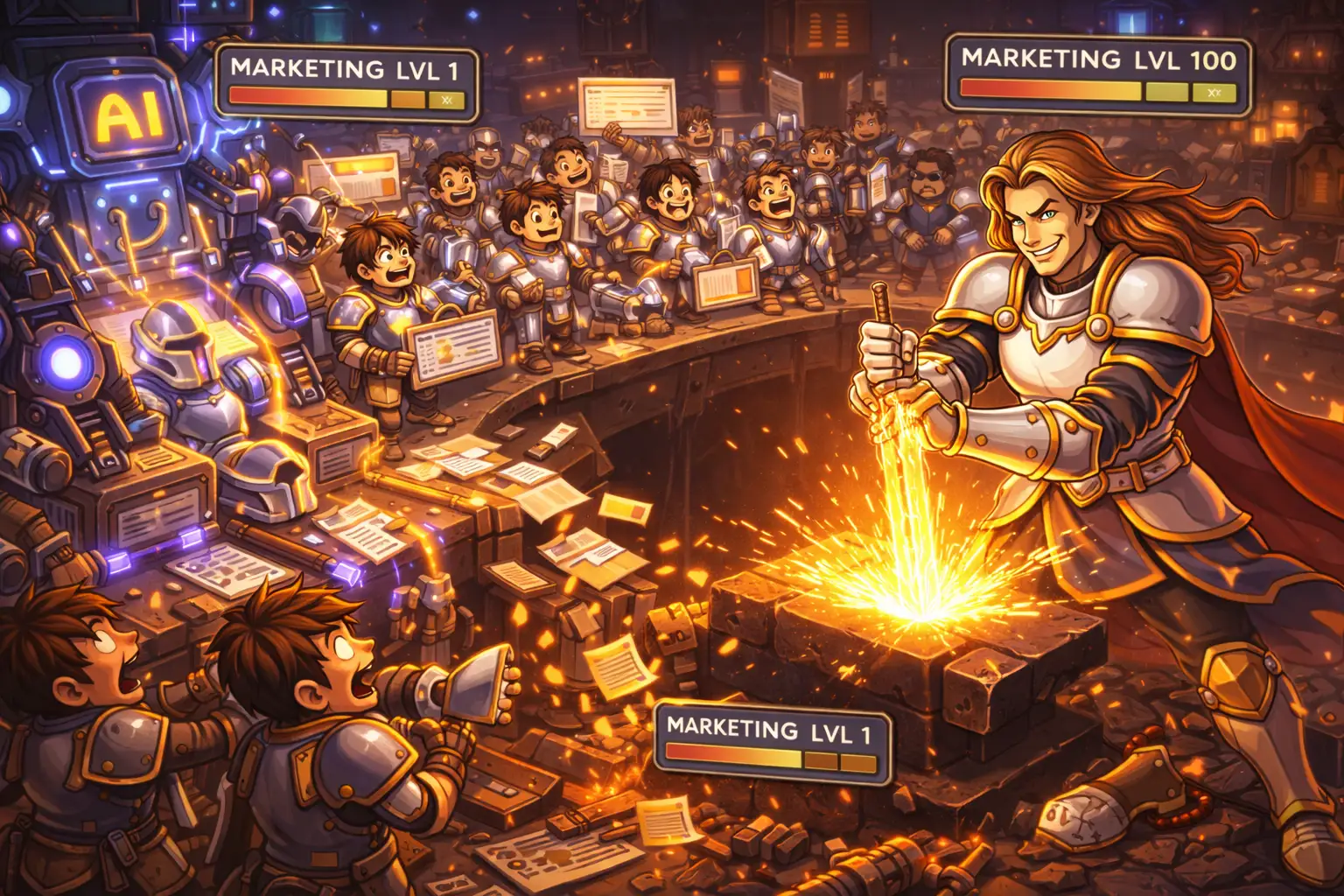
AI compresses the value of average execution while amplifying the value of strategic judgment.
The Growing Divide in Marketing Talent
The divide opening up in marketing is not especially mysterious once you stop pretending capability is distributed evenly across the profession. It never has been. Many people can execute marketing tasks, manage channels, prepare reports, and keep a calendar moving well enough to look competent inside an organization. Far fewer can create the kind of commercial separation that changes the trajectory of a business more than once, in more than one environment, under more than one set of market conditions. AI did not create that hierarchy, but it is making it much harder to hide behind process, polish, and output.
A useful way to understand the shift is through the economics of superstar markets. In his classic paper on the subject, economist Sherwin Rosen argued that in some fields, relatively small differences in performance quality can translate into very large differences in reward. Elite sport is an obvious example, which is partly why the analogy works here. Many people can play football. A much smaller number can play professionally. An even smaller number can decide matches, shape seasons, command global attention, and attract extraordinary pay because their influence on the result is not marginal. Marketing is becoming easier to read through a similar lens, even if the profession has often preferred the fiction that competence is flatter, more transferable, and more evenly spread than it really is.
That is what AI is clarifying. Once execution becomes cheaper and easier to replicate, execution by itself loses status. The more important question becomes whether the person behind the work can make better decisions than the market average: whether they can identify an opening others miss, diagnose the real constraint in a crowded market, and distinguish between activity that feels reassuring and work that is likely to produce a materially different result. Those are the abilities that separate a useful operator from a genuinely valuable one, and they are not distributed widely just because the tools are.
Why the floor is rising faster than the ceiling
The reason this shift is so easy to misread is that AI is visibly raising the floor of execution. Average marketers can now produce cleaner decks, faster briefs, more polished copy, better formatted content, and more confident-looking plans than they could a few years ago. The scale effect is already measurable: Ahrefs found that 87% of marketing professionals use AI for content creation, that marketers using AI publish 42% more content each month, and that AI-generated content is 4.7 times cheaper than human-written content. To an executive who is not looking carefully, those gains can create the impression that the underlying strategic capability has improved at the same pace, when in many cases the presentation has improved far more than the underlying quality of the thinking.
That is why so many teams can look more capable in the AI era while remaining just as ineffective where it matters. They can generate more material, hit more intermediate targets, and sound more fluent in the language of modern marketing without developing sharper judgment about audience behavior, channel selection, positioning, or competitive trade-offs. When the real test arrives—whether the brand becomes harder to ignore, whether demand improves in a durable way, whether a channel strategy creates an actual edge, or whether revenue meaningfully outperforms the field—the gap reappears very quickly. The floor has risen. The ceiling, in most cases, has barely moved.
Why elite marketers gain disproportionate value
This is the part many people inside the industry still underestimate. Once acceptable-looking work becomes abundant, scarce judgment becomes more expensive. The marketer who knows which channel to ignore, which customer tension can support a stronger narrative, which metric is misleading, which competitor behavior is worth copying, and which apparent opportunity is merely a distraction becomes far more valuable than the marketer who is simply able to produce more output. In a crowded market, the quality of those decisions compounds faster than the quantity of the assets.
That compounding effect helps explain why elite marketers often become more valuable over time rather than less. Pattern recognition sharpens across markets. Strategic instincts improve. The ability to interpret weak signals, weigh trade-offs, and spot leverage before it becomes obvious grows with experience, provided the marketer has actually been accountable for results rather than simply close to them. Two people can have access to the same models, the same dashboards, and the same tools, yet still arrive at radically different outcomes because one of them understands the game several layers deeper than the other.
That is the widening gap this article is concerned with. Companies will still be able to buy motion, and in many cases they will be able to buy it cheaply. What they will not be able to buy cheaply is the much smaller class of marketers who can repeatedly create separation from competitors when markets are noisy, channels are saturated, and attribution is imperfect. Those operators are not valuable because they do more marketing. They are valuable because they change what the marketing is capable of accomplishing.
Takeaway: As AI lowers the cost of acceptable execution, the real competitive advantage shifts to the marketer who consistently makes better strategic decisions than the market average.
3. Defining Apathy Marketing
Apathy marketing is the term I use for marketing activity that is disconnected from genuine audience attention, strategic originality, and business outcomes, even when it looks organized, consistent, and professionally managed from the inside. It is not the same thing as laziness. In many cases it is sincere, diligent work carried out by people who believe they are doing exactly what modern marketing requires. What makes it dangerous is not the absence of effort, but the absence of effect.
That is one reason it is so common, and it is also why I have come to think of it as a kind of magnetic force inside organizations. I have seen the same pattern in Asia, Australia, the United States, and Europe: people are drawn toward metrics that are easy to measure, easy to defend, and easy to discuss in meetings, even when those metrics have only a weak relationship to growth. Much of the profession is trained to think in terms of channel management, campaign hygiene, reporting cadence, and KPIs that often have only a loose relationship to business growth. If the posting calendar is full, the traffic trend is up, the engagement dashboard is moving, and the keyword report looks healthy, the work can appear successful even when the brand remains forgettable, the audience remains indifferent, and the revenue line remains stubbornly ordinary. Apathy marketing thrives in that gap between visible motion and meaningful commercial change.
The surest way to recognize it is to stop listening to the narrative around the work and look instead at the shape of the outcomes. A team can publish on schedule for an entire quarter, exceed its activity targets, produce detailed reporting, and still fail to deepen search demand, strengthen pipeline quality, improve conversion economics, or make the brand any more interesting to customers than it was before. In that environment, the marketing may look active, disciplined, and modern while producing little more than a low industrial hum of content, reporting, and internal reassurance. A company can spend heavily on signs of activity while remaining strategically motionless. That is often the hidden answer to the question many founders eventually ask in frustration: why is my business not growing when the marketing team looks busy all the time?
One version of this shows up in the people who become disproportionately concerned with surface-level perfection while losing sight of why the work exists in the first place. Something is not quite on brand. The shade of blue is slightly off. A line of copy feels uncomfortable. A spelling mistake becomes the central issue in the room. None of those things are irrelevant, and strong marketers should care about quality, but apathy marketers turn them into substitute metrics because they are measurable and controllable. It is much easier to insist on perfect formatting than to ask whether the piece will be seen, remembered, shared, trusted, or connected to revenue.
What apathy marketing looks like in practice
Once the pattern is named, it becomes difficult not to see it everywhere. A social media team can beat its posting target by 40% for the quarter and still create almost no additional gravity around the brand because the content was built to satisfy the calendar rather than earn attention. An SEO team can publish article after article that is technically optimized, formatted correctly, and superficially aligned with search intent while saying nothing distinctive enough to attract links, citations, memorability, or retrieval by AI systems. A paid media team can rotate creative, hold spend, and report stable efficiency while relying on concepts so generic that the ads never stand a real chance against the entertainment, personalities, and native content surrounding them. In each case, the visible markers of order are present, but the commercial signal is weak.
The same instinct appears when marketers lose sight of the fact that marketing exists to influence a sale, strengthen demand, and put more money in the bank for the business. Many apathy marketers have spent long careers in-house or inside agencies without ever having to live under the disciplines of commissioned-only work, direct selling, or being held tightly to a commercial outcome. As a result, they learn to optimize for second-, third-, and fourth-tier metrics because those are the numbers most available to them. That is how teams end up obsessing over user experience before they have enough users to create a meaningful user experience problem at all. As I often put it, if you do not have users coming to the website, you do not have a user experience problem yet. You have an attention and demand problem.
The same logic extends into PR and link building, where apathy often hides behind the appearance of distribution. A press team can send out a steady stream of announcements that no serious journalist would choose to cover unless obligation, partnership, or payment entered the picture. An outreach specialist can secure content placements on pages that exist largely to host another generic article with another generic backlink, even though the page itself contributes almost nothing to authority, discoverability, or belief. On paper, deliverables were produced and KPIs may even have been met. In the market, almost nothing of consequence changed.
Why apathy marketing creates indifference
The deeper problem is not simply that apathy marketing fails to create excitement. It creates indifference. It gives potential customers no strong reason to pay attention, existing customers no stronger reason to care, competitors no reason to adjust their behavior, search engines no compelling reason to surface the page more prominently, AI systems no distinctive reason to retrieve or cite the work, and social algorithms no strong signal that the content deserves broader distribution. It asks the market to be interested without first doing enough to earn interest.
That dynamic becomes even more damaging in an environment where the supply of acceptable-looking activity is exploding. Ahrefs found that 87% of marketing professionals use AI for content creation, that marketers using AI publish 42% more content each month, and that AI-generated content is 4.7 times cheaper than human-written content. The same research found that 97% of companies still review or edit AI-generated content before publication, which is a useful reminder that speed has improved far faster than judgment. Meanwhile, the attention market is becoming more crowded by the day. YouTube says more than 20 million videos are uploaded daily, and Shorts now average more than 200 billion daily views. In a media environment like that, simply producing more content, more posts, more pages, or more campaign assets does not create relevance by itself. It just increases the volume of things available to ignore.
One reason apathy marketing survives for so long is that it produces enough evidence to defend itself internally. There are calendars, decks, screenshots, keyword reports, engagement summaries, media lists, and campaign updates. In organizations without deep marketing leadership, that can be enough to sustain the impression that the function is healthy because it is visibly busy. It is much easier to ask whether the posts went live, whether traffic rose, whether the impressions were healthy, whether the colors were correct, or whether the copy stayed tightly on brand than to ask whether any of the work deserved to outperform a crowded market in the first place. Apathy marketing is often less a failure of effort than a failure of standards.
This is where the distinction between apathy marketing and alpha marketing becomes useful. Apathy marketing treats motion as evidence. Alpha marketing treats outcomes as evidence. Apathy marketing asks whether the team executed the plan. Alpha marketing asks whether the plan changed the company’s position in the market. Once that line becomes visible, much of what passes for modern marketing begins to look less like strategy and more like organized reassurance.
Takeaway: Apathy marketing focuses on motion and internal validation, while alpha marketing focuses on measurable shifts in demand, attention, and revenue.

When activity becomes the metric, apathy becomes the strategy.
4. The Michelangelo Problem: Tools vs Talent
The mistake many people make when they look at AI is to confuse access to a tool with access to the talent required to direct it well. That confusion is everywhere right now, and it helps explain why so many companies are getting comically average results from very powerful systems. Anyone can buy marble, a hammer, and a chisel. Very few people can turn those materials into David. Anyone can buy timber, nails, and a saw. Very few people can use them with the judgment of a master carpenter. The difference was never the mere presence of tools. It was the quality of the hands directing them, the standards behind the work, and the ability to see a worthwhile result before it existed.
That is why the familiar claim that AI will make everyone great has always felt unserious to me. AI is only as good as the person directing it. It can make average marketers faster. It can help them generate more copy, more concepts, more plans, more summaries, and more variations than they could have produced on their own. What it does not do is supply the strategic instinct required to know which idea is worth pursuing, which audience tension is worth building around, which format deserves investment, or which message has any real chance of being remembered. It increases output. It does not, by itself, raise judgment.
That distinction matters because output is the easiest thing in the world to misread once powerful tools can produce polished work on command. A marketer can now generate a respectable-looking article, a competent creative brief, a plausible email sequence, or a decent ad concept in very little time. None of that proves the work is original, strategically sound, memorable, or commercially useful. It proves only that the cost of producing something acceptable-looking has collapsed. That is why so many teams now find themselves producing more while still failing to break through.
What average use of AI actually looks like
In most organizations, average use of AI does not look like genius. It looks like acceleration. The team produces more content. The decks come together faster. The copy has fewer obvious rough edges. The reports sound more coherent. The scale effect is already measurable: Ahrefs found that 87% of marketing professionals use AI for content creation, that marketers using AI publish 42% more content each month, and that AI-generated content is 4.7 times cheaper than human-written content. The same research also found that 97% of companies still review or edit AI-generated content before publication, which quietly concedes the central point. The machine can accelerate production, but judgment still has to enter somewhere.
That is also why average operators so often use AI to scale average thinking. They use it to mimic what already exists, summarize what has already been said, and produce material that feels complete because it is fluent rather than strategically sharp. The result is often polished mediocrity: work that is cleaner, quicker, and cheaper than before, but still too generic to win serious attention in a crowded market. Over time, that raises a brutal possibility for a lot of average teams. If all they can reliably produce is apathy-level output, there may eventually be very little reason to pay a full team to do what the tools can increasingly assemble on their own.
What elite use of AI looks like
Elite marketers use the same tools differently because they are trying to solve a different problem. They are not asking the machine to replace judgment. They are using it to extend judgment. That can mean widening the research surface before making a decision, pressure-testing multiple angles before choosing a narrative, drafting faster so more time can be spent on refinement, or building support material around a strategy that already has a strong commercial point of view. This article itself is a useful example. It is being written with AI, but it has taken repeated passes over research, tone, framing, competitive analysis, and argument. By the time it is finished, the process will have taken well over sixteen hours. The tool helped accelerate the work. It did not remove the need for taste, direction, standards, or experience.
Takeaway: AI accelerates production, but it does not supply judgment. The operator directing the tool remains the real source of competitive advantage.
That is why AI compresses the value of labor while expanding the value of judgment. The cheap part of marketing is becoming cheaper. The difficult part—taste, prioritization, narrative instinct, strategic discipline, and the ability to produce work that deserves a market response—is becoming more visible and, in many cases, more valuable. These tools are powerful, and they are the worst they are ever going to be. They will keep improving. Some apathy-driven work may eventually be automated so thoroughly that the people producing it are no longer needed at all. The companies that continue to win will be the ones with the most talented captains steering the ship: the marketers who can direct the tools, direct the team, and direct the story toward a commercial result competitors cannot easily match.
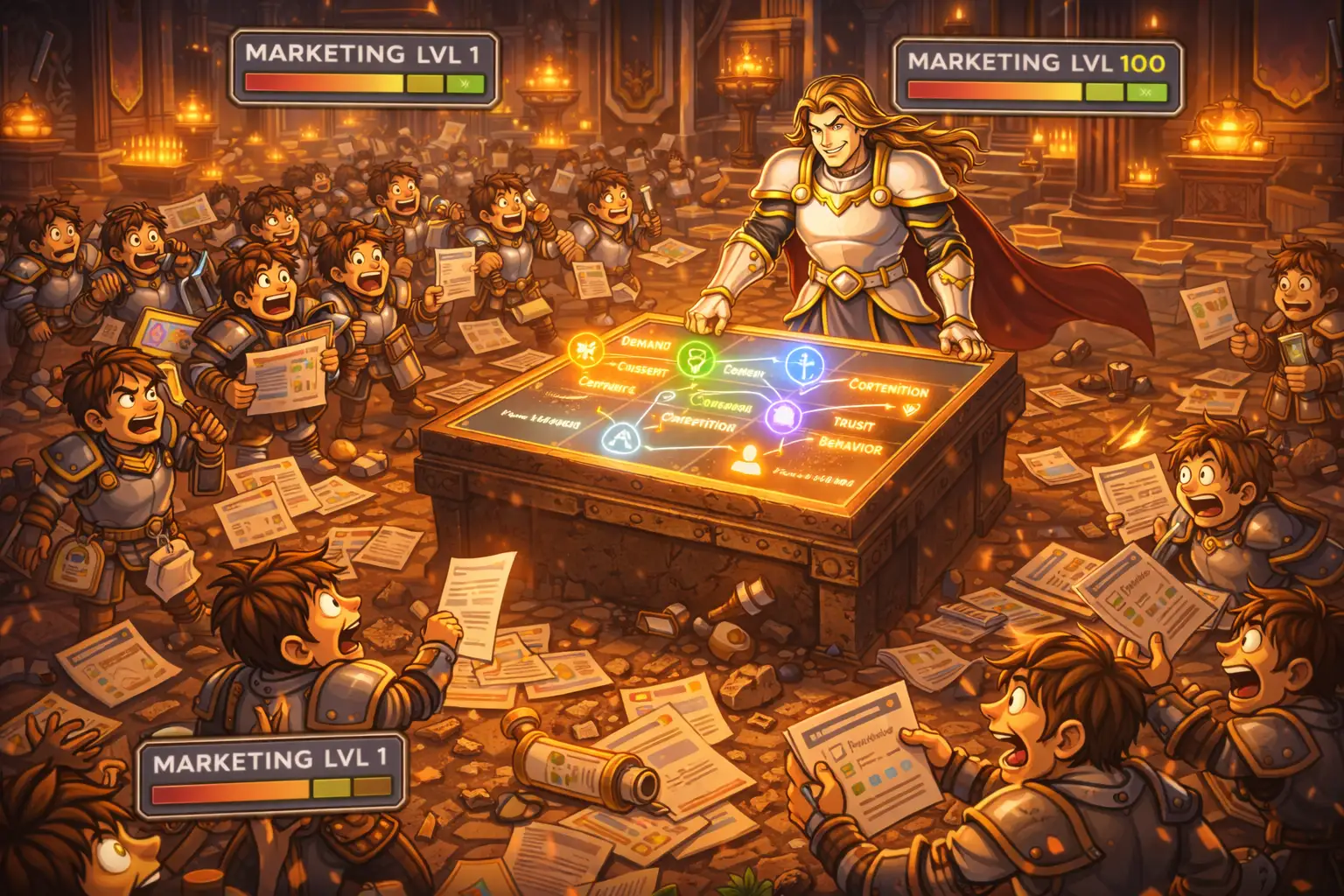
The tools are shared. The judgment is not.
5. Why Most Marketing Knowledge Is Low Quality
A large share of the marketing knowledge that large language models were trained on is not especially high in quality, and that matters more than many people want to admit. Good marketing is rare. The kind of marketing that makes people laugh, remember a brand, tell other people about it, or change their behavior in a way that leads to revenue has always been the exception, not the rule. Most of what the internet produced during the digital marketing era was never operating at that level. It was written by people with ordinary results, ordinary instincts, and ordinary incentives, then published with far more confidence than the quality of the thinking deserved.
Not everyone in the system was lazy or acting in bad faith. In many cases, they were doing the best they could with the knowledge they had. The deeper problem is structural. There were very few barriers to entry, very strong incentives to publish, and almost no requirement that the person giving the advice had ever really had to win. Agencies published to attract leads. Software companies published to capture search traffic. Freelancers published to look authoritative. In-house teams translated routine process into thought leadership because the format rewarded visibility more than proof. Over time, the result was an information economy in which publishing knowledge spread faster than operator knowledge.
The distinction is important. Publishing knowledge tells you how to sound like you know marketing. Operator knowledge tells you how to win a market. The first is easy to package into frameworks, listicles, checklists, and recycled best practices. The second is rarer, messier, more contextual, and usually tied to real commercial scar tissue. A great deal of what later came to be treated as canonical marketing advice was simply repeated often enough to acquire authority. It spread socially before it proved itself empirically. That is how an industry can become saturated with language that sounds strategic while remaining strangely disconnected from whether any of it actually produced meaningful commercial results.
The AI era intensifies that weakness because large language models do not inherit only the best thinking on the web. They inherit the center of gravity of the web. They absorb what was most commonly published, most frequently repeated, most legible, most search-optimized, and most easily remixed. In marketing, that means they inherit not just good ideas and bad ideas, but the publishing incentives of the profession itself. The model has learned to sound like the profession before it has learned how often the profession is wrong.
Why “AI slop” was often just old apathy in a new format
One reason the conversation around AI slop often misses the deeper point is that it treats the machine as though it introduced a completely new kind of mediocrity. If you take a breath and think back only a few years, a large amount of what now gets dismissed as AI slop was already being produced by humans. The sloppy article that regurgitates a safer version of someone else’s opinion, the SEO page that says nothing new, the social post that repeats a tired observation without justification or a counter-argument, the thought-leadership piece written primarily to signal expertise rather than demonstrate it—none of that began with the machine. The machine simply made it faster, cheaper, and easier to multiply.
The point matters because what AI is replacing at the lower end is often not brilliance. It is replacing what used to be tolerated as competent, useful, or at least normal because a human had produced it. Now that the same level of output can be assembled in seconds, the underlying truth becomes harder to avoid. Much of the content published online was already built on apathy: derivative beliefs, recycled frameworks, shallow listicles, and polished content designed to capture attention for the publisher rather than create real leverage for the reader. AI did not invent that weakness. It industrialized it.
Takeaway: When average marketing knowledge becomes easier to reproduce, genuine insight and original thinking become dramatically more valuable.
Why average knowledge cannot reliably produce standout marketing
Marketing is a competitive game for attention, memory, and action. Sometimes you are competing directly with your category peers. Just as often, you are competing with everyone else trying to reach or entertain the same person at the same time. In a zero-sum environment like that, average knowledge is a terrible place to start if the goal is to outperform the field. What is popular is not always right, and in marketing it is often popular precisely because it is the easiest thing to package, repeat, and sell to the next person looking for an answer. If everyone has access to the same listicles, the same frameworks, the same prompts, the same SEO advice, and the same polished summaries of conventional wisdom, then the output those inputs generate will tend toward sameness. And sameness is usually fatal in a crowded market.
The battlefield logic becomes impossible to ignore once you see the market clearly. It is not a static system that politely rewards everyone for following the same playbook. The other side gets a vote. Competitors respond. Platforms shift. Audiences get bored. What worked once becomes crowded, then noisy, then ineffective. One of the clearest limits of average guidance in the hands of an amateur is that it trains people to do what is already legible and already popular, which is often the very moment a channel or tactic starts losing its edge. By contrast, the same tools in the hands of a stronger operator can be used to read the field faster, spot where the crowd is converging, and move before the advantage disappears.
The X factor is whatever cannot be reduced to a template. A serious marketer needs the ability to see the rules, understand the rules, and know when to break them. They need to understand the accepted standards of a channel, but also the truth beneath those standards: what actually earns attention, what actually gets remembered, what actually travels, and what actually converts. The Michelangelo comparison helps here. The amateur and the master may be holding the same tools, but the result is still defined by the person directing them. That is why the best marketers remain valuable even when the tools become widely accessible. Everyone can access the average. Very few people can consistently turn it into something singular.
Takeaway: Access to the same tools does not equalize outcomes. The difference between average and elite marketing still comes from judgment, taste, and strategic courage.
Why this creates a bigger gap between apathy marketers and alpha marketers
The unit economics make the problem worse. Ahrefs found that 87% of marketing professionals use AI for content creation, that marketers using AI publish 42% more content each month, and that AI-generated content is 4.7 times cheaper than human-written content. Once publishing becomes that cheap, the web fills faster with content that is coherent, formatted, and legible but still adds very little to the world. The same research found that 97% of companies still review or edit AI-generated content before publication, which is a quiet admission that the machine can accelerate production without solving the judgment problem underneath it.
The deeper divide running through this article is not that people are suddenly trying less hard. In many cases they are trying just as hard as before. The problem is that the best they can produce now looks much less impressive when everyone else can generate a similar standard of material with the help of a machine. AI is exposing both groups at once: the apathy marketer, whose strengths were always more procedural than strategic, and the alpha marketer, who can still produce something distinctive enough to earn attention, trust, and revenue even after the average has been mechanized.
I do not think the real job is to sound like a marketer. The real job is to produce something the market rewards. When mediocre advice becomes easier to package, publish, and repeat, genuine insight becomes relatively more valuable, not less. The serious operator is not the one who merely uses AI. It is the one who can transcend the average quality of the material the system was trained on and direct it toward something sharper, riskier, more original, and more commercially true.

When average knowledge scales, originality becomes more valuable.
6. The Attention Economy Reality
One of the most common mistakes I see in marketing discussions is that companies ask channel questions before they have done a serious competitive analysis of the attention they are trying to win. A team will ask whether it should run TikTok ads, publish more LinkedIn posts, or invest in YouTube content, as though the channel itself were the answer. It rarely is. Channel is usually secondary. The harder question comes first: once this piece of marketing enters the feed, what is it actually competing against, and why should anyone choose it over everything else available in that moment?
When a brand publishes a post, an ad, or a video today, it is not entering a quiet space filled with attentive potential customers waiting politely for information. It is entering one of the most aggressive attention markets in history. A paid social ad is not competing only with other brands in the same category, or even only with other marketers. It is competing with creators who have spent years learning how to hold attention, with friends sharing personal updates, with favorite celebrities, with sports highlights, with comedians, with music clips, with memes, with breaking news, with cat videos, with influencers, with OnlyFans creators, and with an endless stream of entertainment engineered to stop someone from scrolling. The competition is not merely the brands selling what you sell. It is everyone else trying to command that individual’s attention at the same time.
The scale of that competition is staggering. YouTube says more than 20 million videos are uploaded to the platform every single day, and Shorts alone now generate more than 200 billion views daily. TikTok, Instagram Reels, and other short-form platforms operate with similar intensity. The internet age already made attention brutally competitive, and the LLM era is making it even more targeted, personalized, and crowded. In that environment, the idea that a brand can publish safe, generic marketing content and still capture meaningful attention is difficult to defend because most of what companies produce simply does not stand a realistic chance against the entertainment options surrounding it.
That helps explain why so many teams believe their channels are not working when the deeper problem is that the work never deserved to win the attention battle in the first place. A technically correct advertisement that looks like an advertisement is usually at a severe disadvantage in a feed designed around entertainment, personality, and novelty. A blog post that repeats familiar advice struggles when the reader has thousands of other pieces of content available within seconds. The competition is not merely other marketers. It is the entire internet. If you have ever wondered why nobody cares about your content or why your TikTok ads are not working, this is usually where the real answer begins.
Why elite marketers start with the battlefield
The first instinct of a stronger marketer is to understand the attention they are competing for before committing resources to a channel. Instead of asking whether a brand should be on TikTok, they ask what kind of content actually survives inside the TikTok environment, what kind of creative earns a pause, and what kind of message people will remember after they scroll away. Instead of asking how many LinkedIn posts to publish, they examine what kinds of posts people stop for, return to, and send to colleagues. The work begins with the audience, the competition, and the behavior inside the feed. Only then does channel strategy start to make sense.
A great deal of tactical marketing advice falls apart for the same reason. Checklists that say post three times per week or test multiple ad variations assume that the channel itself is the central variable. In reality, the variable that matters most is whether the work behaves like something the audience actually wants to consume. Platforms reward content that fits the emotional and cultural rhythm of the feed. That often means entertainment, surprise, humor, strong opinions, unusual production choices, or ideas that travel socially. Content that exists only to satisfy a posting calendar rarely survives that filter.
HubSpot’s 2025 social media research points in the same direction, with funny content, relatable content, and authentic behind-the-scenes material all ranking among the most commonly used approaches, which is another way of saying that marketers themselves know the feed rewards work that feels human and native rather than mechanically on-brand.
Why channel strategy often starts somewhere else
Understanding the battlefield also explains why the best marketers sometimes decide not to prioritize a channel at all. A company might technically be able to run TikTok ads, but if the brand cannot produce creative that feels native to the platform, the budget may be better spent somewhere else. A B2B brand might publish consistently on LinkedIn, but if the content does not introduce a distinctive point of view or a useful insight, the audience will quickly learn to scroll past it. Sometimes the correct strategic move is to build authority in search, PR, or long-form media first so that when a brand does appear in social feeds, it arrives with credibility rather than anonymity.
This is also why channel strategy usually comes second. Once you have an idea, an insight, or a narrative that is worth communicating, you can adapt it to the realities of the channel. What often fails is the reverse sequence: teams start with the channel, produce for the format, and only later wonder why the work feels thin. The same mistake appears when brands create something for one medium and then lazily repackage it for another without respecting how different the environments actually are. Some ideas can travel across channels. Many cannot. Attention has to be earned in the language of the medium you are entering.
The divide between apathy marketing and alpha marketing becomes visible here again. Apathy marketers start with the channel because the channel is easy to see. Alpha marketers start by understanding the attention they are competing for, the behaviors already dominating that environment, and the standard the work will need to exceed. Once you understand that, many tactical decisions become much clearer. You either build something strong enough to earn attention in that environment, or you choose a different battlefield where your brand has a better chance of winning.
Takeaway: Great marketers do not begin with channels. They begin with the competitive reality of attention and choose the battlefield only after they understand what winning there would require.
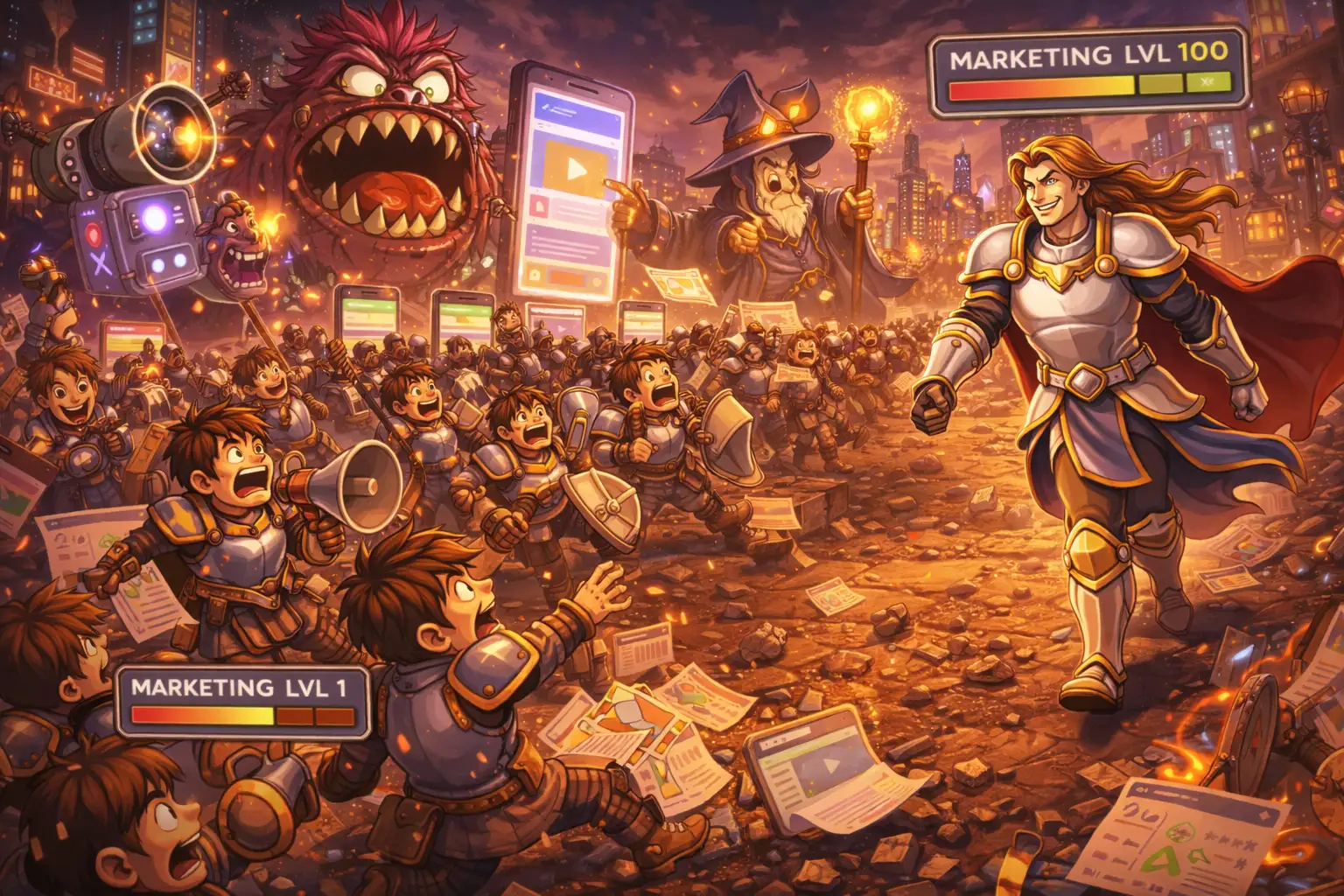
The competition is not just your category. It is the entire internet.
7. First-Principles Marketing
Most bad marketing does not fail because the team cannot execute. It fails because the team began with the wrong question. In my experience, that mistake is everywhere. I have seen teams in different countries, different industries, and different business cultures move quickly on content, channels, and campaign mechanics without first isolating what was actually stopping the customer from paying attention, trusting the message, or taking action. Elite marketers work from first principles. They strip the situation back to demand, trust, competition, attention, and behavior before anyone earns the right to talk about tactics.
That sounds obvious when stated plainly, which is part of the problem. Most organizations begin much lower down the ladder. They start with activity. They want to know whether they should post more often, whether they should be on TikTok, whether they need another landing-page test, whether they should invest in backlinks, whether they should launch another campaign. None of those questions is automatically foolish, but they are usually premature. Asked too early, they treat marketing as a menu of available actions rather than a problem of diagnosis. The business starts moving faster before it has worked out what problem it is actually trying to solve.
First-principles marketing works in the opposite order. It begins with reality rather than ritual. Before deciding on the channel, the format, or the KPI, a strong marketer asks where the customer is already paying attention, what they want emotionally and commercially, what kind of claims they are likely to trust, what the competition is overlooking, and what would genuinely deserve to rank, spread, convert, or be remembered. Diagnosis comes before prescription. In the AI era, that order matters even more because execution is getting cheaper, which means the cost of asking the wrong question is rising.
The questions elite marketers ask first
In practice, first-principles thinking often sounds less impressive in a meeting because the questions are simpler and more fundamental than people expect. Where is the customer actually spending attention when they are in the mood to care about this problem. What are they seeing from competitors, and why is it failing to move them. What friction is stopping them from acting. What emotional need sits underneath the commercial need. What kind of message would earn trust rather than trigger skepticism. What would have to be true for this content, this campaign, or this channel strategy to deserve success. These are not glamorous questions. They are just the questions that keep a marketer tethered to reality.
I have seen too many teams become extremely competent at solving the wrong problem. They optimize a landing page that is not receiving meaningful traffic. They debate user experience before they have built enough demand to create a serious user experience problem. They improve a KPI sitting several steps removed from the commercial outcome and then wonder why the business still feels flat. First-principles thinking cuts through that waste by forcing every decision back through the same filter: is this connected to a real constraint, a real source of demand, or a real opportunity to change behavior. If the answer is no, the tactic is usually noise no matter how cleanly it is executed.
Why first-principles thinkers often frustrate checklist-driven teams
First-principles thinkers are difficult inside mediocre systems because they keep asking questions that force the system to defend its habits. A senior strategist will often say no to things that sound sensible on paper because the underlying logic is weak. They may reject a channel the company feels it should be on, resist a content idea that looks efficient but indistinct, or refuse to optimize a metric that sounds useful but is too detached from revenue. To a checklist-driven team, that can look uncooperative or even arrogant. In reality, it is often the opposite. It is a refusal to waste time polishing tactics that were badly chosen in the first place.
The strongest marketers also think more clearly about trade-offs. Every channel chosen means another channel gets less attention. Every message foregrounded means another message is left behind. Every budget allocation creates an opportunity cost somewhere else. Average marketers often respond to uncertainty by spreading effort thinly, which creates the comforting illusion of coverage. First-principles marketers respond by choosing more carefully. They are thinking in systems, not isolated activities. They understand that strategy is often the art of deciding what not to do.
Where this creates real advantage
The practical advantage of first-principles thinking is that it produces better decisions under messy conditions. When attribution is incomplete, channels are shifting, and competitors are copying one another, the marketer who can return to fundamentals has a much better chance of finding something the market will still reward. Constraints become useful because they force sharper thinking. Limited budget becomes a reason to pursue asymmetry. Audience skepticism becomes a reason to make the message more concrete. Crowded categories become a reason to say something truer, riskier, or more distinctive than the field.
People often imagine elite marketing as a collection of tactics. I do not think that is where the edge lives. The tactics are downstream from the thinking. First-principles marketers do not win because they have memorized more channel advice than everyone else. They win because they can strip a situation back to what matters, decide what is actually worth doing, and execute with far less wasted motion once they decide to move. In a world where AI is making average execution cheaper and easier, that habit of thought becomes even more valuable. It is one of the clearest lines separating the apathy marketer from the alpha marketer.
Takeaway: The edge is rarely the tactic itself. It is the quality of the diagnosis that determines which tactic is worth using in the first place.
The strongest marketers simplify complexity before they choose tactics.
8. The Attribution Illusion
For a long stretch of the digital marketing era, many teams became addicted to the idea that everything valuable should be perfectly measurable. Dashboards improved, attribution models multiplied, and marketing platforms promised increasingly detailed reporting about what had driven a click, a lead, or a sale. For a while, that promise appeared plausible because a large share of marketing activity happened in environments where user behavior could be tracked with reasonable clarity. The industry quietly absorbed the idea that if something could not be measured precisely, it probably was not worth doing.
That assumption now sits awkwardly against reality. The internet has moved toward platform-native content, algorithmic feeds, privacy protections, and fragmented attention patterns that make clean attribution far harder than it once was. A potential customer might discover a brand through a podcast mention, see the founder on LinkedIn two weeks later, watch a short clip shared by a friend, read a comparison article in search results, and finally convert through a branded Google query. The dashboard may only credit the final click even though the real influence was spread across several moments the system cannot easily measure.
Experienced marketers usually sound more relaxed about attribution gaps than junior teams or executives expecting perfect reporting because they understand that the market is larger than the dashboard. Marketing has always included signals that cannot be captured neatly in a spreadsheet, including brand familiarity, word of mouth, reputation, media coverage, cultural presence, and trust built slowly over time. Those forces influence buying behavior even when the reporting system cannot prove the connection with mathematical certainty.
Rand Fishkin has been one of the clearest voices explaining this shift. As he has argued, “clicks are dying and attribution is dying.” Increasingly, the platforms where audiences spend time—social feeds, podcasts, video platforms, communities, messaging apps—are designed to keep users inside their own ecosystems. Valuable marketing can happen there without producing the tidy trail of clicks that older attribution systems were built to measure.
Fishkin has also been unusually clear about the commercial blind spot this creates. Many of the channels that shape demand most powerfully now sit in what he has described as the hard-to-measure category: PR, media, native social, events, many forms of content, and word of mouth. The fact that those channels are difficult to attribute cleanly does not make them strategically unimportant. In many markets, it is the opposite.
Why mediocre marketers cling to attribution certainty
This shift creates a psychological problem inside organizations. When measurement becomes less complete, many teams respond by retreating toward the metrics they can still see. That often means doubling down on lower‑funnel channels where clicks and conversions are easy to track. On paper, this looks rational. In practice, it can create a distorted marketing strategy that overinvests in easily measurable activity while underinvesting in the brand, media, and influence work that actually shapes demand upstream.
It is also one of the clearest reasons marketing KPIs can look healthy while revenue remains stubbornly ordinary.
Apathy marketers are particularly vulnerable to this trap because dashboards offer something they crave: defensibility. A clean attribution report allows a marketer to say exactly what happened and why the team deserves credit. The problem is that the market does not care how comfortable the reporting looks internally. Customers make decisions based on a mixture of signals, impressions, and experiences that rarely pass neatly through a single tracking system, and once everyone in the category has access to roughly the same performance data, there is no durable edge in merely reading what is visible.
Why elite marketers trust incomplete signals differently
Stronger marketers approach the problem differently. They understand that imperfect attribution does not mean the work has no value. It means the system measuring the work is incomplete. Instead of demanding perfect visibility before acting, they look for patterns across multiple weak signals: search demand rising over time, brand mentions increasing in communities, inbound leads referencing content that was never meant to drive direct conversions, or competitors suddenly reacting to a narrative the brand introduced.
In other words, they treat marketing as a probabilistic system rather than a mechanical one. They combine data with judgment, context, and experience. They understand that a podcast appearance may never appear in the dashboard even if it triggered hundreds of future searches. They know a strong article may shape industry perception long before it produces a measurable lead. They recognize that influence often appears first as subtle shifts in attention before it shows up in revenue.
This difference in thinking is why senior marketers sometimes frustrate executives who demand perfect attribution for every decision. The executive may believe they are asking for accountability. In reality, they may be asking the marketer to operate only inside the narrow slice of the market that can be measured easily. That constraint almost always favors short‑term, easily tracked tactics over the deeper strategic work that builds durable demand.
The attribution illusion
The attribution illusion is the belief that what can be measured precisely is the same thing as what matters most. In reality, the relationship often runs in the opposite direction. The easiest activities to measure are rarely the most strategically powerful. The most influential marketing—ideas that reshape a category, narratives that travel socially, brands that become culturally recognizable—often spreads through channels where measurement is partial and delayed.
Elite marketers do not ignore data. They simply refuse to confuse measurement with reality. Attribution systems describe a slice of the market, not the whole market, and because some version of those systems is available to nearly everyone competing for the same customers, the edge comes from interpreting the data and the market together. The real skill lies in knowing when a clean number matters, when a missing number matters more, and when an incomplete signal is enough to justify a bold move before the rest of the field catches up.
Takeaway: The dashboard is never the whole market. Attribution systems are useful, but they are not a substitute for strategic judgment.
What is easiest to measure is not always what matters most.
9. The Only Metric That Matters: Repeatable Alpha Results
One of the simplest ways to identify an alpha marketer is also one of the most uncomfortable tests for the industry: look for repeatable outperformance across different environments. A single success story proves very little. Markets move. Categories heat up. Companies catch favorable timing. Products find traction for reasons that have very little to do with the marketer who later claims credit for the win. Plenty of people can point to one chapter in their career where the company they worked for grew quickly. That is not the same thing as proving they know how to create growth.
In other words, the real definition of an alpha marketer is not a single win but a repeatable ability to produce above‑average commercial results across different companies, markets, and competitive conditions.
What matters is repeatability under different conditions. Alpha marketers can describe multiple situations, in different roles and different industries, where the business outperformed the average of the moment while they were responsible for strategy, and they can explain how they did it. The common thread is not luck, timing, or one hot market. The common thread is the operator.
That pattern matters because elite marketers rarely inherit perfect conditions. Development teams have limitations. Sales pipelines have weaknesses. Budgets are constrained. Competitors may already dominate attention, and internal politics may slow good decisions. None of that changes the real test. The question is whether the marketer can still take the situation in front of them and turn it into an alpha result rather than an apathy result.
Economists have long observed that certain professions produce superstar outcomes in which small differences in ability lead to disproportionate rewards. In The Economics of Superstars, Sherwin Rosen showed how relatively small performance differences can produce dramatically larger rewards in competitive markets because the best operators scale their advantage more effectively than everyone else. Marketing is increasingly behaving this way. A small number of people can repeatedly create commercial momentum while the majority generate activity that leaves the business more or less where it started.
That is also why results matter more than narratives. Anyone can describe a strategy, assemble a marketing plan, or point to dashboards, reporting systems, and publishing schedules. Peter Drucker’s line that the purpose of business is to create a customer remains a useful corrective because it forces marketing back toward its real obligation. The discipline exists to support that outcome, not to produce motion, internal reassurance, or respectable-looking activity that leaves the revenue line unchanged. Results are the only credible proof.
Why I count myself among alpha marketers
I count myself among alpha marketers for a simple reason: I can demonstrate repeatable outperformance across multiple roles, multiple industries, and multiple regions, and I can explain the thinking behind the results. The examples are different on the surface, but the same habit of mind runs through all of them. I look for the constraint others have accepted too quickly, the market signal others are misreading, or the angle competitors are failing to exploit, and then I build strategy around that gap.
At Cover-More Travel Insurance, where I worked as Search and Analytics Manager, the channels under my responsibility materially outperformed other channels in the business. One of the edges came from recognizing that there is no more zero-sum environment than a search auction, where everyone is looking at roughly the same dashboards, roughly the same reports, and roughly the same competitive signals. In our case, internal agents were repeatedly using branded Google searches to reach the company portal. Competitors reading the market were likely to interpret that branded search activity as genuine consumer demand, and because search is auction-based, that misreading could be exploited. By adjusting how those internal searches interacted with our paid search campaigns, we were effectively poisoning the signal the other side was using to make bidding decisions. Competitors increased bids chasing traffic that was never realistically going to convert for them, their teams could show their bosses reports that looked positive on the surface, and meanwhile we could redirect budget into more focused acquisition work that actually helped the business. The clearest commercial proof was simple: during my tenure, customer-acquisition cost on the channels I managed came down while spend went up, which is about as clear a proof of alpha as a performance marketer can ask for.
At Travala, where I served as CMO, the challenge was completely different. Travel demand was under severe pressure during COVID-19, and the obvious reading of the situation would have been to pull back with the rest of the industry. The opportunity, as I saw it, was to recognize that Travala sat in a grey zone between two markets, travel and crypto, and that this intersection created advantages traditional travel marketers were not equipped to see. At the time, spending crypto on travel was still novel, difficult, and exciting to the right audience. While major online travel agencies were pulling back, there were moments when advanced media strategies could pick up attention and clicks for cents on the dollar. At the same time, there were advertising environments where promoting crypto directly was difficult or restricted, but nothing stopped you from promoting travel with the crypto narrative sitting just behind it. That meant we could lead with the travel story, pass through channels other brands could not use as effectively, and still capture the crypto audience on the other side. We also understood that not every crypto user wanted a standard OTA product. Some wanted aspiration, status, and high-end experiences, which helped create the opening for concierge.io, a project I helped spearhead with others in the business. That move brought in customers interested in private islands, jets, and other high-ticket experiences with much stronger margins than ordinary OTA bookings. The result was not a minor lift. Monthly revenue moved from roughly $250,000 per month to around $10 million per month, even during one of the hardest periods the travel industry had faced in modern times, while the AVA ecosystem also experienced major growth in visibility and value. The point is not that every part of that story was marketing alone. The point is that the strategy found leverage where the market was confused, hesitant, or asleep.
At Flipster, the setup changed again. This time the business was a late-arriving derivatives exchange entering a crowded market full of stronger incumbents. The lazy reading of that situation is that a smaller exchange should compete on the same obvious metrics as everyone else and hope to catch up. I did not think that was realistic. My view was that derivatives trading is much closer to a casino environment than most marketers in finance are prepared to admit, which meant the better question was not what another exchange would do, but what a casino would do. How would it frame risk, excitement, reward, and repeat behavior? How would it create gravity with the smallest amount of technical work and the strongest amount of narrative pull? I pushed for strategies much closer to the logic of gambling businesses than to the logic of sterile financial marketing, and the platform climbed into the top 30 derivatives exchanges on CoinMarketCap during my tenure. When I left and the company moved in a different direction, the rankings later fell materially dropping below 50. Again, the point is not to claim that one person is the entire company. It is to point out that when the same operator repeatedly arrives, creates lift, and then the business loses altitude after that operator leaves, the pattern becomes difficult to dismiss as coincidence.
These are just three examples, (there are many more) and deomstrante a pattern of organizations gaining alpha results from my contribution that cant be maintained upon my exit. That is statsictally significant and provides and example of what you should look for when you are trying to identify an alpha marketer. It is the most perfect test we have, much stronger indicatior than the usual one-off success story that is often used to justify marketing talent. Remember one off success is unlikely to come down to one individual it is a team, the track record of time exposes the alpha. The real question is not whether a marketer can point to one win. It is whether they can point to several wins across different environments, and whether those wins show a pattern of outperformance that cannot be easily explained by luck, timing, or market conditions alone.
The common denominator is not the channel. It is the operator.
I do not present these examples as isolated victories. They are evidence of a pattern: different industries, different roles, different market conditions, different customer psychology, and different operational constraints, yet the businesses performed better while I was there and I do not struggle to explain why. That, to me, is the standard companies should use when they are trying to identify serious marketing talent. If a marketer cannot describe multiple environments where the business measurably improved during their tenure, there is a strong possibility that their previous success depended more on circumstance than skill. By contrast, alpha marketers will usually have several stories ready, and those stories will not sound interchangeable. They will be able to explain what the market looked like, what the business constraint was, what competitors misunderstood, what strategic choice created leverage, and what commercial result followed.
An uncomfortable question follows naturally from that pattern. If the improvement was merely coincidental, why did performance fail to continue at the same level after the operator left? The most obvious explanation is often the correct one. When the same pattern of lift appears during a specific operator’s tenure and weakens afterward, that operator was likely part of the causal mechanism.
Why repeatability matters even more in the AI era
As execution becomes cheaper and easier to automate, the value of average marketing activity falls with it. The market has less patience for marketers whose contribution begins and ends with output. What becomes more valuable are the operators who can take incomplete information, imperfect teams, messy products, channel constraints, and competitive pressure, and still produce results that beat the average of the moment. Seth Godin has spent years arguing that marketing has to be remarkable enough to deserve attention. In a market flooded with content, average work vanishes quickly. Alpha marketers operate with a different standard. They are not trying to produce respectable motion. They are trying to produce outcomes that force the market to respond.
That is the real signal of an alpha marketer: not one story, but a pattern of outperformance that survives changes in industry, geography, timing, and role.
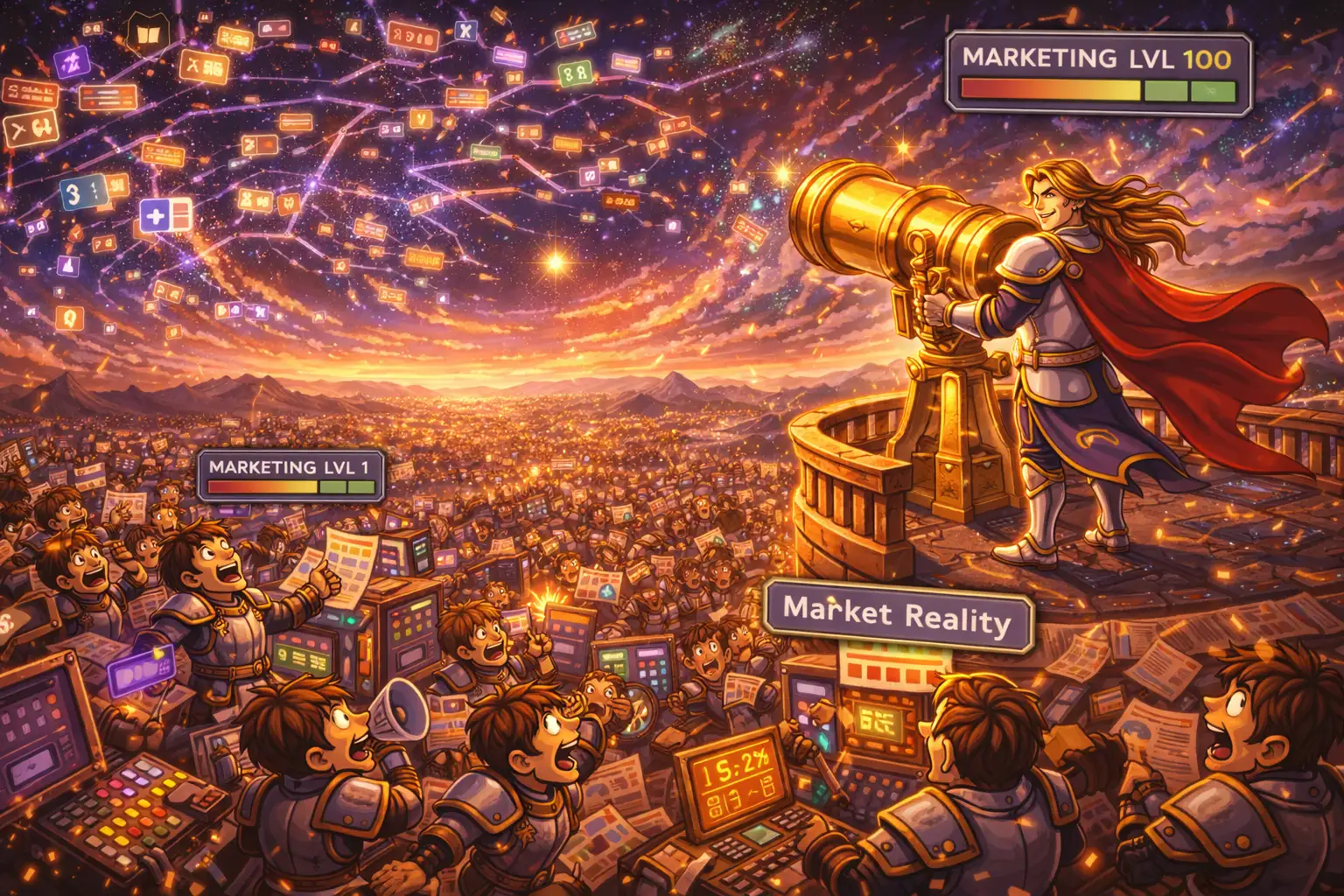
Alpha marketers create leverage by seeing what the rest of the market fails to notice.
10. The Marketers I Pay Attention To
If you want to improve as a marketer, one of the most useful habits you can build is learning to pay attention to people who are clearly operating at a higher level than the industry average. That is true in every serious profession, and marketing should be no different. Over time I have built a habit of following marketers whose work consistently cuts through the clutter, earns attention on merit, and translates that attention into something commercially meaningful. What makes them useful to study is not that they all do the same thing. It is the opposite. They sell different products, think in different ways, and win through very different forms of execution, which is exactly why they are worth paying attention to.
A lot of younger marketers, and a lot of managers supervising mediocre teams, end up learning from the wrong sources. They absorb frameworks from generic agency blogs, low-grade thought leadership, or content written primarily to generate leads rather than to teach anything real. I would rather study people whose work already demonstrates the qualities this article is arguing for: originality, clarity, strong execution, a clear point of view, and a track record of building things that keep earning attention long after publication. These are some of the people I pay attention to.
- Rand Fishkin is worth following because he has spent years explaining how internet systems actually behave rather than repeating the comforting myths marketers tell themselves about them. Whether he was doing that through Moz in the SEO era or through SparkToro in audience research and zero-click analysis, the common thread has been intellectual honesty. He is unusually good at taking a system most people describe badly, stripping it back to what is actually happening, and explaining the commercial implications clearly enough that other marketers can adjust their thinking. That matters because attention increasingly goes to the people who can tell the truth about the platform before everyone else catches up, and Fishkin has built a durable reputation by doing exactly that.
- Tim Soulo is one of the clearest examples of what happens when a company decides to build educational resources that are genuinely useful instead of flooding the web with generic SEO content. What Ahrefs has done under his leadership is not simply publish articles. It has built intellectual infrastructure for the industry. Their best work becomes reference material because it is deeper, more practical, and more durable than the average content produced by SaaS marketing teams, which is worth studying because it shows what happens when a brand chooses authority over volume and long-term trust over content churn.
- Darren Shaw stands out because he built authority in local SEO through reliability and depth rather than noise. Local search is full of contradictory advice, recycled assumptions, and anecdotal claims dressed up as certainty, yet his work through Whitespark repeatedly brings structure and evidence to the conversation. That makes him valuable to follow because he demonstrates a version of alpha marketing that is less about being loud and more about becoming the source the rest of the market refers back to when it needs clarity, which in a noisy field is a very serious competitive asset.
- Tycho Luijten is someone I pay attention to because he and his team understand that apathy is defeated by execution that actually deserves attention. Their work is well produced, well lit, sharply acted, and built around ideas that feel native to the internet rather than bolted awkwardly onto it. That matters in B2B especially, where a great deal of marketing is still painfully forgettable. What I admire is not just the polish. It is the willingness to do more work than the average marketer is prepared to do in order to make the message entertaining, memorable, and socially portable, which is exactly the kind of thinking that separates alpha marketing from the safe, forgettable content most brands produce.
- Jeremy Moser is worth following because he consistently ties content, authority, and backlink strategy back to commercial outcomes rather than vanity metrics. A lot of SEO commentary still treats ranking, traffic, and publishing volume as though they were the end of the story. His work is more useful because it keeps returning to the harder question of how authority compounds and how visibility connects to revenue. In a part of the industry that is full of thin advice and recycled listicles, that commercial discipline stands out.
- Ryan Law is someone I pay attention to because his work repeatedly moves past tactical chatter and into the systems that actually shape how marketing works inside companies. He is very good at making crowded topics interesting again by approaching them through clearer thinking, stronger structure, and more useful distinctions than the average content marketer brings to the table. That is worth studying because it shows that originality in marketing is not always about inventing a new channel or tactic. Sometimes it is about understanding the same material more deeply than everyone else and expressing it in a way that actually helps people think.
The pattern worth studying
What these marketers share is not a single channel, a single tactic, or a single style. They build things that solve real problems, teach something useful, or earn attention on merit, and their work generally travels further, lasts longer, and creates more trust than the average marketing content filling the web because it is built by people who understand their craft deeply enough to produce something that does not feel disposable. That is the standard I would urge younger marketers to study and that I would urge leaders to look for when they are deciding whose voice deserves weight. If you want better models, follow people whose work would still be worth consuming even if it did not contain a single sales pitch.
11. How To Recognize an Alpha Marketer
After everything discussed in this article, a practical question naturally follows: how do you actually recognize an alpha marketer in the real world? The answer is rarely found in a resume bullet point, a polished deck, or a certification badge. It appears in how someone thinks about problems, what they care about when performance is discussed, and whether their instinct is to move the conversation toward commercial reality or away from it.
One of the clearest signals is the metric they instinctively care about first. Alpha marketers are ultimately thinking about revenue, demand, and the commercial outcomes that keep a business alive. They know, whether they say it elegantly or not, that their job is to help the business create customers and bring money into the bank. Peter Drucker’s line that the purpose of business is to create a customer remains useful here because it forces marketing back toward its real obligation. Strong marketers will happily discuss channels, creative, media, and execution, but they almost always frame those things as tools for creating a commercial result. If the conversation stays trapped in impressions, post volume, internal deadlines, or reporting hygiene without making its way back to revenue, trust, pipeline quality, or durable demand, you are usually looking at tactical marketing rather than alpha marketing.
A second signal appears in the kinds of questions they ask. Strong marketers tend to step back and interrogate the situation before they rush into activity. What is the customer actually seeing when this post or advertisement appears in the feed? Why would this message earn attention instead of the dozens of other things competing with it at the same moment? What tension, desire, fear, status signal, or practical problem would make the audience care? Why would they trust this claim? Why does this deserve to rank, spread, or convert? These are not decorative questions. They are the questions that distinguish someone who is trying to understand the market from someone who is simply trying to keep a content plan moving.
Commercial instinct is the first test
Apathy marketers often optimize the visible machinery of marketing because it is easier to defend internally. They ask how many posts should go out each week, how quickly work can be turned around, whether a report was delivered on time, or whether campaign activity matched the plan. Alpha marketers are usually trying to answer a more important question: is this work likely to change the behavior of the market in a way that helps the business grow? That difference in instinct changes almost everything. The stronger marketer is trying to identify what puts money in the bank, what creates demand, what improves conversion quality, what strengthens trust, and what gives the business a real edge. The weaker marketer is often trying to prove that activity occurred.
If you are trying to work out how to tell whether a marketer is good, commercially minded, or simply good at managing optics, that distinction is one of the fastest tests you can apply.
This is also why alpha marketers tend to release, test, and refine rather than overprotect ideas inside the building. They understand that market feedback is more valuable than internal perfection. It is often better to launch something that exists, measure how people actually respond to it, and then scale or improve what proves promising than to spend months polishing work that never had a strong commercial case to begin with. This does not mean they are careless with quality. It means they understand that feedback from the market is more valuable than internal perfection.
The questions great marketers can answer
One practical way to evaluate a marketer is to ask them why they believe something will work and then stay in the conversation long enough to hear whether there is any depth behind the answer. Why does this content deserve to rank? Why would someone stop for this ad instead of scrolling past it? Why is this message more credible than the category average? What other creative or strategic options were considered and rejected? What assumptions could make the whole thing fail? Strong marketers usually have real answers to those questions because they have already put pressure on their own thinking before anyone else did. They can explain the trade-offs, the risks, the customer logic, and the competitive context. They are also comfortable admitting uncertainty, because marketing is probabilistic by nature and anyone pretending otherwise is usually overselling their own confidence.
The same test applies if you are managing a team. When you ask why, do you get an answer rooted in customer behavior, commercial logic, and market context, or do you get an answer rooted in what other brands do, what a platform guide suggested, or what feels right inside the team? Alpha marketers are not immune from being wrong, but they are usually very good at showing their reasoning. They have thought through not only why an idea might work, but why it might fail and what signal would tell them to change course.
They apply what they learn.
A lot of people like to describe themselves as lifelong learners. The stronger signal is whether they can apply a lifetime of learning. Alpha marketers tend to absorb new ideas continuously and then test them against the real world. They update their thinking when the market changes. They are open to being wrong, open to borrowing better ideas from other disciplines, other industries, or other people on the team, and rarely so attached to a past success that they keep repeating it after the market has moved on. They are looking for better ways to solve the problem in front of them, not for excuses to keep recycling the same answer.
That matters because passive learning accumulates information, while applied learning improves judgment. The best marketers are usually well read, culturally alert, and curious about far more than marketing. They read biographies, business history, psychology, storytelling, economics, technology, and whatever else helps them understand how people think and behave. They pay attention to entertainment, politics, fashion, memes, film, and status signals because culture shapes attention before attention shapes marketing results. That breadth of curiosity often makes them more articulate, more creative, and more useful across a team because they are not trapped inside one narrow professional vocabulary.
They also tend to be comfortable across disciplines. A strong marketer may be creative and technical at the same time. They may understand analytics, sales psychology, product positioning, copy, media buying, and enough implementation detail to collaborate intelligently with developers, designers, salespeople, and founders. That does not mean they are the best specialist in every room. It means they are capable of translating across rooms, which is often where a great deal of business value gets created.
They are looking for leverage, not just labor
Another useful distinction is the way strong marketers think about effort. Average marketers often respond to uncertainty by doing more: more posts, more campaigns, more channels, more reporting, more activity. Alpha marketers usually look for leverage instead. They ask which insight, channel, message, offer, or piece of creative could produce disproportionate impact. They want to know where the market is underpriced, where attention is being misread, where the customer is underserved, or where the competition is making an obvious mistake. Once they find something that works, they push harder. Once they find something that clearly does not, they move on quickly.
That mindset is part of why alpha marketers can feel uncomfortable inside slower organizations. They are often less interested in defending the current system than in improving it. They care about whether a strategy is right more than whether it is familiar. They may challenge the brief, question the KPI, reject the channel mix, or push back on brand rituals that are getting in the way of performance. To the wrong manager, that can look difficult. To the right manager, it looks like the behavior of someone trying to create a better result.
A final note for leaders
There is one final reality worth stating plainly: not every organization actually wants an alpha marketer. Some leaders prefer predictable reporting, tight process control, heavily predefined KPIs, and strategies that stay close to how they already think the business should be marketed. That is completely legitimate. It is their company, their capital, and their right to decide how the work gets done.
But in that environment, they may not need an exceptional marketer. They may need a compliant operator who can execute a predefined system efficiently and report it back in the language leadership finds comfortable. Alpha marketers usually create the most value in environments where they are trusted to diagnose the market, shape the strategy, interpret imperfect signals, and pursue outcomes rather than merely activity targets. If that environment exists, they can be extraordinarily valuable. If it does not, their strengths will often remain underused, and both sides will end up frustrated.
Understanding that difference can save a company a great deal of money and can save a strong marketer a great deal of wasted time.
Rise of the Million‑Dollar Marketer
The argument running through this article is simple: artificial intelligence will not distribute value evenly across the marketing profession. It will compress the value of average execution while dramatically expanding the leverage of the small group of operators who can actually move markets.
For years, a large amount of marketing work survived because the effort required to produce it created the illusion that it must have been valuable. Writing content took time. Building research took time. Producing campaigns took time. AI is removing that protection. The same level of acceptable output can now be produced faster, cheaper, and at scale, which means the old defense of average work is collapsing. When average execution becomes abundant, judgment becomes the real differentiator.
That shift changes the economics of the profession. Marketers who can identify real leverage inside a market—the ones who can diagnose demand, spot competitive blind spots, shape narratives that travel, and consistently produce commercial outcomes—will suddenly be able to operate with far more force than before. Research is faster. Drafting is faster. Testing is faster. Market analysis is broader. Execution teams move more quickly under their direction. In practical terms, that means the best marketers can influence more companies at the same time without diluting the quality of their thinking.
I believe we will start seeing headlines very soon about individual marketers earning **more than one million dollars per year in personal take-home pay** from their work. Not from running an agency. Not from selling a company. From their direct marketing influence. Most marketers will never operate at that level, but the very best—the Ronaldos of the profession—will.
The term million-dollar marketer will increasingly refer to individuals whose strategic influence, amplified by AI and modern tools, allows them to generate that level of personal income through direct marketing work rather than ownership or agency scale.
The mechanism is straightforward. Instead of working inside a single organization, elite marketers will increasingly operate fractionally across multiple companies, shaping strategy while execution teams handle the operational work. Five companies. Maybe six. In some cases more. Each company gains access to elite strategic thinking that would previously have required a full-time executive, while the marketer gains leverage across multiple environments.
This pattern already appears in other fields. Elite operators do not become less valuable when tools improve. They become more valuable because the tools amplify their advantage. The same thing happens in elite sport. When the sport globalizes, the best players do not earn less. They earn dramatically more because the world can now see the difference between average and exceptional performance. Marketing is moving into the same kind of market.
As AI makes average marketing easier to produce, companies face a more uncomfortable competitive reality. Everyone will be able to generate respectable content, respectable campaigns, and respectable analysis. Respectable will stop being enough. In competitive markets, companies will need an edge, and that edge will come from the people who can interpret markets better than their competitors and turn that understanding into commercial movement. Those people will have options. Companies that want their expertise will have to compete for it.
Some businesses will pay that cost directly by hiring elite marketers fractionally or compensating them at levels that previously sounded unrealistic. Others will pay the cost indirectly by losing ground to competitors who did. Either way, the economic pressure is the same. AI will not eliminate marketers. It will expose them, and the companies that understand the difference between motion and market-moving ability will be the ones that decide who the million-dollar marketers end up working for.
Frequently Asked Questions
>What is the difference between apathy marketing and alpha marketing?
Apathy marketing is activity that looks organized and professionally managed from the inside but fails to create meaningful changes in attention, trust, demand, or revenue. Alpha marketing is strategic work that repeatedly produces outsized commercial outcomes across different environments and can explain why those outcomes occurred.
Can AI replace marketers?
AI can replace a growing amount of average marketing execution, especially work that is repetitive, generic, and easy to template. What it does not replace is judgment. The more AI compresses the value of average output, the more valuable strong strategic thinking becomes.
Why do some marketing teams hit KPIs without growing the business?
Because many teams are measured against activity metrics that are only loosely connected to revenue. Posting on schedule, publishing more content, or hitting traffic targets can all look impressive internally while leaving the market largely unmoved.
How do you know if a marketer is commercially minded?
Commercially minded marketers instinctively connect channels, content, and campaigns back to customer creation, demand, conversion quality, and revenue. They can explain how the work is supposed to put money in the bank, not merely how it satisfies a reporting framework.
Why are the best marketers becoming more valuable in the AI era?
Because AI makes respectable execution cheaper and easier to produce. Once that happens, respectable stops being enough. The marketers who can interpret markets better than competitors and repeatedly create outperformance become more valuable because their judgment now carries more leverage.
Why is repeatable outperformance a better test than one big success?
A single success can be explained by timing, market conditions, founder quality, or luck. Repeatable outperformance across different roles, industries, and constraints is much stronger evidence that the marketer, rather than circumstance alone, was part of the causal mechanism.
Who should young marketers learn from?
They should study operators whose work is clearly better than the market average and whose ideas continue to earn trust over time. In practice, that usually means learning from people who build durable resources, explain systems honestly, and connect their work back to real commercial outcomes rather than vanity metrics.
Do all companies need an alpha marketer?
No. Some companies want tightly controlled execution, predictable reporting, and strategies that stay close to leadership’s existing view of the market. In those environments, a compliant operator may be a better fit than an exceptional strategist. Alpha marketers create the most value where they are trusted to diagnose the market and shape the strategy around outcomes rather than activity targets.
Sources and Further Reading
AI and Content Production
- Ahrefs — Marketers using AI publish more content — source for the figures on AI content adoption, publishing volume, review behavior, and lower production cost.
Economics of Superstar Markets
- Sherwin Rosen — The Economics of Superstars (American Economic Review, 1981) — the foundational paper referenced for the economics of superstar markets and disproportionate rewards for small performance differences.
Attention Economy Data
- YouTube Press — source for platform-scale figures including daily uploads and daily Shorts views.
- HubSpot — Social Media Marketing Trends Report — source for the social content-format observations referenced in the attention economy section.
Attribution and Marketing Measurement
- SparkToro — Attribution is dying, clicks are dying — source for the discussion of attribution limits, zero-click behavior, and hard-to-measure channels.
Marketing Thought Leadership Referenced
- Peter Drucker — selected writings and quotations — referenced for the line about the purpose of business being to create a customer.
- Seth Godin — How to be remarkable — referenced for the argument that work must be remarkable enough to deserve attention.
Notes on Methodology
This article combines public research with long‑form editorial analysis based on professional experience working with marketing teams across multiple industries and international markets. The goal is not to present a single framework, but to synthesize observable patterns in marketing performance during the early AI era.
The Aggregation Shift: Why AI Reshuffles the Marketing Value Chain
Ben Thompson’s aggregation theory holds that durable business value accrues to whoever controls the relationship with the end user, because that control allows the aggregator to extract value from both sides of a market without being exposed to the costs of either. Applied to marketing, the theory predicts exactly the current moment: AI tools are disaggregating the value chain that gave marketing agencies their position between client and audience, and the marketers who survive will be the ones who find a new aggregator position in the reconfigured chain rather than defending the one that AI is dissolving.
The old marketing value chain had two sources of defensible margin. The first was production cost: creating good-quality content required time, skill, and equipment that created genuine barriers to entry. The second was distribution access: knowing which channels worked for which audiences was tacit knowledge that took years to accumulate and couldn’t be quickly replicated. AI tools are compressing both. Production cost for competent content is approaching zero. Distribution access is being democratized through AI-powered analytics that can identify effective channels in days rather than years. The mediocre marketers who extracted margin from production cost and distribution expertise are watching both erosion events happen simultaneously.
The marketers who are not being disrupted have something AI tools cannot easily replicate: the ability to understand what an audience actually needs before they know they need it. That capability requires genuine domain knowledge — not marketing knowledge, but knowledge of the specific audience’s problems, language, values, and decision processes. Friction is the silent churn driver in any product, and the marketers who can identify friction before it surfaces in churn data are the ones who understand the user at a level that precedes the metric. AI tools are excellent at optimizing toward a specified objective. They are not yet good at identifying whether the specified objective is the right one. That judgment requires domain knowledge that is hard to specify and impossible to fully capture in training data.
The Chinese AI open-source push through DeepSeek and Qwen is accelerating this disruption by reducing the cost of AI marketing capability to near-zero. The CMO who was comfortable spending $200K per year on a content agency to produce competent-but-not-exceptional material now has a credible AI alternative at a small fraction of that cost. The agency that delivers competent-but-not-exceptional material on a production cost basis is now competing with a zero-marginal-cost substitute. The agency that delivers exceptional judgment on strategy, positioning, and audience insight — and uses AI tools to execute faster — is in an entirely different competitive position. The market is separating those two categories in real time, and the separation is accelerating.
The enterprise AI adoption trajectory reveals the same pattern at the organizational level. The enterprises capturing the most measurable value from AI tools are not the ones that deployed AI across all marketing functions simultaneously. They are the ones that identified the specific workflows where AI capability exceeded the human baseline — content scaling, A/B testing, audience segmentation, personalization at scale — and concentrated AI deployment there while preserving human judgment in the functions where the baseline could not be reliably replicated. That targeted deployment approach requires the organizational judgment to distinguish between tasks where AI replaces human work and tasks where AI augments it. Most enterprises have not yet developed that judgment, which is why the measured gains from AI deployment in marketing are so unevenly distributed across companies that are, on paper, making similar investments.
The corporate buyback signal is relevant here as an indirect proxy. US corporate capital return in 2026 is at record levels, which means that organizations with surplus cash are choosing to return it rather than invest it in marketing and growth. That is a signal that the expected return on incremental marketing spend is below the cost of capital for many companies — that more spending is not expected to produce more growth. AI marketing tools offer a different value proposition in that environment: not higher spending toward the same return, but the same or lower spending toward a higher return through better targeting and reduced waste. The enterprises that learn to extract that efficiency are accumulating a cost-structure advantage that compounds as AI capabilities improve.
The Algebra of Disruption: Why AI Concentrates Marketing, Not Democratises It
Scott Galloway’s framework for evaluating technology disruption identifies a pattern that is systematically misrepresented in tech journalism: the technologies marketed as democratising forces almost universally operate as concentrating forces once they mature. The printing press democratised the ability to produce text and concentrated the influence of the most compelling writers. Social media democratised the ability to publish and concentrated attention around the small number of creators who understood distribution better than anyone else. AI in marketing is following the same trajectory precisely.
The attention economy constraint that AI does not change is the key variable: the supply of human attention is fixed while the supply of AI-generated content is approaching infinity. When content supply was artificially scarce, mediocre content could still capture attention through the mechanism of being present. When content supply is unbounded, mediocre content is filtered out before it reaches anyone. AI removes the scarcity that was previously protecting mediocre marketers from the consequences of their mediocrity.
What rigorous alpha marketing actually looks like becomes the discriminating variable: the ability to generate an original insight about audience psychology or market structure, and then deploy AI tools to execute against that insight at scale, is rarer and more valuable than it was before AI. The tactical layer — copywriting, visual production, A/B test generation — is now essentially free. The strategic layer — identifying which insight is worth executing — has zero commoditised substitute. When execution cost approaches zero, insight becomes the entire source of competitive advantage.
The attribution challenge deepens as AI expands attribution data. More channels, more touchpoints, and more AI-generated content create more attribution noise, not less. The marketers who will extract value from AI-expanded attribution are the ones who understood attribution structure before AI added complexity to it. The ones who were already confused now have access to more things to be confused about.
The Web3 marketing mirage is an early case study for what AI-augmented mediocre marketing looks like in practice: more volume, more channels, more metrics, same absence of genuine audience insight. AI generates the additional content; the underlying problem — no clear understanding of who the audience is or what they actually want — is unchanged and unaddressed by the tooling.
The restructuring wave at Cloudflare, Coinbase, and comparable companies is the empirical signal Galloway would point to: firms that understand AI’s concentrating dynamics are eliminating mid-tier marketing roles while retaining or expanding their highest-capability positions. That is not AI democratising the marketing function. It is AI concentrating it around the top decile.